window.__IS_SSR__=true
window.__INITIAL_STATE__={
"attachmentsReducer": {
"audio_0": {
"type": "attachments",
"id": "audio_0",
"imgSizes": {
"kqedFullSize": {
"file": "https://ww2.kqed.org/news/wp-content/themes/KQED-unified/img/audio_bgs/background0.jpg"
}
}
},
"audio_1": {
"type": "attachments",
"id": "audio_1",
"imgSizes": {
"kqedFullSize": {
"file": "https://ww2.kqed.org/news/wp-content/themes/KQED-unified/img/audio_bgs/background1.jpg"
}
}
},
"audio_2": {
"type": "attachments",
"id": "audio_2",
"imgSizes": {
"kqedFullSize": {
"file": "https://ww2.kqed.org/news/wp-content/themes/KQED-unified/img/audio_bgs/background2.jpg"
}
}
},
"audio_3": {
"type": "attachments",
"id": "audio_3",
"imgSizes": {
"kqedFullSize": {
"file": "https://ww2.kqed.org/news/wp-content/themes/KQED-unified/img/audio_bgs/background3.jpg"
}
}
},
"audio_4": {
"type": "attachments",
"id": "audio_4",
"imgSizes": {
"kqedFullSize": {
"file": "https://ww2.kqed.org/news/wp-content/themes/KQED-unified/img/audio_bgs/background4.jpg"
}
}
},
"placeholder": {
"type": "attachments",
"id": "placeholder",
"imgSizes": {
"thumbnail": {
"file": "https://cdn.kqed.org/wp-content/uploads/2024/12/KQED-Default-Image-816638274-2000x1333-1-160x107.jpg",
"width": 160,
"height": 107,
"mimeType": "image/jpeg"
},
"medium": {
"file": "https://cdn.kqed.org/wp-content/uploads/2024/12/KQED-Default-Image-816638274-2000x1333-1-800x533.jpg",
"width": 800,
"height": 533,
"mimeType": "image/jpeg"
},
"medium_large": {
"file": "https://cdn.kqed.org/wp-content/uploads/2024/12/KQED-Default-Image-816638274-2000x1333-1-768x512.jpg",
"width": 768,
"height": 512,
"mimeType": "image/jpeg"
},
"large": {
"file": "https://cdn.kqed.org/wp-content/uploads/2024/12/KQED-Default-Image-816638274-2000x1333-1-1020x680.jpg",
"width": 1020,
"height": 680,
"mimeType": "image/jpeg"
},
"1536x1536": {
"file": "https://cdn.kqed.org/wp-content/uploads/2024/12/KQED-Default-Image-816638274-2000x1333-1-1536x1024.jpg",
"width": 1536,
"height": 1024,
"mimeType": "image/jpeg"
},
"fd-lrg": {
"file": "https://cdn.kqed.org/wp-content/uploads/2024/12/KQED-Default-Image-816638274-2000x1333-1-1536x1024.jpg",
"width": 1536,
"height": 1024,
"mimeType": "image/jpeg"
},
"fd-med": {
"file": "https://cdn.kqed.org/wp-content/uploads/2024/12/KQED-Default-Image-816638274-2000x1333-1-1020x680.jpg",
"width": 1020,
"height": 680,
"mimeType": "image/jpeg"
},
"fd-sm": {
"file": "https://cdn.kqed.org/wp-content/uploads/2024/12/KQED-Default-Image-816638274-2000x1333-1-800x533.jpg",
"width": 800,
"height": 533,
"mimeType": "image/jpeg"
},
"post-thumbnail": {
"file": "https://cdn.kqed.org/wp-content/uploads/2024/12/KQED-Default-Image-816638274-2000x1333-1-672x372.jpg",
"width": 672,
"height": 372,
"mimeType": "image/jpeg"
},
"twentyfourteen-full-width": {
"file": "https://cdn.kqed.org/wp-content/uploads/2024/12/KQED-Default-Image-816638274-2000x1333-1-1038x576.jpg",
"width": 1038,
"height": 576,
"mimeType": "image/jpeg"
},
"xxsmall": {
"file": "https://cdn.kqed.org/wp-content/uploads/2024/12/KQED-Default-Image-816638274-2000x1333-1-160x107.jpg",
"width": 160,
"height": 107,
"mimeType": "image/jpeg"
},
"xsmall": {
"file": "https://cdn.kqed.org/wp-content/uploads/2024/12/KQED-Default-Image-816638274-2000x1333-1-672x372.jpg",
"width": 672,
"height": 372,
"mimeType": "image/jpeg"
},
"small": {
"file": "https://cdn.kqed.org/wp-content/uploads/2024/12/KQED-Default-Image-816638274-2000x1333-1-672x372.jpg",
"width": 672,
"height": 372,
"mimeType": "image/jpeg"
},
"xlarge": {
"file": "https://cdn.kqed.org/wp-content/uploads/2024/12/KQED-Default-Image-816638274-2000x1333-1-1020x680.jpg",
"width": 1020,
"height": 680,
"mimeType": "image/jpeg"
},
"full-width": {
"file": "https://cdn.kqed.org/wp-content/uploads/2024/12/KQED-Default-Image-816638274-2000x1333-1-1920x1280.jpg",
"width": 1920,
"height": 1280,
"mimeType": "image/jpeg"
},
"guest-author-32": {
"file": "https://cdn.kqed.org/wp-content/uploads/2025/01/KQED-Default-Image-816638274-1333x1333-1-160x160.jpg",
"width": 32,
"height": 32,
"mimeType": "image/jpeg"
},
"guest-author-50": {
"file": "https://cdn.kqed.org/wp-content/uploads/2025/01/KQED-Default-Image-816638274-1333x1333-1-160x160.jpg",
"width": 50,
"height": 50,
"mimeType": "image/jpeg"
},
"guest-author-64": {
"file": "https://cdn.kqed.org/wp-content/uploads/2025/01/KQED-Default-Image-816638274-1333x1333-1-160x160.jpg",
"width": 64,
"height": 64,
"mimeType": "image/jpeg"
},
"guest-author-96": {
"file": "https://cdn.kqed.org/wp-content/uploads/2025/01/KQED-Default-Image-816638274-1333x1333-1-160x160.jpg",
"width": 96,
"height": 96,
"mimeType": "image/jpeg"
},
"guest-author-128": {
"file": "https://cdn.kqed.org/wp-content/uploads/2025/01/KQED-Default-Image-816638274-1333x1333-1-160x160.jpg",
"width": 128,
"height": 128,
"mimeType": "image/jpeg"
},
"detail": {
"file": "https://cdn.kqed.org/wp-content/uploads/2025/01/KQED-Default-Image-816638274-1333x1333-1-160x160.jpg",
"width": 160,
"height": 160,
"mimeType": "image/jpeg"
},
"kqedFullSize": {
"file": "https://cdn.kqed.org/wp-content/uploads/2024/12/KQED-Default-Image-816638274-2000x1333-1.jpg",
"width": 2000,
"height": 1333
}
}
},
"news_12095788": {
"type": "attachments",
"id": "news_12095788",
"meta": {
"index": "attachments_1716263798",
"site": "news",
"id": "12095788",
"found": true
},
"title": "Featured Image Justin Reich",
"publishDate": 1787079096,
"status": "inherit",
"parent": 12095781,
"modified": 1787079335,
"caption": "(Headshot courtesy of Justin Reich, image courtesy of Kellogg School of Management.)",
"credit": null,
"altTag": "ext box asking whether AI will really change our classrooms, with headshot of guest Justin Reich",
"description": null,
"imgSizes": {
"thumbnail": {
"file": "https://cdn.kqed.org/wp-content/uploads/sites/10/2026/08/Featured-Image-Justin-Reich-160x90.png",
"width": 160,
"height": 90,
"mimeType": "image/png"
},
"1536x1536": {
"file": "https://cdn.kqed.org/wp-content/uploads/sites/10/2026/08/Featured-Image-Justin-Reich-1536x864.png",
"width": 1536,
"height": 864,
"mimeType": "image/png"
},
"post-thumbnail": {
"file": "https://cdn.kqed.org/wp-content/uploads/sites/10/2026/08/Featured-Image-Justin-Reich-672x372.png",
"width": 672,
"height": 372,
"mimeType": "image/png"
},
"twentyfourteen-full-width": {
"file": "https://cdn.kqed.org/wp-content/uploads/sites/10/2026/08/Featured-Image-Justin-Reich-1038x576.png",
"width": 1038,
"height": 576,
"mimeType": "image/png"
},
"npr-cds-wide": {
"file": "https://cdn.kqed.org/wp-content/uploads/sites/10/2026/08/Featured-Image-Justin-Reich-1200x675.png",
"width": 1200,
"height": 675,
"mimeType": "image/png"
},
"npr-cds-square": {
"file": "https://cdn.kqed.org/wp-content/uploads/sites/10/2026/08/Featured-Image-Justin-Reich-600x600.png",
"width": 600,
"height": 600,
"mimeType": "image/png"
},
"kqedFullSize": {
"file": "https://cdn.kqed.org/wp-content/uploads/sites/10/2026/08/Featured-Image-Justin-Reich.png",
"width": 1920,
"height": 1080
}
},
"isLoading": false,
"fetchFailed": false
},
"news_11947437": {
"type": "attachments",
"id": "news_11947437",
"meta": {
"index": "attachments_1716263798",
"site": "news",
"id": "11947437",
"found": true
},
"parent": 11947432,
"imgSizes": {
"twentyfourteen-full-width": {
"file": "https://ww2.kqed.org/app/uploads/sites/10/2023/04/RS64554_005_KQED_ChatGPTBalboaHS_04172023-qut-1038x576.jpg",
"width": 1038,
"mimeType": "image/jpeg",
"height": 576
},
"thumbnail": {
"file": "https://ww2.kqed.org/app/uploads/sites/10/2023/04/RS64554_005_KQED_ChatGPTBalboaHS_04172023-qut-160x107.jpg",
"width": 160,
"mimeType": "image/jpeg",
"height": 107
},
"post-thumbnail": {
"file": "https://ww2.kqed.org/app/uploads/sites/10/2023/04/RS64554_005_KQED_ChatGPTBalboaHS_04172023-qut-672x372.jpg",
"width": 672,
"mimeType": "image/jpeg",
"height": 372
},
"kqedFullSize": {
"file": "https://ww2.kqed.org/app/uploads/sites/10/2023/04/RS64554_005_KQED_ChatGPTBalboaHS_04172023-qut.jpg",
"width": 1920,
"height": 1280
},
"large": {
"file": "https://ww2.kqed.org/app/uploads/sites/10/2023/04/RS64554_005_KQED_ChatGPTBalboaHS_04172023-qut-1020x680.jpg",
"width": 1020,
"mimeType": "image/jpeg",
"height": 680
},
"1536x1536": {
"file": "https://ww2.kqed.org/app/uploads/sites/10/2023/04/RS64554_005_KQED_ChatGPTBalboaHS_04172023-qut-1536x1024.jpg",
"width": 1536,
"mimeType": "image/jpeg",
"height": 1024
},
"medium": {
"file": "https://ww2.kqed.org/app/uploads/sites/10/2023/04/RS64554_005_KQED_ChatGPTBalboaHS_04172023-qut-800x533.jpg",
"width": 800,
"mimeType": "image/jpeg",
"height": 533
}
},
"publishDate": 1682360244,
"modified": 1682369415,
"caption": "Balboa High School teacher Michael Rosenberg checks the text from an essay assignment to see how much was generated by AI, at the school in San Francisco on April 17, 2023. The text highlighted in yellow is idenitified as AI generated text.",
"description": null,
"title": "RS64554_005_KQED_ChatGPTBalboaHS_04172023-qut",
"credit": "Beth LaBerge/KQED",
"status": "inherit",
"altTag": "A closeup of a laptop screen with text on display.",
"isLoading": false,
"fetchFailed": false
},
"news_12094384": {
"type": "attachments",
"id": "news_12094384",
"meta": {
"index": "attachments_1716263798",
"site": "news",
"id": "12094384",
"found": true
},
"title": "260807-Kennedy-High-BK-01-KQED",
"publishDate": 1786135437,
"status": "inherit",
"parent": 0,
"modified": 1786138660,
"caption": "The campus of John F. Kennedy High School in Richmond is closed on Aug. 7, 2026, as school district officials await air-testing results from the California Department of Toxic Substances Control. ",
"credit": "Brian Krans/KQED",
"altTag": null,
"description": null,
"imgSizes": {
"thumbnail": {
"file": "https://cdn.kqed.org/wp-content/uploads/sites/10/2026/08/260807-Kennedy-High-BK-01-KQED-160x107.jpg",
"width": 160,
"height": 107,
"mimeType": "image/jpeg"
},
"1536x1536": {
"file": "https://cdn.kqed.org/wp-content/uploads/sites/10/2026/08/260807-Kennedy-High-BK-01-KQED-1536x1024.jpg",
"width": 1536,
"height": 1024,
"mimeType": "image/jpeg"
},
"post-thumbnail": {
"file": "https://cdn.kqed.org/wp-content/uploads/sites/10/2026/08/260807-Kennedy-High-BK-01-KQED-672x372.jpg",
"width": 672,
"height": 372,
"mimeType": "image/jpeg"
},
"twentyfourteen-full-width": {
"file": "https://cdn.kqed.org/wp-content/uploads/sites/10/2026/08/260807-Kennedy-High-BK-01-KQED-1038x576.jpg",
"width": 1038,
"height": 576,
"mimeType": "image/jpeg"
},
"npr-cds-wide": {
"file": "https://cdn.kqed.org/wp-content/uploads/sites/10/2026/08/260807-Kennedy-High-BK-01-KQED-1200x675.jpg",
"width": 1200,
"height": 675,
"mimeType": "image/jpeg"
},
"npr-cds-square": {
"file": "https://cdn.kqed.org/wp-content/uploads/sites/10/2026/08/260807-Kennedy-High-BK-01-KQED-600x600.jpg",
"width": 600,
"height": 600,
"mimeType": "image/jpeg"
},
"kqedFullSize": {
"file": "https://cdn.kqed.org/wp-content/uploads/sites/10/2026/08/260807-Kennedy-High-BK-01-KQED.jpg",
"width": 2000,
"height": 1333
}
},
"isLoading": false,
"fetchFailed": false
},
"news_12095558": {
"type": "attachments",
"id": "news_12095558",
"meta": {
"index": "attachments_1716263798",
"site": "news",
"id": "12095558",
"found": true
},
"title": "081726-SFUSDFIRSTDAY-02-MC-KQED",
"publishDate": 1786991448,
"status": "inherit",
"parent": 0,
"modified": 1786991564,
"caption": "Students arrive at Jose Ortega Elementary School for the first day of their school year on August 17, 2026, in San Francisco.",
"credit": "Miles Cull/KQED",
"altTag": null,
"description": null,
"imgSizes": {
"thumbnail": {
"file": "https://cdn.kqed.org/wp-content/uploads/sites/10/2026/08/081726-SFUSDFIRSTDAY-02-MC-KQED-160x107.jpg",
"width": 160,
"height": 107,
"mimeType": "image/jpeg"
},
"1536x1536": {
"file": "https://cdn.kqed.org/wp-content/uploads/sites/10/2026/08/081726-SFUSDFIRSTDAY-02-MC-KQED-1536x1025.jpg",
"width": 1536,
"height": 1025,
"mimeType": "image/jpeg"
},
"post-thumbnail": {
"file": "https://cdn.kqed.org/wp-content/uploads/sites/10/2026/08/081726-SFUSDFIRSTDAY-02-MC-KQED-672x372.jpg",
"width": 672,
"height": 372,
"mimeType": "image/jpeg"
},
"twentyfourteen-full-width": {
"file": "https://cdn.kqed.org/wp-content/uploads/sites/10/2026/08/081726-SFUSDFIRSTDAY-02-MC-KQED-1038x576.jpg",
"width": 1038,
"height": 576,
"mimeType": "image/jpeg"
},
"npr-cds-wide": {
"file": "https://cdn.kqed.org/wp-content/uploads/sites/10/2026/08/081726-SFUSDFIRSTDAY-02-MC-KQED-1200x675.jpg",
"width": 1200,
"height": 675,
"mimeType": "image/jpeg"
},
"npr-cds-square": {
"file": "https://cdn.kqed.org/wp-content/uploads/sites/10/2026/08/081726-SFUSDFIRSTDAY-02-MC-KQED-600x600.jpg",
"width": 600,
"height": 600,
"mimeType": "image/jpeg"
},
"kqedFullSize": {
"file": "https://cdn.kqed.org/wp-content/uploads/sites/10/2026/08/081726-SFUSDFIRSTDAY-02-MC-KQED.jpg",
"width": 2000,
"height": 1334
}
},
"isLoading": false,
"fetchFailed": false
},
"news_11948823": {
"type": "attachments",
"id": "news_11948823",
"meta": {
"index": "attachments_1716263798",
"site": "news",
"id": "11948823",
"found": true
},
"parent": 11948690,
"imgSizes": {
"twentyfourteen-full-width": {
"file": "https://ww2.kqed.org/app/uploads/sites/10/2030/05/018_KQED_EachOneTeachOneChildCare_04262023-1038x576.jpg",
"width": 1038,
"mimeType": "image/jpeg",
"height": 576
},
"thumbnail": {
"file": "https://ww2.kqed.org/app/uploads/sites/10/2030/05/018_KQED_EachOneTeachOneChildCare_04262023-160x107.jpg",
"width": 160,
"mimeType": "image/jpeg",
"height": 107
},
"post-thumbnail": {
"file": "https://ww2.kqed.org/app/uploads/sites/10/2030/05/018_KQED_EachOneTeachOneChildCare_04262023-672x372.jpg",
"width": 672,
"mimeType": "image/jpeg",
"height": 372
},
"kqedFullSize": {
"file": "https://ww2.kqed.org/app/uploads/sites/10/2030/05/018_KQED_EachOneTeachOneChildCare_04262023.jpg",
"width": 1920,
"height": 1280
},
"large": {
"file": "https://ww2.kqed.org/app/uploads/sites/10/2030/05/018_KQED_EachOneTeachOneChildCare_04262023-1020x680.jpg",
"width": 1020,
"mimeType": "image/jpeg",
"height": 680
},
"1536x1536": {
"file": "https://ww2.kqed.org/app/uploads/sites/10/2030/05/018_KQED_EachOneTeachOneChildCare_04262023-1536x1024.jpg",
"width": 1536,
"mimeType": "image/jpeg",
"height": 1024
},
"medium": {
"file": "https://ww2.kqed.org/app/uploads/sites/10/2030/05/018_KQED_EachOneTeachOneChildCare_04262023-800x533.jpg",
"width": 800,
"mimeType": "image/jpeg",
"height": 533
}
},
"publishDate": 1683577443,
"modified": 1683577582,
"caption": "Krystle Danridge-Pierson, founder and director at Each One Teach One Child Care, holds a small child at the San Francisco daycare facility on April 26, 2023.",
"description": null,
"title": "018_KQED_EachOneTeachOneChildCare_04262023",
"credit": "Beth LaBerge/KQED",
"status": "inherit",
"altTag": "A Black woman holds a small child up to her face while smiling. The child touches her face.",
"isLoading": false,
"fetchFailed": false
},
"news_11905961": {
"type": "attachments",
"id": "news_11905961",
"meta": {
"index": "attachments_1716263798",
"site": "news",
"id": "11905961",
"found": true
},
"parent": 11905959,
"imgSizes": {
"twentyfourteen-full-width": {
"file": "https://ww2.kqed.org/app/uploads/sites/10/2022/02/RS53816_GettyImages-1366036344-qut-1038x576.jpg",
"width": 1038,
"mimeType": "image/jpeg",
"height": 576
},
"thumbnail": {
"file": "https://ww2.kqed.org/app/uploads/sites/10/2022/02/RS53816_GettyImages-1366036344-qut-160x107.jpg",
"width": 160,
"mimeType": "image/jpeg",
"height": 107
},
"post-thumbnail": {
"file": "https://ww2.kqed.org/app/uploads/sites/10/2022/02/RS53816_GettyImages-1366036344-qut-672x372.jpg",
"width": 672,
"mimeType": "image/jpeg",
"height": 372
},
"kqedFullSize": {
"file": "https://ww2.kqed.org/app/uploads/sites/10/2022/02/RS53816_GettyImages-1366036344-qut.jpg",
"width": 1920,
"height": 1278
},
"large": {
"file": "https://ww2.kqed.org/app/uploads/sites/10/2022/02/RS53816_GettyImages-1366036344-qut-1020x679.jpg",
"width": 1020,
"mimeType": "image/jpeg",
"height": 679
},
"1536x1536": {
"file": "https://ww2.kqed.org/app/uploads/sites/10/2022/02/RS53816_GettyImages-1366036344-qut-1536x1022.jpg",
"width": 1536,
"mimeType": "image/jpeg",
"height": 1022
},
"medium": {
"file": "https://ww2.kqed.org/app/uploads/sites/10/2022/02/RS53816_GettyImages-1366036344-qut-800x533.jpg",
"width": 800,
"mimeType": "image/jpeg",
"height": 533
}
},
"publishDate": 1645396337,
"modified": 1645559777,
"caption": "An Afghan woman begs for money from passing cars in the snow, with her child at her feet, on the Kabul road south to Pul-e Alam, Afghanistan, on Jan. 17, 2022. The UN World Food Programme warns that 98% of Afghans are not getting enough to eat, due to a severe drought, the onset of winter, the collapse of the economy and the freezing of Afghan and donor funds after the Taliban takeover of the country in August 2021. The UN has made an emergency appeal for $5 billion to feed the hungry and forestall further economic collapse.",
"description": null,
"title": "Afghans Face Looming Humanitarian Disaster",
"credit": "Scott Peterson/Getty Images",
"status": "inherit",
"altTag": "A woman begs for money from passing cars as a child sits beside her in the snow.",
"isLoading": false,
"fetchFailed": false
},
"news_12095418": {
"type": "attachments",
"id": "news_12095418",
"meta": {
"index": "attachments_1716263798",
"site": "news",
"id": "12095418",
"found": true
},
"title": "260814-SF Street Safety-ADE-01-KQED",
"publishDate": 1786745330,
"status": "inherit",
"parent": 0,
"modified": 1786745608,
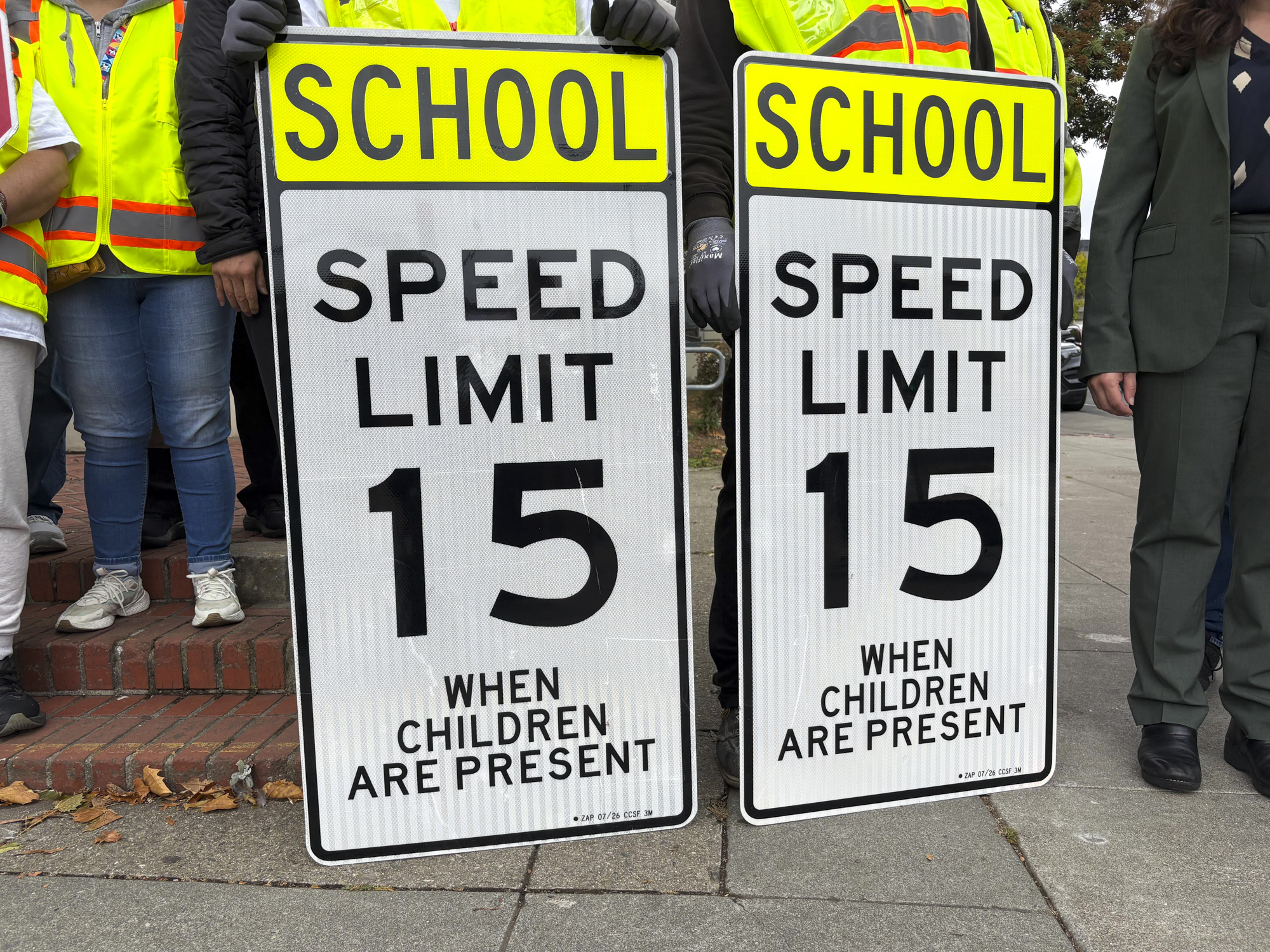
"caption": "The San Francisco Municipal Transportation Agency installed new speed limit signs near Flynn Leonard R. Flynn Elementary School on Aug. 14, 2026.",
"credit": "Azul Dahlstrom-Eckman/KQED",
"altTag": null,
"description": null,
"imgSizes": {
"thumbnail": {
"file": "https://cdn.kqed.org/wp-content/uploads/sites/10/2026/08/260814-SF-Street-Safety-ADE-01-KQED-160x120.jpg",
"width": 160,
"height": 120,
"mimeType": "image/jpeg"
},
"1536x1536": {
"file": "https://cdn.kqed.org/wp-content/uploads/sites/10/2026/08/260814-SF-Street-Safety-ADE-01-KQED-1536x1152.jpg",
"width": 1536,
"height": 1152,
"mimeType": "image/jpeg"
},
"post-thumbnail": {
"file": "https://cdn.kqed.org/wp-content/uploads/sites/10/2026/08/260814-SF-Street-Safety-ADE-01-KQED-672x372.jpg",
"width": 672,
"height": 372,
"mimeType": "image/jpeg"
},
"twentyfourteen-full-width": {
"file": "https://cdn.kqed.org/wp-content/uploads/sites/10/2026/08/260814-SF-Street-Safety-ADE-01-KQED-1038x576.jpg",
"width": 1038,
"height": 576,
"mimeType": "image/jpeg"
},
"npr-cds-wide": {
"file": "https://cdn.kqed.org/wp-content/uploads/sites/10/2026/08/260814-SF-Street-Safety-ADE-01-KQED-1200x675.jpg",
"width": 1200,
"height": 675,
"mimeType": "image/jpeg"
},
"npr-cds-square": {
"file": "https://cdn.kqed.org/wp-content/uploads/sites/10/2026/08/260814-SF-Street-Safety-ADE-01-KQED-600x600.jpg",
"width": 600,
"height": 600,
"mimeType": "image/jpeg"
},
"kqedFullSize": {
"file": "https://cdn.kqed.org/wp-content/uploads/sites/10/2026/08/260814-SF-Street-Safety-ADE-01-KQED.jpg",
"width": 2000,
"height": 1500
}
},
"isLoading": false,
"fetchFailed": false
},
"news_12094740": {
"type": "attachments",
"id": "news_12094740",
"meta": {
"index": "attachments_1716263798",
"site": "news",
"id": "12094740",
"found": true
},
"title": "Eliah Shamir and Juan Salvatierra settle in with their books at Alamo Square in San Francisco, Calif. on Saturday, May 23, 2020. Officials are concerned that parks and other outdoor locations may be magnets for people who want to enjoy the warm Memorial D",
"publishDate": 1786472565,
"status": "inherit",
"parent": 12094593,
"modified": 1786472607,
"caption": "Eliah Shamir and Juan Salvatierra settle in with their books at Alamo Square in San Francisco, California, on May 23, 2020. ",
"credit": "Paul Chinn/The San Francisco Chronicle via Getty Images",
"altTag": null,
"description": null,
"imgSizes": {
"thumbnail": {
"file": "https://cdn.kqed.org/wp-content/uploads/sites/10/2026/08/SFAlamoSquareReadingGetty-160x111.jpg",
"width": 160,
"height": 111,
"mimeType": "image/jpeg"
},
"1536x1536": {
"file": "https://cdn.kqed.org/wp-content/uploads/sites/10/2026/08/SFAlamoSquareReadingGetty-1536x1067.jpg",
"width": 1536,
"height": 1067,
"mimeType": "image/jpeg"
},
"post-thumbnail": {
"file": "https://cdn.kqed.org/wp-content/uploads/sites/10/2026/08/SFAlamoSquareReadingGetty-672x372.jpg",
"width": 672,
"height": 372,
"mimeType": "image/jpeg"
},
"twentyfourteen-full-width": {
"file": "https://cdn.kqed.org/wp-content/uploads/sites/10/2026/08/SFAlamoSquareReadingGetty-1038x576.jpg",
"width": 1038,
"height": 576,
"mimeType": "image/jpeg"
},
"npr-cds-wide": {
"file": "https://cdn.kqed.org/wp-content/uploads/sites/10/2026/08/SFAlamoSquareReadingGetty-1200x675.jpg",
"width": 1200,
"height": 675,
"mimeType": "image/jpeg"
},
"npr-cds-square": {
"file": "https://cdn.kqed.org/wp-content/uploads/sites/10/2026/08/SFAlamoSquareReadingGetty-600x600.jpg",
"width": 600,
"height": 600,
"mimeType": "image/jpeg"
},
"kqedFullSize": {
"file": "https://cdn.kqed.org/wp-content/uploads/sites/10/2026/08/SFAlamoSquareReadingGetty.jpg",
"width": 2000,
"height": 1389
}
},
"isLoading": false,
"fetchFailed": false
},
"news_12094956": {
"type": "attachments",
"id": "news_12094956",
"meta": {
"index": "attachments_1716263798",
"site": "news",
"id": "12094956",
"found": true
},
"title": "260812-CSUStrike-FJR-02",
"publishDate": 1786554272,
"status": "inherit",
"parent": 0,
"modified": 1786554323,
"caption": "CSU staffers from Northern California campuses and organizers with the CSU Employees Union rally ahead of a bargaining session at Cal State East Bay in Hayward on Aug. 11, 2026.",
"credit": "Farida Jhabvala Romero",
"altTag": null,
"description": null,
"imgSizes": {
"thumbnail": {
"file": "https://cdn.kqed.org/wp-content/uploads/sites/10/2026/08/260812-CSUStrike-FJR-02-160x120.jpg",
"width": 160,
"height": 120,
"mimeType": "image/jpeg"
},
"1536x1536": {
"file": "https://cdn.kqed.org/wp-content/uploads/sites/10/2026/08/260812-CSUStrike-FJR-02-1536x1152.jpg",
"width": 1536,
"height": 1152,
"mimeType": "image/jpeg"
},
"post-thumbnail": {
"file": "https://cdn.kqed.org/wp-content/uploads/sites/10/2026/08/260812-CSUStrike-FJR-02-672x372.jpg",
"width": 672,
"height": 372,
"mimeType": "image/jpeg"
},
"twentyfourteen-full-width": {
"file": "https://cdn.kqed.org/wp-content/uploads/sites/10/2026/08/260812-CSUStrike-FJR-02-1038x576.jpg",
"width": 1038,
"height": 576,
"mimeType": "image/jpeg"
},
"npr-cds-wide": {
"file": "https://cdn.kqed.org/wp-content/uploads/sites/10/2026/08/260812-CSUStrike-FJR-02-1200x675.jpg",
"width": 1200,
"height": 675,
"mimeType": "image/jpeg"
},
"npr-cds-square": {
"file": "https://cdn.kqed.org/wp-content/uploads/sites/10/2026/08/260812-CSUStrike-FJR-02-600x600.jpg",
"width": 600,
"height": 600,
"mimeType": "image/jpeg"
},
"kqedFullSize": {
"file": "https://cdn.kqed.org/wp-content/uploads/sites/10/2026/08/260812-CSUStrike-FJR-02.jpg",
"width": 1777,
"height": 1333
}
},
"isLoading": false,
"fetchFailed": false
},
"news_12069332": {
"type": "attachments",
"id": "news_12069332",
"meta": {
"index": "attachments_1716263798",
"site": "news",
"id": "12069332",
"found": true
},
"title": "Male Student Secretly Using Phone Under Table Cheating on Exam",
"publishDate": 1768005219,
"status": "inherit",
"parent": 12069286,
"modified": 1768005230,
"caption": "In September 2024, Governor Gavin Newsom signed the Phone‑Free Schools Act (AB 3216), which requires every school district, charter school, and county education office to adopt policies by July 1, 2026 that limit or prohibit the use of smartphones by students while on campus or under school supervision.\n",
"credit": null,
"altTag": null,
"description": null,
"imgSizes": {
"thumbnail": {
"file": "https://cdn.kqed.org/wp-content/uploads/sites/10/2026/01/phones-at-school-getty-160x107.jpg",
"width": 160,
"height": 107,
"mimeType": "image/jpeg"
},
"1536x1536": {
"file": "https://cdn.kqed.org/wp-content/uploads/sites/10/2026/01/phones-at-school-getty-1536x1024.jpg",
"width": 1536,
"height": 1024,
"mimeType": "image/jpeg"
},
"post-thumbnail": {
"file": "https://cdn.kqed.org/wp-content/uploads/sites/10/2026/01/phones-at-school-getty-672x372.jpg",
"width": 672,
"height": 372,
"mimeType": "image/jpeg"
},
"twentyfourteen-full-width": {
"file": "https://cdn.kqed.org/wp-content/uploads/sites/10/2026/01/phones-at-school-getty-1038x576.jpg",
"width": 1038,
"height": 576,
"mimeType": "image/jpeg"
},
"npr-cds-wide": {
"file": "https://cdn.kqed.org/wp-content/uploads/sites/10/2026/01/phones-at-school-getty-1200x675.jpg",
"width": 1200,
"height": 675,
"mimeType": "image/jpeg"
},
"kqedFullSize": {
"file": "https://cdn.kqed.org/wp-content/uploads/sites/10/2026/01/phones-at-school-getty.jpg",
"width": 2000,
"height": 1333
}
},
"isLoading": false,
"fetchFailed": false
},
"news_12094703": {
"type": "attachments",
"id": "news_12094703",
"meta": {
"index": "attachments_1716263798",
"site": "news",
"id": "12094703",
"found": true
},
"title": "FINAL (4)",
"publishDate": 1786467228,
"status": "inherit",
"parent": 12094640,
"modified": 1786492003,
"caption": "Sébastien Martin, Associate Professor of Operations at Kellogg School of Management (courtesy of Kellogg School of Management)",
"credit": null,
"altTag": "Text box asking could AI actually improve the way students learn? Photo of episode guest Sebastien Martin",
"description": null,
"imgSizes": {
"thumbnail": {
"file": "https://cdn.kqed.org/wp-content/uploads/sites/10/2026/08/FINAL-4-160x90.png",
"width": 160,
"height": 90,
"mimeType": "image/png"
},
"1536x1536": {
"file": "https://cdn.kqed.org/wp-content/uploads/sites/10/2026/08/FINAL-4-1536x864.png",
"width": 1536,
"height": 864,
"mimeType": "image/png"
},
"post-thumbnail": {
"file": "https://cdn.kqed.org/wp-content/uploads/sites/10/2026/08/FINAL-4-672x372.png",
"width": 672,
"height": 372,
"mimeType": "image/png"
},
"twentyfourteen-full-width": {
"file": "https://cdn.kqed.org/wp-content/uploads/sites/10/2026/08/FINAL-4-1038x576.png",
"width": 1038,
"height": 576,
"mimeType": "image/png"
},
"npr-cds-wide": {
"file": "https://cdn.kqed.org/wp-content/uploads/sites/10/2026/08/FINAL-4-1200x675.png",
"width": 1200,
"height": 675,
"mimeType": "image/png"
},
"npr-cds-square": {
"file": "https://cdn.kqed.org/wp-content/uploads/sites/10/2026/08/FINAL-4-600x600.png",
"width": 600,
"height": 600,
"mimeType": "image/png"
},
"kqedFullSize": {
"file": "https://cdn.kqed.org/wp-content/uploads/sites/10/2026/08/FINAL-4.png",
"width": 1920,
"height": 1080
}
},
"isLoading": false,
"fetchFailed": false
},
"news_12094624": {
"type": "attachments",
"id": "news_12094624",
"meta": {
"index": "attachments_1716263798",
"site": "news",
"id": "12094624",
"found": true
},
"title": "Bishop O'Dowd High School in Oakland on Aug. 10, 2026.",
"publishDate": 1786393239,
"status": "inherit",
"parent": 0,
"modified": 1786393284,
"caption": "Bishop O'Dowd High School in Oakland on Aug. 10, 2026.",
"credit": "Martin do Nascimento/KQED",
"altTag": null,
"description": null,
"imgSizes": {
"thumbnail": {
"file": "https://cdn.kqed.org/wp-content/uploads/sites/10/2026/08/260810-INCLUSIVE-O-MD-03-KQED-160x107.jpg",
"width": 160,
"height": 107,
"mimeType": "image/jpeg"
},
"1536x1536": {
"file": "https://cdn.kqed.org/wp-content/uploads/sites/10/2026/08/260810-INCLUSIVE-O-MD-03-KQED-1536x1025.jpg",
"width": 1536,
"height": 1025,
"mimeType": "image/jpeg"
},
"post-thumbnail": {
"file": "https://cdn.kqed.org/wp-content/uploads/sites/10/2026/08/260810-INCLUSIVE-O-MD-03-KQED-672x372.jpg",
"width": 672,
"height": 372,
"mimeType": "image/jpeg"
},
"twentyfourteen-full-width": {
"file": "https://cdn.kqed.org/wp-content/uploads/sites/10/2026/08/260810-INCLUSIVE-O-MD-03-KQED-1038x576.jpg",
"width": 1038,
"height": 576,
"mimeType": "image/jpeg"
},
"npr-cds-wide": {
"file": "https://cdn.kqed.org/wp-content/uploads/sites/10/2026/08/260810-INCLUSIVE-O-MD-03-KQED-1200x675.jpg",
"width": 1200,
"height": 675,
"mimeType": "image/jpeg"
},
"npr-cds-square": {
"file": "https://cdn.kqed.org/wp-content/uploads/sites/10/2026/08/260810-INCLUSIVE-O-MD-03-KQED-600x600.jpg",
"width": 600,
"height": 600,
"mimeType": "image/jpeg"
},
"kqedFullSize": {
"file": "https://cdn.kqed.org/wp-content/uploads/sites/10/2026/08/260810-INCLUSIVE-O-MD-03-KQED.jpg",
"width": 2000,
"height": 1334
}
},
"isLoading": false,
"fetchFailed": false
}
},
"audioPlayerReducer": {
"postId": "stream_live",
"isPaused": true,
"isPlaying": false,
"pfsActive": false,
"pledgeModalIsOpen": true,
"playerDrawerIsOpen": false,
"liveAudioPlayStartedAt": 0,
"liveAudioPlayContext": ""
},
"authorsReducer": {
"byline_news_12095108": {
"type": "authors",
"id": "byline_news_12095108",
"meta": {
"override": true
},
"slug": "byline_news_12095108",
"name": "Amina Wase",
"isLoading": false
},
"ecruzguevarra": {
"type": "authors",
"id": "8654",
"meta": {
"index": "authors_1716337520",
"id": "8654",
"found": true
},
"name": "Ericka Cruz Guevarra",
"firstName": "Ericka",
"lastName": "Cruz Guevarra",
"slug": "ecruzguevarra",
"email": "ecruzguevarra@kqed.org",
"display_author_email": true,
"staff_mastheads": [
"news"
],
"title": "Producer, The Bay Podcast",
"bio": "Ericka Cruz Guevarra is host of \u003ca href=\"https://www.kqed.org/podcasts/thebay\">\u003cem>The Bay\u003c/em>\u003c/a> podcast at KQED. Before host, she was the show’s producer. Her work in that capacity includes a three-part reported series on policing in Vallejo, which won a 2020 excellence in journalism award from the Society of Professional Journalists. Ericka has worked as a breaking news reporter at Oregon Public Broadcasting, helped produce the Code Switch podcast, and was KQED’s inaugural Raul Ramirez Diversity Fund intern. She’s also an alumna of NPR’s Next Generation Radio program. Send her an email if you have strong feelings about whether Fairfield and Suisun City are the Bay. Ericka is represented by SAG-AFTRA.",
"avatar": "https://secure.gravatar.com/avatar/accefc1de4bafc7e234b69bcb9b6f6536c130fd84709bc3069ef11a78787e1bb?s=600&d=blank&r=g",
"twitter": "NotoriousECG",
"bluesky": null,
"facebook": null,
"instagram": null,
"linkedin": null,
"sites": [
{
"site": "arts",
"roles": [
"subscriber"
]
},
{
"site": "news",
"roles": [
"editor",
"manage_categories"
]
},
{
"site": "futureofyou",
"roles": [
"subscriber"
]
},
{
"site": "stateofhealth",
"roles": [
"subscriber"
]
},
{
"site": "science",
"roles": [
"editor"
]
},
{
"site": "forum",
"roles": [
"subscriber"
]
}
],
"headData": {
"title": "Ericka Cruz Guevarra | KQED",
"description": "Producer, The Bay Podcast",
"ogImgSrc": "https://secure.gravatar.com/avatar/accefc1de4bafc7e234b69bcb9b6f6536c130fd84709bc3069ef11a78787e1bb?s=600&d=blank&r=g",
"twImgSrc": "https://secure.gravatar.com/avatar/accefc1de4bafc7e234b69bcb9b6f6536c130fd84709bc3069ef11a78787e1bb?s=600&d=blank&r=g"
},
"isLoading": false,
"link": "/author/ecruzguevarra"
},
"fjhabvala": {
"type": "authors",
"id": "8659",
"meta": {
"index": "authors_1716337520",
"id": "8659",
"found": true
},
"name": "Farida Jhabvala Romero",
"firstName": "Farida",
"lastName": "Jhabvala Romero",
"slug": "fjhabvala",
"email": "fjhabvala@kqed.org",
"display_author_email": true,
"staff_mastheads": [
"news"
],
"title": "KQED Contributor",
"bio": "Farida Jhabvala Romero is a Labor Correspondent for KQED. She previously covered immigration. Farida was \u003ca href=\"https://www.ccnma.org/2022-most-influential-latina-journalists\">named\u003c/a> one of the 10 Most Influential Latina Journalists in California in 2022 by the California Chicano News Media Association. Her work has won awards from the Society of Professional Journalists (Northern California), as well as a national and regional Edward M. Murrow Award for the collaborative reporting projects “Dangerous Air” and “Graying California.” Before joining KQED, Farida worked as a producer at Radio Bilingüe, a national public radio network. Farida earned her master’s degree in journalism from Stanford University.",
"avatar": "https://secure.gravatar.com/avatar/f9f022d4e2609741874222a1e9d41f48fea74011aa7c615eef91d9a50c944ebe?s=600&d=blank&r=g",
"twitter": "FaridaJhabvala",
"bluesky": null,
"facebook": null,
"instagram": null,
"linkedin": "https://www.linkedin.com/in/faridajhabvala/",
"sites": [
{
"site": "news",
"roles": [
"editor"
]
},
{
"site": "stateofhealth",
"roles": [
"author"
]
},
{
"site": "liveblog",
"roles": [
"author"
]
}
],
"headData": {
"title": "Farida Jhabvala Romero | KQED",
"description": "KQED Contributor",
"ogImgSrc": "https://secure.gravatar.com/avatar/f9f022d4e2609741874222a1e9d41f48fea74011aa7c615eef91d9a50c944ebe?s=600&d=blank&r=g",
"twImgSrc": "https://secure.gravatar.com/avatar/f9f022d4e2609741874222a1e9d41f48fea74011aa7c615eef91d9a50c944ebe?s=600&d=blank&r=g"
},
"isLoading": false,
"link": "/author/fjhabvala"
},
"amontecillo": {
"type": "authors",
"id": "11649",
"meta": {
"index": "authors_1716337520",
"id": "11649",
"found": true
},
"name": "Alan Montecillo",
"firstName": "Alan",
"lastName": "Montecillo",
"slug": "amontecillo",
"email": "amontecillo@kqed.org",
"display_author_email": false,
"staff_mastheads": [
"news"
],
"title": "KQED Contributor",
"bio": "Alan Montecillo is the senior editor of \u003cem>\u003ca href=\"http://kqed.org/thebay\">The Bay\u003c/a>, \u003c/em> KQED's local news podcast. Before moving to the Bay Area, he worked as a senior talk show producer for WILL in Champaign-Urbana, Illinois and at Oregon Public Broadcasting in Portland, Oregon. He has won journalism awards from the Society of Professional Journalists Northern California, the Public Media Journalists Association, The Signal Awards, and has also received a regional Edward R. Murrow award. Alan is a Filipino American from Hong Kong and a graduate of Reed College.",
"avatar": "https://secure.gravatar.com/avatar/268f53a2066899ea9efdd8a5900218b17c822d9862cbc9326cccec53ef41d349?s=600&d=blank&r=g",
"twitter": "alanmontecillo",
"bluesky": null,
"facebook": null,
"instagram": null,
"linkedin": null,
"sites": [
{
"site": "",
"roles": [
"editor"
]
},
{
"site": "news",
"roles": [
"editor",
"manage_categories"
]
}
],
"headData": {
"title": "Alan Montecillo | KQED",
"description": "KQED Contributor",
"ogImgSrc": "https://secure.gravatar.com/avatar/268f53a2066899ea9efdd8a5900218b17c822d9862cbc9326cccec53ef41d349?s=600&d=blank&r=g",
"twImgSrc": "https://secure.gravatar.com/avatar/268f53a2066899ea9efdd8a5900218b17c822d9862cbc9326cccec53ef41d349?s=600&d=blank&r=g"
},
"isLoading": false,
"link": "/author/amontecillo"
},
"adahlstromeckman": {
"type": "authors",
"id": "11785",
"meta": {
"index": "authors_1716337520",
"id": "11785",
"found": true
},
"name": "Azul Dahlstrom-Eckman",
"firstName": "Azul",
"lastName": "Dahlstrom-Eckman",
"slug": "adahlstromeckman",
"email": "adahlstrom-eckman@kqed.org",
"display_author_email": true,
"staff_mastheads": [],
"title": "Reporter",
"bio": "Azul is a reporter for KQED focusing on transportation and features. He joined KQED in 2021 as an alumna of KALW's Audio Academy radio journalism training program.",
"avatar": "https://secure.gravatar.com/avatar/9cb750298435add7815a777f55bf1f46845c1386bb8452555c60a7b820b5aba3?s=600&d=blank&r=g",
"twitter": "@zuliemann",
"bluesky": "@azul415.bsky.social",
"facebook": null,
"instagram": null,
"linkedin": null,
"sites": [
{
"site": "arts",
"roles": [
"editor"
]
},
{
"site": "news",
"roles": [
"editor"
]
},
{
"site": "science",
"roles": [
"editor"
]
},
{
"site": "liveblog",
"roles": [
"author"
]
}
],
"headData": {
"title": "Azul Dahlstrom-Eckman | KQED",
"description": "Reporter",
"ogImgSrc": "https://secure.gravatar.com/avatar/9cb750298435add7815a777f55bf1f46845c1386bb8452555c60a7b820b5aba3?s=600&d=blank&r=g",
"twImgSrc": "https://secure.gravatar.com/avatar/9cb750298435add7815a777f55bf1f46845c1386bb8452555c60a7b820b5aba3?s=600&d=blank&r=g"
},
"isLoading": false,
"link": "/author/adahlstromeckman"
},
"daisynguyen": {
"type": "authors",
"id": "11829",
"meta": {
"index": "authors_1716337520",
"id": "11829",
"found": true
},
"name": "Daisy Nguyen",
"firstName": "Daisy",
"lastName": "Nguyen",
"slug": "daisynguyen",
"email": "daisynguyen@kqed.org",
"display_author_email": true,
"staff_mastheads": [
"news"
],
"title": "KQED Contributor",
"bio": "I have covered early childhood education and child care for KQED since 2022. I focus on policies aimed at increasing access to early care and education and how they shape individual lives. I've been a journalist for more than two decades, with most of that time devoted to covering breaking news throughout California for The Associated Press. I grew up in San Francisco and studied at UC Davis and Columbia University's Graduate School of Journalism. I live in Oakland with my husband and two kids.",
"avatar": "https://secure.gravatar.com/avatar/2da2127c27f7143b53ebd419800fd55f?s=600&d=blank&r=g",
"twitter": null,
"facebook": null,
"instagram": null,
"linkedin": "https://www.linkedin.com/in/daisynguyen/",
"sites": [
{
"site": "news",
"roles": [
"author"
]
},
{
"site": "liveblog",
"roles": [
"author"
]
}
],
"headData": {
"title": "Daisy Nguyen | KQED",
"description": "KQED Contributor",
"ogImgSrc": "https://secure.gravatar.com/avatar/2da2127c27f7143b53ebd419800fd55f?s=600&d=blank&r=g",
"twImgSrc": "https://secure.gravatar.com/avatar/2da2127c27f7143b53ebd419800fd55f?s=600&d=blank&r=g"
},
"isLoading": false,
"link": "/author/daisynguyen"
},
"nkhan": {
"type": "authors",
"id": "11867",
"meta": {
"index": "authors_1716337520",
"id": "11867",
"found": true
},
"name": "Nisa Khan",
"firstName": "Nisa",
"lastName": "Khan",
"slug": "nkhan",
"email": "nkhan@kqed.org",
"display_author_email": false,
"staff_mastheads": [],
"title": "KQED Contributor",
"bio": "Nisa Khan is a reporter for KQED's Audience News Desk. She was formerly a data reporter at Michigan Radio. She earned a Bachelor of Science in Information from the University of Michigan and a Master of Arts in Communication from Stanford University.",
"avatar": "https://secure.gravatar.com/avatar/8720459eef081ff64582b3506b124d58523e80e120704a0cbd9892533c914991?s=600&d=blank&r=g",
"twitter": "mnisakhan",
"bluesky": null,
"facebook": null,
"instagram": null,
"linkedin": null,
"sites": [
{
"site": "arts",
"roles": [
"editor"
]
},
{
"site": "news",
"roles": [
"editor"
]
},
{
"site": "science",
"roles": [
"editor",
"author"
]
},
{
"site": "forum",
"roles": [
"editor"
]
},
{
"site": "liveblog",
"roles": [
"contributor"
]
}
],
"headData": {
"title": "Nisa Khan | KQED",
"description": "KQED Contributor",
"ogImgSrc": "https://secure.gravatar.com/avatar/8720459eef081ff64582b3506b124d58523e80e120704a0cbd9892533c914991?s=600&d=blank&r=g",
"twImgSrc": "https://secure.gravatar.com/avatar/8720459eef081ff64582b3506b124d58523e80e120704a0cbd9892533c914991?s=600&d=blank&r=g"
},
"isLoading": false,
"link": "/author/nkhan"
},
"kdebenedetti": {
"type": "authors",
"id": "11913",
"meta": {
"index": "authors_1716337520",
"id": "11913",
"found": true
},
"name": "Katie DeBenedetti",
"firstName": "Katie",
"lastName": "DeBenedetti",
"slug": "kdebenedetti",
"email": "kdebenedetti@kqed.org",
"display_author_email": false,
"staff_mastheads": [
"news",
"science"
],
"title": "KQED Contributor",
"bio": "Katie DeBenedetti is a digital reporter covering daily news for the Express Desk. Prior to joining KQED as a culture reporting intern in January 2024, she covered education and city government for the Napa Valley Register.",
"avatar": "https://secure.gravatar.com/avatar/6e31073cb8f7e4214ab03f42771d0f45?s=600&d=blank&r=g",
"twitter": null,
"facebook": null,
"instagram": null,
"linkedin": null,
"sites": [
{
"site": "news",
"roles": [
"author"
]
},
{
"site": "science",
"roles": [
"author"
]
},
{
"site": "liveblog",
"roles": [
"author"
]
}
],
"headData": {
"title": "Katie DeBenedetti | KQED",
"description": "KQED Contributor",
"ogImgSrc": "https://secure.gravatar.com/avatar/6e31073cb8f7e4214ab03f42771d0f45?s=600&d=blank&r=g",
"twImgSrc": "https://secure.gravatar.com/avatar/6e31073cb8f7e4214ab03f42771d0f45?s=600&d=blank&r=g"
},
"isLoading": false,
"link": "/author/kdebenedetti"
},
"gglueck": {
"type": "authors",
"id": "11946",
"meta": {
"index": "authors_1716337520",
"id": "11946",
"found": true
},
"name": "Gabriela Glueck",
"firstName": "Gabriela",
"lastName": "Glueck",
"slug": "gglueck",
"email": "gglueck@kqed.org",
"display_author_email": false,
"staff_mastheads": [
"news"
],
"title": "KQED Contributor",
"bio": null,
"avatar": "https://secure.gravatar.com/avatar/ec62b7e3f7727ce1070cc7046dde80271d1e63cf2178d6194f68bb8d1440f841?s=600&d=blank&r=g",
"twitter": null,
"bluesky": null,
"facebook": null,
"instagram": null,
"linkedin": null,
"sites": [
{
"site": "news",
"roles": [
"editor"
]
}
],
"headData": {
"title": "Gabriela Glueck | KQED",
"description": "KQED Contributor",
"ogImgSrc": "https://secure.gravatar.com/avatar/ec62b7e3f7727ce1070cc7046dde80271d1e63cf2178d6194f68bb8d1440f841?s=600&d=blank&r=g",
"twImgSrc": "https://secure.gravatar.com/avatar/ec62b7e3f7727ce1070cc7046dde80271d1e63cf2178d6194f68bb8d1440f841?s=600&d=blank&r=g"
},
"isLoading": false,
"link": "/author/gglueck"
},
"aaliahmad": {
"type": "authors",
"id": "11986",
"meta": {
"index": "authors_1716337520",
"id": "11986",
"found": true
},
"name": "Ayah Ali-Ahmad",
"firstName": "Ayah",
"lastName": "Ali-Ahmad",
"slug": "aaliahmad",
"email": "aaliahmad@KQED.org",
"display_author_email": false,
"staff_mastheads": [],
"title": "KQED Contributor",
"bio": null,
"avatar": "https://secure.gravatar.com/avatar/7f340465c69a2c816f6c07000137a3ee?s=600&d=blank&r=g",
"twitter": "ayahaliahmad",
"bluesky": null,
"facebook": null,
"instagram": null,
"linkedin": null,
"sites": [
{
"site": "news",
"roles": [
"author"
]
}
],
"headData": {
"title": "Ayah Ali-Ahmad | KQED",
"description": "KQED Contributor",
"ogImgSrc": "https://secure.gravatar.com/avatar/7f340465c69a2c816f6c07000137a3ee?s=600&d=blank&r=g",
"twImgSrc": "https://secure.gravatar.com/avatar/7f340465c69a2c816f6c07000137a3ee?s=600&d=blank&r=g"
},
"isLoading": false,
"link": "/author/aaliahmad"
},
"jlove": {
"type": "authors",
"id": "12009",
"meta": {
"index": "authors_1716337520",
"id": "12009",
"found": true
},
"name": "Jessica Love",
"firstName": "Jessica",
"lastName": "Love",
"slug": "jlove",
"email": "jessica-love@kellogg.northwestern.edu",
"display_author_email": false,
"staff_mastheads": [],
"title": "KQED Contributor",
"bio": null,
"avatar": "https://secure.gravatar.com/avatar/723149095a074e9aa227d30a332e0686f89f692011f304d6ceefa21a066391eb?s=600&d=blank&r=g",
"twitter": null,
"bluesky": null,
"facebook": null,
"instagram": null,
"linkedin": null,
"sites": [
{
"site": "news",
"roles": [
"contributor"
]
}
],
"headData": {
"title": "Jessica Love | KQED",
"description": "KQED Contributor",
"ogImgSrc": "https://secure.gravatar.com/avatar/723149095a074e9aa227d30a332e0686f89f692011f304d6ceefa21a066391eb?s=600&d=blank&r=g",
"twImgSrc": "https://secure.gravatar.com/avatar/723149095a074e9aa227d30a332e0686f89f692011f304d6ceefa21a066391eb?s=600&d=blank&r=g"
},
"isLoading": false,
"link": "/author/jlove"
}
},
"pagesReducer": {
"news_category_education": {
"type": "terms",
"id": "news_18540",
"meta": {
"index": "terms_1716263798",
"site": "news",
"id": "18540",
"score": 10.970313
},
"featImg": null,
"name": "Education",
"description": null,
"taxonomy": "category",
"headData": {
"twImgId": null,
"twTitle": null,
"ogTitle": null,
"ogImgId": null,
"twDescription": null,
"description": null,
"title": "Education Archives | KQED News",
"ogDescription": null
},
"ttid": 2595,
"slug": "education",
"isLoading": false,
"title": "Education",
"pageMeta": {
"site": "news",
"WpPageTemplate": "page-topic-editorial",
"currentPage": 1
},
"blocks": [
{
"blockName": "kqed/post-list",
"attrs": {
"layout": "cardArticle2",
"query": "posts/news?category=education",
"seeMore": false,
"paginated": true,
"page": 1
}
},
{
"blockName": "kqed/ad"
}
]
}
},
"pfsSessionReducer": {},
"postsReducer": {
"stream_live": {
"type": "live",
"id": "stream_live",
"audioUrl": "https://streams.kqed.org/kqedradio",
"title": "Live Stream",
"excerpt": "Live Stream information currently unavailable.",
"link": "/radio",
"featImg": "",
"label": {
"name": "KQED Live",
"link": "/"
}
},
"stream_kqedNewscast": {
"type": "posts",
"id": "stream_kqedNewscast",
"audioUrl": "https://www.kqed.org/.stream/anon/radio/RDnews/newscast.mp3?_=1",
"title": "KQED Newscast",
"featImg": "",
"label": {
"name": "88.5 FM",
"link": "/"
}
},
"news_12095781": {
"type": "posts",
"id": "news_12095781",
"meta": {
"index": "posts_1716263798",
"site": "news",
"id": "12095781",
"score": null,
"sort": [
1787133600000
]
},
"guestAuthors": [],
"slug": "why-ai-might-not-change-education-much-at-all-with-justin-reich",
"title": "Why AI Might Not Change Education Much at All (With Justin Reich)",
"publishDate": 1787133600,
"format": "audio",
"headTitle": "Why AI Might Not Change Education Much at All (With Justin Reich) | KQED",
"labelTerm": {
"term": 37188,
"site": "news"
},
"content": "\u003cp>\u003ca href=\"#Transcript\">View Full Episode Transcript\u003c/a>\u003c/p>\n\n\n\n\u003cp>AI will revolutionize education! No, it will destroy it! Which is it? If history is any guide, the impact will be limited in either direction. In this episode, MIT education researcher \u003ca href=\"https://tsl.mit.edu/team/justin-reich/\">Justin Reich\u003c/a> walks through a century of hype cycles — from filmstrips and radio to MOOCs and smartphones — to show what actually changed in classrooms, and what didn’t. Drawing on\u003ca href=\"https://www.teachlabpodcast.com/the-homework-machine-ep-1-buckle-up-here-it-comes/\"> interviews with 120 teachers and students\u003c/a> across the U.S., he explains why new tools tend to extend old habits, why gains from new technology are usually modest, and why they tend to benefit affluent schools most. (Part 2/2 in our back-to-school series.)\u003c/p>\n\n\n\n\u003ch2 class=\"wp-block-heading\">Further Listening and Reading:\u003c/h2>\n\n\n\n\u003cp>\u003ca href=\"https://www.teachlabpodcast.com/the-homework-machine-ep-1-buckle-up-here-it-comes/\">The Homework Machine\u003c/a> (Audio)\u003c/p>\n\n\n\n\u003cp>\u003ca href=\"https://www.amazon.com/dp/0674089049?lv=shuf&channelId=500&plpRedirect=mhFallback\">Failure to Disrupt: Why Technology Alone Can’t Transform Education\u003c/a>\u003c/p>\n\n\n\n\u003ch2 class=\"wp-block-heading\" id=\"Transcript\">Episode Transcript\u003c/h2>\n\n\n\n\u003cp>\u003cem>This is a computer-generated transcript. While our team has reviewed it, there may be errors.\u003c/em>\u003c/p>\n\n\n\n\u003cp>[ad fullwidth]\u003c/p>\n\u003cp>\u003cstrong>Jess Love:\u003c/strong> Welcome to Life, Automated, the show where we explore how to live, work, and make decisions in a world increasingly shaped by machines. I’ll admit it, I’m the kind of person who hears something about the incredible capabilities of AI and then immediately tries to project all the ways those capabilities might transform the world.\u003c/p>\n\n\n\n\u003cp>That’s actually one of the goals of this podcast, to try to determine how many of these mental leaps are grounded in evidence. And sometimes I talk to someone and I’m like, “Yeah, this is a really big deal.” Today’s conversation, not that. I’ll be talking to Justin Reich, a researcher and director of the Teaching Systems Lab at MIT, about AI’s likely impact on K-12 education.\u003c/p>\n\n\n\n\u003cp>This is not my first conversation about AI and education. I recently spoke with one of my colleagues here at Kellogg, Sébastien Martin, who has entirely reimagined many aspects of how he teaches his MBA students in ways I find pretty inspiring. But he’s admittedly an edge case, like if you accidentally ended up having Beethoven as your piano instructor and he gave you a warped sense of what piano lessons typically look like.\u003c/p>\n\n\n\n\u003cp>Justin Reich, on the other hand, does have a sense of what lessons typically look like, not those designed by tech-savvy professors at top-ranked business schools, but in the rest of the world where budgets are limited, professional development is scarce, and time and time again, technology has entered the classroom only to fail to live up to its promise.\u003c/p>\n\n\n\n\u003cp>Justin recently interviewed 120 K-12 teachers and students across America about AI for his podcast, “The Homework Machine.” His verdict? AI might modestly help some students learn some things. AI certainly is causing a lot of headaches. But somewhat surprisingly, given we’re talking about a technology that can pretty convincingly mimic human intelligence, he does not view it as transformational in the least.\u003c/p>\n\n\n\n\u003cp>I’m Jess Love, and this is Life, Automated, a project from Kellogg’s Ryan Institute on Complexity, distributed by KQED. And here is my very grounded conversation with Justin. \u003c/p>\n\n\n\n\u003cp>You have been described as a healthy skeptic when it comes to bringing technology into classrooms. Do you agree with that characterization?\u003c/p>\n\n\n\n\u003cp>\u003cstrong>Justin Reich:\u003c/strong> Yeah, healthy skeptic. I was recently at DeepMind in London where one of the Google engineers said that I was the token skeptic. I don’t know. I’m not ideologically skeptical. Like, I’ve used technology, computers in my teaching for more than 20 years now, and I still do it. What I aspire to be is evidence-based.\u003c/p>\n\n\n\n\u003cp>To me, maybe that’s skeptical, but it’s not skeptical as like, “I don’t know if I trust this technology stuff.” It’s more skeptical in the sense of like, what does a century of evidence tell us, and based on that century, what would we expect to happen next? \u003c/p>\n\n\n\n\u003cp>\u003cstrong>Jess Love: \u003c/strong>Well, it seems like you’re kind of in a position to interview yourself, so I’m just gonna ask you the question you asked yourself. What does a century of experience with technology tell us about this current moment? \u003c/p>\n\n\n\n\u003cp>\u003cstrong>Justin Reich: \u003c/strong>The first things that happen when teachers get access to new technologies is they use them to extend existing practices. So they do whatever they were doing before but with the new technology. So we used to write our notes on chalkboards, and then we wrote our notes on whiteboards, and then we put them on acetate sheets, and then they got projected onto SMART Boards, into LCD projectors. It’s the same notes. We just reproduce them in all these different formats. If you give teachers enough time and support and coaching, they will invent new kinds of practices. Unfortunately, the second pattern that we see is that, where there are benefits to new technologies, they tend to disproportionately benefit the affluent.\u003c/p>\n\n\n\n\u003cp>They benefit people with the financial, social, and technical capital to take advantage of new innovations. So for instance, in 2012, we invented these giant, these massive open online courses, and the main thing that we found is that they were pretty good for helping people earn their second master’s degree.\u003c/p>\n\n\n\n\u003cp>So if you were already educated, already affluent person, there are these great new opportunities for you, and it turned out that they really weren’t very good at helping onboard new kinds of students into the higher education system. \u003c/p>\n\n\n\n\u003cp>The third pattern that we see over and over again is that technologies are only as powerful as the communities that guide their use. So we’re constantly hoping that we can invent the software or these machines. You just sort of download things onto a bunch of people’s computers, and all of a sudden, learning gets better. And that essentially never happens. What can happen, where you can see improvements in learning, is when teachers have time to experiment and to try new things and to collaborate with their colleagues.\u003c/p>\n\n\n\n\u003cp>Principals come up with new disciplinary standards. Students learn new routines. Families learn new ways of helping people. When whole communities have a chance to make improvements, you know, across the curriculum and lesson planning with technologies, that’s when we can sometimes see some benefits. And, we should typically expect that benefits are modest, because the benefits of anything that we do in educational settings are typically modest.\u003c/p>\n\n\n\n\u003cp>If you want to make education better, what you’re usually doing is, like, putting your shoulder to the wheel for a long time and being like, “Oh, it’s one percent better this year. That’s great. Let’s see if we can make it one percent better again next year.” Which is, of course, not at all what techno-utopians want to have happen or describing what happened, where there’s this giant disjunction with the past, and everything is better afterwards.\u003c/p>\n\n\n\n\u003cp>I mean, it’s kind of fun to think that way. There’s not a lot of historical evidence for it, and, I mean, I think the reason why I critique that approach the most is that it tends to be where you see people wasting a lot of time and money. \u003c/p>\n\n\n\n\u003cp>\u003cstrong>Jess Love: \u003c/strong>So let’s do a couple of examples here. So can you give us a couple of examples of times when techno-utopians came in and said, “This is it. This is going to change everything,” and then what actually happened? \u003c/p>\n\n\n\n\u003cp>\u003cstrong>Justin Reich: \u003c/strong>Well, you got to start with the OG, Thomas Edison. Wow, so my man, a century ago, Thomas Edison, went in front of Congress, I think it was in 1913, and said, “In 10 years, textbooks will be gone, that they’ll be completely replaced by film strips, and this is gonna be a good thing as computers have been introduced” – I mean, radio went through this phase. \u003c/p>\n\n\n\n\u003cp>There’s a Larry Cuban has a great book called Teachers and Machines with a photograph in it, of a big, like, an armour-sized radio set. And it says, “With radio, the underprivileged school becomes a privileged one.” And so the idea that, like, we’re gonna have the best experts in the world broadcast radio lectures, radio lessons into homes all across the country, and it’s gonna be totally transformative of how students learn. Massive open online courses are probably the one that most recently went through higher education.\u003c/p>\n\n\n\n\u003cp>And, I don’t know, Sebastian Thrun, who was a Google employee, a founder of Udacity, said that, “In 10 years, there will be fifty universities left, and Udacity might be one of them.” And as it turns out, today, sitting here in 2026, there are more than fifty universities that are left. People were really enthusiastic about the web, online courses.\u003c/p>\n\n\n\n\u003cp>There was a book called Disrupting Class, which Clay Christensen wrote. He’s the developer of the theory of disruptive innovation. In 2009, he said that in 10 years, by 2019, half of all secondary school courses would be mediated online, that they would cost a third as much to deliver, and they would have better outcomes.\u003c/p>\n\n\n\n\u003cp>And my hunch is, if any of your listeners wander to their local public high school, they will not find that half of the classes are delivered online, that they will not find that the costs of running educational institutions have gone down by sixty-six percent, and they will not find, that the educational outcomes of the online learning experiences are substantially better than the ones that are being mediated by teachers. So there’s a pile of them.\u003c/p>\n\n\n\n\u003cp>\u003cstrong>Jess Love:\u003c/strong> Now, this does not mean that these previous technologies haven’t changed anything about the classroom experience, or that they didn’t feel, in small ways, kind of magical. Here’s a story Justin likes to tell, one from before he became a researcher, back when he was a teacher.\u003c/p>\n\n\n\n\u003cp>\u003cstrong>Justin Reich:\u003c/strong> So when I went to go get my first teaching job, the department head was interviewing me the summer before and he said, “Can you teach world history?”And I said, “No, but I promise that if you hire me by September, I’ll figure out how to teach world history.” And he said, “Well, maybe.” And he said, “All right, one more thing, you’re gonna be teaching in this kind of trial classroom where there’s a cart of laptops in the corner. There are these blue and orange clamshell MacBooks”, this sort of iconic form factor.\u003c/p>\n\n\n\n\u003cp>And he said, you know, “And we’ve used ninth grade world history as sort of a testing bed to,” this was in 2003, “to see how these new computers could affect teaching and learning.” I said, “You can put a cart of bananas in the back corner of the classroom and I’ll teach with them. I just really need this job.”\u003c/p>\n\n\n\n\u003cp>And he went ahead and hired me, and it was really fun teaching in that classroom. It was a moment where the world’s government and archives and museums were rapidly digitizing primary sources. And so as a history teacher, with those computers, I could really do some things that were quite different from my own high school education where, you know, maybe I had a book of primary source documents with 20 documents in it or something like that.\u003c/p>\n\n\n\n\u003cp>Now I can, you know, you just sort of imagine like, oh, what was, you know, I wanna teach my students about the Harlem Renaissance. Oh, the Smithsonian has 20,000 song sheets from the Harlem Renaissance. They can each study their own document, which maybe nobody has looked at, in the last hundred years or something like that.\u003c/p>\n\n\n\n\u003cp>\u003cstrong>Jess Love: \u003c/strong>Now, Justin says this was great. His students got a taste of what real historians do, find their own sources and documents and interpret them. But it also came with some hidden costs, in many ways, much greater than those of the computers themselves. \u003c/p>\n\n\n\n\u003cp>\u003cstrong>Justin Reich: \u003c/strong>I was working in a private school, and I also recognized that the kinds of resources that were required to keep those computers running, to keep them charged, to keep our networks running, to find the productive things that students were doing and to highlight them, to find the malicious things that students were doing and stop them, was an enormous amount of resources.\u003c/p>\n\n\n\n\u003cp>And so the sort of incredible possibility of what students and me as a teacher could do with new computers was always balanced against the challenges and realities of turning those new affordances into everyday routines of learning that really helped students. \u003c/p>\n\n\n\n\u003cp>\u003cstrong>Jess Love: \u003c/strong>So fun, genuinely interesting, but not necessarily a game changer, and very resource intensive. I could see where this was going, and I wanted to know, is ChatGPT really just computers in classrooms all over again? \u003c/p>\n\n\n\n\u003cp>Yeah. Well, what is different, if anything, about generative AI? \u003c/p>\n\n\n\n\u003cp>\u003cstrong>Justin Reich: \u003c/strong>Well, I think we will by and large see those same kinds of patterns, I mean, people get really enthusiastic about the new technology that are in front of them to the point of dismissing the magic of previous technologies. There’s sort of an argument that emerges, which is kind of like… I’m calling it the web was met. Like you hear people say, like, “Well, you know, this AI thing is just totally different. I mean, we-\u003cs> \u003c/s>like, what could the web have possibly done?” I was like, “My guy, we took a handheld supercomputer, and we put it in the pocket of every child 13 years older in the networked world. We connected them to basically the world’s corpus of information, to every person they know, to every expert you can possibly imagine, and the effects on education range from not that much to maybe actually not that good.” You know, to the point where schools across the country are banning those mobile devices from people’s classrooms.\u003c/p>\n\n\n\n\u003cp>\u003cstrong>Jess Love: \u003c/strong>Justin says that like previous technologies, there will be some things that AI is really good at. They just won’t be, in his words, “transformative.”\u003c/p>\n\n\n\n\u003cp>\u003cstrong>Justin Reich:\u003c/strong> They seem to be pretty good at translation. Like, maybe that will become less expensive, and that will be sort of helpful, but we actually… It’s gonna find that it’s not transformative to schools because, like, just translating materials is not, like, the only thing you need to unlock educating, you know, students that come from all over the world and speak all kinds of different languages.\u003c/p>\n\n\n\n\u003cp>I’m kind of enthusiastic about writing feedback, maybe. You know, one of the things we know is that, like, you need a lot of feedback to improve at things, and the machines seem to be able to generate reasonable writing feedback, but then you get other kinds of reports from classrooms that are like, “Yeah, my students really just want feedback from me, the human being teacher in the room,” because it turns out that most of what motivates us to learn is our social relationships with one another, and it doesn’t seem like social relationships with chatbots is a very promising direction for humanity to go.\u003c/p>\n\n\n\n\u003cp>\u003cstrong>Jess Love:\u003c/strong> Well, there is at least one kind of disruption that absolutely is happening in schools right now. So this very deep intel comes from my husband. He is a Chicago public school teacher. He teaches at high school.\u003c/p>\n\n\n\n\u003cp>\u003cstrong>Justin Reich: \u003c/strong>Excellent!\u003c/p>\n\n\n\n\u003cp>\u003cstrong>Jess Love: \u003c/strong>And so I asked him, I was like, “All right, I’m gonna talk to this ed tech expert.” Like, “Give me the lowdown. Like, what is happening in your high school?” And so he had a number of things to say, and so I’m gonna share these with you. I think we’ll do it, like, one at a time, and you can tell me if you are in any way surprised by this. \u003c/p>\n\n\n\n\u003cp>So, to prevent students from using these chatbots to just do entire homework assignments, there’s been a big shift toward in-class assignments done on paper, which does seem to help with that cheating problem, but it introduces another challenge, which is that you’re then not spending that class time actually doing instruction.\u003c/p>\n\n\n\n\u003cp>\u003cstrong>Justin Reich:\u003c/strong> Yeah. Happening all over the place, happening in universities, happening in lots of different contexts. If, like definitely, one potential thing to be sad about is that, like, if you believed it could be possible that five years ago you could send students home to write stuff and be reasonably likely that they would write stuff, and then you could use class for the time of being together and engaging with one another.\u003c/p>\n\n\n\n\u003cp>And now it sounds like your husband, like many other teachers, believes, “If I want to read something that my students have actually written, I pretty much have to put them in a room and watch them write it themselves.” \u003c/p>\n\n\n\n\u003cp>Yeah, I think it’s quite possible that there are millions of fewer minutes of homework being assigned than in previous years. And if you believe that homework gives students practice that’s valuable for their learning, then that could be a massive drawdown in the amount of learning time that students are doing. \u003c/p>\n\n\n\n\u003cp>\u003cstrong>Jess Love: \u003c/strong>So he and his colleagues have not entirely given up on the idea of homework, but what they’ve done is try to use technology to fight technology.\u003c/p>\n\n\n\n\u003cp>So he and his colleagues pay out of pocket, mind you, for a Google Doc extension that shows them a detailed history of the revisions made to a document. So the idea is you can actually see a video of an essay being constructed in real time, kind of sped up. And the downside is that it is still possible for students to cheat.\u003c/p>\n\n\n\n\u003cp>\u003cstrong>Justin Reich: \u003c/strong>They just, they ask ChatGPT to write the essay, and then they’re literally sitting there, like, typing the essay from ChatGPT into Google Docs at, like, roughly a pace that they think it would look like you know, a 17-year-old comes up with thoughts in a unique manner and things like that. It’s kind of an interesting learning experience for the students, but obviously they’re not learning the thing that they’re supposed to be doing.\u003c/p>\n\n\n\n\u003cp>Yeah, like, the best possible use of your husband’s expertise is not surveilling students’ writing. I think we could find that as we ramp up the level of surveillance in schools, that that’s really not good for a democratic society, that you know, that a certain amount of privacy, a certain amount of freedom from surveillance is actually necessary for the Republic to continue as a Republic.\u003c/p>\n\n\n\n\u003cp>In the context that he’s in, what he’s doing is sensible, but if you aggregate that context across a lot of classrooms, you’re like, “Oh, that could be really bad, actually.” \u003c/p>\n\n\n\n\u003cp>\u003cstrong>Jess Love: \u003c/strong>Yeah. And I’ll share one more with you. So the last thing he mentioned is building, he calls it “layers of resistance.” So for an essay, this might mean breaking down an assignment into a bunch of different pieces. Then students do each piece separately, and then once they’ve already done that work, they then combine it into a longer piece. So, you are making it easier to do the eventual assignment yourself since you’ve had to do earlier parts yourself before.\u003c/p>\n\n\n\n\u003cp>But you’re also making it harder to cheat because that would be, you know, just a lot more difficult to cheat at each of those steps and then combine them into cheating. And again, he says it’s fairly effective, and that’s kinda like his favorite strategy right now. And I asked him, I said, “Well, is this having the effect of requiring your students to kind of use training wheels to think longer than they would otherwise?”\u003c/p>\n\n\n\n\u003cp>\u003cstrong>Justin Reich:\u003c/strong> So training wheels to think is oftentimes better than we imagine it is. There’s a group of educational researchers that are interested in this set of ideas called cognitive load theory, and an idea that we often have is that people become experts by behaving like experts. And they sort of argue, “No, no, no when people develop expertise, it looks quite different than being an expert.”\u003c/p>\n\n\n\n\u003cp>But I mean, you do, I think, Jess, have a good intuition there, which is like, “man, at some point, the kids, like, before they leave high school, probably just need to be able to write the essay.” Like, that it seems like that would be a pretty good thing, that we would want young people to be able to independently generate an argument in prose.\u003c/p>\n\n\n\n\u003cp>At least for the last, like, 30 years, we’ve thought that’s a pretty good idea to do, you know, with computers in particular. And boy, is generative AI making it hard for teachers to assign that task that we think is pretty good. \u003c/p>\n\n\n\n\u003cp>\u003cstrong>Jess Love: \u003c/strong>But after going into these specifics, like, wouldn’t you agree that this is pretty transformative in terms of what students are actually doing during the school day?\u003c/p>\n\n\n\n\u003cp>\u003cstrong>Justin Reich: \u003c/strong>I mean, definitely not transformative in the sense of, “Boy, this is great.” \u003c/p>\n\n\n\n\u003cp>\u003cstrong>Jess Love: \u003c/strong>Justin really wouldn’t take the bait here. He was adamant. No, we don’t have any great evidence that how teachers and students actually spend their days, think lectures, group work, has really changed that much over the past couple of years, or for that matter, the past few decades, even if take-home essays are basically off the table now. \u003c/p>\n\n\n\n\u003cp>But I kept at him. That’s after the break.\u003c/p>\n\n\n\n\u003cp>It does seem like one really big difference right now is that there’s a lot of discussions about how AI is or isn’t going to change the kind of future and work that we’re preparing students for. I’m curious if you’re seeing, you know, is that impacting students’ motivation to learn, which would obviously have a very big impact in the classrooms.\u003c/p>\n\n\n\n\u003cp>And I guess it also could start to change the question of what school should be for. \u003c/p>\n\n\n\n\u003cp>\u003cstrong>Justin Reich: \u003c/strong>Yes. New technologies are a great catalyst to provoke conversations about what schools are for. In the last few decades, we’ve been particularly interested in the question, like, how do you prepare individuals for work in the labor market?\u003c/p>\n\n\n\n\u003cp>Although if you go through the history of schooling, you know, in the United States, we have public schools as a bulwark of our democracy. When Thomas Jefferson wrote about public schooling in the notes of the State of Virginia, and proposed the system of public schooling, it would be so that our nascent democracy would continue to exist and have citizens who are prepared to take on their roles as citizens.\u003c/p>\n\n\n\n\u003cp>But, you know, citizenship is gonna change with generative AI, too, and so we should be thinking about some of those kinds of changes. My hunch is if you went to all of the K-12 schools in the United States, you would not see huge changes in student motivation because like, students are not that great at thinking about their long-term futures.\u003c/p>\n\n\n\n\u003cp>Like, students primarily, like, they do not care that much about the subjects that we teach, for the most part. They care a ton about their teacher and their peers. \u003c/p>\n\n\n\n\u003cp>\u003cstrong>Jess Love: \u003c/strong>Well, whether the students feel it or not, I guess my question would be to you, do you think that schools should be rethinking what education is for in this moment?\u003c/p>\n\n\n\n\u003cp>\u003cstrong>Justin Reich:\u003c/strong> I don’t know – I think we should start by saying we don’t know. Not only do we not know, but historically, when we’ve made some of these guesses in the past, we’ve been wrong. So you could look at things like, you know, the sort of computer science industry telling people that it’s enormously important to learn to code in order to get good jobs, and now there’s a possibility that computer programming won’t actually be a very viable field in the near future.\u003c/p>\n\n\n\n\u003cp>And, and these things go back histor- You know, in the 19th century, there were a group of educators who passionately believed that you really had to teach sentence diagramming – that if you didn’t teach sentence diagramming, like, Western civilization would fall. And we’ve mostly stopped teaching sentence diagramming, and maybe Western civilization will fall apart, but it’s probably not gonna be for the lack of sentence diagramming.\u003c/p>\n\n\n\n\u003cp>\u003cstrong>Jess Love: \u003c/strong>Cursive. The great cursive debate. \u003c/p>\n\n\n\n\u003cp>\u003cstrong>Justin Reich: \u003c/strong>The great cursive debate continues. Here, here, here are two stories you could tell about AI. One story you could tell about AI is that there is a lot to learn to figure out how to use AI, and that students should begin the process of learning that as soon as possible, that there should be a set of scaffold experiences, that we should change our curriculum, so that as people get older and older, there are more and more tasks that they do in partnership with AI, ’cause partnering with AI is hard to learn how to do, and if they do it with the supervision of teachers, they’ll be better.\u003c/p>\n\n\n\n\u003cp>A second story that you could tell is that getting generative AI to spit stuff out is actually super easy, that there really is not that much to learn, and that what really differentiates people who are proficient and less proficient with using generative AI is whether or not they can evaluate output. Since the output is highly uneven, what you really need are people who can say, “Oh, this is a good idea, this is a good practice, and this one is not.”\u003c/p>\n\n\n\n\u003cp>It could be that there’s actually very little general expertise that you can develop to distinguish good output from bad output. What you probably primarily need is domain knowledge. Like, if you ask ChatGPT a question about plumbing, there’s nothing about AI which is gonna tell you whether or not it gave you a good plumbing answer.\u003c/p>\n\n\n\n\u003cp>What you need to know about is plumbing. If that was the case, if domain expertise was sort of the key differentiator in people skills in using AI, then that would be pretty good news for schools and universities, ’cause the main thing they’ve done for however many hundreds of years is try to help people develop domain expertise.\u003c/p>\n\n\n\n\u003cp>\u003cstrong>Jess Love:\u003c/strong> But I don’t- as a civilization, science does not know the answer to those two stories. Science cannot tell you today which of those two stories is correct. \u003c/p>\n\n\n\n\u003cp>\u003cstrong>Jess Love: \u003c/strong>Yeah, it’s interesting. So I’m guessing you’re not a big fan of some of these moves more recently by school districts, university systems, states, even potentially the federal government, to implement various AI competency or AI literacy requirements.\u003c/p>\n\n\n\n\u003cp>And I will point out some of these seem more, you know, pro-technology, like giving the students the skills they need to succeed with these technologies. Others actually take a bit more of a defensive crouch, like let’s teach students the critical thinking skills so they can discriminate between the good and the bad. But there is nonetheless a lot of overlap, which is that these requirements purport to prepare students to live in a world alongside AI. And I’m curious what you make of those. \u003c/p>\n\n\n\n\u003cp>\u003cstrong>Justin Reich:\u003c/strong> Well, one thing that we’ve tried over the last twenty years in the United States is a strategy they might call, like, the ‘tech literacy’ strategy, where every time a new technology comes along, you define a set of skills that correlate with that technology.\u003c/p>\n\n\n\n\u003cp>You write some policy documents that say schools should be teaching those things, and then you, like, bake it for a while and watch and see what happens. And, like, if you were to pick a sort of education reform strategy that we could be almost certain does not work, it would be that one.\u003c/p>\n\n\n\n\u003cp>It works really well for pundits and policymakers. Like, it’s a great way for policymakers to be like, “Look, we did a thing. We passed a bill which says you have to learn some stuff.” But what you actually have to do to make a difference in schools is you have to translate those policy guidance into curriculum documents.\u003c/p>\n\n\n\n\u003cp>There are 3.5 million teachers in the United States. Like your husband, one in every one hundred living Americans has to raise their hand and say, “I will be a teacher this year,” in order for our system to function. To improve the capacity of 3.5 million people is mind-bogglingly complex.\u003c/p>\n\n\n\n\u003cp>You could probably tell me the number of minutes or hours that your husband has gotten for, you know, AI-related professional development, and I bet the number is not super high. What I’m sure of is the number is not commensurate to some kind of transformational change. And so, I mean, I’m not opposed to that strategy on any kind of ideological or philosophical… Like, sounds kind of great to me. Just historically, it has not worked at all. Go ask young people – “have people, have young people describe their social media practices to you?”, and you’ll be like, “Oh, that sounds pretty bad and not good for your health, actually.”\u003c/p>\n\n\n\n\u003cp>But there has been ten or fifteen years of, like, social media literacy in schools. Like, ask one of your students to, like, save a file to a folder, and watch their head explode. And you’ll be like, “Oh, maybe, like, we’re not that good at teaching digital literacy in schools.” So one is just, like, an efficacy approach – But even if you believe that that, like, general approach would work, you have to sort of ask the question, like, what kinds of things are we gonna stuff into that AI fluency and AI literacy?\u003c/p>\n\n\n\n\u003cp>Like, what should that be? And I think we really, to this day, don’t know. So I mentioned before that I went to DeepMind the other day in London, and I cornered every engineer I could find, and I said, “Do you know how to train a junior engineer to code with a copilot?” I asked in big groups, in small groups, one-on-one. There was not an engineer or program manager there who told me yes. Every single one of them told me, “We do not know how to do that.” \u003c/p>\n\n\n\n\u003cp>\u003cstrong>Jess Love:\u003c/strong> DeepMind, Google’s elite AI laboratory. Justin went to a conference there about AI and education. And when he says that software engineers told him that they don’t know how to train a junior engineer to code with a copilot, what he means is that they may have protocols and practices, but they’re not yet confident that they work.\u003c/p>\n\n\n\n\u003cp>This is a major concern in the software industry. Many big companies are adopting coding assistants like Claude Code, GitHub Copilot, Cursor, and Codex. Senior engineers can thrive in this kind of environment. They can prompt the AI with exactly what they’re looking for, and then they can manually check the outputs and write their own code when something goes wrong.\u003c/p>\n\n\n\n\u003cp>A much more junior engineer can also use these code assistants to generate code that seems like it works, but if it has a bug or a vulnerability, they may not notice or be able to fix it. And worse, they may never get a chance to develop their skills further. So we could end up with a generation of software engineers who don’t understand how the software works, can’t fix it if it goes wrong, and have shaky ideas of what is technologically possible. Not ideal. \u003c/p>\n\n\n\n\u003cp>Companies know this could be a problem, so they’re experimenting with protocols for junior engineers, but this is all so new that nobody knows yet if these protocols will work. And they were frank about this with Justin. \u003c/p>\n\n\n\n\u003cp>\u003cstrong>Justin Reich: \u003c/strong>If Google, which has billions and billions of dollars at stake to answer this question, does not know how to teach a junior engineer how to code with a copilot, like, what is a seventh grade middle school’s computer science teacher supposed to do?\u003c/p>\n\n\n\n\u003cp>Like, what would AI literacy in that class look like until Google can figure it out? That is an excellent point. So you mentioned earlier this idea that, in general, previous educational technologies have – if they’ve had a positive impact, it’s been toward the students who are already either high-performing or come from very high-resourced schools.\u003c/p>\n\n\n\n\u003cp>And I wanna ask you a little bit about special education, and in particular, kind of the extreme edges of special education. So this is kind of personal for me. My 11-year-old now, she has a rare genetic disorder, and I would say she does fall in that sort of extreme end of the continuum. Like, she literally will not look at a piece of paper if it hasn’t been, like, personalized with things that, you know, her teachers and aides and therapists know will draw her attention.\u003c/p>\n\n\n\n\u003cp>And so there’s certainly this kind of low-hanging fruit that I could see being very easy helping, you know, busy professionals in the classroom. But I do see the possibility of something a little bit more transformative in a positive way – for kids whose brains just work so differently that the professionals involved don’t always have a ton of intuition about what will work.\u003c/p>\n\n\n\n\u003cp>So we talk a lot about AI having these jagged skills that are hard to understand from the outside, so being amazing at one skill and, like, hilariously bad at another. But there is a population of students for whom this is also true. I think a very concrete example here is severe language disabilities.\u003c/p>\n\n\n\n\u003cp>So right now, the vast majority of educational instruction is done via language. If you have a kid whose language skills are significantly more impaired than their other skills, how do you teach them? How do you assess them? Non-verbal assessments do exist, but guess how the instructions are given? They’re given in language.\u003c/p>\n\n\n\n\u003cp>And it just seems like this place where a tool that can radically personalize, that’s completely agnostic to how a student chooses to answer a question, that has zero preconceived ideas about what will or won’t be an effective learning tool, could be transformative. And I know this is very hand-wavy, it’s very in the distance, but is there something here?\u003c/p>\n\n\n\n\u003cp>\u003cstrong>Justin Reich:\u003c/strong> Oh well, for sure. So first, I’m definitely rooting for these people – I mean, I’m always rooting for the people who are making education much, much better. My, like, very boring, sometimes sad job is to, like, hop into these conversations and be like, “That would totally be great. Just, we should remember that people have been working on this for decades, and progress tends to be more measured.”\u003c/p>\n\n\n\n\u003cp>\u003cstrong>Jess Love: \u003c/strong>That’s why they call you the skeptic. \u003c/p>\n\n\n\n\u003cp>\u003cstrong>Justin Reich: \u003c/strong>There’s this whole field called universal design for learning, which, you know, has observed for a long time, sometimes better to think of curriculum as disabled than people as disabled. The curriculum is just not presenting information in ways and in mechanisms that people with different kinds of ability can access. And so we should do a better job of reinventing our curriculum and, you know, in fact, as we start bringing generative AI into the application of these kinds of things in special education, we don’t have to start from scratch. We can start from decades of effort of people using computers to do these same kinds of things.\u003c/p>\n\n\n\n\u003cp>You know, translation is one thing that we mentioned, putting learning resources into different kinds of modalities. So if there are people who don’t read text well, then we can just have the machine speak the text. You know, a strategy that we’ve tried a lot is to build just-in-time learning supports for people into resources, saying like, “Okay, if this learning resource in its current form isn’t working for you, like, push this button and it will talk. Push this button and the reading level will change. Push this button and this other kind of feature of it can be modified to suit your needs.”\u003c/p>\n\n\n\n\u003cp>What we found historically is that the kids that we most want to push those buttons are not the ones who push the button. The like high-performing kids push the ‘Help Me’ button and the kids who we most wish would push the, like, ‘Give Me Some Extra Resources’ or ‘Change This to Support Me’ button would.\u003c/p>\n\n\n\n\u003cp>You know, when we talk to teachers across the country, adapting resources to folks with different kinds of abilities is one of the things that they’re most enthusiastic. The you know, generative AI technologies might be able to help them do, and I’m rooting for them, and I hope that there are companies that figure out ways of doing this more sustainably and at scale. And I wouldn’t be surprised if we saw some potential benefits from that. And those benefits are most likely to emerge not in the places where people download the, you know, the software that personalizes things for students with different learning capacities and things like that. It’s gonna be where whole communities are able to, like, rethink the way that they do special education in the context of that.\u003c/p>\n\n\n\n\u003cp>And, you know, and it’s probably gonna be that students who live in more affluent places are gonna have the kinds of systemic resources that allow for all that training and adoption to occur.\u003c/p>\n\n\n\n\u003cp>\u003cstrong>Jess Love: \u003c/strong>This idea of resources, it’s an important one, and not just for special education because every dollar, every hour of an educator’s time, it comes at the expense of money or time spent elsewhere, including on things that we do know work. \u003c/p>\n\n\n\n\u003cp>\u003cstrong>Justin Reich: \u003c/strong>And the worst case scenario, which I think we’ve seen a lot of places, is that we make substantial additional investments, both in technology platforms and then in a bunch of extra humans to manage those technology platforms.\u003c/p>\n\n\n\n\u003cp>And so the cost of schooling goes up, but because at best, the gains of those technology platforms is pretty moderate, you’re like adding a whole bunch of additional expense. Like, you know, you’re basically like in the Chicago Public Schools, like you bought all these Google Docs, and you bought all of these computers so that all the students can use them, and you bought all these IT professionals because the computers break all the time, and your husband like, is like, “Well, actually, the best thing to do is to have them write essays on pencils and paper.”\u003c/p>\n\n\n\n\u003cp>Well, that’s an awful lot of money that we’re spending on all of this infrastructure to sit in a closet while your students are writing in composition notebooks. \u003c/p>\n\n\n\n\u003cp>\u003cstrong>Jess Love: \u003c/strong>Will AI transform K-12 education? Justin really doesn’t think so. And frankly, I’m not sure whether to be disappointed or relieved by that.\u003c/p>\n\n\n\n\u003cp>Like, there is something reassuring about a world where students continue to learn the same kinds of things that I learned when I was in school. It’s certainly preferable to one where the whole educational system grinds to a panicked halt because they’ve decided students don’t need to learn anything anymore.\u003c/p>\n\n\n\n\u003cp>But on the other hand, it seems my dreams of some automated tool that can magically help my daughter learn in a way no human has yet managed to is probably not right around the corner either. And I still think that experiments will be important, including the kind of ambitious, dare I say transformative experiments that folks like my colleague Sébastien Martin are pursuing.\u003c/p>\n\n\n\n\u003cp>We have to know what’s possible, and then we’ll need to roll up our sleeves. Test, learn, make sure that whatever gains we see in one classroom with one teacher can eventually benefit a much larger group of students. Because, and I’ll end with this, even our resident skeptic Justin agrees. At the end of the day, alongside all the headaches, new technologies do bring new capabilities. And little by little, these capabilities can tangibly improve the status quo. \u003c/p>\n\n\n\n\u003cp>\u003cstrong>Justin Reich: \u003c/strong>I mean, the things that do work, it’s probably going to be more like 10 or 20 years of development rather than sort of stumbling across something which works super well in a year or two. \u003c/p>\n\n\n\n\u003cp>\u003cstrong>Jess Love: \u003c/strong>So it could be transformative for the better, but it’s just going to take a ton of work and dedication and probably resources to get there.\u003c/p>\n\n\n\n\u003cp>\u003cstrong>Justin Reich:\u003c/strong> My colleague Ken Kaedinger says that step change is what 25 years of incremental change looks like from a distance.\u003c/p>\n\n\n\n\u003cp>\u003cstrong>Jess Love:\u003c/strong> I’m Jess Love. Life, Automated is a project of the Ryan Institute on Complexity at the Kellogg School of Management at Northwestern University. We’re distributed by KQED. Special thanks to today’s guest, Justin Reich. Jesse Dukes is our producer. Music by Steven Jackson. Recording help from Will Feeney and George Christensen. Marketing support from Ananya Mallapragada. Administrative support, recording, and wise counsel from Stacia Sliger.\u003c/p>\n\n\n\n\u003cp>[ad floatright]\u003c/p>\n\u003cp>\u003c/p>\n\n",
"blocks": [
{
"blockName": "core/paragraph",
"attrs": {
"dropCap": false
},
"innerHTML": "\n\u003cp>\u003ca href=\"#Transcript\">View Full Episode Transcript\u003c/a>\u003c/p>\n",
"innerContent": [
"\n\u003cp>\u003ca href=\"#Transcript\">View Full Episode Transcript\u003c/a>\u003c/p>\n"
],
"innerBlocks": []
},
{
"blockName": "core/paragraph",
"attrs": {
"dropCap": false
},
"innerHTML": "\n\u003cp>AI will revolutionize education! No, it will destroy it! Which is it? If history is any guide, the impact will be limited in either direction. In this episode, MIT education researcher \u003ca href=\"https://tsl.mit.edu/team/justin-reich/\">Justin Reich\u003c/a> walks through a century of hype cycles — from filmstrips and radio to MOOCs and smartphones — to show what actually changed in classrooms, and what didn’t. Drawing on\u003ca href=\"https://www.teachlabpodcast.com/the-homework-machine-ep-1-buckle-up-here-it-comes/\"> interviews with 120 teachers and students\u003c/a> across the U.S., he explains why new tools tend to extend old habits, why gains from new technology are usually modest, and why they tend to benefit affluent schools most. (Part 2/2 in our back-to-school series.)\u003c/p>\n",
"innerContent": [
"\n\u003cp>AI will revolutionize education! No, it will destroy it! Which is it? If history is any guide, the impact will be limited in either direction. In this episode, MIT education researcher \u003ca href=\"https://tsl.mit.edu/team/justin-reich/\">Justin Reich\u003c/a> walks through a century of hype cycles — from filmstrips and radio to MOOCs and smartphones — to show what actually changed in classrooms, and what didn’t. Drawing on\u003ca href=\"https://www.teachlabpodcast.com/the-homework-machine-ep-1-buckle-up-here-it-comes/\"> interviews with 120 teachers and students\u003c/a> across the U.S., he explains why new tools tend to extend old habits, why gains from new technology are usually modest, and why they tend to benefit affluent schools most. (Part 2/2 in our back-to-school series.)\u003c/p>\n"
],
"innerBlocks": []
},
{
"blockName": "core/heading",
"attrs": {
"text": "Further Listening and Reading:",
"level": 2
},
"innerHTML": "\n\u003ch2 class=\"wp-block-heading\">Further Listening and Reading:\u003c/h2>\n",
"innerContent": [
"\n\u003ch2 class=\"wp-block-heading\">Further Listening and Reading:\u003c/h2>\n"
],
"innerBlocks": []
},
{
"blockName": "core/paragraph",
"attrs": {
"dropCap": false
},
"innerHTML": "\n\u003cp>\u003ca href=\"https://www.teachlabpodcast.com/the-homework-machine-ep-1-buckle-up-here-it-comes/\">The Homework Machine\u003c/a> (Audio)\u003c/p>\n",
"innerContent": [
"\n\u003cp>\u003ca href=\"https://www.teachlabpodcast.com/the-homework-machine-ep-1-buckle-up-here-it-comes/\">The Homework Machine\u003c/a> (Audio)\u003c/p>\n"
],
"innerBlocks": []
},
{
"blockName": "core/paragraph",
"attrs": {
"dropCap": false
},
"innerHTML": "\n\u003cp>\u003ca href=\"https://www.amazon.com/dp/0674089049?lv=shuf&channelId=500&plpRedirect=mhFallback\">Failure to Disrupt: Why Technology Alone Can’t Transform Education\u003c/a>\u003c/p>\n",
"innerContent": [
"\n\u003cp>\u003ca href=\"https://www.amazon.com/dp/0674089049?lv=shuf&channelId=500&plpRedirect=mhFallback\">Failure to Disrupt: Why Technology Alone Can’t Transform Education\u003c/a>\u003c/p>\n"
],
"innerBlocks": []
},
{
"blockName": "core/heading",
"attrs": {
"text": "Episode Transcript",
"level": 2
},
"innerHTML": "\n\u003ch2 class=\"wp-block-heading\" id=\"Transcript\">Episode Transcript\u003c/h2>\n",
"innerContent": [
"\n\u003ch2 class=\"wp-block-heading\" id=\"Transcript\">Episode Transcript\u003c/h2>\n"
],
"innerBlocks": []
},
{
"blockName": "core/paragraph",
"attrs": {
"dropCap": false
},
"innerHTML": "\n\u003cp>\u003cem>This is a computer-generated transcript. While our team has reviewed it, there may be errors.\u003c/em>\u003c/p>\n",
"innerContent": [
"\n\u003cp>\u003cem>This is a computer-generated transcript. While our team has reviewed it, there may be errors.\u003c/em>\u003c/p>\n"
],
"innerBlocks": []
},
{
"blockName": "kqed/ad",
"attrs": {
"format": "fullwidth"
},
"innerBlocks": [],
"innerHTML": "",
"innerContent": []
},
{
"blockName": "core/paragraph",
"attrs": {
"dropCap": false
},
"innerHTML": "\n\u003cp>\u003cstrong>Jess Love:\u003c/strong> Welcome to Life, Automated, the show where we explore how to live, work, and make decisions in a world increasingly shaped by machines. I’ll admit it, I’m the kind of person who hears something about the incredible capabilities of AI and then immediately tries to project all the ways those capabilities might transform the world.\u003c/p>\n",
"innerContent": [
"\n\u003cp>\u003cstrong>Jess Love:\u003c/strong> Welcome to Life, Automated, the show where we explore how to live, work, and make decisions in a world increasingly shaped by machines. I’ll admit it, I’m the kind of person who hears something about the incredible capabilities of AI and then immediately tries to project all the ways those capabilities might transform the world.\u003c/p>\n"
],
"innerBlocks": []
},
{
"blockName": "core/paragraph",
"attrs": {
"dropCap": false
},
"innerHTML": "\n\u003cp>That’s actually one of the goals of this podcast, to try to determine how many of these mental leaps are grounded in evidence. And sometimes I talk to someone and I’m like, “Yeah, this is a really big deal.” Today’s conversation, not that. I’ll be talking to Justin Reich, a researcher and director of the Teaching Systems Lab at MIT, about AI’s likely impact on K-12 education.\u003c/p>\n",
"innerContent": [
"\n\u003cp>That’s actually one of the goals of this podcast, to try to determine how many of these mental leaps are grounded in evidence. And sometimes I talk to someone and I’m like, “Yeah, this is a really big deal.” Today’s conversation, not that. I’ll be talking to Justin Reich, a researcher and director of the Teaching Systems Lab at MIT, about AI’s likely impact on K-12 education.\u003c/p>\n"
],
"innerBlocks": []
},
{
"blockName": "core/paragraph",
"attrs": {
"dropCap": false
},
"innerHTML": "\n\u003cp>This is not my first conversation about AI and education. I recently spoke with one of my colleagues here at Kellogg, Sébastien Martin, who has entirely reimagined many aspects of how he teaches his MBA students in ways I find pretty inspiring. But he’s admittedly an edge case, like if you accidentally ended up having Beethoven as your piano instructor and he gave you a warped sense of what piano lessons typically look like.\u003c/p>\n",
"innerContent": [
"\n\u003cp>This is not my first conversation about AI and education. I recently spoke with one of my colleagues here at Kellogg, Sébastien Martin, who has entirely reimagined many aspects of how he teaches his MBA students in ways I find pretty inspiring. But he’s admittedly an edge case, like if you accidentally ended up having Beethoven as your piano instructor and he gave you a warped sense of what piano lessons typically look like.\u003c/p>\n"
],
"innerBlocks": []
},
{
"blockName": "core/paragraph",
"attrs": {
"dropCap": false
},
"innerHTML": "\n\u003cp>Justin Reich, on the other hand, does have a sense of what lessons typically look like, not those designed by tech-savvy professors at top-ranked business schools, but in the rest of the world where budgets are limited, professional development is scarce, and time and time again, technology has entered the classroom only to fail to live up to its promise.\u003c/p>\n",
"innerContent": [
"\n\u003cp>Justin Reich, on the other hand, does have a sense of what lessons typically look like, not those designed by tech-savvy professors at top-ranked business schools, but in the rest of the world where budgets are limited, professional development is scarce, and time and time again, technology has entered the classroom only to fail to live up to its promise.\u003c/p>\n"
],
"innerBlocks": []
},
{
"blockName": "core/paragraph",
"attrs": {
"dropCap": false
},
"innerHTML": "\n\u003cp>Justin recently interviewed 120 K-12 teachers and students across America about AI for his podcast, “The Homework Machine.” His verdict? AI might modestly help some students learn some things. AI certainly is causing a lot of headaches. But somewhat surprisingly, given we’re talking about a technology that can pretty convincingly mimic human intelligence, he does not view it as transformational in the least.\u003c/p>\n",
"innerContent": [
"\n\u003cp>Justin recently interviewed 120 K-12 teachers and students across America about AI for his podcast, “The Homework Machine.” His verdict? AI might modestly help some students learn some things. AI certainly is causing a lot of headaches. But somewhat surprisingly, given we’re talking about a technology that can pretty convincingly mimic human intelligence, he does not view it as transformational in the least.\u003c/p>\n"
],
"innerBlocks": []
},
{
"blockName": "core/paragraph",
"attrs": {
"dropCap": false
},
"innerHTML": "\n\u003cp>I’m Jess Love, and this is Life, Automated, a project from Kellogg’s Ryan Institute on Complexity, distributed by KQED. And here is my very grounded conversation with Justin. \u003c/p>\n",
"innerContent": [
"\n\u003cp>I’m Jess Love, and this is Life, Automated, a project from Kellogg’s Ryan Institute on Complexity, distributed by KQED. And here is my very grounded conversation with Justin. \u003c/p>\n"
],
"innerBlocks": []
},
{
"blockName": "core/paragraph",
"attrs": {
"dropCap": false
},
"innerHTML": "\n\u003cp>You have been described as a healthy skeptic when it comes to bringing technology into classrooms. Do you agree with that characterization?\u003c/p>\n",
"innerContent": [
"\n\u003cp>You have been described as a healthy skeptic when it comes to bringing technology into classrooms. Do you agree with that characterization?\u003c/p>\n"
],
"innerBlocks": []
},
{
"blockName": "core/paragraph",
"attrs": {
"dropCap": false
},
"innerHTML": "\n\u003cp>\u003cstrong>Justin Reich:\u003c/strong> Yeah, healthy skeptic. I was recently at DeepMind in London where one of the Google engineers said that I was the token skeptic. I don’t know. I’m not ideologically skeptical. Like, I’ve used technology, computers in my teaching for more than 20 years now, and I still do it. What I aspire to be is evidence-based.\u003c/p>\n",
"innerContent": [
"\n\u003cp>\u003cstrong>Justin Reich:\u003c/strong> Yeah, healthy skeptic. I was recently at DeepMind in London where one of the Google engineers said that I was the token skeptic. I don’t know. I’m not ideologically skeptical. Like, I’ve used technology, computers in my teaching for more than 20 years now, and I still do it. What I aspire to be is evidence-based.\u003c/p>\n"
],
"innerBlocks": []
},
{
"blockName": "core/paragraph",
"attrs": {
"dropCap": false
},
"innerHTML": "\n\u003cp>To me, maybe that’s skeptical, but it’s not skeptical as like, “I don’t know if I trust this technology stuff.” It’s more skeptical in the sense of like, what does a century of evidence tell us, and based on that century, what would we expect to happen next? \u003c/p>\n",
"innerContent": [
"\n\u003cp>To me, maybe that’s skeptical, but it’s not skeptical as like, “I don’t know if I trust this technology stuff.” It’s more skeptical in the sense of like, what does a century of evidence tell us, and based on that century, what would we expect to happen next? \u003c/p>\n"
],
"innerBlocks": []
},
{
"blockName": "core/paragraph",
"attrs": {
"dropCap": false
},
"innerHTML": "\n\u003cp>\u003cstrong>Jess Love: \u003c/strong>Well, it seems like you’re kind of in a position to interview yourself, so I’m just gonna ask you the question you asked yourself. What does a century of experience with technology tell us about this current moment? \u003c/p>\n",
"innerContent": [
"\n\u003cp>\u003cstrong>Jess Love: \u003c/strong>Well, it seems like you’re kind of in a position to interview yourself, so I’m just gonna ask you the question you asked yourself. What does a century of experience with technology tell us about this current moment? \u003c/p>\n"
],
"innerBlocks": []
},
{
"blockName": "core/paragraph",
"attrs": {
"dropCap": false
},
"innerHTML": "\n\u003cp>\u003cstrong>Justin Reich: \u003c/strong>The first things that happen when teachers get access to new technologies is they use them to extend existing practices. So they do whatever they were doing before but with the new technology. So we used to write our notes on chalkboards, and then we wrote our notes on whiteboards, and then we put them on acetate sheets, and then they got projected onto SMART Boards, into LCD projectors. It’s the same notes. We just reproduce them in all these different formats. If you give teachers enough time and support and coaching, they will invent new kinds of practices. Unfortunately, the second pattern that we see is that, where there are benefits to new technologies, they tend to disproportionately benefit the affluent.\u003c/p>\n",
"innerContent": [
"\n\u003cp>\u003cstrong>Justin Reich: \u003c/strong>The first things that happen when teachers get access to new technologies is they use them to extend existing practices. So they do whatever they were doing before but with the new technology. So we used to write our notes on chalkboards, and then we wrote our notes on whiteboards, and then we put them on acetate sheets, and then they got projected onto SMART Boards, into LCD projectors. It’s the same notes. We just reproduce them in all these different formats. If you give teachers enough time and support and coaching, they will invent new kinds of practices. Unfortunately, the second pattern that we see is that, where there are benefits to new technologies, they tend to disproportionately benefit the affluent.\u003c/p>\n"
],
"innerBlocks": []
},
{
"blockName": "core/paragraph",
"attrs": {
"dropCap": false
},
"innerHTML": "\n\u003cp>They benefit people with the financial, social, and technical capital to take advantage of new innovations. So for instance, in 2012, we invented these giant, these massive open online courses, and the main thing that we found is that they were pretty good for helping people earn their second master’s degree.\u003c/p>\n",
"innerContent": [
"\n\u003cp>They benefit people with the financial, social, and technical capital to take advantage of new innovations. So for instance, in 2012, we invented these giant, these massive open online courses, and the main thing that we found is that they were pretty good for helping people earn their second master’s degree.\u003c/p>\n"
],
"innerBlocks": []
},
{
"blockName": "core/paragraph",
"attrs": {
"dropCap": false
},
"innerHTML": "\n\u003cp>So if you were already educated, already affluent person, there are these great new opportunities for you, and it turned out that they really weren’t very good at helping onboard new kinds of students into the higher education system. \u003c/p>\n",
"innerContent": [
"\n\u003cp>So if you were already educated, already affluent person, there are these great new opportunities for you, and it turned out that they really weren’t very good at helping onboard new kinds of students into the higher education system. \u003c/p>\n"
],
"innerBlocks": []
},
{
"blockName": "core/paragraph",
"attrs": {
"dropCap": false
},
"innerHTML": "\n\u003cp>The third pattern that we see over and over again is that technologies are only as powerful as the communities that guide their use. So we’re constantly hoping that we can invent the software or these machines. You just sort of download things onto a bunch of people’s computers, and all of a sudden, learning gets better. And that essentially never happens. What can happen, where you can see improvements in learning, is when teachers have time to experiment and to try new things and to collaborate with their colleagues.\u003c/p>\n",
"innerContent": [
"\n\u003cp>The third pattern that we see over and over again is that technologies are only as powerful as the communities that guide their use. So we’re constantly hoping that we can invent the software or these machines. You just sort of download things onto a bunch of people’s computers, and all of a sudden, learning gets better. And that essentially never happens. What can happen, where you can see improvements in learning, is when teachers have time to experiment and to try new things and to collaborate with their colleagues.\u003c/p>\n"
],
"innerBlocks": []
},
{
"blockName": "core/paragraph",
"attrs": {
"dropCap": false
},
"innerHTML": "\n\u003cp>Principals come up with new disciplinary standards. Students learn new routines. Families learn new ways of helping people. When whole communities have a chance to make improvements, you know, across the curriculum and lesson planning with technologies, that’s when we can sometimes see some benefits. And, we should typically expect that benefits are modest, because the benefits of anything that we do in educational settings are typically modest.\u003c/p>\n",
"innerContent": [
"\n\u003cp>Principals come up with new disciplinary standards. Students learn new routines. Families learn new ways of helping people. When whole communities have a chance to make improvements, you know, across the curriculum and lesson planning with technologies, that’s when we can sometimes see some benefits. And, we should typically expect that benefits are modest, because the benefits of anything that we do in educational settings are typically modest.\u003c/p>\n"
],
"innerBlocks": []
},
{
"blockName": "core/paragraph",
"attrs": {
"dropCap": false
},
"innerHTML": "\n\u003cp>If you want to make education better, what you’re usually doing is, like, putting your shoulder to the wheel for a long time and being like, “Oh, it’s one percent better this year. That’s great. Let’s see if we can make it one percent better again next year.” Which is, of course, not at all what techno-utopians want to have happen or describing what happened, where there’s this giant disjunction with the past, and everything is better afterwards.\u003c/p>\n",
"innerContent": [
"\n\u003cp>If you want to make education better, what you’re usually doing is, like, putting your shoulder to the wheel for a long time and being like, “Oh, it’s one percent better this year. That’s great. Let’s see if we can make it one percent better again next year.” Which is, of course, not at all what techno-utopians want to have happen or describing what happened, where there’s this giant disjunction with the past, and everything is better afterwards.\u003c/p>\n"
],
"innerBlocks": []
},
{
"blockName": "core/paragraph",
"attrs": {
"dropCap": false
},
"innerHTML": "\n\u003cp>I mean, it’s kind of fun to think that way. There’s not a lot of historical evidence for it, and, I mean, I think the reason why I critique that approach the most is that it tends to be where you see people wasting a lot of time and money. \u003c/p>\n",
"innerContent": [
"\n\u003cp>I mean, it’s kind of fun to think that way. There’s not a lot of historical evidence for it, and, I mean, I think the reason why I critique that approach the most is that it tends to be where you see people wasting a lot of time and money. \u003c/p>\n"
],
"innerBlocks": []
},
{
"blockName": "core/paragraph",
"attrs": {
"dropCap": false
},
"innerHTML": "\n\u003cp>\u003cstrong>Jess Love: \u003c/strong>So let’s do a couple of examples here. So can you give us a couple of examples of times when techno-utopians came in and said, “This is it. This is going to change everything,” and then what actually happened? \u003c/p>\n",
"innerContent": [
"\n\u003cp>\u003cstrong>Jess Love: \u003c/strong>So let’s do a couple of examples here. So can you give us a couple of examples of times when techno-utopians came in and said, “This is it. This is going to change everything,” and then what actually happened? \u003c/p>\n"
],
"innerBlocks": []
},
{
"blockName": "core/paragraph",
"attrs": {
"dropCap": false
},
"innerHTML": "\n\u003cp>\u003cstrong>Justin Reich: \u003c/strong>Well, you got to start with the OG, Thomas Edison. Wow, so my man, a century ago, Thomas Edison, went in front of Congress, I think it was in 1913, and said, “In 10 years, textbooks will be gone, that they’ll be completely replaced by film strips, and this is gonna be a good thing as computers have been introduced” – I mean, radio went through this phase. \u003c/p>\n",
"innerContent": [
"\n\u003cp>\u003cstrong>Justin Reich: \u003c/strong>Well, you got to start with the OG, Thomas Edison. Wow, so my man, a century ago, Thomas Edison, went in front of Congress, I think it was in 1913, and said, “In 10 years, textbooks will be gone, that they’ll be completely replaced by film strips, and this is gonna be a good thing as computers have been introduced” – I mean, radio went through this phase. \u003c/p>\n"
],
"innerBlocks": []
},
{
"blockName": "core/paragraph",
"attrs": {
"dropCap": false
},
"innerHTML": "\n\u003cp>There’s a Larry Cuban has a great book called Teachers and Machines with a photograph in it, of a big, like, an armour-sized radio set. And it says, “With radio, the underprivileged school becomes a privileged one.” And so the idea that, like, we’re gonna have the best experts in the world broadcast radio lectures, radio lessons into homes all across the country, and it’s gonna be totally transformative of how students learn. Massive open online courses are probably the one that most recently went through higher education.\u003c/p>\n",
"innerContent": [
"\n\u003cp>There’s a Larry Cuban has a great book called Teachers and Machines with a photograph in it, of a big, like, an armour-sized radio set. And it says, “With radio, the underprivileged school becomes a privileged one.” And so the idea that, like, we’re gonna have the best experts in the world broadcast radio lectures, radio lessons into homes all across the country, and it’s gonna be totally transformative of how students learn. Massive open online courses are probably the one that most recently went through higher education.\u003c/p>\n"
],
"innerBlocks": []
},
{
"blockName": "core/paragraph",
"attrs": {
"dropCap": false
},
"innerHTML": "\n\u003cp>And, I don’t know, Sebastian Thrun, who was a Google employee, a founder of Udacity, said that, “In 10 years, there will be fifty universities left, and Udacity might be one of them.” And as it turns out, today, sitting here in 2026, there are more than fifty universities that are left. People were really enthusiastic about the web, online courses.\u003c/p>\n",
"innerContent": [
"\n\u003cp>And, I don’t know, Sebastian Thrun, who was a Google employee, a founder of Udacity, said that, “In 10 years, there will be fifty universities left, and Udacity might be one of them.” And as it turns out, today, sitting here in 2026, there are more than fifty universities that are left. People were really enthusiastic about the web, online courses.\u003c/p>\n"
],
"innerBlocks": []
},
{
"blockName": "core/paragraph",
"attrs": {
"dropCap": false
},
"innerHTML": "\n\u003cp>There was a book called Disrupting Class, which Clay Christensen wrote. He’s the developer of the theory of disruptive innovation. In 2009, he said that in 10 years, by 2019, half of all secondary school courses would be mediated online, that they would cost a third as much to deliver, and they would have better outcomes.\u003c/p>\n",
"innerContent": [
"\n\u003cp>There was a book called Disrupting Class, which Clay Christensen wrote. He’s the developer of the theory of disruptive innovation. In 2009, he said that in 10 years, by 2019, half of all secondary school courses would be mediated online, that they would cost a third as much to deliver, and they would have better outcomes.\u003c/p>\n"
],
"innerBlocks": []
},
{
"blockName": "core/paragraph",
"attrs": {
"dropCap": false
},
"innerHTML": "\n\u003cp>And my hunch is, if any of your listeners wander to their local public high school, they will not find that half of the classes are delivered online, that they will not find that the costs of running educational institutions have gone down by sixty-six percent, and they will not find, that the educational outcomes of the online learning experiences are substantially better than the ones that are being mediated by teachers. So there’s a pile of them.\u003c/p>\n",
"innerContent": [
"\n\u003cp>And my hunch is, if any of your listeners wander to their local public high school, they will not find that half of the classes are delivered online, that they will not find that the costs of running educational institutions have gone down by sixty-six percent, and they will not find, that the educational outcomes of the online learning experiences are substantially better than the ones that are being mediated by teachers. So there’s a pile of them.\u003c/p>\n"
],
"innerBlocks": []
},
{
"blockName": "core/paragraph",
"attrs": {
"dropCap": false
},
"innerHTML": "\n\u003cp>\u003cstrong>Jess Love:\u003c/strong> Now, this does not mean that these previous technologies haven’t changed anything about the classroom experience, or that they didn’t feel, in small ways, kind of magical. Here’s a story Justin likes to tell, one from before he became a researcher, back when he was a teacher.\u003c/p>\n",
"innerContent": [
"\n\u003cp>\u003cstrong>Jess Love:\u003c/strong> Now, this does not mean that these previous technologies haven’t changed anything about the classroom experience, or that they didn’t feel, in small ways, kind of magical. Here’s a story Justin likes to tell, one from before he became a researcher, back when he was a teacher.\u003c/p>\n"
],
"innerBlocks": []
},
{
"blockName": "core/paragraph",
"attrs": {
"dropCap": false
},
"innerHTML": "\n\u003cp>\u003cstrong>Justin Reich:\u003c/strong> So when I went to go get my first teaching job, the department head was interviewing me the summer before and he said, “Can you teach world history?”And I said, “No, but I promise that if you hire me by September, I’ll figure out how to teach world history.” And he said, “Well, maybe.” And he said, “All right, one more thing, you’re gonna be teaching in this kind of trial classroom where there’s a cart of laptops in the corner. There are these blue and orange clamshell MacBooks”, this sort of iconic form factor.\u003c/p>\n",
"innerContent": [
"\n\u003cp>\u003cstrong>Justin Reich:\u003c/strong> So when I went to go get my first teaching job, the department head was interviewing me the summer before and he said, “Can you teach world history?”And I said, “No, but I promise that if you hire me by September, I’ll figure out how to teach world history.” And he said, “Well, maybe.” And he said, “All right, one more thing, you’re gonna be teaching in this kind of trial classroom where there’s a cart of laptops in the corner. There are these blue and orange clamshell MacBooks”, this sort of iconic form factor.\u003c/p>\n"
],
"innerBlocks": []
},
{
"blockName": "core/paragraph",
"attrs": {
"dropCap": false
},
"innerHTML": "\n\u003cp>And he said, you know, “And we’ve used ninth grade world history as sort of a testing bed to,” this was in 2003, “to see how these new computers could affect teaching and learning.” I said, “You can put a cart of bananas in the back corner of the classroom and I’ll teach with them. I just really need this job.”\u003c/p>\n",
"innerContent": [
"\n\u003cp>And he said, you know, “And we’ve used ninth grade world history as sort of a testing bed to,” this was in 2003, “to see how these new computers could affect teaching and learning.” I said, “You can put a cart of bananas in the back corner of the classroom and I’ll teach with them. I just really need this job.”\u003c/p>\n"
],
"innerBlocks": []
},
{
"blockName": "core/paragraph",
"attrs": {
"dropCap": false
},
"innerHTML": "\n\u003cp>And he went ahead and hired me, and it was really fun teaching in that classroom. It was a moment where the world’s government and archives and museums were rapidly digitizing primary sources. And so as a history teacher, with those computers, I could really do some things that were quite different from my own high school education where, you know, maybe I had a book of primary source documents with 20 documents in it or something like that.\u003c/p>\n",
"innerContent": [
"\n\u003cp>And he went ahead and hired me, and it was really fun teaching in that classroom. It was a moment where the world’s government and archives and museums were rapidly digitizing primary sources. And so as a history teacher, with those computers, I could really do some things that were quite different from my own high school education where, you know, maybe I had a book of primary source documents with 20 documents in it or something like that.\u003c/p>\n"
],
"innerBlocks": []
},
{
"blockName": "core/paragraph",
"attrs": {
"dropCap": false
},
"innerHTML": "\n\u003cp>Now I can, you know, you just sort of imagine like, oh, what was, you know, I wanna teach my students about the Harlem Renaissance. Oh, the Smithsonian has 20,000 song sheets from the Harlem Renaissance. They can each study their own document, which maybe nobody has looked at, in the last hundred years or something like that.\u003c/p>\n",
"innerContent": [
"\n\u003cp>Now I can, you know, you just sort of imagine like, oh, what was, you know, I wanna teach my students about the Harlem Renaissance. Oh, the Smithsonian has 20,000 song sheets from the Harlem Renaissance. They can each study their own document, which maybe nobody has looked at, in the last hundred years or something like that.\u003c/p>\n"
],
"innerBlocks": []
},
{
"blockName": "core/paragraph",
"attrs": {
"dropCap": false
},
"innerHTML": "\n\u003cp>\u003cstrong>Jess Love: \u003c/strong>Now, Justin says this was great. His students got a taste of what real historians do, find their own sources and documents and interpret them. But it also came with some hidden costs, in many ways, much greater than those of the computers themselves. \u003c/p>\n",
"innerContent": [
"\n\u003cp>\u003cstrong>Jess Love: \u003c/strong>Now, Justin says this was great. His students got a taste of what real historians do, find their own sources and documents and interpret them. But it also came with some hidden costs, in many ways, much greater than those of the computers themselves. \u003c/p>\n"
],
"innerBlocks": []
},
{
"blockName": "core/paragraph",
"attrs": {
"dropCap": false
},
"innerHTML": "\n\u003cp>\u003cstrong>Justin Reich: \u003c/strong>I was working in a private school, and I also recognized that the kinds of resources that were required to keep those computers running, to keep them charged, to keep our networks running, to find the productive things that students were doing and to highlight them, to find the malicious things that students were doing and stop them, was an enormous amount of resources.\u003c/p>\n",
"innerContent": [
"\n\u003cp>\u003cstrong>Justin Reich: \u003c/strong>I was working in a private school, and I also recognized that the kinds of resources that were required to keep those computers running, to keep them charged, to keep our networks running, to find the productive things that students were doing and to highlight them, to find the malicious things that students were doing and stop them, was an enormous amount of resources.\u003c/p>\n"
],
"innerBlocks": []
},
{
"blockName": "core/paragraph",
"attrs": {
"dropCap": false
},
"innerHTML": "\n\u003cp>And so the sort of incredible possibility of what students and me as a teacher could do with new computers was always balanced against the challenges and realities of turning those new affordances into everyday routines of learning that really helped students. \u003c/p>\n",
"innerContent": [
"\n\u003cp>And so the sort of incredible possibility of what students and me as a teacher could do with new computers was always balanced against the challenges and realities of turning those new affordances into everyday routines of learning that really helped students. \u003c/p>\n"
],
"innerBlocks": []
},
{
"blockName": "core/paragraph",
"attrs": {
"dropCap": false
},
"innerHTML": "\n\u003cp>\u003cstrong>Jess Love: \u003c/strong>So fun, genuinely interesting, but not necessarily a game changer, and very resource intensive. I could see where this was going, and I wanted to know, is ChatGPT really just computers in classrooms all over again? \u003c/p>\n",
"innerContent": [
"\n\u003cp>\u003cstrong>Jess Love: \u003c/strong>So fun, genuinely interesting, but not necessarily a game changer, and very resource intensive. I could see where this was going, and I wanted to know, is ChatGPT really just computers in classrooms all over again? \u003c/p>\n"
],
"innerBlocks": []
},
{
"blockName": "core/paragraph",
"attrs": {
"dropCap": false
},
"innerHTML": "\n\u003cp>Yeah. Well, what is different, if anything, about generative AI? \u003c/p>\n",
"innerContent": [
"\n\u003cp>Yeah. Well, what is different, if anything, about generative AI? \u003c/p>\n"
],
"innerBlocks": []
},
{
"blockName": "core/paragraph",
"attrs": {
"dropCap": false
},
"innerHTML": "\n\u003cp>\u003cstrong>Justin Reich: \u003c/strong>Well, I think we will by and large see those same kinds of patterns, I mean, people get really enthusiastic about the new technology that are in front of them to the point of dismissing the magic of previous technologies. There’s sort of an argument that emerges, which is kind of like… I’m calling it the web was met. Like you hear people say, like, “Well, you know, this AI thing is just totally different. I mean, we-\u003cs> \u003c/s>like, what could the web have possibly done?” I was like, “My guy, we took a handheld supercomputer, and we put it in the pocket of every child 13 years older in the networked world. We connected them to basically the world’s corpus of information, to every person they know, to every expert you can possibly imagine, and the effects on education range from not that much to maybe actually not that good.” You know, to the point where schools across the country are banning those mobile devices from people’s classrooms.\u003c/p>\n",
"innerContent": [
"\n\u003cp>\u003cstrong>Justin Reich: \u003c/strong>Well, I think we will by and large see those same kinds of patterns, I mean, people get really enthusiastic about the new technology that are in front of them to the point of dismissing the magic of previous technologies. There’s sort of an argument that emerges, which is kind of like… I’m calling it the web was met. Like you hear people say, like, “Well, you know, this AI thing is just totally different. I mean, we-\u003cs> \u003c/s>like, what could the web have possibly done?” I was like, “My guy, we took a handheld supercomputer, and we put it in the pocket of every child 13 years older in the networked world. We connected them to basically the world’s corpus of information, to every person they know, to every expert you can possibly imagine, and the effects on education range from not that much to maybe actually not that good.” You know, to the point where schools across the country are banning those mobile devices from people’s classrooms.\u003c/p>\n"
],
"innerBlocks": []
},
{
"blockName": "core/paragraph",
"attrs": {
"dropCap": false
},
"innerHTML": "\n\u003cp>\u003cstrong>Jess Love: \u003c/strong>Justin says that like previous technologies, there will be some things that AI is really good at. They just won’t be, in his words, “transformative.”\u003c/p>\n",
"innerContent": [
"\n\u003cp>\u003cstrong>Jess Love: \u003c/strong>Justin says that like previous technologies, there will be some things that AI is really good at. They just won’t be, in his words, “transformative.”\u003c/p>\n"
],
"innerBlocks": []
},
{
"blockName": "core/paragraph",
"attrs": {
"dropCap": false
},
"innerHTML": "\n\u003cp>\u003cstrong>Justin Reich:\u003c/strong> They seem to be pretty good at translation. Like, maybe that will become less expensive, and that will be sort of helpful, but we actually… It’s gonna find that it’s not transformative to schools because, like, just translating materials is not, like, the only thing you need to unlock educating, you know, students that come from all over the world and speak all kinds of different languages.\u003c/p>\n",
"innerContent": [
"\n\u003cp>\u003cstrong>Justin Reich:\u003c/strong> They seem to be pretty good at translation. Like, maybe that will become less expensive, and that will be sort of helpful, but we actually… It’s gonna find that it’s not transformative to schools because, like, just translating materials is not, like, the only thing you need to unlock educating, you know, students that come from all over the world and speak all kinds of different languages.\u003c/p>\n"
],
"innerBlocks": []
},
{
"blockName": "core/paragraph",
"attrs": {
"dropCap": false
},
"innerHTML": "\n\u003cp>I’m kind of enthusiastic about writing feedback, maybe. You know, one of the things we know is that, like, you need a lot of feedback to improve at things, and the machines seem to be able to generate reasonable writing feedback, but then you get other kinds of reports from classrooms that are like, “Yeah, my students really just want feedback from me, the human being teacher in the room,” because it turns out that most of what motivates us to learn is our social relationships with one another, and it doesn’t seem like social relationships with chatbots is a very promising direction for humanity to go.\u003c/p>\n",
"innerContent": [
"\n\u003cp>I’m kind of enthusiastic about writing feedback, maybe. You know, one of the things we know is that, like, you need a lot of feedback to improve at things, and the machines seem to be able to generate reasonable writing feedback, but then you get other kinds of reports from classrooms that are like, “Yeah, my students really just want feedback from me, the human being teacher in the room,” because it turns out that most of what motivates us to learn is our social relationships with one another, and it doesn’t seem like social relationships with chatbots is a very promising direction for humanity to go.\u003c/p>\n"
],
"innerBlocks": []
},
{
"blockName": "core/paragraph",
"attrs": {
"dropCap": false
},
"innerHTML": "\n\u003cp>\u003cstrong>Jess Love:\u003c/strong> Well, there is at least one kind of disruption that absolutely is happening in schools right now. So this very deep intel comes from my husband. He is a Chicago public school teacher. He teaches at high school.\u003c/p>\n",
"innerContent": [
"\n\u003cp>\u003cstrong>Jess Love:\u003c/strong> Well, there is at least one kind of disruption that absolutely is happening in schools right now. So this very deep intel comes from my husband. He is a Chicago public school teacher. He teaches at high school.\u003c/p>\n"
],
"innerBlocks": []
},
{
"blockName": "core/paragraph",
"attrs": {
"dropCap": false
},
"innerHTML": "\n\u003cp>\u003cstrong>Justin Reich: \u003c/strong>Excellent!\u003c/p>\n",
"innerContent": [
"\n\u003cp>\u003cstrong>Justin Reich: \u003c/strong>Excellent!\u003c/p>\n"
],
"innerBlocks": []
},
{
"blockName": "core/paragraph",
"attrs": {
"dropCap": false
},
"innerHTML": "\n\u003cp>\u003cstrong>Jess Love: \u003c/strong>And so I asked him, I was like, “All right, I’m gonna talk to this ed tech expert.” Like, “Give me the lowdown. Like, what is happening in your high school?” And so he had a number of things to say, and so I’m gonna share these with you. I think we’ll do it, like, one at a time, and you can tell me if you are in any way surprised by this. \u003c/p>\n",
"innerContent": [
"\n\u003cp>\u003cstrong>Jess Love: \u003c/strong>And so I asked him, I was like, “All right, I’m gonna talk to this ed tech expert.” Like, “Give me the lowdown. Like, what is happening in your high school?” And so he had a number of things to say, and so I’m gonna share these with you. I think we’ll do it, like, one at a time, and you can tell me if you are in any way surprised by this. \u003c/p>\n"
],
"innerBlocks": []
},
{
"blockName": "core/paragraph",
"attrs": {
"dropCap": false
},
"innerHTML": "\n\u003cp>So, to prevent students from using these chatbots to just do entire homework assignments, there’s been a big shift toward in-class assignments done on paper, which does seem to help with that cheating problem, but it introduces another challenge, which is that you’re then not spending that class time actually doing instruction.\u003c/p>\n",
"innerContent": [
"\n\u003cp>So, to prevent students from using these chatbots to just do entire homework assignments, there’s been a big shift toward in-class assignments done on paper, which does seem to help with that cheating problem, but it introduces another challenge, which is that you’re then not spending that class time actually doing instruction.\u003c/p>\n"
],
"innerBlocks": []
},
{
"blockName": "core/paragraph",
"attrs": {
"dropCap": false
},
"innerHTML": "\n\u003cp>\u003cstrong>Justin Reich:\u003c/strong> Yeah. Happening all over the place, happening in universities, happening in lots of different contexts. If, like definitely, one potential thing to be sad about is that, like, if you believed it could be possible that five years ago you could send students home to write stuff and be reasonably likely that they would write stuff, and then you could use class for the time of being together and engaging with one another.\u003c/p>\n",
"innerContent": [
"\n\u003cp>\u003cstrong>Justin Reich:\u003c/strong> Yeah. Happening all over the place, happening in universities, happening in lots of different contexts. If, like definitely, one potential thing to be sad about is that, like, if you believed it could be possible that five years ago you could send students home to write stuff and be reasonably likely that they would write stuff, and then you could use class for the time of being together and engaging with one another.\u003c/p>\n"
],
"innerBlocks": []
},
{
"blockName": "core/paragraph",
"attrs": {
"dropCap": false
},
"innerHTML": "\n\u003cp>And now it sounds like your husband, like many other teachers, believes, “If I want to read something that my students have actually written, I pretty much have to put them in a room and watch them write it themselves.” \u003c/p>\n",
"innerContent": [
"\n\u003cp>And now it sounds like your husband, like many other teachers, believes, “If I want to read something that my students have actually written, I pretty much have to put them in a room and watch them write it themselves.” \u003c/p>\n"
],
"innerBlocks": []
},
{
"blockName": "core/paragraph",
"attrs": {
"dropCap": false
},
"innerHTML": "\n\u003cp>Yeah, I think it’s quite possible that there are millions of fewer minutes of homework being assigned than in previous years. And if you believe that homework gives students practice that’s valuable for their learning, then that could be a massive drawdown in the amount of learning time that students are doing. \u003c/p>\n",
"innerContent": [
"\n\u003cp>Yeah, I think it’s quite possible that there are millions of fewer minutes of homework being assigned than in previous years. And if you believe that homework gives students practice that’s valuable for their learning, then that could be a massive drawdown in the amount of learning time that students are doing. \u003c/p>\n"
],
"innerBlocks": []
},
{
"blockName": "core/paragraph",
"attrs": {
"dropCap": false
},
"innerHTML": "\n\u003cp>\u003cstrong>Jess Love: \u003c/strong>So he and his colleagues have not entirely given up on the idea of homework, but what they’ve done is try to use technology to fight technology.\u003c/p>\n",
"innerContent": [
"\n\u003cp>\u003cstrong>Jess Love: \u003c/strong>So he and his colleagues have not entirely given up on the idea of homework, but what they’ve done is try to use technology to fight technology.\u003c/p>\n"
],
"innerBlocks": []
},
{
"blockName": "core/paragraph",
"attrs": {
"dropCap": false
},
"innerHTML": "\n\u003cp>So he and his colleagues pay out of pocket, mind you, for a Google Doc extension that shows them a detailed history of the revisions made to a document. So the idea is you can actually see a video of an essay being constructed in real time, kind of sped up. And the downside is that it is still possible for students to cheat.\u003c/p>\n",
"innerContent": [
"\n\u003cp>So he and his colleagues pay out of pocket, mind you, for a Google Doc extension that shows them a detailed history of the revisions made to a document. So the idea is you can actually see a video of an essay being constructed in real time, kind of sped up. And the downside is that it is still possible for students to cheat.\u003c/p>\n"
],
"innerBlocks": []
},
{
"blockName": "core/paragraph",
"attrs": {
"dropCap": false
},
"innerHTML": "\n\u003cp>\u003cstrong>Justin Reich: \u003c/strong>They just, they ask ChatGPT to write the essay, and then they’re literally sitting there, like, typing the essay from ChatGPT into Google Docs at, like, roughly a pace that they think it would look like you know, a 17-year-old comes up with thoughts in a unique manner and things like that. It’s kind of an interesting learning experience for the students, but obviously they’re not learning the thing that they’re supposed to be doing.\u003c/p>\n",
"innerContent": [
"\n\u003cp>\u003cstrong>Justin Reich: \u003c/strong>They just, they ask ChatGPT to write the essay, and then they’re literally sitting there, like, typing the essay from ChatGPT into Google Docs at, like, roughly a pace that they think it would look like you know, a 17-year-old comes up with thoughts in a unique manner and things like that. It’s kind of an interesting learning experience for the students, but obviously they’re not learning the thing that they’re supposed to be doing.\u003c/p>\n"
],
"innerBlocks": []
},
{
"blockName": "core/paragraph",
"attrs": {
"dropCap": false
},
"innerHTML": "\n\u003cp>Yeah, like, the best possible use of your husband’s expertise is not surveilling students’ writing. I think we could find that as we ramp up the level of surveillance in schools, that that’s really not good for a democratic society, that you know, that a certain amount of privacy, a certain amount of freedom from surveillance is actually necessary for the Republic to continue as a Republic.\u003c/p>\n",
"innerContent": [
"\n\u003cp>Yeah, like, the best possible use of your husband’s expertise is not surveilling students’ writing. I think we could find that as we ramp up the level of surveillance in schools, that that’s really not good for a democratic society, that you know, that a certain amount of privacy, a certain amount of freedom from surveillance is actually necessary for the Republic to continue as a Republic.\u003c/p>\n"
],
"innerBlocks": []
},
{
"blockName": "core/paragraph",
"attrs": {
"dropCap": false
},
"innerHTML": "\n\u003cp>In the context that he’s in, what he’s doing is sensible, but if you aggregate that context across a lot of classrooms, you’re like, “Oh, that could be really bad, actually.” \u003c/p>\n",
"innerContent": [
"\n\u003cp>In the context that he’s in, what he’s doing is sensible, but if you aggregate that context across a lot of classrooms, you’re like, “Oh, that could be really bad, actually.” \u003c/p>\n"
],
"innerBlocks": []
},
{
"blockName": "core/paragraph",
"attrs": {
"dropCap": false
},
"innerHTML": "\n\u003cp>\u003cstrong>Jess Love: \u003c/strong>Yeah. And I’ll share one more with you. So the last thing he mentioned is building, he calls it “layers of resistance.” So for an essay, this might mean breaking down an assignment into a bunch of different pieces. Then students do each piece separately, and then once they’ve already done that work, they then combine it into a longer piece. So, you are making it easier to do the eventual assignment yourself since you’ve had to do earlier parts yourself before.\u003c/p>\n",
"innerContent": [
"\n\u003cp>\u003cstrong>Jess Love: \u003c/strong>Yeah. And I’ll share one more with you. So the last thing he mentioned is building, he calls it “layers of resistance.” So for an essay, this might mean breaking down an assignment into a bunch of different pieces. Then students do each piece separately, and then once they’ve already done that work, they then combine it into a longer piece. So, you are making it easier to do the eventual assignment yourself since you’ve had to do earlier parts yourself before.\u003c/p>\n"
],
"innerBlocks": []
},
{
"blockName": "core/paragraph",
"attrs": {
"dropCap": false
},
"innerHTML": "\n\u003cp>But you’re also making it harder to cheat because that would be, you know, just a lot more difficult to cheat at each of those steps and then combine them into cheating. And again, he says it’s fairly effective, and that’s kinda like his favorite strategy right now. And I asked him, I said, “Well, is this having the effect of requiring your students to kind of use training wheels to think longer than they would otherwise?”\u003c/p>\n",
"innerContent": [
"\n\u003cp>But you’re also making it harder to cheat because that would be, you know, just a lot more difficult to cheat at each of those steps and then combine them into cheating. And again, he says it’s fairly effective, and that’s kinda like his favorite strategy right now. And I asked him, I said, “Well, is this having the effect of requiring your students to kind of use training wheels to think longer than they would otherwise?”\u003c/p>\n"
],
"innerBlocks": []
},
{
"blockName": "core/paragraph",
"attrs": {
"dropCap": false
},
"innerHTML": "\n\u003cp>\u003cstrong>Justin Reich:\u003c/strong> So training wheels to think is oftentimes better than we imagine it is. There’s a group of educational researchers that are interested in this set of ideas called cognitive load theory, and an idea that we often have is that people become experts by behaving like experts. And they sort of argue, “No, no, no when people develop expertise, it looks quite different than being an expert.”\u003c/p>\n",
"innerContent": [
"\n\u003cp>\u003cstrong>Justin Reich:\u003c/strong> So training wheels to think is oftentimes better than we imagine it is. There’s a group of educational researchers that are interested in this set of ideas called cognitive load theory, and an idea that we often have is that people become experts by behaving like experts. And they sort of argue, “No, no, no when people develop expertise, it looks quite different than being an expert.”\u003c/p>\n"
],
"innerBlocks": []
},
{
"blockName": "core/paragraph",
"attrs": {
"dropCap": false
},
"innerHTML": "\n\u003cp>But I mean, you do, I think, Jess, have a good intuition there, which is like, “man, at some point, the kids, like, before they leave high school, probably just need to be able to write the essay.” Like, that it seems like that would be a pretty good thing, that we would want young people to be able to independently generate an argument in prose.\u003c/p>\n",
"innerContent": [
"\n\u003cp>But I mean, you do, I think, Jess, have a good intuition there, which is like, “man, at some point, the kids, like, before they leave high school, probably just need to be able to write the essay.” Like, that it seems like that would be a pretty good thing, that we would want young people to be able to independently generate an argument in prose.\u003c/p>\n"
],
"innerBlocks": []
},
{
"blockName": "core/paragraph",
"attrs": {
"dropCap": false
},
"innerHTML": "\n\u003cp>At least for the last, like, 30 years, we’ve thought that’s a pretty good idea to do, you know, with computers in particular. And boy, is generative AI making it hard for teachers to assign that task that we think is pretty good. \u003c/p>\n",
"innerContent": [
"\n\u003cp>At least for the last, like, 30 years, we’ve thought that’s a pretty good idea to do, you know, with computers in particular. And boy, is generative AI making it hard for teachers to assign that task that we think is pretty good. \u003c/p>\n"
],
"innerBlocks": []
},
{
"blockName": "core/paragraph",
"attrs": {
"dropCap": false
},
"innerHTML": "\n\u003cp>\u003cstrong>Jess Love: \u003c/strong>But after going into these specifics, like, wouldn’t you agree that this is pretty transformative in terms of what students are actually doing during the school day?\u003c/p>\n",
"innerContent": [
"\n\u003cp>\u003cstrong>Jess Love: \u003c/strong>But after going into these specifics, like, wouldn’t you agree that this is pretty transformative in terms of what students are actually doing during the school day?\u003c/p>\n"
],
"innerBlocks": []
},
{
"blockName": "core/paragraph",
"attrs": {
"dropCap": false
},
"innerHTML": "\n\u003cp>\u003cstrong>Justin Reich: \u003c/strong>I mean, definitely not transformative in the sense of, “Boy, this is great.” \u003c/p>\n",
"innerContent": [
"\n\u003cp>\u003cstrong>Justin Reich: \u003c/strong>I mean, definitely not transformative in the sense of, “Boy, this is great.” \u003c/p>\n"
],
"innerBlocks": []
},
{
"blockName": "core/paragraph",
"attrs": {
"dropCap": false
},
"innerHTML": "\n\u003cp>\u003cstrong>Jess Love: \u003c/strong>Justin really wouldn’t take the bait here. He was adamant. No, we don’t have any great evidence that how teachers and students actually spend their days, think lectures, group work, has really changed that much over the past couple of years, or for that matter, the past few decades, even if take-home essays are basically off the table now. \u003c/p>\n",
"innerContent": [
"\n\u003cp>\u003cstrong>Jess Love: \u003c/strong>Justin really wouldn’t take the bait here. He was adamant. No, we don’t have any great evidence that how teachers and students actually spend their days, think lectures, group work, has really changed that much over the past couple of years, or for that matter, the past few decades, even if take-home essays are basically off the table now. \u003c/p>\n"
],
"innerBlocks": []
},
{
"blockName": "core/paragraph",
"attrs": {
"dropCap": false
},
"innerHTML": "\n\u003cp>But I kept at him. That’s after the break.\u003c/p>\n",
"innerContent": [
"\n\u003cp>But I kept at him. That’s after the break.\u003c/p>\n"
],
"innerBlocks": []
},
{
"blockName": "core/paragraph",
"attrs": {
"dropCap": false
},
"innerHTML": "\n\u003cp>It does seem like one really big difference right now is that there’s a lot of discussions about how AI is or isn’t going to change the kind of future and work that we’re preparing students for. I’m curious if you’re seeing, you know, is that impacting students’ motivation to learn, which would obviously have a very big impact in the classrooms.\u003c/p>\n",
"innerContent": [
"\n\u003cp>It does seem like one really big difference right now is that there’s a lot of discussions about how AI is or isn’t going to change the kind of future and work that we’re preparing students for. I’m curious if you’re seeing, you know, is that impacting students’ motivation to learn, which would obviously have a very big impact in the classrooms.\u003c/p>\n"
],
"innerBlocks": []
},
{
"blockName": "core/paragraph",
"attrs": {
"dropCap": false
},
"innerHTML": "\n\u003cp>And I guess it also could start to change the question of what school should be for. \u003c/p>\n",
"innerContent": [
"\n\u003cp>And I guess it also could start to change the question of what school should be for. \u003c/p>\n"
],
"innerBlocks": []
},
{
"blockName": "core/paragraph",
"attrs": {
"dropCap": false
},
"innerHTML": "\n\u003cp>\u003cstrong>Justin Reich: \u003c/strong>Yes. New technologies are a great catalyst to provoke conversations about what schools are for. In the last few decades, we’ve been particularly interested in the question, like, how do you prepare individuals for work in the labor market?\u003c/p>\n",
"innerContent": [
"\n\u003cp>\u003cstrong>Justin Reich: \u003c/strong>Yes. New technologies are a great catalyst to provoke conversations about what schools are for. In the last few decades, we’ve been particularly interested in the question, like, how do you prepare individuals for work in the labor market?\u003c/p>\n"
],
"innerBlocks": []
},
{
"blockName": "core/paragraph",
"attrs": {
"dropCap": false
},
"innerHTML": "\n\u003cp>Although if you go through the history of schooling, you know, in the United States, we have public schools as a bulwark of our democracy. When Thomas Jefferson wrote about public schooling in the notes of the State of Virginia, and proposed the system of public schooling, it would be so that our nascent democracy would continue to exist and have citizens who are prepared to take on their roles as citizens.\u003c/p>\n",
"innerContent": [
"\n\u003cp>Although if you go through the history of schooling, you know, in the United States, we have public schools as a bulwark of our democracy. When Thomas Jefferson wrote about public schooling in the notes of the State of Virginia, and proposed the system of public schooling, it would be so that our nascent democracy would continue to exist and have citizens who are prepared to take on their roles as citizens.\u003c/p>\n"
],
"innerBlocks": []
},
{
"blockName": "core/paragraph",
"attrs": {
"dropCap": false
},
"innerHTML": "\n\u003cp>But, you know, citizenship is gonna change with generative AI, too, and so we should be thinking about some of those kinds of changes. My hunch is if you went to all of the K-12 schools in the United States, you would not see huge changes in student motivation because like, students are not that great at thinking about their long-term futures.\u003c/p>\n",
"innerContent": [
"\n\u003cp>But, you know, citizenship is gonna change with generative AI, too, and so we should be thinking about some of those kinds of changes. My hunch is if you went to all of the K-12 schools in the United States, you would not see huge changes in student motivation because like, students are not that great at thinking about their long-term futures.\u003c/p>\n"
],
"innerBlocks": []
},
{
"blockName": "core/paragraph",
"attrs": {
"dropCap": false
},
"innerHTML": "\n\u003cp>Like, students primarily, like, they do not care that much about the subjects that we teach, for the most part. They care a ton about their teacher and their peers. \u003c/p>\n",
"innerContent": [
"\n\u003cp>Like, students primarily, like, they do not care that much about the subjects that we teach, for the most part. They care a ton about their teacher and their peers. \u003c/p>\n"
],
"innerBlocks": []
},
{
"blockName": "core/paragraph",
"attrs": {
"dropCap": false
},
"innerHTML": "\n\u003cp>\u003cstrong>Jess Love: \u003c/strong>Well, whether the students feel it or not, I guess my question would be to you, do you think that schools should be rethinking what education is for in this moment?\u003c/p>\n",
"innerContent": [
"\n\u003cp>\u003cstrong>Jess Love: \u003c/strong>Well, whether the students feel it or not, I guess my question would be to you, do you think that schools should be rethinking what education is for in this moment?\u003c/p>\n"
],
"innerBlocks": []
},
{
"blockName": "core/paragraph",
"attrs": {
"dropCap": false
},
"innerHTML": "\n\u003cp>\u003cstrong>Justin Reich:\u003c/strong> I don’t know – I think we should start by saying we don’t know. Not only do we not know, but historically, when we’ve made some of these guesses in the past, we’ve been wrong. So you could look at things like, you know, the sort of computer science industry telling people that it’s enormously important to learn to code in order to get good jobs, and now there’s a possibility that computer programming won’t actually be a very viable field in the near future.\u003c/p>\n",
"innerContent": [
"\n\u003cp>\u003cstrong>Justin Reich:\u003c/strong> I don’t know – I think we should start by saying we don’t know. Not only do we not know, but historically, when we’ve made some of these guesses in the past, we’ve been wrong. So you could look at things like, you know, the sort of computer science industry telling people that it’s enormously important to learn to code in order to get good jobs, and now there’s a possibility that computer programming won’t actually be a very viable field in the near future.\u003c/p>\n"
],
"innerBlocks": []
},
{
"blockName": "core/paragraph",
"attrs": {
"dropCap": false
},
"innerHTML": "\n\u003cp>And, and these things go back histor- You know, in the 19th century, there were a group of educators who passionately believed that you really had to teach sentence diagramming – that if you didn’t teach sentence diagramming, like, Western civilization would fall. And we’ve mostly stopped teaching sentence diagramming, and maybe Western civilization will fall apart, but it’s probably not gonna be for the lack of sentence diagramming.\u003c/p>\n",
"innerContent": [
"\n\u003cp>And, and these things go back histor- You know, in the 19th century, there were a group of educators who passionately believed that you really had to teach sentence diagramming – that if you didn’t teach sentence diagramming, like, Western civilization would fall. And we’ve mostly stopped teaching sentence diagramming, and maybe Western civilization will fall apart, but it’s probably not gonna be for the lack of sentence diagramming.\u003c/p>\n"
],
"innerBlocks": []
},
{
"blockName": "core/paragraph",
"attrs": {
"dropCap": false
},
"innerHTML": "\n\u003cp>\u003cstrong>Jess Love: \u003c/strong>Cursive. The great cursive debate. \u003c/p>\n",
"innerContent": [
"\n\u003cp>\u003cstrong>Jess Love: \u003c/strong>Cursive. The great cursive debate. \u003c/p>\n"
],
"innerBlocks": []
},
{
"blockName": "core/paragraph",
"attrs": {
"dropCap": false
},
"innerHTML": "\n\u003cp>\u003cstrong>Justin Reich: \u003c/strong>The great cursive debate continues. Here, here, here are two stories you could tell about AI. One story you could tell about AI is that there is a lot to learn to figure out how to use AI, and that students should begin the process of learning that as soon as possible, that there should be a set of scaffold experiences, that we should change our curriculum, so that as people get older and older, there are more and more tasks that they do in partnership with AI, ’cause partnering with AI is hard to learn how to do, and if they do it with the supervision of teachers, they’ll be better.\u003c/p>\n",
"innerContent": [
"\n\u003cp>\u003cstrong>Justin Reich: \u003c/strong>The great cursive debate continues. Here, here, here are two stories you could tell about AI. One story you could tell about AI is that there is a lot to learn to figure out how to use AI, and that students should begin the process of learning that as soon as possible, that there should be a set of scaffold experiences, that we should change our curriculum, so that as people get older and older, there are more and more tasks that they do in partnership with AI, ’cause partnering with AI is hard to learn how to do, and if they do it with the supervision of teachers, they’ll be better.\u003c/p>\n"
],
"innerBlocks": []
},
{
"blockName": "core/paragraph",
"attrs": {
"dropCap": false
},
"innerHTML": "\n\u003cp>A second story that you could tell is that getting generative AI to spit stuff out is actually super easy, that there really is not that much to learn, and that what really differentiates people who are proficient and less proficient with using generative AI is whether or not they can evaluate output. Since the output is highly uneven, what you really need are people who can say, “Oh, this is a good idea, this is a good practice, and this one is not.”\u003c/p>\n",
"innerContent": [
"\n\u003cp>A second story that you could tell is that getting generative AI to spit stuff out is actually super easy, that there really is not that much to learn, and that what really differentiates people who are proficient and less proficient with using generative AI is whether or not they can evaluate output. Since the output is highly uneven, what you really need are people who can say, “Oh, this is a good idea, this is a good practice, and this one is not.”\u003c/p>\n"
],
"innerBlocks": []
},
{
"blockName": "core/paragraph",
"attrs": {
"dropCap": false
},
"innerHTML": "\n\u003cp>It could be that there’s actually very little general expertise that you can develop to distinguish good output from bad output. What you probably primarily need is domain knowledge. Like, if you ask ChatGPT a question about plumbing, there’s nothing about AI which is gonna tell you whether or not it gave you a good plumbing answer.\u003c/p>\n",
"innerContent": [
"\n\u003cp>It could be that there’s actually very little general expertise that you can develop to distinguish good output from bad output. What you probably primarily need is domain knowledge. Like, if you ask ChatGPT a question about plumbing, there’s nothing about AI which is gonna tell you whether or not it gave you a good plumbing answer.\u003c/p>\n"
],
"innerBlocks": []
},
{
"blockName": "core/paragraph",
"attrs": {
"dropCap": false
},
"innerHTML": "\n\u003cp>What you need to know about is plumbing. If that was the case, if domain expertise was sort of the key differentiator in people skills in using AI, then that would be pretty good news for schools and universities, ’cause the main thing they’ve done for however many hundreds of years is try to help people develop domain expertise.\u003c/p>\n",
"innerContent": [
"\n\u003cp>What you need to know about is plumbing. If that was the case, if domain expertise was sort of the key differentiator in people skills in using AI, then that would be pretty good news for schools and universities, ’cause the main thing they’ve done for however many hundreds of years is try to help people develop domain expertise.\u003c/p>\n"
],
"innerBlocks": []
},
{
"blockName": "core/paragraph",
"attrs": {
"dropCap": false
},
"innerHTML": "\n\u003cp>\u003cstrong>Jess Love:\u003c/strong> But I don’t- as a civilization, science does not know the answer to those two stories. Science cannot tell you today which of those two stories is correct. \u003c/p>\n",
"innerContent": [
"\n\u003cp>\u003cstrong>Jess Love:\u003c/strong> But I don’t- as a civilization, science does not know the answer to those two stories. Science cannot tell you today which of those two stories is correct. \u003c/p>\n"
],
"innerBlocks": []
},
{
"blockName": "core/paragraph",
"attrs": {
"dropCap": false
},
"innerHTML": "\n\u003cp>\u003cstrong>Jess Love: \u003c/strong>Yeah, it’s interesting. So I’m guessing you’re not a big fan of some of these moves more recently by school districts, university systems, states, even potentially the federal government, to implement various AI competency or AI literacy requirements.\u003c/p>\n",
"innerContent": [
"\n\u003cp>\u003cstrong>Jess Love: \u003c/strong>Yeah, it’s interesting. So I’m guessing you’re not a big fan of some of these moves more recently by school districts, university systems, states, even potentially the federal government, to implement various AI competency or AI literacy requirements.\u003c/p>\n"
],
"innerBlocks": []
},
{
"blockName": "core/paragraph",
"attrs": {
"dropCap": false
},
"innerHTML": "\n\u003cp>And I will point out some of these seem more, you know, pro-technology, like giving the students the skills they need to succeed with these technologies. Others actually take a bit more of a defensive crouch, like let’s teach students the critical thinking skills so they can discriminate between the good and the bad. But there is nonetheless a lot of overlap, which is that these requirements purport to prepare students to live in a world alongside AI. And I’m curious what you make of those. \u003c/p>\n",
"innerContent": [
"\n\u003cp>And I will point out some of these seem more, you know, pro-technology, like giving the students the skills they need to succeed with these technologies. Others actually take a bit more of a defensive crouch, like let’s teach students the critical thinking skills so they can discriminate between the good and the bad. But there is nonetheless a lot of overlap, which is that these requirements purport to prepare students to live in a world alongside AI. And I’m curious what you make of those. \u003c/p>\n"
],
"innerBlocks": []
},
{
"blockName": "core/paragraph",
"attrs": {
"dropCap": false
},
"innerHTML": "\n\u003cp>\u003cstrong>Justin Reich:\u003c/strong> Well, one thing that we’ve tried over the last twenty years in the United States is a strategy they might call, like, the ‘tech literacy’ strategy, where every time a new technology comes along, you define a set of skills that correlate with that technology.\u003c/p>\n",
"innerContent": [
"\n\u003cp>\u003cstrong>Justin Reich:\u003c/strong> Well, one thing that we’ve tried over the last twenty years in the United States is a strategy they might call, like, the ‘tech literacy’ strategy, where every time a new technology comes along, you define a set of skills that correlate with that technology.\u003c/p>\n"
],
"innerBlocks": []
},
{
"blockName": "core/paragraph",
"attrs": {
"dropCap": false
},
"innerHTML": "\n\u003cp>You write some policy documents that say schools should be teaching those things, and then you, like, bake it for a while and watch and see what happens. And, like, if you were to pick a sort of education reform strategy that we could be almost certain does not work, it would be that one.\u003c/p>\n",
"innerContent": [
"\n\u003cp>You write some policy documents that say schools should be teaching those things, and then you, like, bake it for a while and watch and see what happens. And, like, if you were to pick a sort of education reform strategy that we could be almost certain does not work, it would be that one.\u003c/p>\n"
],
"innerBlocks": []
},
{
"blockName": "core/paragraph",
"attrs": {
"dropCap": false
},
"innerHTML": "\n\u003cp>It works really well for pundits and policymakers. Like, it’s a great way for policymakers to be like, “Look, we did a thing. We passed a bill which says you have to learn some stuff.” But what you actually have to do to make a difference in schools is you have to translate those policy guidance into curriculum documents.\u003c/p>\n",
"innerContent": [
"\n\u003cp>It works really well for pundits and policymakers. Like, it’s a great way for policymakers to be like, “Look, we did a thing. We passed a bill which says you have to learn some stuff.” But what you actually have to do to make a difference in schools is you have to translate those policy guidance into curriculum documents.\u003c/p>\n"
],
"innerBlocks": []
},
{
"blockName": "core/paragraph",
"attrs": {
"dropCap": false
},
"innerHTML": "\n\u003cp>There are 3.5 million teachers in the United States. Like your husband, one in every one hundred living Americans has to raise their hand and say, “I will be a teacher this year,” in order for our system to function. To improve the capacity of 3.5 million people is mind-bogglingly complex.\u003c/p>\n",
"innerContent": [
"\n\u003cp>There are 3.5 million teachers in the United States. Like your husband, one in every one hundred living Americans has to raise their hand and say, “I will be a teacher this year,” in order for our system to function. To improve the capacity of 3.5 million people is mind-bogglingly complex.\u003c/p>\n"
],
"innerBlocks": []
},
{
"blockName": "core/paragraph",
"attrs": {
"dropCap": false
},
"innerHTML": "\n\u003cp>You could probably tell me the number of minutes or hours that your husband has gotten for, you know, AI-related professional development, and I bet the number is not super high. What I’m sure of is the number is not commensurate to some kind of transformational change. And so, I mean, I’m not opposed to that strategy on any kind of ideological or philosophical… Like, sounds kind of great to me. Just historically, it has not worked at all. Go ask young people – “have people, have young people describe their social media practices to you?”, and you’ll be like, “Oh, that sounds pretty bad and not good for your health, actually.”\u003c/p>\n",
"innerContent": [
"\n\u003cp>You could probably tell me the number of minutes or hours that your husband has gotten for, you know, AI-related professional development, and I bet the number is not super high. What I’m sure of is the number is not commensurate to some kind of transformational change. And so, I mean, I’m not opposed to that strategy on any kind of ideological or philosophical… Like, sounds kind of great to me. Just historically, it has not worked at all. Go ask young people – “have people, have young people describe their social media practices to you?”, and you’ll be like, “Oh, that sounds pretty bad and not good for your health, actually.”\u003c/p>\n"
],
"innerBlocks": []
},
{
"blockName": "core/paragraph",
"attrs": {
"dropCap": false
},
"innerHTML": "\n\u003cp>But there has been ten or fifteen years of, like, social media literacy in schools. Like, ask one of your students to, like, save a file to a folder, and watch their head explode. And you’ll be like, “Oh, maybe, like, we’re not that good at teaching digital literacy in schools.” So one is just, like, an efficacy approach – But even if you believe that that, like, general approach would work, you have to sort of ask the question, like, what kinds of things are we gonna stuff into that AI fluency and AI literacy?\u003c/p>\n",
"innerContent": [
"\n\u003cp>But there has been ten or fifteen years of, like, social media literacy in schools. Like, ask one of your students to, like, save a file to a folder, and watch their head explode. And you’ll be like, “Oh, maybe, like, we’re not that good at teaching digital literacy in schools.” So one is just, like, an efficacy approach – But even if you believe that that, like, general approach would work, you have to sort of ask the question, like, what kinds of things are we gonna stuff into that AI fluency and AI literacy?\u003c/p>\n"
],
"innerBlocks": []
},
{
"blockName": "core/paragraph",
"attrs": {
"dropCap": false
},
"innerHTML": "\n\u003cp>Like, what should that be? And I think we really, to this day, don’t know. So I mentioned before that I went to DeepMind the other day in London, and I cornered every engineer I could find, and I said, “Do you know how to train a junior engineer to code with a copilot?” I asked in big groups, in small groups, one-on-one. There was not an engineer or program manager there who told me yes. Every single one of them told me, “We do not know how to do that.” \u003c/p>\n",
"innerContent": [
"\n\u003cp>Like, what should that be? And I think we really, to this day, don’t know. So I mentioned before that I went to DeepMind the other day in London, and I cornered every engineer I could find, and I said, “Do you know how to train a junior engineer to code with a copilot?” I asked in big groups, in small groups, one-on-one. There was not an engineer or program manager there who told me yes. Every single one of them told me, “We do not know how to do that.” \u003c/p>\n"
],
"innerBlocks": []
},
{
"blockName": "core/paragraph",
"attrs": {
"dropCap": false
},
"innerHTML": "\n\u003cp>\u003cstrong>Jess Love:\u003c/strong> DeepMind, Google’s elite AI laboratory. Justin went to a conference there about AI and education. And when he says that software engineers told him that they don’t know how to train a junior engineer to code with a copilot, what he means is that they may have protocols and practices, but they’re not yet confident that they work.\u003c/p>\n",
"innerContent": [
"\n\u003cp>\u003cstrong>Jess Love:\u003c/strong> DeepMind, Google’s elite AI laboratory. Justin went to a conference there about AI and education. And when he says that software engineers told him that they don’t know how to train a junior engineer to code with a copilot, what he means is that they may have protocols and practices, but they’re not yet confident that they work.\u003c/p>\n"
],
"innerBlocks": []
},
{
"blockName": "core/paragraph",
"attrs": {
"dropCap": false
},
"innerHTML": "\n\u003cp>This is a major concern in the software industry. Many big companies are adopting coding assistants like Claude Code, GitHub Copilot, Cursor, and Codex. Senior engineers can thrive in this kind of environment. They can prompt the AI with exactly what they’re looking for, and then they can manually check the outputs and write their own code when something goes wrong.\u003c/p>\n",
"innerContent": [
"\n\u003cp>This is a major concern in the software industry. Many big companies are adopting coding assistants like Claude Code, GitHub Copilot, Cursor, and Codex. Senior engineers can thrive in this kind of environment. They can prompt the AI with exactly what they’re looking for, and then they can manually check the outputs and write their own code when something goes wrong.\u003c/p>\n"
],
"innerBlocks": []
},
{
"blockName": "core/paragraph",
"attrs": {
"dropCap": false
},
"innerHTML": "\n\u003cp>A much more junior engineer can also use these code assistants to generate code that seems like it works, but if it has a bug or a vulnerability, they may not notice or be able to fix it. And worse, they may never get a chance to develop their skills further. So we could end up with a generation of software engineers who don’t understand how the software works, can’t fix it if it goes wrong, and have shaky ideas of what is technologically possible. Not ideal. \u003c/p>\n",
"innerContent": [
"\n\u003cp>A much more junior engineer can also use these code assistants to generate code that seems like it works, but if it has a bug or a vulnerability, they may not notice or be able to fix it. And worse, they may never get a chance to develop their skills further. So we could end up with a generation of software engineers who don’t understand how the software works, can’t fix it if it goes wrong, and have shaky ideas of what is technologically possible. Not ideal. \u003c/p>\n"
],
"innerBlocks": []
},
{
"blockName": "core/paragraph",
"attrs": {
"dropCap": false
},
"innerHTML": "\n\u003cp>Companies know this could be a problem, so they’re experimenting with protocols for junior engineers, but this is all so new that nobody knows yet if these protocols will work. And they were frank about this with Justin. \u003c/p>\n",
"innerContent": [
"\n\u003cp>Companies know this could be a problem, so they’re experimenting with protocols for junior engineers, but this is all so new that nobody knows yet if these protocols will work. And they were frank about this with Justin. \u003c/p>\n"
],
"innerBlocks": []
},
{
"blockName": "core/paragraph",
"attrs": {
"dropCap": false
},
"innerHTML": "\n\u003cp>\u003cstrong>Justin Reich: \u003c/strong>If Google, which has billions and billions of dollars at stake to answer this question, does not know how to teach a junior engineer how to code with a copilot, like, what is a seventh grade middle school’s computer science teacher supposed to do?\u003c/p>\n",
"innerContent": [
"\n\u003cp>\u003cstrong>Justin Reich: \u003c/strong>If Google, which has billions and billions of dollars at stake to answer this question, does not know how to teach a junior engineer how to code with a copilot, like, what is a seventh grade middle school’s computer science teacher supposed to do?\u003c/p>\n"
],
"innerBlocks": []
},
{
"blockName": "core/paragraph",
"attrs": {
"dropCap": false
},
"innerHTML": "\n\u003cp>Like, what would AI literacy in that class look like until Google can figure it out? That is an excellent point. So you mentioned earlier this idea that, in general, previous educational technologies have – if they’ve had a positive impact, it’s been toward the students who are already either high-performing or come from very high-resourced schools.\u003c/p>\n",
"innerContent": [
"\n\u003cp>Like, what would AI literacy in that class look like until Google can figure it out? That is an excellent point. So you mentioned earlier this idea that, in general, previous educational technologies have – if they’ve had a positive impact, it’s been toward the students who are already either high-performing or come from very high-resourced schools.\u003c/p>\n"
],
"innerBlocks": []
},
{
"blockName": "core/paragraph",
"attrs": {
"dropCap": false
},
"innerHTML": "\n\u003cp>And I wanna ask you a little bit about special education, and in particular, kind of the extreme edges of special education. So this is kind of personal for me. My 11-year-old now, she has a rare genetic disorder, and I would say she does fall in that sort of extreme end of the continuum. Like, she literally will not look at a piece of paper if it hasn’t been, like, personalized with things that, you know, her teachers and aides and therapists know will draw her attention.\u003c/p>\n",
"innerContent": [
"\n\u003cp>And I wanna ask you a little bit about special education, and in particular, kind of the extreme edges of special education. So this is kind of personal for me. My 11-year-old now, she has a rare genetic disorder, and I would say she does fall in that sort of extreme end of the continuum. Like, she literally will not look at a piece of paper if it hasn’t been, like, personalized with things that, you know, her teachers and aides and therapists know will draw her attention.\u003c/p>\n"
],
"innerBlocks": []
},
{
"blockName": "core/paragraph",
"attrs": {
"dropCap": false
},
"innerHTML": "\n\u003cp>And so there’s certainly this kind of low-hanging fruit that I could see being very easy helping, you know, busy professionals in the classroom. But I do see the possibility of something a little bit more transformative in a positive way – for kids whose brains just work so differently that the professionals involved don’t always have a ton of intuition about what will work.\u003c/p>\n",
"innerContent": [
"\n\u003cp>And so there’s certainly this kind of low-hanging fruit that I could see being very easy helping, you know, busy professionals in the classroom. But I do see the possibility of something a little bit more transformative in a positive way – for kids whose brains just work so differently that the professionals involved don’t always have a ton of intuition about what will work.\u003c/p>\n"
],
"innerBlocks": []
},
{
"blockName": "core/paragraph",
"attrs": {
"dropCap": false
},
"innerHTML": "\n\u003cp>So we talk a lot about AI having these jagged skills that are hard to understand from the outside, so being amazing at one skill and, like, hilariously bad at another. But there is a population of students for whom this is also true. I think a very concrete example here is severe language disabilities.\u003c/p>\n",
"innerContent": [
"\n\u003cp>So we talk a lot about AI having these jagged skills that are hard to understand from the outside, so being amazing at one skill and, like, hilariously bad at another. But there is a population of students for whom this is also true. I think a very concrete example here is severe language disabilities.\u003c/p>\n"
],
"innerBlocks": []
},
{
"blockName": "core/paragraph",
"attrs": {
"dropCap": false
},
"innerHTML": "\n\u003cp>So right now, the vast majority of educational instruction is done via language. If you have a kid whose language skills are significantly more impaired than their other skills, how do you teach them? How do you assess them? Non-verbal assessments do exist, but guess how the instructions are given? They’re given in language.\u003c/p>\n",
"innerContent": [
"\n\u003cp>So right now, the vast majority of educational instruction is done via language. If you have a kid whose language skills are significantly more impaired than their other skills, how do you teach them? How do you assess them? Non-verbal assessments do exist, but guess how the instructions are given? They’re given in language.\u003c/p>\n"
],
"innerBlocks": []
},
{
"blockName": "core/paragraph",
"attrs": {
"dropCap": false
},
"innerHTML": "\n\u003cp>And it just seems like this place where a tool that can radically personalize, that’s completely agnostic to how a student chooses to answer a question, that has zero preconceived ideas about what will or won’t be an effective learning tool, could be transformative. And I know this is very hand-wavy, it’s very in the distance, but is there something here?\u003c/p>\n",
"innerContent": [
"\n\u003cp>And it just seems like this place where a tool that can radically personalize, that’s completely agnostic to how a student chooses to answer a question, that has zero preconceived ideas about what will or won’t be an effective learning tool, could be transformative. And I know this is very hand-wavy, it’s very in the distance, but is there something here?\u003c/p>\n"
],
"innerBlocks": []
},
{
"blockName": "core/paragraph",
"attrs": {
"dropCap": false
},
"innerHTML": "\n\u003cp>\u003cstrong>Justin Reich:\u003c/strong> Oh well, for sure. So first, I’m definitely rooting for these people – I mean, I’m always rooting for the people who are making education much, much better. My, like, very boring, sometimes sad job is to, like, hop into these conversations and be like, “That would totally be great. Just, we should remember that people have been working on this for decades, and progress tends to be more measured.”\u003c/p>\n",
"innerContent": [
"\n\u003cp>\u003cstrong>Justin Reich:\u003c/strong> Oh well, for sure. So first, I’m definitely rooting for these people – I mean, I’m always rooting for the people who are making education much, much better. My, like, very boring, sometimes sad job is to, like, hop into these conversations and be like, “That would totally be great. Just, we should remember that people have been working on this for decades, and progress tends to be more measured.”\u003c/p>\n"
],
"innerBlocks": []
},
{
"blockName": "core/paragraph",
"attrs": {
"dropCap": false
},
"innerHTML": "\n\u003cp>\u003cstrong>Jess Love: \u003c/strong>That’s why they call you the skeptic. \u003c/p>\n",
"innerContent": [
"\n\u003cp>\u003cstrong>Jess Love: \u003c/strong>That’s why they call you the skeptic. \u003c/p>\n"
],
"innerBlocks": []
},
{
"blockName": "core/paragraph",
"attrs": {
"dropCap": false
},
"innerHTML": "\n\u003cp>\u003cstrong>Justin Reich: \u003c/strong>There’s this whole field called universal design for learning, which, you know, has observed for a long time, sometimes better to think of curriculum as disabled than people as disabled. The curriculum is just not presenting information in ways and in mechanisms that people with different kinds of ability can access. And so we should do a better job of reinventing our curriculum and, you know, in fact, as we start bringing generative AI into the application of these kinds of things in special education, we don’t have to start from scratch. We can start from decades of effort of people using computers to do these same kinds of things.\u003c/p>\n",
"innerContent": [
"\n\u003cp>\u003cstrong>Justin Reich: \u003c/strong>There’s this whole field called universal design for learning, which, you know, has observed for a long time, sometimes better to think of curriculum as disabled than people as disabled. The curriculum is just not presenting information in ways and in mechanisms that people with different kinds of ability can access. And so we should do a better job of reinventing our curriculum and, you know, in fact, as we start bringing generative AI into the application of these kinds of things in special education, we don’t have to start from scratch. We can start from decades of effort of people using computers to do these same kinds of things.\u003c/p>\n"
],
"innerBlocks": []
},
{
"blockName": "core/paragraph",
"attrs": {
"dropCap": false
},
"innerHTML": "\n\u003cp>You know, translation is one thing that we mentioned, putting learning resources into different kinds of modalities. So if there are people who don’t read text well, then we can just have the machine speak the text. You know, a strategy that we’ve tried a lot is to build just-in-time learning supports for people into resources, saying like, “Okay, if this learning resource in its current form isn’t working for you, like, push this button and it will talk. Push this button and the reading level will change. Push this button and this other kind of feature of it can be modified to suit your needs.”\u003c/p>\n",
"innerContent": [
"\n\u003cp>You know, translation is one thing that we mentioned, putting learning resources into different kinds of modalities. So if there are people who don’t read text well, then we can just have the machine speak the text. You know, a strategy that we’ve tried a lot is to build just-in-time learning supports for people into resources, saying like, “Okay, if this learning resource in its current form isn’t working for you, like, push this button and it will talk. Push this button and the reading level will change. Push this button and this other kind of feature of it can be modified to suit your needs.”\u003c/p>\n"
],
"innerBlocks": []
},
{
"blockName": "core/paragraph",
"attrs": {
"dropCap": false
},
"innerHTML": "\n\u003cp>What we found historically is that the kids that we most want to push those buttons are not the ones who push the button. The like high-performing kids push the ‘Help Me’ button and the kids who we most wish would push the, like, ‘Give Me Some Extra Resources’ or ‘Change This to Support Me’ button would.\u003c/p>\n",
"innerContent": [
"\n\u003cp>What we found historically is that the kids that we most want to push those buttons are not the ones who push the button. The like high-performing kids push the ‘Help Me’ button and the kids who we most wish would push the, like, ‘Give Me Some Extra Resources’ or ‘Change This to Support Me’ button would.\u003c/p>\n"
],
"innerBlocks": []
},
{
"blockName": "core/paragraph",
"attrs": {
"dropCap": false
},
"innerHTML": "\n\u003cp>You know, when we talk to teachers across the country, adapting resources to folks with different kinds of abilities is one of the things that they’re most enthusiastic. The you know, generative AI technologies might be able to help them do, and I’m rooting for them, and I hope that there are companies that figure out ways of doing this more sustainably and at scale. And I wouldn’t be surprised if we saw some potential benefits from that. And those benefits are most likely to emerge not in the places where people download the, you know, the software that personalizes things for students with different learning capacities and things like that. It’s gonna be where whole communities are able to, like, rethink the way that they do special education in the context of that.\u003c/p>\n",
"innerContent": [
"\n\u003cp>You know, when we talk to teachers across the country, adapting resources to folks with different kinds of abilities is one of the things that they’re most enthusiastic. The you know, generative AI technologies might be able to help them do, and I’m rooting for them, and I hope that there are companies that figure out ways of doing this more sustainably and at scale. And I wouldn’t be surprised if we saw some potential benefits from that. And those benefits are most likely to emerge not in the places where people download the, you know, the software that personalizes things for students with different learning capacities and things like that. It’s gonna be where whole communities are able to, like, rethink the way that they do special education in the context of that.\u003c/p>\n"
],
"innerBlocks": []
},
{
"blockName": "core/paragraph",
"attrs": {
"dropCap": false
},
"innerHTML": "\n\u003cp>And, you know, and it’s probably gonna be that students who live in more affluent places are gonna have the kinds of systemic resources that allow for all that training and adoption to occur.\u003c/p>\n",
"innerContent": [
"\n\u003cp>And, you know, and it’s probably gonna be that students who live in more affluent places are gonna have the kinds of systemic resources that allow for all that training and adoption to occur.\u003c/p>\n"
],
"innerBlocks": []
},
{
"blockName": "core/paragraph",
"attrs": {
"dropCap": false
},
"innerHTML": "\n\u003cp>\u003cstrong>Jess Love: \u003c/strong>This idea of resources, it’s an important one, and not just for special education because every dollar, every hour of an educator’s time, it comes at the expense of money or time spent elsewhere, including on things that we do know work. \u003c/p>\n",
"innerContent": [
"\n\u003cp>\u003cstrong>Jess Love: \u003c/strong>This idea of resources, it’s an important one, and not just for special education because every dollar, every hour of an educator’s time, it comes at the expense of money or time spent elsewhere, including on things that we do know work. \u003c/p>\n"
],
"innerBlocks": []
},
{
"blockName": "core/paragraph",
"attrs": {
"dropCap": false
},
"innerHTML": "\n\u003cp>\u003cstrong>Justin Reich: \u003c/strong>And the worst case scenario, which I think we’ve seen a lot of places, is that we make substantial additional investments, both in technology platforms and then in a bunch of extra humans to manage those technology platforms.\u003c/p>\n",
"innerContent": [
"\n\u003cp>\u003cstrong>Justin Reich: \u003c/strong>And the worst case scenario, which I think we’ve seen a lot of places, is that we make substantial additional investments, both in technology platforms and then in a bunch of extra humans to manage those technology platforms.\u003c/p>\n"
],
"innerBlocks": []
},
{
"blockName": "core/paragraph",
"attrs": {
"dropCap": false
},
"innerHTML": "\n\u003cp>And so the cost of schooling goes up, but because at best, the gains of those technology platforms is pretty moderate, you’re like adding a whole bunch of additional expense. Like, you know, you’re basically like in the Chicago Public Schools, like you bought all these Google Docs, and you bought all of these computers so that all the students can use them, and you bought all these IT professionals because the computers break all the time, and your husband like, is like, “Well, actually, the best thing to do is to have them write essays on pencils and paper.”\u003c/p>\n",
"innerContent": [
"\n\u003cp>And so the cost of schooling goes up, but because at best, the gains of those technology platforms is pretty moderate, you’re like adding a whole bunch of additional expense. Like, you know, you’re basically like in the Chicago Public Schools, like you bought all these Google Docs, and you bought all of these computers so that all the students can use them, and you bought all these IT professionals because the computers break all the time, and your husband like, is like, “Well, actually, the best thing to do is to have them write essays on pencils and paper.”\u003c/p>\n"
],
"innerBlocks": []
},
{
"blockName": "core/paragraph",
"attrs": {
"dropCap": false
},
"innerHTML": "\n\u003cp>Well, that’s an awful lot of money that we’re spending on all of this infrastructure to sit in a closet while your students are writing in composition notebooks. \u003c/p>\n",
"innerContent": [
"\n\u003cp>Well, that’s an awful lot of money that we’re spending on all of this infrastructure to sit in a closet while your students are writing in composition notebooks. \u003c/p>\n"
],
"innerBlocks": []
},
{
"blockName": "core/paragraph",
"attrs": {
"dropCap": false
},
"innerHTML": "\n\u003cp>\u003cstrong>Jess Love: \u003c/strong>Will AI transform K-12 education? Justin really doesn’t think so. And frankly, I’m not sure whether to be disappointed or relieved by that.\u003c/p>\n",
"innerContent": [
"\n\u003cp>\u003cstrong>Jess Love: \u003c/strong>Will AI transform K-12 education? Justin really doesn’t think so. And frankly, I’m not sure whether to be disappointed or relieved by that.\u003c/p>\n"
],
"innerBlocks": []
},
{
"blockName": "core/paragraph",
"attrs": {
"dropCap": false
},
"innerHTML": "\n\u003cp>Like, there is something reassuring about a world where students continue to learn the same kinds of things that I learned when I was in school. It’s certainly preferable to one where the whole educational system grinds to a panicked halt because they’ve decided students don’t need to learn anything anymore.\u003c/p>\n",
"innerContent": [
"\n\u003cp>Like, there is something reassuring about a world where students continue to learn the same kinds of things that I learned when I was in school. It’s certainly preferable to one where the whole educational system grinds to a panicked halt because they’ve decided students don’t need to learn anything anymore.\u003c/p>\n"
],
"innerBlocks": []
},
{
"blockName": "core/paragraph",
"attrs": {
"dropCap": false
},
"innerHTML": "\n\u003cp>But on the other hand, it seems my dreams of some automated tool that can magically help my daughter learn in a way no human has yet managed to is probably not right around the corner either. And I still think that experiments will be important, including the kind of ambitious, dare I say transformative experiments that folks like my colleague Sébastien Martin are pursuing.\u003c/p>\n",
"innerContent": [
"\n\u003cp>But on the other hand, it seems my dreams of some automated tool that can magically help my daughter learn in a way no human has yet managed to is probably not right around the corner either. And I still think that experiments will be important, including the kind of ambitious, dare I say transformative experiments that folks like my colleague Sébastien Martin are pursuing.\u003c/p>\n"
],
"innerBlocks": []
},
{
"blockName": "core/paragraph",
"attrs": {
"dropCap": false
},
"innerHTML": "\n\u003cp>We have to know what’s possible, and then we’ll need to roll up our sleeves. Test, learn, make sure that whatever gains we see in one classroom with one teacher can eventually benefit a much larger group of students. Because, and I’ll end with this, even our resident skeptic Justin agrees. At the end of the day, alongside all the headaches, new technologies do bring new capabilities. And little by little, these capabilities can tangibly improve the status quo. \u003c/p>\n",
"innerContent": [
"\n\u003cp>We have to know what’s possible, and then we’ll need to roll up our sleeves. Test, learn, make sure that whatever gains we see in one classroom with one teacher can eventually benefit a much larger group of students. Because, and I’ll end with this, even our resident skeptic Justin agrees. At the end of the day, alongside all the headaches, new technologies do bring new capabilities. And little by little, these capabilities can tangibly improve the status quo. \u003c/p>\n"
],
"innerBlocks": []
},
{
"blockName": "core/paragraph",
"attrs": {
"dropCap": false
},
"innerHTML": "\n\u003cp>\u003cstrong>Justin Reich: \u003c/strong>I mean, the things that do work, it’s probably going to be more like 10 or 20 years of development rather than sort of stumbling across something which works super well in a year or two. \u003c/p>\n",
"innerContent": [
"\n\u003cp>\u003cstrong>Justin Reich: \u003c/strong>I mean, the things that do work, it’s probably going to be more like 10 or 20 years of development rather than sort of stumbling across something which works super well in a year or two. \u003c/p>\n"
],
"innerBlocks": []
},
{
"blockName": "core/paragraph",
"attrs": {
"dropCap": false
},
"innerHTML": "\n\u003cp>\u003cstrong>Jess Love: \u003c/strong>So it could be transformative for the better, but it’s just going to take a ton of work and dedication and probably resources to get there.\u003c/p>\n",
"innerContent": [
"\n\u003cp>\u003cstrong>Jess Love: \u003c/strong>So it could be transformative for the better, but it’s just going to take a ton of work and dedication and probably resources to get there.\u003c/p>\n"
],
"innerBlocks": []
},
{
"blockName": "core/paragraph",
"attrs": {
"dropCap": false
},
"innerHTML": "\n\u003cp>\u003cstrong>Justin Reich:\u003c/strong> My colleague Ken Kaedinger says that step change is what 25 years of incremental change looks like from a distance.\u003c/p>\n",
"innerContent": [
"\n\u003cp>\u003cstrong>Justin Reich:\u003c/strong> My colleague Ken Kaedinger says that step change is what 25 years of incremental change looks like from a distance.\u003c/p>\n"
],
"innerBlocks": []
},
{
"blockName": "core/paragraph",
"attrs": {
"dropCap": false
},
"innerHTML": "\n\u003cp>\u003cstrong>Jess Love:\u003c/strong> I’m Jess Love. Life, Automated is a project of the Ryan Institute on Complexity at the Kellogg School of Management at Northwestern University. We’re distributed by KQED. Special thanks to today’s guest, Justin Reich. Jesse Dukes is our producer. Music by Steven Jackson. Recording help from Will Feeney and George Christensen. Marketing support from Ananya Mallapragada. Administrative support, recording, and wise counsel from Stacia Sliger.\u003c/p>\n",
"innerContent": [
"\n\u003cp>\u003cstrong>Jess Love:\u003c/strong> I’m Jess Love. Life, Automated is a project of the Ryan Institute on Complexity at the Kellogg School of Management at Northwestern University. We’re distributed by KQED. Special thanks to today’s guest, Justin Reich. Jesse Dukes is our producer. Music by Steven Jackson. Recording help from Will Feeney and George Christensen. Marketing support from Ananya Mallapragada. Administrative support, recording, and wise counsel from Stacia Sliger.\u003c/p>\n"
],
"innerBlocks": []
},
{
"blockName": "kqed/ad",
"attrs": {
"format": "floatright"
},
"innerBlocks": [],
"innerHTML": "",
"innerContent": []
},
{
"blockName": "core/paragraph",
"attrs": {
"dropCap": false
},
"innerHTML": "\n\u003cp>\u003c/p>\n",
"innerContent": [
"\n\u003cp>\u003c/p>\n"
],
"innerBlocks": []
}
],
"excerpt": "Will AI actually be transformative for K-12 education, or will it fail to live up to the hype?",
"status": "publish",
"parent": 0,
"modified": 1787156742,
"stats": {
"hasAudio": false,
"hasVideo": false,
"hasChartOrMap": false,
"iframeSrcs": [],
"hasGoogleForm": false,
"hasGallery": false,
"hasHearkenModule": false,
"hasPolis": false,
"paragraphCount": 120,
"wordCount": 7299
},
"headData": {
"title": "Why AI Might Not Change Education Much at All (With Justin Reich) | KQED",
"description": "AI will revolutionize education! No, it will destroy it! Which is it? If history is any guide, the impact will be limited in either direction. In this episode, MIT education researcher Justin Reich walks through a century of hype cycles — from filmstrips and radio to MOOCs and smartphones — to show what actually changed in classrooms, and what didn’t. Drawing on interviews with 120 teachers and students across the U.S., he explains why new tools tend to extend old habits, why gains from new technology are usually modest, and why they tend to benefit affluent schools most. (Part 2/2 in our back-to-school series.)",
"ogTitle": "",
"ogDescription": "",
"ogImgId": "",
"twTitle": "",
"twDescription": "",
"twImgId": "",
"socialDescription": "AI will revolutionize education! No, it will destroy it! Which is it? If history is any guide, the impact will be limited in either direction. In this episode, MIT education researcher Justin Reich walks through a century of hype cycles — from filmstrips and radio to MOOCs and smartphones — to show what actually changed in classrooms, and what didn’t. Drawing on interviews with 120 teachers and students across the U.S., he explains why new tools tend to extend old habits, why gains from new technology are usually modest, and why they tend to benefit affluent schools most. (Part 2/2 in our back-to-school series.)",
"schema": {
"@context": "https://schema.org",
"@type": "NewsArticle",
"headline": "Why AI Might Not Change Education Much at All (With Justin Reich)",
"datePublished": "2026-08-19T03:00:00-07:00",
"dateModified": "2026-08-19T09:25:42-07:00",
"image": "https://cdn.kqed.org/wp-content/uploads/2020/02/KQED-OG-Image@1x.png",
"isAccessibleForFree": "True",
"publisher": {
"@type": "NewsMediaOrganization",
"@id": "https://www.kqed.org/#organization",
"name": "KQED",
"logo": "https://cdn.kqed.org/wp-content/uploads/2020/02/KQED-OG-Image@1x.png",
"url": "https://www.kqed.org",
"sameAs": [
"https://www.facebook.com/KQED",
"https://twitter.com/KQED",
"https://www.instagram.com/kqed/",
"https://www.tiktok.com/@kqedofficial",
"https://www.linkedin.com/company/kqed",
"https://www.youtube.com/channel/UCeC0IOo7i1P_61zVUWbJ4nw"
]
}
}
},
"primaryCategory": {
"termId": 33520,
"slug": "podcast",
"name": "Podcast"
},
"audioUrl": "https://traffic.megaphone.fm/KQINC2131125302.mp3",
"sticky": false,
"nprStoryId": "kqed-12095781",
"templateType": "standard",
"featuredImageType": "standard",
"excludeFromSiteSearch": "Include",
"articleAge": "0",
"path": "/news/12095781/why-ai-might-not-change-education-much-at-all-with-justin-reich",
"audioTrackLength": null,
"parsedContent": [
{
"type": "contentString",
"content": "\u003cdiv class=\"post-body\">\u003cp>\u003cp>\u003ca href=\"#Transcript\">View Full Episode Transcript\u003c/a>\u003c/p>\n\n\n\n\u003cp>AI will revolutionize education! No, it will destroy it! Which is it? If history is any guide, the impact will be limited in either direction. In this episode, MIT education researcher \u003ca href=\"https://tsl.mit.edu/team/justin-reich/\">Justin Reich\u003c/a> walks through a century of hype cycles — from filmstrips and radio to MOOCs and smartphones — to show what actually changed in classrooms, and what didn’t. Drawing on\u003ca href=\"https://www.teachlabpodcast.com/the-homework-machine-ep-1-buckle-up-here-it-comes/\"> interviews with 120 teachers and students\u003c/a> across the U.S., he explains why new tools tend to extend old habits, why gains from new technology are usually modest, and why they tend to benefit affluent schools most. (Part 2/2 in our back-to-school series.)\u003c/p>\n\n\n\n\u003ch2 class=\"wp-block-heading\">Further Listening and Reading:\u003c/h2>\n\n\n\n\u003cp>\u003ca href=\"https://www.teachlabpodcast.com/the-homework-machine-ep-1-buckle-up-here-it-comes/\">The Homework Machine\u003c/a> (Audio)\u003c/p>\n\n\n\n\u003cp>\u003ca href=\"https://www.amazon.com/dp/0674089049?lv=shuf&channelId=500&plpRedirect=mhFallback\">Failure to Disrupt: Why Technology Alone Can’t Transform Education\u003c/a>\u003c/p>\n\n\n\n\u003ch2 class=\"wp-block-heading\" id=\"Transcript\">Episode Transcript\u003c/h2>\n\n\n\n\u003cp>\u003cem>This is a computer-generated transcript. While our team has reviewed it, there may be errors.\u003c/em>\u003c/p>\n\n\n\n\u003cp>\u003c/p>\u003c/div>",
"attributes": {
"named": {},
"numeric": []
}
},
{
"type": "component",
"content": "",
"name": "ad",
"attributes": {
"named": {
"label": "fullwidth"
},
"numeric": [
"fullwidth"
]
}
},
{
"type": "contentString",
"content": "\u003cdiv class=\"post-body\">\u003cp>\u003c/p>\n\u003cp>\u003cstrong>Jess Love:\u003c/strong> Welcome to Life, Automated, the show where we explore how to live, work, and make decisions in a world increasingly shaped by machines. I’ll admit it, I’m the kind of person who hears something about the incredible capabilities of AI and then immediately tries to project all the ways those capabilities might transform the world.\u003c/p>\n\n\n\n\u003cp>That’s actually one of the goals of this podcast, to try to determine how many of these mental leaps are grounded in evidence. And sometimes I talk to someone and I’m like, “Yeah, this is a really big deal.” Today’s conversation, not that. I’ll be talking to Justin Reich, a researcher and director of the Teaching Systems Lab at MIT, about AI’s likely impact on K-12 education.\u003c/p>\n\n\n\n\u003cp>This is not my first conversation about AI and education. I recently spoke with one of my colleagues here at Kellogg, Sébastien Martin, who has entirely reimagined many aspects of how he teaches his MBA students in ways I find pretty inspiring. But he’s admittedly an edge case, like if you accidentally ended up having Beethoven as your piano instructor and he gave you a warped sense of what piano lessons typically look like.\u003c/p>\n\n\n\n\u003cp>Justin Reich, on the other hand, does have a sense of what lessons typically look like, not those designed by tech-savvy professors at top-ranked business schools, but in the rest of the world where budgets are limited, professional development is scarce, and time and time again, technology has entered the classroom only to fail to live up to its promise.\u003c/p>\n\n\n\n\u003cp>Justin recently interviewed 120 K-12 teachers and students across America about AI for his podcast, “The Homework Machine.” His verdict? AI might modestly help some students learn some things. AI certainly is causing a lot of headaches. But somewhat surprisingly, given we’re talking about a technology that can pretty convincingly mimic human intelligence, he does not view it as transformational in the least.\u003c/p>\n\n\n\n\u003cp>I’m Jess Love, and this is Life, Automated, a project from Kellogg’s Ryan Institute on Complexity, distributed by KQED. And here is my very grounded conversation with Justin. \u003c/p>\n\n\n\n\u003cp>You have been described as a healthy skeptic when it comes to bringing technology into classrooms. Do you agree with that characterization?\u003c/p>\n\n\n\n\u003cp>\u003cstrong>Justin Reich:\u003c/strong> Yeah, healthy skeptic. I was recently at DeepMind in London where one of the Google engineers said that I was the token skeptic. I don’t know. I’m not ideologically skeptical. Like, I’ve used technology, computers in my teaching for more than 20 years now, and I still do it. What I aspire to be is evidence-based.\u003c/p>\n\n\n\n\u003cp>To me, maybe that’s skeptical, but it’s not skeptical as like, “I don’t know if I trust this technology stuff.” It’s more skeptical in the sense of like, what does a century of evidence tell us, and based on that century, what would we expect to happen next? \u003c/p>\n\n\n\n\u003cp>\u003cstrong>Jess Love: \u003c/strong>Well, it seems like you’re kind of in a position to interview yourself, so I’m just gonna ask you the question you asked yourself. What does a century of experience with technology tell us about this current moment? \u003c/p>\n\n\n\n\u003cp>\u003cstrong>Justin Reich: \u003c/strong>The first things that happen when teachers get access to new technologies is they use them to extend existing practices. So they do whatever they were doing before but with the new technology. So we used to write our notes on chalkboards, and then we wrote our notes on whiteboards, and then we put them on acetate sheets, and then they got projected onto SMART Boards, into LCD projectors. It’s the same notes. We just reproduce them in all these different formats. If you give teachers enough time and support and coaching, they will invent new kinds of practices. Unfortunately, the second pattern that we see is that, where there are benefits to new technologies, they tend to disproportionately benefit the affluent.\u003c/p>\n\n\n\n\u003cp>They benefit people with the financial, social, and technical capital to take advantage of new innovations. So for instance, in 2012, we invented these giant, these massive open online courses, and the main thing that we found is that they were pretty good for helping people earn their second master’s degree.\u003c/p>\n\n\n\n\u003cp>So if you were already educated, already affluent person, there are these great new opportunities for you, and it turned out that they really weren’t very good at helping onboard new kinds of students into the higher education system. \u003c/p>\n\n\n\n\u003cp>The third pattern that we see over and over again is that technologies are only as powerful as the communities that guide their use. So we’re constantly hoping that we can invent the software or these machines. You just sort of download things onto a bunch of people’s computers, and all of a sudden, learning gets better. And that essentially never happens. What can happen, where you can see improvements in learning, is when teachers have time to experiment and to try new things and to collaborate with their colleagues.\u003c/p>\n\n\n\n\u003cp>Principals come up with new disciplinary standards. Students learn new routines. Families learn new ways of helping people. When whole communities have a chance to make improvements, you know, across the curriculum and lesson planning with technologies, that’s when we can sometimes see some benefits. And, we should typically expect that benefits are modest, because the benefits of anything that we do in educational settings are typically modest.\u003c/p>\n\n\n\n\u003cp>If you want to make education better, what you’re usually doing is, like, putting your shoulder to the wheel for a long time and being like, “Oh, it’s one percent better this year. That’s great. Let’s see if we can make it one percent better again next year.” Which is, of course, not at all what techno-utopians want to have happen or describing what happened, where there’s this giant disjunction with the past, and everything is better afterwards.\u003c/p>\n\n\n\n\u003cp>I mean, it’s kind of fun to think that way. There’s not a lot of historical evidence for it, and, I mean, I think the reason why I critique that approach the most is that it tends to be where you see people wasting a lot of time and money. \u003c/p>\n\n\n\n\u003cp>\u003cstrong>Jess Love: \u003c/strong>So let’s do a couple of examples here. So can you give us a couple of examples of times when techno-utopians came in and said, “This is it. This is going to change everything,” and then what actually happened? \u003c/p>\n\n\n\n\u003cp>\u003cstrong>Justin Reich: \u003c/strong>Well, you got to start with the OG, Thomas Edison. Wow, so my man, a century ago, Thomas Edison, went in front of Congress, I think it was in 1913, and said, “In 10 years, textbooks will be gone, that they’ll be completely replaced by film strips, and this is gonna be a good thing as computers have been introduced” – I mean, radio went through this phase. \u003c/p>\n\n\n\n\u003cp>There’s a Larry Cuban has a great book called Teachers and Machines with a photograph in it, of a big, like, an armour-sized radio set. And it says, “With radio, the underprivileged school becomes a privileged one.” And so the idea that, like, we’re gonna have the best experts in the world broadcast radio lectures, radio lessons into homes all across the country, and it’s gonna be totally transformative of how students learn. Massive open online courses are probably the one that most recently went through higher education.\u003c/p>\n\n\n\n\u003cp>And, I don’t know, Sebastian Thrun, who was a Google employee, a founder of Udacity, said that, “In 10 years, there will be fifty universities left, and Udacity might be one of them.” And as it turns out, today, sitting here in 2026, there are more than fifty universities that are left. People were really enthusiastic about the web, online courses.\u003c/p>\n\n\n\n\u003cp>There was a book called Disrupting Class, which Clay Christensen wrote. He’s the developer of the theory of disruptive innovation. In 2009, he said that in 10 years, by 2019, half of all secondary school courses would be mediated online, that they would cost a third as much to deliver, and they would have better outcomes.\u003c/p>\n\n\n\n\u003cp>And my hunch is, if any of your listeners wander to their local public high school, they will not find that half of the classes are delivered online, that they will not find that the costs of running educational institutions have gone down by sixty-six percent, and they will not find, that the educational outcomes of the online learning experiences are substantially better than the ones that are being mediated by teachers. So there’s a pile of them.\u003c/p>\n\n\n\n\u003cp>\u003cstrong>Jess Love:\u003c/strong> Now, this does not mean that these previous technologies haven’t changed anything about the classroom experience, or that they didn’t feel, in small ways, kind of magical. Here’s a story Justin likes to tell, one from before he became a researcher, back when he was a teacher.\u003c/p>\n\n\n\n\u003cp>\u003cstrong>Justin Reich:\u003c/strong> So when I went to go get my first teaching job, the department head was interviewing me the summer before and he said, “Can you teach world history?”And I said, “No, but I promise that if you hire me by September, I’ll figure out how to teach world history.” And he said, “Well, maybe.” And he said, “All right, one more thing, you’re gonna be teaching in this kind of trial classroom where there’s a cart of laptops in the corner. There are these blue and orange clamshell MacBooks”, this sort of iconic form factor.\u003c/p>\n\n\n\n\u003cp>And he said, you know, “And we’ve used ninth grade world history as sort of a testing bed to,” this was in 2003, “to see how these new computers could affect teaching and learning.” I said, “You can put a cart of bananas in the back corner of the classroom and I’ll teach with them. I just really need this job.”\u003c/p>\n\n\n\n\u003cp>And he went ahead and hired me, and it was really fun teaching in that classroom. It was a moment where the world’s government and archives and museums were rapidly digitizing primary sources. And so as a history teacher, with those computers, I could really do some things that were quite different from my own high school education where, you know, maybe I had a book of primary source documents with 20 documents in it or something like that.\u003c/p>\n\n\n\n\u003cp>Now I can, you know, you just sort of imagine like, oh, what was, you know, I wanna teach my students about the Harlem Renaissance. Oh, the Smithsonian has 20,000 song sheets from the Harlem Renaissance. They can each study their own document, which maybe nobody has looked at, in the last hundred years or something like that.\u003c/p>\n\n\n\n\u003cp>\u003cstrong>Jess Love: \u003c/strong>Now, Justin says this was great. His students got a taste of what real historians do, find their own sources and documents and interpret them. But it also came with some hidden costs, in many ways, much greater than those of the computers themselves. \u003c/p>\n\n\n\n\u003cp>\u003cstrong>Justin Reich: \u003c/strong>I was working in a private school, and I also recognized that the kinds of resources that were required to keep those computers running, to keep them charged, to keep our networks running, to find the productive things that students were doing and to highlight them, to find the malicious things that students were doing and stop them, was an enormous amount of resources.\u003c/p>\n\n\n\n\u003cp>And so the sort of incredible possibility of what students and me as a teacher could do with new computers was always balanced against the challenges and realities of turning those new affordances into everyday routines of learning that really helped students. \u003c/p>\n\n\n\n\u003cp>\u003cstrong>Jess Love: \u003c/strong>So fun, genuinely interesting, but not necessarily a game changer, and very resource intensive. I could see where this was going, and I wanted to know, is ChatGPT really just computers in classrooms all over again? \u003c/p>\n\n\n\n\u003cp>Yeah. Well, what is different, if anything, about generative AI? \u003c/p>\n\n\n\n\u003cp>\u003cstrong>Justin Reich: \u003c/strong>Well, I think we will by and large see those same kinds of patterns, I mean, people get really enthusiastic about the new technology that are in front of them to the point of dismissing the magic of previous technologies. There’s sort of an argument that emerges, which is kind of like… I’m calling it the web was met. Like you hear people say, like, “Well, you know, this AI thing is just totally different. I mean, we-\u003cs> \u003c/s>like, what could the web have possibly done?” I was like, “My guy, we took a handheld supercomputer, and we put it in the pocket of every child 13 years older in the networked world. We connected them to basically the world’s corpus of information, to every person they know, to every expert you can possibly imagine, and the effects on education range from not that much to maybe actually not that good.” You know, to the point where schools across the country are banning those mobile devices from people’s classrooms.\u003c/p>\n\n\n\n\u003cp>\u003cstrong>Jess Love: \u003c/strong>Justin says that like previous technologies, there will be some things that AI is really good at. They just won’t be, in his words, “transformative.”\u003c/p>\n\n\n\n\u003cp>\u003cstrong>Justin Reich:\u003c/strong> They seem to be pretty good at translation. Like, maybe that will become less expensive, and that will be sort of helpful, but we actually… It’s gonna find that it’s not transformative to schools because, like, just translating materials is not, like, the only thing you need to unlock educating, you know, students that come from all over the world and speak all kinds of different languages.\u003c/p>\n\n\n\n\u003cp>I’m kind of enthusiastic about writing feedback, maybe. You know, one of the things we know is that, like, you need a lot of feedback to improve at things, and the machines seem to be able to generate reasonable writing feedback, but then you get other kinds of reports from classrooms that are like, “Yeah, my students really just want feedback from me, the human being teacher in the room,” because it turns out that most of what motivates us to learn is our social relationships with one another, and it doesn’t seem like social relationships with chatbots is a very promising direction for humanity to go.\u003c/p>\n\n\n\n\u003cp>\u003cstrong>Jess Love:\u003c/strong> Well, there is at least one kind of disruption that absolutely is happening in schools right now. So this very deep intel comes from my husband. He is a Chicago public school teacher. He teaches at high school.\u003c/p>\n\n\n\n\u003cp>\u003cstrong>Justin Reich: \u003c/strong>Excellent!\u003c/p>\n\n\n\n\u003cp>\u003cstrong>Jess Love: \u003c/strong>And so I asked him, I was like, “All right, I’m gonna talk to this ed tech expert.” Like, “Give me the lowdown. Like, what is happening in your high school?” And so he had a number of things to say, and so I’m gonna share these with you. I think we’ll do it, like, one at a time, and you can tell me if you are in any way surprised by this. \u003c/p>\n\n\n\n\u003cp>So, to prevent students from using these chatbots to just do entire homework assignments, there’s been a big shift toward in-class assignments done on paper, which does seem to help with that cheating problem, but it introduces another challenge, which is that you’re then not spending that class time actually doing instruction.\u003c/p>\n\n\n\n\u003cp>\u003cstrong>Justin Reich:\u003c/strong> Yeah. Happening all over the place, happening in universities, happening in lots of different contexts. If, like definitely, one potential thing to be sad about is that, like, if you believed it could be possible that five years ago you could send students home to write stuff and be reasonably likely that they would write stuff, and then you could use class for the time of being together and engaging with one another.\u003c/p>\n\n\n\n\u003cp>And now it sounds like your husband, like many other teachers, believes, “If I want to read something that my students have actually written, I pretty much have to put them in a room and watch them write it themselves.” \u003c/p>\n\n\n\n\u003cp>Yeah, I think it’s quite possible that there are millions of fewer minutes of homework being assigned than in previous years. And if you believe that homework gives students practice that’s valuable for their learning, then that could be a massive drawdown in the amount of learning time that students are doing. \u003c/p>\n\n\n\n\u003cp>\u003cstrong>Jess Love: \u003c/strong>So he and his colleagues have not entirely given up on the idea of homework, but what they’ve done is try to use technology to fight technology.\u003c/p>\n\n\n\n\u003cp>So he and his colleagues pay out of pocket, mind you, for a Google Doc extension that shows them a detailed history of the revisions made to a document. So the idea is you can actually see a video of an essay being constructed in real time, kind of sped up. And the downside is that it is still possible for students to cheat.\u003c/p>\n\n\n\n\u003cp>\u003cstrong>Justin Reich: \u003c/strong>They just, they ask ChatGPT to write the essay, and then they’re literally sitting there, like, typing the essay from ChatGPT into Google Docs at, like, roughly a pace that they think it would look like you know, a 17-year-old comes up with thoughts in a unique manner and things like that. It’s kind of an interesting learning experience for the students, but obviously they’re not learning the thing that they’re supposed to be doing.\u003c/p>\n\n\n\n\u003cp>Yeah, like, the best possible use of your husband’s expertise is not surveilling students’ writing. I think we could find that as we ramp up the level of surveillance in schools, that that’s really not good for a democratic society, that you know, that a certain amount of privacy, a certain amount of freedom from surveillance is actually necessary for the Republic to continue as a Republic.\u003c/p>\n\n\n\n\u003cp>In the context that he’s in, what he’s doing is sensible, but if you aggregate that context across a lot of classrooms, you’re like, “Oh, that could be really bad, actually.” \u003c/p>\n\n\n\n\u003cp>\u003cstrong>Jess Love: \u003c/strong>Yeah. And I’ll share one more with you. So the last thing he mentioned is building, he calls it “layers of resistance.” So for an essay, this might mean breaking down an assignment into a bunch of different pieces. Then students do each piece separately, and then once they’ve already done that work, they then combine it into a longer piece. So, you are making it easier to do the eventual assignment yourself since you’ve had to do earlier parts yourself before.\u003c/p>\n\n\n\n\u003cp>But you’re also making it harder to cheat because that would be, you know, just a lot more difficult to cheat at each of those steps and then combine them into cheating. And again, he says it’s fairly effective, and that’s kinda like his favorite strategy right now. And I asked him, I said, “Well, is this having the effect of requiring your students to kind of use training wheels to think longer than they would otherwise?”\u003c/p>\n\n\n\n\u003cp>\u003cstrong>Justin Reich:\u003c/strong> So training wheels to think is oftentimes better than we imagine it is. There’s a group of educational researchers that are interested in this set of ideas called cognitive load theory, and an idea that we often have is that people become experts by behaving like experts. And they sort of argue, “No, no, no when people develop expertise, it looks quite different than being an expert.”\u003c/p>\n\n\n\n\u003cp>But I mean, you do, I think, Jess, have a good intuition there, which is like, “man, at some point, the kids, like, before they leave high school, probably just need to be able to write the essay.” Like, that it seems like that would be a pretty good thing, that we would want young people to be able to independently generate an argument in prose.\u003c/p>\n\n\n\n\u003cp>At least for the last, like, 30 years, we’ve thought that’s a pretty good idea to do, you know, with computers in particular. And boy, is generative AI making it hard for teachers to assign that task that we think is pretty good. \u003c/p>\n\n\n\n\u003cp>\u003cstrong>Jess Love: \u003c/strong>But after going into these specifics, like, wouldn’t you agree that this is pretty transformative in terms of what students are actually doing during the school day?\u003c/p>\n\n\n\n\u003cp>\u003cstrong>Justin Reich: \u003c/strong>I mean, definitely not transformative in the sense of, “Boy, this is great.” \u003c/p>\n\n\n\n\u003cp>\u003cstrong>Jess Love: \u003c/strong>Justin really wouldn’t take the bait here. He was adamant. No, we don’t have any great evidence that how teachers and students actually spend their days, think lectures, group work, has really changed that much over the past couple of years, or for that matter, the past few decades, even if take-home essays are basically off the table now. \u003c/p>\n\n\n\n\u003cp>But I kept at him. That’s after the break.\u003c/p>\n\n\n\n\u003cp>It does seem like one really big difference right now is that there’s a lot of discussions about how AI is or isn’t going to change the kind of future and work that we’re preparing students for. I’m curious if you’re seeing, you know, is that impacting students’ motivation to learn, which would obviously have a very big impact in the classrooms.\u003c/p>\n\n\n\n\u003cp>And I guess it also could start to change the question of what school should be for. \u003c/p>\n\n\n\n\u003cp>\u003cstrong>Justin Reich: \u003c/strong>Yes. New technologies are a great catalyst to provoke conversations about what schools are for. In the last few decades, we’ve been particularly interested in the question, like, how do you prepare individuals for work in the labor market?\u003c/p>\n\n\n\n\u003cp>Although if you go through the history of schooling, you know, in the United States, we have public schools as a bulwark of our democracy. When Thomas Jefferson wrote about public schooling in the notes of the State of Virginia, and proposed the system of public schooling, it would be so that our nascent democracy would continue to exist and have citizens who are prepared to take on their roles as citizens.\u003c/p>\n\n\n\n\u003cp>But, you know, citizenship is gonna change with generative AI, too, and so we should be thinking about some of those kinds of changes. My hunch is if you went to all of the K-12 schools in the United States, you would not see huge changes in student motivation because like, students are not that great at thinking about their long-term futures.\u003c/p>\n\n\n\n\u003cp>Like, students primarily, like, they do not care that much about the subjects that we teach, for the most part. They care a ton about their teacher and their peers. \u003c/p>\n\n\n\n\u003cp>\u003cstrong>Jess Love: \u003c/strong>Well, whether the students feel it or not, I guess my question would be to you, do you think that schools should be rethinking what education is for in this moment?\u003c/p>\n\n\n\n\u003cp>\u003cstrong>Justin Reich:\u003c/strong> I don’t know – I think we should start by saying we don’t know. Not only do we not know, but historically, when we’ve made some of these guesses in the past, we’ve been wrong. So you could look at things like, you know, the sort of computer science industry telling people that it’s enormously important to learn to code in order to get good jobs, and now there’s a possibility that computer programming won’t actually be a very viable field in the near future.\u003c/p>\n\n\n\n\u003cp>And, and these things go back histor- You know, in the 19th century, there were a group of educators who passionately believed that you really had to teach sentence diagramming – that if you didn’t teach sentence diagramming, like, Western civilization would fall. And we’ve mostly stopped teaching sentence diagramming, and maybe Western civilization will fall apart, but it’s probably not gonna be for the lack of sentence diagramming.\u003c/p>\n\n\n\n\u003cp>\u003cstrong>Jess Love: \u003c/strong>Cursive. The great cursive debate. \u003c/p>\n\n\n\n\u003cp>\u003cstrong>Justin Reich: \u003c/strong>The great cursive debate continues. Here, here, here are two stories you could tell about AI. One story you could tell about AI is that there is a lot to learn to figure out how to use AI, and that students should begin the process of learning that as soon as possible, that there should be a set of scaffold experiences, that we should change our curriculum, so that as people get older and older, there are more and more tasks that they do in partnership with AI, ’cause partnering with AI is hard to learn how to do, and if they do it with the supervision of teachers, they’ll be better.\u003c/p>\n\n\n\n\u003cp>A second story that you could tell is that getting generative AI to spit stuff out is actually super easy, that there really is not that much to learn, and that what really differentiates people who are proficient and less proficient with using generative AI is whether or not they can evaluate output. Since the output is highly uneven, what you really need are people who can say, “Oh, this is a good idea, this is a good practice, and this one is not.”\u003c/p>\n\n\n\n\u003cp>It could be that there’s actually very little general expertise that you can develop to distinguish good output from bad output. What you probably primarily need is domain knowledge. Like, if you ask ChatGPT a question about plumbing, there’s nothing about AI which is gonna tell you whether or not it gave you a good plumbing answer.\u003c/p>\n\n\n\n\u003cp>What you need to know about is plumbing. If that was the case, if domain expertise was sort of the key differentiator in people skills in using AI, then that would be pretty good news for schools and universities, ’cause the main thing they’ve done for however many hundreds of years is try to help people develop domain expertise.\u003c/p>\n\n\n\n\u003cp>\u003cstrong>Jess Love:\u003c/strong> But I don’t- as a civilization, science does not know the answer to those two stories. Science cannot tell you today which of those two stories is correct. \u003c/p>\n\n\n\n\u003cp>\u003cstrong>Jess Love: \u003c/strong>Yeah, it’s interesting. So I’m guessing you’re not a big fan of some of these moves more recently by school districts, university systems, states, even potentially the federal government, to implement various AI competency or AI literacy requirements.\u003c/p>\n\n\n\n\u003cp>And I will point out some of these seem more, you know, pro-technology, like giving the students the skills they need to succeed with these technologies. Others actually take a bit more of a defensive crouch, like let’s teach students the critical thinking skills so they can discriminate between the good and the bad. But there is nonetheless a lot of overlap, which is that these requirements purport to prepare students to live in a world alongside AI. And I’m curious what you make of those. \u003c/p>\n\n\n\n\u003cp>\u003cstrong>Justin Reich:\u003c/strong> Well, one thing that we’ve tried over the last twenty years in the United States is a strategy they might call, like, the ‘tech literacy’ strategy, where every time a new technology comes along, you define a set of skills that correlate with that technology.\u003c/p>\n\n\n\n\u003cp>You write some policy documents that say schools should be teaching those things, and then you, like, bake it for a while and watch and see what happens. And, like, if you were to pick a sort of education reform strategy that we could be almost certain does not work, it would be that one.\u003c/p>\n\n\n\n\u003cp>It works really well for pundits and policymakers. Like, it’s a great way for policymakers to be like, “Look, we did a thing. We passed a bill which says you have to learn some stuff.” But what you actually have to do to make a difference in schools is you have to translate those policy guidance into curriculum documents.\u003c/p>\n\n\n\n\u003cp>There are 3.5 million teachers in the United States. Like your husband, one in every one hundred living Americans has to raise their hand and say, “I will be a teacher this year,” in order for our system to function. To improve the capacity of 3.5 million people is mind-bogglingly complex.\u003c/p>\n\n\n\n\u003cp>You could probably tell me the number of minutes or hours that your husband has gotten for, you know, AI-related professional development, and I bet the number is not super high. What I’m sure of is the number is not commensurate to some kind of transformational change. And so, I mean, I’m not opposed to that strategy on any kind of ideological or philosophical… Like, sounds kind of great to me. Just historically, it has not worked at all. Go ask young people – “have people, have young people describe their social media practices to you?”, and you’ll be like, “Oh, that sounds pretty bad and not good for your health, actually.”\u003c/p>\n\n\n\n\u003cp>But there has been ten or fifteen years of, like, social media literacy in schools. Like, ask one of your students to, like, save a file to a folder, and watch their head explode. And you’ll be like, “Oh, maybe, like, we’re not that good at teaching digital literacy in schools.” So one is just, like, an efficacy approach – But even if you believe that that, like, general approach would work, you have to sort of ask the question, like, what kinds of things are we gonna stuff into that AI fluency and AI literacy?\u003c/p>\n\n\n\n\u003cp>Like, what should that be? And I think we really, to this day, don’t know. So I mentioned before that I went to DeepMind the other day in London, and I cornered every engineer I could find, and I said, “Do you know how to train a junior engineer to code with a copilot?” I asked in big groups, in small groups, one-on-one. There was not an engineer or program manager there who told me yes. Every single one of them told me, “We do not know how to do that.” \u003c/p>\n\n\n\n\u003cp>\u003cstrong>Jess Love:\u003c/strong> DeepMind, Google’s elite AI laboratory. Justin went to a conference there about AI and education. And when he says that software engineers told him that they don’t know how to train a junior engineer to code with a copilot, what he means is that they may have protocols and practices, but they’re not yet confident that they work.\u003c/p>\n\n\n\n\u003cp>This is a major concern in the software industry. Many big companies are adopting coding assistants like Claude Code, GitHub Copilot, Cursor, and Codex. Senior engineers can thrive in this kind of environment. They can prompt the AI with exactly what they’re looking for, and then they can manually check the outputs and write their own code when something goes wrong.\u003c/p>\n\n\n\n\u003cp>A much more junior engineer can also use these code assistants to generate code that seems like it works, but if it has a bug or a vulnerability, they may not notice or be able to fix it. And worse, they may never get a chance to develop their skills further. So we could end up with a generation of software engineers who don’t understand how the software works, can’t fix it if it goes wrong, and have shaky ideas of what is technologically possible. Not ideal. \u003c/p>\n\n\n\n\u003cp>Companies know this could be a problem, so they’re experimenting with protocols for junior engineers, but this is all so new that nobody knows yet if these protocols will work. And they were frank about this with Justin. \u003c/p>\n\n\n\n\u003cp>\u003cstrong>Justin Reich: \u003c/strong>If Google, which has billions and billions of dollars at stake to answer this question, does not know how to teach a junior engineer how to code with a copilot, like, what is a seventh grade middle school’s computer science teacher supposed to do?\u003c/p>\n\n\n\n\u003cp>Like, what would AI literacy in that class look like until Google can figure it out? That is an excellent point. So you mentioned earlier this idea that, in general, previous educational technologies have – if they’ve had a positive impact, it’s been toward the students who are already either high-performing or come from very high-resourced schools.\u003c/p>\n\n\n\n\u003cp>And I wanna ask you a little bit about special education, and in particular, kind of the extreme edges of special education. So this is kind of personal for me. My 11-year-old now, she has a rare genetic disorder, and I would say she does fall in that sort of extreme end of the continuum. Like, she literally will not look at a piece of paper if it hasn’t been, like, personalized with things that, you know, her teachers and aides and therapists know will draw her attention.\u003c/p>\n\n\n\n\u003cp>And so there’s certainly this kind of low-hanging fruit that I could see being very easy helping, you know, busy professionals in the classroom. But I do see the possibility of something a little bit more transformative in a positive way – for kids whose brains just work so differently that the professionals involved don’t always have a ton of intuition about what will work.\u003c/p>\n\n\n\n\u003cp>So we talk a lot about AI having these jagged skills that are hard to understand from the outside, so being amazing at one skill and, like, hilariously bad at another. But there is a population of students for whom this is also true. I think a very concrete example here is severe language disabilities.\u003c/p>\n\n\n\n\u003cp>So right now, the vast majority of educational instruction is done via language. If you have a kid whose language skills are significantly more impaired than their other skills, how do you teach them? How do you assess them? Non-verbal assessments do exist, but guess how the instructions are given? They’re given in language.\u003c/p>\n\n\n\n\u003cp>And it just seems like this place where a tool that can radically personalize, that’s completely agnostic to how a student chooses to answer a question, that has zero preconceived ideas about what will or won’t be an effective learning tool, could be transformative. And I know this is very hand-wavy, it’s very in the distance, but is there something here?\u003c/p>\n\n\n\n\u003cp>\u003cstrong>Justin Reich:\u003c/strong> Oh well, for sure. So first, I’m definitely rooting for these people – I mean, I’m always rooting for the people who are making education much, much better. My, like, very boring, sometimes sad job is to, like, hop into these conversations and be like, “That would totally be great. Just, we should remember that people have been working on this for decades, and progress tends to be more measured.”\u003c/p>\n\n\n\n\u003cp>\u003cstrong>Jess Love: \u003c/strong>That’s why they call you the skeptic. \u003c/p>\n\n\n\n\u003cp>\u003cstrong>Justin Reich: \u003c/strong>There’s this whole field called universal design for learning, which, you know, has observed for a long time, sometimes better to think of curriculum as disabled than people as disabled. The curriculum is just not presenting information in ways and in mechanisms that people with different kinds of ability can access. And so we should do a better job of reinventing our curriculum and, you know, in fact, as we start bringing generative AI into the application of these kinds of things in special education, we don’t have to start from scratch. We can start from decades of effort of people using computers to do these same kinds of things.\u003c/p>\n\n\n\n\u003cp>You know, translation is one thing that we mentioned, putting learning resources into different kinds of modalities. So if there are people who don’t read text well, then we can just have the machine speak the text. You know, a strategy that we’ve tried a lot is to build just-in-time learning supports for people into resources, saying like, “Okay, if this learning resource in its current form isn’t working for you, like, push this button and it will talk. Push this button and the reading level will change. Push this button and this other kind of feature of it can be modified to suit your needs.”\u003c/p>\n\n\n\n\u003cp>What we found historically is that the kids that we most want to push those buttons are not the ones who push the button. The like high-performing kids push the ‘Help Me’ button and the kids who we most wish would push the, like, ‘Give Me Some Extra Resources’ or ‘Change This to Support Me’ button would.\u003c/p>\n\n\n\n\u003cp>You know, when we talk to teachers across the country, adapting resources to folks with different kinds of abilities is one of the things that they’re most enthusiastic. The you know, generative AI technologies might be able to help them do, and I’m rooting for them, and I hope that there are companies that figure out ways of doing this more sustainably and at scale. And I wouldn’t be surprised if we saw some potential benefits from that. And those benefits are most likely to emerge not in the places where people download the, you know, the software that personalizes things for students with different learning capacities and things like that. It’s gonna be where whole communities are able to, like, rethink the way that they do special education in the context of that.\u003c/p>\n\n\n\n\u003cp>And, you know, and it’s probably gonna be that students who live in more affluent places are gonna have the kinds of systemic resources that allow for all that training and adoption to occur.\u003c/p>\n\n\n\n\u003cp>\u003cstrong>Jess Love: \u003c/strong>This idea of resources, it’s an important one, and not just for special education because every dollar, every hour of an educator’s time, it comes at the expense of money or time spent elsewhere, including on things that we do know work. \u003c/p>\n\n\n\n\u003cp>\u003cstrong>Justin Reich: \u003c/strong>And the worst case scenario, which I think we’ve seen a lot of places, is that we make substantial additional investments, both in technology platforms and then in a bunch of extra humans to manage those technology platforms.\u003c/p>\n\n\n\n\u003cp>And so the cost of schooling goes up, but because at best, the gains of those technology platforms is pretty moderate, you’re like adding a whole bunch of additional expense. Like, you know, you’re basically like in the Chicago Public Schools, like you bought all these Google Docs, and you bought all of these computers so that all the students can use them, and you bought all these IT professionals because the computers break all the time, and your husband like, is like, “Well, actually, the best thing to do is to have them write essays on pencils and paper.”\u003c/p>\n\n\n\n\u003cp>Well, that’s an awful lot of money that we’re spending on all of this infrastructure to sit in a closet while your students are writing in composition notebooks. \u003c/p>\n\n\n\n\u003cp>\u003cstrong>Jess Love: \u003c/strong>Will AI transform K-12 education? Justin really doesn’t think so. And frankly, I’m not sure whether to be disappointed or relieved by that.\u003c/p>\n\n\n\n\u003cp>Like, there is something reassuring about a world where students continue to learn the same kinds of things that I learned when I was in school. It’s certainly preferable to one where the whole educational system grinds to a panicked halt because they’ve decided students don’t need to learn anything anymore.\u003c/p>\n\n\n\n\u003cp>But on the other hand, it seems my dreams of some automated tool that can magically help my daughter learn in a way no human has yet managed to is probably not right around the corner either. And I still think that experiments will be important, including the kind of ambitious, dare I say transformative experiments that folks like my colleague Sébastien Martin are pursuing.\u003c/p>\n\n\n\n\u003cp>We have to know what’s possible, and then we’ll need to roll up our sleeves. Test, learn, make sure that whatever gains we see in one classroom with one teacher can eventually benefit a much larger group of students. Because, and I’ll end with this, even our resident skeptic Justin agrees. At the end of the day, alongside all the headaches, new technologies do bring new capabilities. And little by little, these capabilities can tangibly improve the status quo. \u003c/p>\n\n\n\n\u003cp>\u003cstrong>Justin Reich: \u003c/strong>I mean, the things that do work, it’s probably going to be more like 10 or 20 years of development rather than sort of stumbling across something which works super well in a year or two. \u003c/p>\n\n\n\n\u003cp>\u003cstrong>Jess Love: \u003c/strong>So it could be transformative for the better, but it’s just going to take a ton of work and dedication and probably resources to get there.\u003c/p>\n\n\n\n\u003cp>\u003cstrong>Justin Reich:\u003c/strong> My colleague Ken Kaedinger says that step change is what 25 years of incremental change looks like from a distance.\u003c/p>\n\n\n\n\u003cp>\u003cstrong>Jess Love:\u003c/strong> I’m Jess Love. Life, Automated is a project of the Ryan Institute on Complexity at the Kellogg School of Management at Northwestern University. We’re distributed by KQED. Special thanks to today’s guest, Justin Reich. Jesse Dukes is our producer. Music by Steven Jackson. Recording help from Will Feeney and George Christensen. Marketing support from Ananya Mallapragada. Administrative support, recording, and wise counsel from Stacia Sliger.\u003c/p>\n\n\n\n\u003cp>\u003c/p>\u003c/div>",
"attributes": {
"named": {},
"numeric": []
}
},
{
"type": "component",
"content": "",
"name": "ad",
"attributes": {
"named": {
"label": "floatright"
},
"numeric": [
"floatright"
]
}
},
{
"type": "contentString",
"content": "\u003cdiv class=\"post-body\">\u003cp>\u003c/p>\n\u003cp>\u003c/p>\n\n\u003c/div>\u003c/p>",
"attributes": {
"named": {},
"numeric": []
}
}
],
"link": "/news/12095781/why-ai-might-not-change-education-much-at-all-with-justin-reich",
"authors": [
"12009"
],
"programs": [
"news_37188"
],
"categories": [
"news_18540",
"news_33520",
"news_248"
],
"tags": [
"news_25184",
"news_37354",
"news_20013",
"news_35401",
"news_1631"
],
"featImg": "news_12095788",
"label": "news_37188"
},
"news_12095554": {
"type": "posts",
"id": "news_12095554",
"meta": {
"index": "posts_1716263798",
"site": "news",
"id": "12095554",
"score": null,
"sort": [
1787050800000
]
},
"guestAuthors": [],
"slug": "most-teens-use-ai-for-homework-even-if-some-think-theyre-missing-out-on-learning",
"title": "Most Teens Use AI for Homework, Even if Some Think They’re Missing Out on Learning",
"publishDate": 1787050800,
"format": "standard",
"headTitle": "Most Teens Use AI for Homework, Even if Some Think They’re Missing Out on Learning | KQED",
"labelTerm": {
"site": "news"
},
"content": "\u003cp>Seven in ten teenagers are \u003ca href=\"https://www.kqed.org/news/category/technology\">using artificial intelligence\u003c/a> for their schoolwork, according to new data released by San Francisco-based nonprofit Common Sense Media. \u003c/p>\n\n\n\n\u003cp>As schools and parents grapple with how to better control students’ technology and AI access, the survey of more than 1,000 teens across the U.S. found that the vast majority are already relying on the tools, while few are learning how to use them safely. \u003c/p>\n\n\n\n\u003cp>“AI has become routine in how teens do homework,” said Michael Robb, the head of research at Common Sense Media. “I actually think the more interesting finding is kind of how they are using AI.\u003c/p>\n\n\n\n\u003cfigure class=\"wp-block-image size-full\">\u003cimg loading=\"lazy\" decoding=\"async\" width=\"2000\" height=\"1334\" src=\"https://cdn.kqed.org/wp-content/uploads/sites/10/2025/09/GettyImages-2159671948-scaled-e1781542152687.jpg\" alt=\"\" class=\"wp-image-12058035\">\u003cfigcaption class=\"wp-element-caption\">Close-up of phone screen displaying Anthropic Claude, a Large Language Model (LLM) powered generative artificial intelligence chatbot in Lafayette, California, on June 27, 2024. (Smith Collection/Gado via Getty Images)\u003c/figcaption>\u003c/figure>\n\n\n\n\u003cp>“Our biggest concern … is that even if you think you are using AI in a way that’s beneficial to your learning, you might actually be subtly undermining your learning,” he said. \u003c/p>\n\n\n\n\u003cp>The survey found that 63% of teens using AI for schoolwork are getting an answer from the tool in some form. What they do with these responses varies: a quarter said they use the AI-generated text as is, while about 31% rewrite it in their voice and just 35% say they improve it with their own knowledge. \u003c/p>\n\n\n\n\u003cp>[ad fullwidth]\u003c/p>\n\u003cp>Robb said the concern with all of those uses is whether they are disrupting the learning process. The Common Sense Media report found that among the AI users surveyed, 38% say having the tools available leads them to develop fewer of their own ideas.\u003c/p>\n\n\n\n\n\n\u003cp>Two-thirds of teens said that AI helped them understand their schoolwork, but almost four in 10 reported feeling like they were missing out on learning when they used AI to complete assignments.\u003c/p>\n\n\n\n\u003cp>Schools, Robb said, should be “trying to design assignments so that AI is not removing the important thinking parts, things like drafting or revising, coming up with arguments.”\u003c/p>\n\n\n\n\u003cp>Teens reported that they believe the skills that will matter most for their future are social skills, fact-checking, critical thinking and understanding complex information. Robb said AI companies, school districts and employers should be considering if the tools available to their students are counterintuitive to those goals.\u003c/p>\n\n\n\n\u003cp>“The question is, if we’re introducing AI in all these various forms, are those things actually supporting human connection or critical thinking? Or are they replacing or disrupting them?” he asked. “Because if it’s the latter, then … we are undercutting the very things we set to value.”\u003c/p>\n\n\n\n\u003cp>While Robb said using AI to check work or get feedback can be useful, he worries about students who said they use it to brainstorm for assignments. \u003c/p>\n\n\n\n\u003cp>“They are starting with an answer before a student is trying the problem,” Robb said. “There are a couple of skills I think are at stake. Starting hard things, generating your own ideas flexibly — these are executive function skills that are still developing.”\u003c/p>\n\n\n\n\u003cfigure class=\"wp-block-image size-full\">\u003cimg loading=\"lazy\" decoding=\"async\" width=\"2000\" height=\"1335\" src=\"https://cdn.kqed.org/wp-content/uploads/sites/10/2024/06/101023-AI-College-Toby-Reed-LA-CM-21-copy.jpg\" alt=\"\" class=\"wp-image-11992395\" srcset=\"https://cdn.kqed.org/wp-content/uploads/sites/10/2024/06/101023-AI-College-Toby-Reed-LA-CM-21-copy.jpg 2000w, https://cdn.kqed.org/wp-content/uploads/sites/10/2024/06/101023-AI-College-Toby-Reed-LA-CM-21-copy-800x534.jpg 800w, https://cdn.kqed.org/wp-content/uploads/sites/10/2024/06/101023-AI-College-Toby-Reed-LA-CM-21-copy-1020x681.jpg 1020w, https://cdn.kqed.org/wp-content/uploads/sites/10/2024/06/101023-AI-College-Toby-Reed-LA-CM-21-copy-160x107.jpg 160w, https://cdn.kqed.org/wp-content/uploads/sites/10/2024/06/101023-AI-College-Toby-Reed-LA-CM-21-copy-1536x1025.jpg 1536w, https://cdn.kqed.org/wp-content/uploads/sites/10/2024/06/101023-AI-College-Toby-Reed-LA-CM-21-copy-1920x1282.jpg 1920w\" sizes=\"auto, (max-width: 2000px) 100vw, 2000px\">\u003cfigcaption class=\"wp-element-caption\">Students walk down a hallway at Fremont High School in Oakland on Oct. 10, 2023. (Laure Andrillon for CalMatters)\u003c/figcaption>\u003c/figure>\n\n\n\n\u003cp>“This is happening at a period in adolescence where you really want to hone and strengthen these skills, and I’m concerned that we are undermining them,” he continued. \u003c/p>\n\n\n\n\u003cp>Sixty-eight percent of students who use AI said they use one of those multi-purpose tools, like ChatGPT, for their schoolwork, while four in 10 reported that they use a reading or writing assistant, like Grammarly. Smaller percentages use AI-backed research tools, image and video generators or tutors.\u003c/p>\n\n\n\n\u003cp>San Francisco’s school district in 2025 introduced an AI-powered tutoring program called Amira, which it said provides students with individualized reading support, without the need for one-on-one human tutors. Amira’s \u003ca href=\"https://amiralearning.com/research\">website\u003c/a> said studies show that the software “outperforms high dosage human tutoring at scale,” though critics have \u003ca href=\"https://sfeducation.substack.com/p/no-amiras-ai-tutor-is-not-ready-to\">disputed\u003c/a> this claim. According to district documents, SFUSD uses the program for elementary students in class and at home.\u003c/p>\n\n\n\n\u003cp>“I think [something] that schools should be looking at is making sure that AI is not replacing learning from people,” Robb said. “People throw around the word ‘personalized’ a lot … but that should really just mean that kids need to be better supported, not leaving kids along with an AI system instead of a teacher or a classmate.”\u003c/p>\n\n\n\n\u003cp>The report comes amid a parent-led movement across some major school districts to restrict school technology use, as the majority have \u003ca href=\"https://www.cosn.org/edtech-topics/state-of-edtech-leadership/\">1:1\u003c/a> device programs that give students access to a laptop or tablet both in their classrooms and at home. \u003c/p>\n\n\n\n\u003cfigure class=\"wp-block-image size-full\">\u003cimg loading=\"lazy\" decoding=\"async\" width=\"2000\" height=\"1334\" src=\"https://cdn.kqed.org/wp-content/uploads/sites/10/2024/05/AP24134775174210-scaled-e1770337042768.jpg\" alt=\"\" class=\"wp-image-11985952\">\u003cfigcaption class=\"wp-element-caption\">The OpenAI logo is seen on a mobile phone in front of a computer screen displaying output from ChatGPT, March 21, 2023, in Boston, Massachusetts. (Michael Dwyer/Associated Press)\u003c/figcaption>\u003c/figure>\n\n\n\n\u003cp>Many of these devices make it easy for students to access artificial intelligence technology — from the automatically generated AI summary that tops Google search result pages to access to tools like ChatGPT, Grok and Gemini — leading the national parent group \u003ca href=\"https://www.schoolsbeyondscreens.com/reform-proposals\">Schools Beyond Screens\u003c/a> to call for a moratorium on AI in schools. \u003c/p>\n\n\n\n\u003cp>The Common Sense Media survey found that while many students have access to this tech, they aren’t all discussing how to use it safely or to support their learning. \u003c/p>\n\n\n\n\u003cp>“It’s important that schools make their rules really clear,” Robb said. \u003c/p>\n\n\n\n\u003cp>Common Sense Media has also created a new curriculum that focuses on safety concerns like deepfakes and social engineering, a technique cybercriminals use to get people to reveal sensitive data or grant access to restricted systems.\u003c/p>\n\n\n\n\u003cp>\u003c/p>\n\u003cp>\u003cem>KQED’s Jose Velazquez contributed to this report.\u003c/em>\u003c/p>\n\n",
"blocks": [
{
"blockName": "core/paragraph",
"attrs": {
"dropCap": false
},
"innerHTML": "\n\u003cp>Seven in ten teenagers are \u003ca href=\"https://www.kqed.org/news/category/technology\">using artificial intelligence\u003c/a> for their schoolwork, according to new data released by San Francisco-based nonprofit Common Sense Media. \u003c/p>\n",
"innerContent": [
"\n\u003cp>Seven in ten teenagers are \u003ca href=\"https://www.kqed.org/news/category/technology\">using artificial intelligence\u003c/a> for their schoolwork, according to new data released by San Francisco-based nonprofit Common Sense Media. \u003c/p>\n"
],
"innerBlocks": []
},
{
"blockName": "core/paragraph",
"attrs": {
"dropCap": false
},
"innerHTML": "\n\u003cp>As schools and parents grapple with how to better control students’ technology and AI access, the survey of more than 1,000 teens across the U.S. found that the vast majority are already relying on the tools, while few are learning how to use them safely. \u003c/p>\n",
"innerContent": [
"\n\u003cp>As schools and parents grapple with how to better control students’ technology and AI access, the survey of more than 1,000 teens across the U.S. found that the vast majority are already relying on the tools, while few are learning how to use them safely. \u003c/p>\n"
],
"innerBlocks": []
},
{
"blockName": "core/paragraph",
"attrs": {
"dropCap": false
},
"innerHTML": "\n\u003cp>“AI has become routine in how teens do homework,” said Michael Robb, the head of research at Common Sense Media. “I actually think the more interesting finding is kind of how they are using AI.\u003c/p>\n",
"innerContent": [
"\n\u003cp>“AI has become routine in how teens do homework,” said Michael Robb, the head of research at Common Sense Media. “I actually think the more interesting finding is kind of how they are using AI.\u003c/p>\n"
],
"innerBlocks": []
},
{
"blockName": "core/image",
"attrs": {
"id": 12058035,
"sizeSlug": "full",
"linkDestination": "none",
"imageCredit": "Smith Collection/Gado via Getty Images",
"alt": ""
},
"innerHTML": "\n\u003cfigure class=\"wp-block-image size-full\">\u003cimg src=\"https://cdn.kqed.org/wp-content/uploads/sites/10/2025/09/GettyImages-2159671948-scaled-e1781542152687.jpg\" alt=\"\" class=\"wp-image-12058035\" />\u003cfigcaption class=\"wp-element-caption\">Close-up of phone screen displaying Anthropic Claude, a Large Language Model (LLM) powered generative artificial intelligence chatbot in Lafayette, California, on June 27, 2024. \u003c/figcaption>\u003c/figure>\n",
"innerContent": [
"\n\u003cfigure class=\"wp-block-image size-full\">\u003cimg src=\"https://cdn.kqed.org/wp-content/uploads/sites/10/2025/09/GettyImages-2159671948-scaled-e1781542152687.jpg\" alt=\"\" class=\"wp-image-12058035\" />\u003cfigcaption class=\"wp-element-caption\">Close-up of phone screen displaying Anthropic Claude, a Large Language Model (LLM) powered generative artificial intelligence chatbot in Lafayette, California, on June 27, 2024. \u003c/figcaption>\u003c/figure>\n"
],
"innerBlocks": []
},
{
"blockName": "core/paragraph",
"attrs": {
"dropCap": false
},
"innerHTML": "\n\u003cp>“Our biggest concern … is that even if you think you are using AI in a way that’s beneficial to your learning, you might actually be subtly undermining your learning,” he said. \u003c/p>\n",
"innerContent": [
"\n\u003cp>“Our biggest concern … is that even if you think you are using AI in a way that’s beneficial to your learning, you might actually be subtly undermining your learning,” he said. \u003c/p>\n"
],
"innerBlocks": []
},
{
"blockName": "core/paragraph",
"attrs": {
"dropCap": false
},
"innerHTML": "\n\u003cp>The survey found that 63% of teens using AI for schoolwork are getting an answer from the tool in some form. What they do with these responses varies: a quarter said they use the AI-generated text as is, while about 31% rewrite it in their voice and just 35% say they improve it with their own knowledge. \u003c/p>\n",
"innerContent": [
"\n\u003cp>The survey found that 63% of teens using AI for schoolwork are getting an answer from the tool in some form. What they do with these responses varies: a quarter said they use the AI-generated text as is, while about 31% rewrite it in their voice and just 35% say they improve it with their own knowledge. \u003c/p>\n"
],
"innerBlocks": []
},
{
"blockName": "kqed/ad",
"attrs": {
"format": "fullwidth"
},
"innerBlocks": [],
"innerHTML": "",
"innerContent": []
},
{
"blockName": "core/paragraph",
"attrs": {
"dropCap": false
},
"innerHTML": "\n\u003cp>Robb said the concern with all of those uses is whether they are disrupting the learning process. The Common Sense Media report found that among the AI users surveyed, 38% say having the tools available leads them to develop fewer of their own ideas.\u003c/p>\n",
"innerContent": [
"\n\u003cp>Robb said the concern with all of those uses is whether they are disrupting the learning process. The Common Sense Media report found that among the AI users surveyed, 38% say having the tools available leads them to develop fewer of their own ideas.\u003c/p>\n"
],
"innerBlocks": []
},
{
"blockName": "kqed-v2/related-articles",
"attrs": {
"postIds": [
"news_12091964"
],
"label": "Related Articles",
"maxPosts": 1,
"showImages": false,
"heroImage": "https://cdn.kqed.org/wp-content/uploads/sites/10/2026/07/AIGetty.jpg",
"query": "",
"labelWasCleared": false,
"heroImageAlt": "",
"heroImageLink": "",
"labelLink": "",
"alignment": "right",
"target": "_self",
"manualLinks": [],
"posts": []
},
"innerHTML": "",
"innerContent": [],
"innerBlocks": []
},
{
"blockName": "core/paragraph",
"attrs": {
"dropCap": false
},
"innerHTML": "\n\u003cp>Two-thirds of teens said that AI helped them understand their schoolwork, but almost four in 10 reported feeling like they were missing out on learning when they used AI to complete assignments.\u003c/p>\n",
"innerContent": [
"\n\u003cp>Two-thirds of teens said that AI helped them understand their schoolwork, but almost four in 10 reported feeling like they were missing out on learning when they used AI to complete assignments.\u003c/p>\n"
],
"innerBlocks": []
},
{
"blockName": "core/paragraph",
"attrs": {
"dropCap": false
},
"innerHTML": "\n\u003cp>Schools, Robb said, should be “trying to design assignments so that AI is not removing the important thinking parts, things like drafting or revising, coming up with arguments.”\u003c/p>\n",
"innerContent": [
"\n\u003cp>Schools, Robb said, should be “trying to design assignments so that AI is not removing the important thinking parts, things like drafting or revising, coming up with arguments.”\u003c/p>\n"
],
"innerBlocks": []
},
{
"blockName": "core/paragraph",
"attrs": {
"dropCap": false
},
"innerHTML": "\n\u003cp>Teens reported that they believe the skills that will matter most for their future are social skills, fact-checking, critical thinking and understanding complex information. Robb said AI companies, school districts and employers should be considering if the tools available to their students are counterintuitive to those goals.\u003c/p>\n",
"innerContent": [
"\n\u003cp>Teens reported that they believe the skills that will matter most for their future are social skills, fact-checking, critical thinking and understanding complex information. Robb said AI companies, school districts and employers should be considering if the tools available to their students are counterintuitive to those goals.\u003c/p>\n"
],
"innerBlocks": []
},
{
"blockName": "core/paragraph",
"attrs": {
"dropCap": false
},
"innerHTML": "\n\u003cp>“The question is, if we’re introducing AI in all these various forms, are those things actually supporting human connection or critical thinking? Or are they replacing or disrupting them?” he asked. “Because if it’s the latter, then … we are undercutting the very things we set to value.”\u003c/p>\n",
"innerContent": [
"\n\u003cp>“The question is, if we’re introducing AI in all these various forms, are those things actually supporting human connection or critical thinking? Or are they replacing or disrupting them?” he asked. “Because if it’s the latter, then … we are undercutting the very things we set to value.”\u003c/p>\n"
],
"innerBlocks": []
},
{
"blockName": "core/paragraph",
"attrs": {
"dropCap": false
},
"innerHTML": "\n\u003cp>While Robb said using AI to check work or get feedback can be useful, he worries about students who said they use it to brainstorm for assignments. \u003c/p>\n",
"innerContent": [
"\n\u003cp>While Robb said using AI to check work or get feedback can be useful, he worries about students who said they use it to brainstorm for assignments. \u003c/p>\n"
],
"innerBlocks": []
},
{
"blockName": "core/paragraph",
"attrs": {
"dropCap": false
},
"innerHTML": "\n\u003cp>“They are starting with an answer before a student is trying the problem,” Robb said. “There are a couple of skills I think are at stake. Starting hard things, generating your own ideas flexibly — these are executive function skills that are still developing.”\u003c/p>\n",
"innerContent": [
"\n\u003cp>“They are starting with an answer before a student is trying the problem,” Robb said. “There are a couple of skills I think are at stake. Starting hard things, generating your own ideas flexibly — these are executive function skills that are still developing.”\u003c/p>\n"
],
"innerBlocks": []
},
{
"blockName": "core/image",
"attrs": {
"id": 11992395,
"sizeSlug": "full",
"linkDestination": "none",
"imageCredit": "Laure Andrillon for CalMatters",
"srcset": "https://cdn.kqed.org/wp-content/uploads/sites/10/2024/06/101023-AI-College-Toby-Reed-LA-CM-21-copy.jpg 2000w, https://cdn.kqed.org/wp-content/uploads/sites/10/2024/06/101023-AI-College-Toby-Reed-LA-CM-21-copy-800x534.jpg 800w, https://cdn.kqed.org/wp-content/uploads/sites/10/2024/06/101023-AI-College-Toby-Reed-LA-CM-21-copy-1020x681.jpg 1020w, https://cdn.kqed.org/wp-content/uploads/sites/10/2024/06/101023-AI-College-Toby-Reed-LA-CM-21-copy-160x107.jpg 160w, https://cdn.kqed.org/wp-content/uploads/sites/10/2024/06/101023-AI-College-Toby-Reed-LA-CM-21-copy-1536x1025.jpg 1536w, https://cdn.kqed.org/wp-content/uploads/sites/10/2024/06/101023-AI-College-Toby-Reed-LA-CM-21-copy-1920x1282.jpg 1920w",
"sizes": "(min-width: 992px) min(100vw, 1536px), (min-width: 768px) min(100vw, 1280px), min(100vw, 1020px)",
"alt": ""
},
"innerHTML": "\n\u003cfigure class=\"wp-block-image size-full\">\u003cimg src=\"https://cdn.kqed.org/wp-content/uploads/sites/10/2024/06/101023-AI-College-Toby-Reed-LA-CM-21-copy.jpg\" alt=\"\" class=\"wp-image-11992395\" srcset=\"https://cdn.kqed.org/wp-content/uploads/sites/10/2024/06/101023-AI-College-Toby-Reed-LA-CM-21-copy.jpg 2000w, https://cdn.kqed.org/wp-content/uploads/sites/10/2024/06/101023-AI-College-Toby-Reed-LA-CM-21-copy-800x534.jpg 800w, https://cdn.kqed.org/wp-content/uploads/sites/10/2024/06/101023-AI-College-Toby-Reed-LA-CM-21-copy-1020x681.jpg 1020w, https://cdn.kqed.org/wp-content/uploads/sites/10/2024/06/101023-AI-College-Toby-Reed-LA-CM-21-copy-160x107.jpg 160w, https://cdn.kqed.org/wp-content/uploads/sites/10/2024/06/101023-AI-College-Toby-Reed-LA-CM-21-copy-1536x1025.jpg 1536w, https://cdn.kqed.org/wp-content/uploads/sites/10/2024/06/101023-AI-College-Toby-Reed-LA-CM-21-copy-1920x1282.jpg 1920w\" sizes=\"(min-width: 992px) min(100vw, 1536px), (min-width: 768px) min(100vw, 1280px), min(100vw, 1020px)\" />\u003cfigcaption class=\"wp-element-caption\">Students walk down a hallway at Fremont High School in Oakland on Oct. 10, 2023. \u003c/figcaption>\u003c/figure>\n",
"innerContent": [
"\n\u003cfigure class=\"wp-block-image size-full\">\u003cimg src=\"https://cdn.kqed.org/wp-content/uploads/sites/10/2024/06/101023-AI-College-Toby-Reed-LA-CM-21-copy.jpg\" alt=\"\" class=\"wp-image-11992395\" />\u003cfigcaption class=\"wp-element-caption\">Students walk down a hallway at Fremont High School in Oakland on Oct. 10, 2023. \u003c/figcaption>\u003c/figure>\n"
],
"innerBlocks": []
},
{
"blockName": "core/paragraph",
"attrs": {
"dropCap": false
},
"innerHTML": "\n\u003cp>“This is happening at a period in adolescence where you really want to hone and strengthen these skills, and I’m concerned that we are undermining them,” he continued. \u003c/p>\n",
"innerContent": [
"\n\u003cp>“This is happening at a period in adolescence where you really want to hone and strengthen these skills, and I’m concerned that we are undermining them,” he continued. \u003c/p>\n"
],
"innerBlocks": []
},
{
"blockName": "core/paragraph",
"attrs": {
"dropCap": false
},
"innerHTML": "\n\u003cp>Sixty-eight percent of students who use AI said they use one of those multi-purpose tools, like ChatGPT, for their schoolwork, while four in 10 reported that they use a reading or writing assistant, like Grammarly. Smaller percentages use AI-backed research tools, image and video generators or tutors.\u003c/p>\n",
"innerContent": [
"\n\u003cp>Sixty-eight percent of students who use AI said they use one of those multi-purpose tools, like ChatGPT, for their schoolwork, while four in 10 reported that they use a reading or writing assistant, like Grammarly. Smaller percentages use AI-backed research tools, image and video generators or tutors.\u003c/p>\n"
],
"innerBlocks": []
},
{
"blockName": "core/paragraph",
"attrs": {
"dropCap": false
},
"innerHTML": "\n\u003cp>San Francisco’s school district in 2025 introduced an AI-powered tutoring program called Amira, which it said provides students with individualized reading support, without the need for one-on-one human tutors. Amira’s \u003ca href=\"https://amiralearning.com/research\">website\u003c/a> said studies show that the software “outperforms high dosage human tutoring at scale,” though critics have \u003ca href=\"https://sfeducation.substack.com/p/no-amiras-ai-tutor-is-not-ready-to\">disputed\u003c/a> this claim. According to district documents, SFUSD uses the program for elementary students in class and at home.\u003c/p>\n",
"innerContent": [
"\n\u003cp>San Francisco’s school district in 2025 introduced an AI-powered tutoring program called Amira, which it said provides students with individualized reading support, without the need for one-on-one human tutors. Amira’s \u003ca href=\"https://amiralearning.com/research\">website\u003c/a> said studies show that the software “outperforms high dosage human tutoring at scale,” though critics have \u003ca href=\"https://sfeducation.substack.com/p/no-amiras-ai-tutor-is-not-ready-to\">disputed\u003c/a> this claim. According to district documents, SFUSD uses the program for elementary students in class and at home.\u003c/p>\n"
],
"innerBlocks": []
},
{
"blockName": "core/paragraph",
"attrs": {
"dropCap": false
},
"innerHTML": "\n\u003cp>“I think [something] that schools should be looking at is making sure that AI is not replacing learning from people,” Robb said. “People throw around the word ‘personalized’ a lot … but that should really just mean that kids need to be better supported, not leaving kids along with an AI system instead of a teacher or a classmate.”\u003c/p>\n",
"innerContent": [
"\n\u003cp>“I think [something] that schools should be looking at is making sure that AI is not replacing learning from people,” Robb said. “People throw around the word ‘personalized’ a lot … but that should really just mean that kids need to be better supported, not leaving kids along with an AI system instead of a teacher or a classmate.”\u003c/p>\n"
],
"innerBlocks": []
},
{
"blockName": "core/paragraph",
"attrs": {
"dropCap": false
},
"innerHTML": "\n\u003cp>The report comes amid a parent-led movement across some major school districts to restrict school technology use, as the majority have \u003ca href=\"https://www.cosn.org/edtech-topics/state-of-edtech-leadership/\">1:1\u003c/a> device programs that give students access to a laptop or tablet both in their classrooms and at home. \u003c/p>\n",
"innerContent": [
"\n\u003cp>The report comes amid a parent-led movement across some major school districts to restrict school technology use, as the majority have \u003ca href=\"https://www.cosn.org/edtech-topics/state-of-edtech-leadership/\">1:1\u003c/a> device programs that give students access to a laptop or tablet both in their classrooms and at home. \u003c/p>\n"
],
"innerBlocks": []
},
{
"blockName": "core/image",
"attrs": {
"id": 11985952,
"sizeSlug": "full",
"linkDestination": "none",
"imageCredit": "Michael Dwyer/Associated Press",
"alt": ""
},
"innerHTML": "\n\u003cfigure class=\"wp-block-image size-full\">\u003cimg src=\"https://cdn.kqed.org/wp-content/uploads/sites/10/2024/05/AP24134775174210-scaled-e1770337042768.jpg\" alt=\"\" class=\"wp-image-11985952\" />\u003cfigcaption class=\"wp-element-caption\">The OpenAI logo is seen on a mobile phone in front of a computer screen displaying output from ChatGPT, March 21, 2023, in Boston, Massachusetts. \u003c/figcaption>\u003c/figure>\n",
"innerContent": [
"\n\u003cfigure class=\"wp-block-image size-full\">\u003cimg src=\"https://cdn.kqed.org/wp-content/uploads/sites/10/2024/05/AP24134775174210-scaled-e1770337042768.jpg\" alt=\"\" class=\"wp-image-11985952\" />\u003cfigcaption class=\"wp-element-caption\">The OpenAI logo is seen on a mobile phone in front of a computer screen displaying output from ChatGPT, March 21, 2023, in Boston, Massachusetts. \u003c/figcaption>\u003c/figure>\n"
],
"innerBlocks": []
},
{
"blockName": "core/paragraph",
"attrs": {
"dropCap": false
},
"innerHTML": "\n\u003cp>Many of these devices make it easy for students to access artificial intelligence technology — from the automatically generated AI summary that tops Google search result pages to access to tools like ChatGPT, Grok and Gemini — leading the national parent group \u003ca href=\"https://www.schoolsbeyondscreens.com/reform-proposals\">Schools Beyond Screens\u003c/a> to call for a moratorium on AI in schools. \u003c/p>\n",
"innerContent": [
"\n\u003cp>Many of these devices make it easy for students to access artificial intelligence technology — from the automatically generated AI summary that tops Google search result pages to access to tools like ChatGPT, Grok and Gemini — leading the national parent group \u003ca href=\"https://www.schoolsbeyondscreens.com/reform-proposals\">Schools Beyond Screens\u003c/a> to call for a moratorium on AI in schools. \u003c/p>\n"
],
"innerBlocks": []
},
{
"blockName": "core/paragraph",
"attrs": {
"dropCap": false
},
"innerHTML": "\n\u003cp>The Common Sense Media survey found that while many students have access to this tech, they aren’t all discussing how to use it safely or to support their learning. \u003c/p>\n",
"innerContent": [
"\n\u003cp>The Common Sense Media survey found that while many students have access to this tech, they aren’t all discussing how to use it safely or to support their learning. \u003c/p>\n"
],
"innerBlocks": []
},
{
"blockName": "core/paragraph",
"attrs": {
"dropCap": false
},
"innerHTML": "\n\u003cp>“It’s important that schools make their rules really clear,” Robb said. \u003c/p>\n",
"innerContent": [
"\n\u003cp>“It’s important that schools make their rules really clear,” Robb said. \u003c/p>\n"
],
"innerBlocks": []
},
{
"blockName": "core/paragraph",
"attrs": {
"dropCap": false
},
"innerHTML": "\n\u003cp>Common Sense Media has also created a new curriculum that focuses on safety concerns like deepfakes and social engineering, a technique cybercriminals use to get people to reveal sensitive data or grant access to restricted systems.\u003c/p>\n",
"innerContent": [
"\n\u003cp>Common Sense Media has also created a new curriculum that focuses on safety concerns like deepfakes and social engineering, a technique cybercriminals use to get people to reveal sensitive data or grant access to restricted systems.\u003c/p>\n"
],
"innerBlocks": []
},
{
"blockName": "kqed/ad",
"attrs": {
"format": "floatright"
},
"innerBlocks": [],
"innerHTML": "",
"innerContent": []
},
{
"blockName": "core/paragraph",
"attrs": {
"dropCap": false
},
"innerHTML": "\n\u003cp>\u003cem>KQED’s Jose Velazquez contributed to this report.\u003c/em>\u003c/p>\n",
"innerContent": [
"\n\u003cp>\u003cem>KQED’s Jose Velazquez contributed to this report.\u003c/em>\u003c/p>\n"
],
"innerBlocks": []
}
],
"excerpt": "A new study from Bay Area-based Common Sense Media suggests AI tools could be disrupting students’ development of key skills, like critical thinking and executive function.",
"status": "publish",
"parent": 0,
"modified": 1787009179,
"stats": {
"hasAudio": false,
"hasVideo": false,
"hasChartOrMap": false,
"iframeSrcs": [],
"hasGoogleForm": false,
"hasGallery": false,
"hasHearkenModule": false,
"hasPolis": false,
"paragraphCount": 24,
"wordCount": 992
},
"headData": {
"title": "Most Teens Use AI for Homework, Even if Some Think They’re Missing Out on Learning | KQED",
"description": "A new study from Bay Area-based Common Sense Media suggests AI tools could be disrupting students’ development of key skills, like critical thinking and executive function.",
"ogTitle": "",
"ogDescription": "",
"ogImgId": "",
"twTitle": "",
"twDescription": "",
"twImgId": "",
"schema": {
"@context": "https://schema.org",
"@type": "NewsArticle",
"headline": "Most Teens Use AI for Homework, Even if Some Think They’re Missing Out on Learning",
"datePublished": "2026-08-18T04:00:00-07:00",
"dateModified": "2026-08-17T16:26:19-07:00",
"image": "https://cdn.kqed.org/wp-content/uploads/2020/02/KQED-OG-Image@1x.png",
"isAccessibleForFree": "True",
"publisher": {
"@type": "NewsMediaOrganization",
"@id": "https://www.kqed.org/#organization",
"name": "KQED",
"logo": "https://cdn.kqed.org/wp-content/uploads/2020/02/KQED-OG-Image@1x.png",
"url": "https://www.kqed.org",
"sameAs": [
"https://www.facebook.com/KQED",
"https://twitter.com/KQED",
"https://www.instagram.com/kqed/",
"https://www.tiktok.com/@kqedofficial",
"https://www.linkedin.com/company/kqed",
"https://www.youtube.com/channel/UCeC0IOo7i1P_61zVUWbJ4nw"
]
}
}
},
"primaryCategory": {
"termId": 18540,
"slug": "education",
"name": "Education"
},
"sticky": false,
"templateType": "standard",
"featuredImageType": "standard",
"excludeFromSiteSearch": "Include",
"articleAge": "0",
"path": "/news/12095554/most-teens-use-ai-for-homework-even-if-some-think-theyre-missing-out-on-learning",
"audioTrackLength": null,
"parsedContent": [
{
"type": "contentString",
"content": "\u003cdiv class=\"post-body\">\u003cp>\u003cp>Seven in ten teenagers are \u003ca href=\"https://www.kqed.org/news/category/technology\">using artificial intelligence\u003c/a> for their schoolwork, according to new data released by San Francisco-based nonprofit Common Sense Media. \u003c/p>\n\n\n\n\u003cp>As schools and parents grapple with how to better control students’ technology and AI access, the survey of more than 1,000 teens across the U.S. found that the vast majority are already relying on the tools, while few are learning how to use them safely. \u003c/p>\n\n\n\n\u003cp>“AI has become routine in how teens do homework,” said Michael Robb, the head of research at Common Sense Media. “I actually think the more interesting finding is kind of how they are using AI.\u003c/p>\n\n\n\n\u003cfigure class=\"wp-block-image size-full\">\u003cimg loading=\"lazy\" decoding=\"async\" width=\"2000\" height=\"1334\" src=\"https://cdn.kqed.org/wp-content/uploads/sites/10/2025/09/GettyImages-2159671948-scaled-e1781542152687.jpg\" alt=\"\" class=\"wp-image-12058035\">\u003cfigcaption class=\"wp-element-caption\">Close-up of phone screen displaying Anthropic Claude, a Large Language Model (LLM) powered generative artificial intelligence chatbot in Lafayette, California, on June 27, 2024. (Smith Collection/Gado via Getty Images)\u003c/figcaption>\u003c/figure>\n\n\n\n\u003cp>“Our biggest concern … is that even if you think you are using AI in a way that’s beneficial to your learning, you might actually be subtly undermining your learning,” he said. \u003c/p>\n\n\n\n\u003cp>The survey found that 63% of teens using AI for schoolwork are getting an answer from the tool in some form. What they do with these responses varies: a quarter said they use the AI-generated text as is, while about 31% rewrite it in their voice and just 35% say they improve it with their own knowledge. \u003c/p>\n\n\n\n\u003cp>\u003c/p>\u003c/div>",
"attributes": {
"named": {},
"numeric": []
}
},
{
"type": "component",
"content": "",
"name": "ad",
"attributes": {
"named": {
"label": "fullwidth"
},
"numeric": [
"fullwidth"
]
}
},
{
"type": "contentString",
"content": "\u003cdiv class=\"post-body\">\u003cp>\u003c/p>\n\u003cp>Robb said the concern with all of those uses is whether they are disrupting the learning process. The Common Sense Media report found that among the AI users surveyed, 38% say having the tools available leads them to develop fewer of their own ideas.\u003c/p>\n\n\n\n\n\n\u003cp>Two-thirds of teens said that AI helped them understand their schoolwork, but almost four in 10 reported feeling like they were missing out on learning when they used AI to complete assignments.\u003c/p>\n\n\n\n\u003cp>Schools, Robb said, should be “trying to design assignments so that AI is not removing the important thinking parts, things like drafting or revising, coming up with arguments.”\u003c/p>\n\n\n\n\u003cp>Teens reported that they believe the skills that will matter most for their future are social skills, fact-checking, critical thinking and understanding complex information. Robb said AI companies, school districts and employers should be considering if the tools available to their students are counterintuitive to those goals.\u003c/p>\n\n\n\n\u003cp>“The question is, if we’re introducing AI in all these various forms, are those things actually supporting human connection or critical thinking? Or are they replacing or disrupting them?” he asked. “Because if it’s the latter, then … we are undercutting the very things we set to value.”\u003c/p>\n\n\n\n\u003cp>While Robb said using AI to check work or get feedback can be useful, he worries about students who said they use it to brainstorm for assignments. \u003c/p>\n\n\n\n\u003cp>“They are starting with an answer before a student is trying the problem,” Robb said. “There are a couple of skills I think are at stake. Starting hard things, generating your own ideas flexibly — these are executive function skills that are still developing.”\u003c/p>\n\n\n\n\u003cfigure class=\"wp-block-image size-full\">\u003cimg loading=\"lazy\" decoding=\"async\" width=\"2000\" height=\"1335\" src=\"https://cdn.kqed.org/wp-content/uploads/sites/10/2024/06/101023-AI-College-Toby-Reed-LA-CM-21-copy.jpg\" alt=\"\" class=\"wp-image-11992395\" srcset=\"https://cdn.kqed.org/wp-content/uploads/sites/10/2024/06/101023-AI-College-Toby-Reed-LA-CM-21-copy.jpg 2000w, https://cdn.kqed.org/wp-content/uploads/sites/10/2024/06/101023-AI-College-Toby-Reed-LA-CM-21-copy-800x534.jpg 800w, https://cdn.kqed.org/wp-content/uploads/sites/10/2024/06/101023-AI-College-Toby-Reed-LA-CM-21-copy-1020x681.jpg 1020w, https://cdn.kqed.org/wp-content/uploads/sites/10/2024/06/101023-AI-College-Toby-Reed-LA-CM-21-copy-160x107.jpg 160w, https://cdn.kqed.org/wp-content/uploads/sites/10/2024/06/101023-AI-College-Toby-Reed-LA-CM-21-copy-1536x1025.jpg 1536w, https://cdn.kqed.org/wp-content/uploads/sites/10/2024/06/101023-AI-College-Toby-Reed-LA-CM-21-copy-1920x1282.jpg 1920w\" sizes=\"auto, (max-width: 2000px) 100vw, 2000px\">\u003cfigcaption class=\"wp-element-caption\">Students walk down a hallway at Fremont High School in Oakland on Oct. 10, 2023. (Laure Andrillon for CalMatters)\u003c/figcaption>\u003c/figure>\n\n\n\n\u003cp>“This is happening at a period in adolescence where you really want to hone and strengthen these skills, and I’m concerned that we are undermining them,” he continued. \u003c/p>\n\n\n\n\u003cp>Sixty-eight percent of students who use AI said they use one of those multi-purpose tools, like ChatGPT, for their schoolwork, while four in 10 reported that they use a reading or writing assistant, like Grammarly. Smaller percentages use AI-backed research tools, image and video generators or tutors.\u003c/p>\n\n\n\n\u003cp>San Francisco’s school district in 2025 introduced an AI-powered tutoring program called Amira, which it said provides students with individualized reading support, without the need for one-on-one human tutors. Amira’s \u003ca href=\"https://amiralearning.com/research\">website\u003c/a> said studies show that the software “outperforms high dosage human tutoring at scale,” though critics have \u003ca href=\"https://sfeducation.substack.com/p/no-amiras-ai-tutor-is-not-ready-to\">disputed\u003c/a> this claim. According to district documents, SFUSD uses the program for elementary students in class and at home.\u003c/p>\n\n\n\n\u003cp>“I think [something] that schools should be looking at is making sure that AI is not replacing learning from people,” Robb said. “People throw around the word ‘personalized’ a lot … but that should really just mean that kids need to be better supported, not leaving kids along with an AI system instead of a teacher or a classmate.”\u003c/p>\n\n\n\n\u003cp>The report comes amid a parent-led movement across some major school districts to restrict school technology use, as the majority have \u003ca href=\"https://www.cosn.org/edtech-topics/state-of-edtech-leadership/\">1:1\u003c/a> device programs that give students access to a laptop or tablet both in their classrooms and at home. \u003c/p>\n\n\n\n\u003cfigure class=\"wp-block-image size-full\">\u003cimg loading=\"lazy\" decoding=\"async\" width=\"2000\" height=\"1334\" src=\"https://cdn.kqed.org/wp-content/uploads/sites/10/2024/05/AP24134775174210-scaled-e1770337042768.jpg\" alt=\"\" class=\"wp-image-11985952\">\u003cfigcaption class=\"wp-element-caption\">The OpenAI logo is seen on a mobile phone in front of a computer screen displaying output from ChatGPT, March 21, 2023, in Boston, Massachusetts. (Michael Dwyer/Associated Press)\u003c/figcaption>\u003c/figure>\n\n\n\n\u003cp>Many of these devices make it easy for students to access artificial intelligence technology — from the automatically generated AI summary that tops Google search result pages to access to tools like ChatGPT, Grok and Gemini — leading the national parent group \u003ca href=\"https://www.schoolsbeyondscreens.com/reform-proposals\">Schools Beyond Screens\u003c/a> to call for a moratorium on AI in schools. \u003c/p>\n\n\n\n\u003cp>The Common Sense Media survey found that while many students have access to this tech, they aren’t all discussing how to use it safely or to support their learning. \u003c/p>\n\n\n\n\u003cp>“It’s important that schools make their rules really clear,” Robb said. \u003c/p>\n\n\n\n\u003cp>Common Sense Media has also created a new curriculum that focuses on safety concerns like deepfakes and social engineering, a technique cybercriminals use to get people to reveal sensitive data or grant access to restricted systems.\u003c/p>\n\n\n\n\u003cp>\u003c/p>\n\u003cp>\u003cem>KQED’s Jose Velazquez contributed to this report.\u003c/em>\u003c/p>\n\n\u003c/div>\u003c/p>",
"attributes": {
"named": {},
"numeric": []
}
}
],
"link": "/news/12095554/most-teens-use-ai-for-homework-even-if-some-think-theyre-missing-out-on-learning",
"authors": [
"11913"
],
"categories": [
"news_18540",
"news_8",
"news_248"
],
"tags": [
"news_25184",
"news_32668",
"news_20013",
"news_27626",
"news_22602",
"news_3457",
"news_348",
"news_1631",
"news_20385",
"news_98"
],
"featImg": "news_11947437",
"label": "news"
},
"news_12095551": {
"type": "posts",
"id": "news_12095551",
"meta": {
"index": "posts_1716263798",
"site": "news",
"id": "12095551",
"score": null,
"sort": [
1787005800000
]
},
"guestAuthors": [],
"slug": "kennedy-high-clears-toxic-vapor-test-in-time-for-first-day-back",
"title": "Kennedy High Clears Toxic-Vapor Test in Time for First Day Back",
"publishDate": 1787005800,
"format": "standard",
"headTitle": "Kennedy High Clears Toxic-Vapor Test in Time for First Day Back | KQED",
"labelTerm": {
"site": "news"
},
"content": "\u003cp>A \u003ca href=\"https://www.kqed.org/news/tag/pollution\">carcinogenic dry-cleaning solvent\u003c/a> is not seeping into classrooms at John F. Kennedy High School in Richmond, state officials announced, clearing the way for the campus to begin a new school year on Tuesday as scheduled.\u003c/p>\n\n\n\n\u003cp>Had the air testing shown similar contamination to what was found in the soil, the school district \u003ca href=\"https://www.kqed.org/news/12094345/richmonds-kennedy-high-to-stay-closed-pending-test-for-toxic-chemical\">was prepared\u003c/a> to start the school year at Contra Costa College, the Craneway Pavilion or another district site.\u003c/p>\n\n\n\n\u003cp>The West Contra Costa Unified School District was notified on July 31 when tetrachloroethylene, a carcinogen commonly abbreviated as PCE, turned up in five of six soil-vapor samples drilled about 5 feet down on the east side of campus. \u003c/p>\n\n\n\n\u003cfigure class=\"wp-block-image size-full\">\u003cimg loading=\"lazy\" decoding=\"async\" width=\"2000\" height=\"1333\" src=\"https://cdn.kqed.org/wp-content/uploads/sites/10/2026/08/260807-Kennedy-High-BK-03-KQED.jpg\" alt=\"\" class=\"wp-image-12094386\" srcset=\"https://cdn.kqed.org/wp-content/uploads/sites/10/2026/08/260807-Kennedy-High-BK-03-KQED.jpg 2000w, https://cdn.kqed.org/wp-content/uploads/sites/10/2026/08/260807-Kennedy-High-BK-03-KQED-160x107.jpg 160w, https://cdn.kqed.org/wp-content/uploads/sites/10/2026/08/260807-Kennedy-High-BK-03-KQED-1536x1024.jpg 1536w\" sizes=\"auto, (max-width: 2000px) 100vw, 2000px\">\u003cfigcaption class=\"wp-element-caption\">The campus of John F. Kennedy High School in Richmond is closed on Aug. 7, 2026, as school district officials await air-testing results from the California Department of Toxic Substances Control. The campus has been under construction since 2025. (Brian Krans/KQED)\u003c/figcaption>\u003c/figure>\n\n\n\n\u003cp>Though now banned in California, \u003ca href=\"https://wwwn.cdc.gov/TSp/PHS/PHS.aspx?phsid=263&toxid=48\">PCE\u003c/a> was once commonly used in dry cleaning. California officials have linked the underground contamination at Kennedy High to a broader plume that includes the Miraflores housing development and the former location of a dry cleaning business that operated at nearby San Pablo Avenue from 1959 to 2015. \u003c/p>\n\n\n\n\u003cp>In March, the current and former owners of Omo’s Fabricare Dry Cleaners paid $100,800 to \u003ca href=\"https://dtsc.ca.gov/2026/03/26/dtsc-secures-more-than-100000-settlement-with-former-bay-area-dry-cleaner-for-cleanup-violations/\">settle\u003c/a> charges that they had failed to clean up the site.\u003c/p>\n\n\n\n\u003cp>[ad fullwidth]\u003c/p>\n\u003cp>When teachers learned the results of the air testing on Thursday morning, Principal David Luongo said the room broke into “loud cheers and excitement.”\u003c/p>\n\n\n\n\u003cp>Luongo said the campus opened Monday for anyone who wanted to walk through it, and that upperclassmen would show incoming freshmen around, making up for the fact that orientation had been moved off campus.\u003c/p>\n\n\n\n\n\n\u003cp>Marikka Hughes, a licensed geologist who runs the site mitigation and restoration program at the state Department of Toxic Substances Control, told an Aug. 13 town hall that the agency is “confident that there is no vapor intrusion at Kennedy High School based off of the samples and data that have been collected to date.” \u003c/p>\n\n\n\n\u003cp>Crews took indoor air, outdoor air and sub-slab samples, she said, and found almost nothing directly beneath the buildings, “which means that there is nothing to move from the ground into indoor spaces.”\u003c/p>\n\n\n\n\u003cp>There were two exceptions to those findings — in the kitchen and in the metal welding shop. In a letter to the district on Thursday, scientists for the state stated that the source of detected PCE is expected to be consumer products rather than the plume underground.\u003c/p>\n\n\n\n\u003cp>Hughes said the readings in both rooms fall below standards set by the state’s Division of Occupational Safety and Health, as well as the state’s commercial screening level.\u003c/p>\n\n\n\n\u003cp>Jeff Carter, the district’s interim associate superintendent of business services, said staff will inventory the chemicals stored in those rooms, “remove those consumer products that we believe are enhancing that level of PCE,” retest and then decide whether to reopen the spaces.\u003c/p>\n\n\n\n\u003cfigure class=\"wp-block-image size-full\">\u003cimg loading=\"lazy\" decoding=\"async\" width=\"2000\" height=\"1333\" src=\"https://cdn.kqed.org/wp-content/uploads/sites/10/2026/08/260807-Kennedy-High-BK-02-KQED.jpg\" alt=\"\" class=\"wp-image-12094385\" srcset=\"https://cdn.kqed.org/wp-content/uploads/sites/10/2026/08/260807-Kennedy-High-BK-02-KQED.jpg 2000w, https://cdn.kqed.org/wp-content/uploads/sites/10/2026/08/260807-Kennedy-High-BK-02-KQED-160x107.jpg 160w, https://cdn.kqed.org/wp-content/uploads/sites/10/2026/08/260807-Kennedy-High-BK-02-KQED-1536x1024.jpg 1536w\" sizes=\"auto, (max-width: 2000px) 100vw, 2000px\">\u003cfigcaption class=\"wp-element-caption\">The campus of John F. Kennedy High School in Richmond is closed on Aug. 7, 2026. The campus has been under construction since 2025. (Brian Krans/KQED)\u003c/figcaption>\u003c/figure>\n\n\n\n\u003cp>Hughes said the samples were collected under deliberately conservative conditions, with no ventilation running, and that the kitchen in particular needs to be sampled again “under typical working conditions.”\u003c/p>\n\n\n\n\u003cp>Dr. Gina Solomon, chief of occupational, environmental and climate medicine at UCSF, who was briefed by state investigators and has advised the district as a volunteer, said that she feels “extremely confident that the school is safe.” \u003c/p>\n\n\n\n\u003cp>If she were the parent of a Kennedy student, she said, “I would feel totally comfortable sending my child to that high school.” In the district’s news release, Solomon called the results “truly the best case scenario.”\u003c/p>\n\n\n\n\u003cp>Hughes said her office has not identified the source of the contamination, nor has it mapped how far the plume extends, and that cleanup options cannot be evaluated until those determinations are made. \u003c/p>\n\n\n\n\u003cp>Asked whether the state could simply dig the chemical out, she said that would be ideal but that the agency expects to be working on it “in the coming years.” A schedule for future testing at Kennedy has not been set. Carter said the district hopes to test again during a school break, when results can be compared across seasons.\u003c/p>\n\n\n\n\u003cp>Addressing the town hall on Thursday, a woman who said she lives directly across from the school, at the corner of 45th Street and Cutting Boulevard, said she watches construction crews dig, and that “the dirt blows into my house” while her children play in the backyard. She pressed for regular retesting and for assurances about the welding teacher, who spends the day in one of the two rooms where PCE was detected. \u003c/p>\n\n\n\n\u003cfigure class=\"wp-block-image size-full\">\u003cimg loading=\"lazy\" decoding=\"async\" width=\"2000\" height=\"1333\" src=\"https://cdn.kqed.org/wp-content/uploads/sites/10/2026/08/260807-Kennedy-High-BK-04-KQED.jpg\" alt=\"\" class=\"wp-image-12094387\" srcset=\"https://cdn.kqed.org/wp-content/uploads/sites/10/2026/08/260807-Kennedy-High-BK-04-KQED.jpg 2000w, https://cdn.kqed.org/wp-content/uploads/sites/10/2026/08/260807-Kennedy-High-BK-04-KQED-160x107.jpg 160w, https://cdn.kqed.org/wp-content/uploads/sites/10/2026/08/260807-Kennedy-High-BK-04-KQED-1536x1024.jpg 1536w\" sizes=\"auto, (max-width: 2000px) 100vw, 2000px\">\u003cfigcaption class=\"wp-element-caption\">The campus of John F. Kennedy High School in Richmond is closed on Aug. 7, 2026, as school district officials await air-testing results from the California Department of Toxic Substances Control. Soil samples detected the presence of PCE, a carcinogenic solvent that is used in dry cleaning. (Brian Krans/KQED)\u003c/figcaption>\u003c/figure>\n\n\n\n\u003cp>Hughes said the western side of the campus on Burke Avenue was not sampled because the plume, as mapped, has not reached that far, and that her office has found no PCE in indoor air in nearby homes.\u003c/p>\n\n\n\n\u003cp>The Richmond Swim Center, closed alongside the school, will reopen and start moving programs back during the week of Aug. 24, said LaShonda White, the city’s deputy city manager for community services.\u003c/p>\n\n\n\n\u003cp>Carter, the associate superintendent, put the cost of testing so far at “somewhere north of $100,000,” covered by bond and general fund money, along with air purifiers for classrooms and offices. \u003c/p>\n\n\n\n\u003cp>\u003c/p>\n\u003cp>Superintendent Cheryl Cotton said the district’s involvement does not end Tuesday. “We would not bring our students back to a situation that was not safe,” she said. “We will continue to monitor the situation, so this is not the end of this process.”\u003c/p>\n\n",
"blocks": [
{
"blockName": "core/paragraph",
"attrs": {
"dropCap": false
},
"innerHTML": "\n\u003cp>A \u003ca href=\"https://www.kqed.org/news/tag/pollution\">carcinogenic dry-cleaning solvent\u003c/a> is not seeping into classrooms at John F. Kennedy High School in Richmond, state officials announced, clearing the way for the campus to begin a new school year on Tuesday as scheduled.\u003c/p>\n",
"innerContent": [
"\n\u003cp>A \u003ca href=\"https://www.kqed.org/news/tag/pollution\">carcinogenic dry-cleaning solvent\u003c/a> is not seeping into classrooms at John F. Kennedy High School in Richmond, state officials announced, clearing the way for the campus to begin a new school year on Tuesday as scheduled.\u003c/p>\n"
],
"innerBlocks": []
},
{
"blockName": "core/paragraph",
"attrs": {
"dropCap": false
},
"innerHTML": "\n\u003cp>Had the air testing shown similar contamination to what was found in the soil, the school district \u003ca href=\"https://www.kqed.org/news/12094345/richmonds-kennedy-high-to-stay-closed-pending-test-for-toxic-chemical\">was prepared\u003c/a> to start the school year at Contra Costa College, the Craneway Pavilion or another district site.\u003c/p>\n",
"innerContent": [
"\n\u003cp>Had the air testing shown similar contamination to what was found in the soil, the school district \u003ca href=\"https://www.kqed.org/news/12094345/richmonds-kennedy-high-to-stay-closed-pending-test-for-toxic-chemical\">was prepared\u003c/a> to start the school year at Contra Costa College, the Craneway Pavilion or another district site.\u003c/p>\n"
],
"innerBlocks": []
},
{
"blockName": "core/paragraph",
"attrs": {
"dropCap": false
},
"innerHTML": "\n\u003cp>The West Contra Costa Unified School District was notified on July 31 when tetrachloroethylene, a carcinogen commonly abbreviated as PCE, turned up in five of six soil-vapor samples drilled about 5 feet down on the east side of campus. \u003c/p>\n",
"innerContent": [
"\n\u003cp>The West Contra Costa Unified School District was notified on July 31 when tetrachloroethylene, a carcinogen commonly abbreviated as PCE, turned up in five of six soil-vapor samples drilled about 5 feet down on the east side of campus. \u003c/p>\n"
],
"innerBlocks": []
},
{
"blockName": "core/image",
"attrs": {
"id": 12094386,
"sizeSlug": "full",
"linkDestination": "none",
"imageCredit": "Brian Krans/KQED",
"srcset": "https://cdn.kqed.org/wp-content/uploads/sites/10/2026/08/260807-Kennedy-High-BK-03-KQED.jpg 2000w, https://cdn.kqed.org/wp-content/uploads/sites/10/2026/08/260807-Kennedy-High-BK-03-KQED-160x107.jpg 160w, https://cdn.kqed.org/wp-content/uploads/sites/10/2026/08/260807-Kennedy-High-BK-03-KQED-1536x1024.jpg 1536w",
"sizes": "(min-width: 992px) min(100vw, 1536px), (min-width: 768px) min(100vw, 1280px), min(100vw, 1020px)",
"alt": ""
},
"innerHTML": "\n\u003cfigure class=\"wp-block-image size-full\">\u003cimg src=\"https://cdn.kqed.org/wp-content/uploads/sites/10/2026/08/260807-Kennedy-High-BK-03-KQED.jpg\" alt=\"\" class=\"wp-image-12094386\" srcset=\"https://cdn.kqed.org/wp-content/uploads/sites/10/2026/08/260807-Kennedy-High-BK-03-KQED.jpg 2000w, https://cdn.kqed.org/wp-content/uploads/sites/10/2026/08/260807-Kennedy-High-BK-03-KQED-160x107.jpg 160w, https://cdn.kqed.org/wp-content/uploads/sites/10/2026/08/260807-Kennedy-High-BK-03-KQED-1536x1024.jpg 1536w\" sizes=\"(min-width: 992px) min(100vw, 1536px), (min-width: 768px) min(100vw, 1280px), min(100vw, 1020px)\" />\u003cfigcaption class=\"wp-element-caption\">The campus of John F. Kennedy High School in Richmond is closed on Aug. 7, 2026, as school district officials await air-testing results from the California Department of Toxic Substances Control. The campus has been under construction since 2025.\u003c/figcaption>\u003c/figure>\n",
"innerContent": [
"\n\u003cfigure class=\"wp-block-image size-full\">\u003cimg src=\"https://cdn.kqed.org/wp-content/uploads/sites/10/2026/08/260807-Kennedy-High-BK-03-KQED.jpg\" alt=\"\" class=\"wp-image-12094386\" />\u003cfigcaption class=\"wp-element-caption\">The campus of John F. Kennedy High School in Richmond is closed on Aug. 7, 2026, as school district officials await air-testing results from the California Department of Toxic Substances Control. The campus has been under construction since 2025.\u003c/figcaption>\u003c/figure>\n"
],
"innerBlocks": []
},
{
"blockName": "core/paragraph",
"attrs": {
"dropCap": false
},
"innerHTML": "\n\u003cp>Though now banned in California, \u003ca href=\"https://wwwn.cdc.gov/TSp/PHS/PHS.aspx?phsid=263&toxid=48\">PCE\u003c/a> was once commonly used in dry cleaning. California officials have linked the underground contamination at Kennedy High to a broader plume that includes the Miraflores housing development and the former location of a dry cleaning business that operated at nearby San Pablo Avenue from 1959 to 2015. \u003c/p>\n",
"innerContent": [
"\n\u003cp>Though now banned in California, \u003ca href=\"https://wwwn.cdc.gov/TSp/PHS/PHS.aspx?phsid=263&toxid=48\">PCE\u003c/a> was once commonly used in dry cleaning. California officials have linked the underground contamination at Kennedy High to a broader plume that includes the Miraflores housing development and the former location of a dry cleaning business that operated at nearby San Pablo Avenue from 1959 to 2015. \u003c/p>\n"
],
"innerBlocks": []
},
{
"blockName": "core/paragraph",
"attrs": {
"dropCap": false
},
"innerHTML": "\n\u003cp>In March, the current and former owners of Omo’s Fabricare Dry Cleaners paid $100,800 to \u003ca href=\"https://dtsc.ca.gov/2026/03/26/dtsc-secures-more-than-100000-settlement-with-former-bay-area-dry-cleaner-for-cleanup-violations/\">settle\u003c/a> charges that they had failed to clean up the site.\u003c/p>\n",
"innerContent": [
"\n\u003cp>In March, the current and former owners of Omo’s Fabricare Dry Cleaners paid $100,800 to \u003ca href=\"https://dtsc.ca.gov/2026/03/26/dtsc-secures-more-than-100000-settlement-with-former-bay-area-dry-cleaner-for-cleanup-violations/\">settle\u003c/a> charges that they had failed to clean up the site.\u003c/p>\n"
],
"innerBlocks": []
},
{
"blockName": "kqed/ad",
"attrs": {
"format": "fullwidth"
},
"innerBlocks": [],
"innerHTML": "",
"innerContent": []
},
{
"blockName": "core/paragraph",
"attrs": {
"dropCap": false
},
"innerHTML": "\n\u003cp>When teachers learned the results of the air testing on Thursday morning, Principal David Luongo said the room broke into “loud cheers and excitement.”\u003c/p>\n",
"innerContent": [
"\n\u003cp>When teachers learned the results of the air testing on Thursday morning, Principal David Luongo said the room broke into “loud cheers and excitement.”\u003c/p>\n"
],
"innerBlocks": []
},
{
"blockName": "core/paragraph",
"attrs": {
"dropCap": false
},
"innerHTML": "\n\u003cp>Luongo said the campus opened Monday for anyone who wanted to walk through it, and that upperclassmen would show incoming freshmen around, making up for the fact that orientation had been moved off campus.\u003c/p>\n",
"innerContent": [
"\n\u003cp>Luongo said the campus opened Monday for anyone who wanted to walk through it, and that upperclassmen would show incoming freshmen around, making up for the fact that orientation had been moved off campus.\u003c/p>\n"
],
"innerBlocks": []
},
{
"blockName": "kqed-v2/related-articles",
"attrs": {
"postIds": [
"news_12095382"
],
"label": "Related Articles",
"maxPosts": 1,
"showImages": false,
"heroImage": "https://cdn.kqed.org/wp-content/uploads/sites/10/2026/08/081726-SFUSDFIRSTDAY-02-MC-KQED.jpg",
"query": "",
"labelWasCleared": false,
"heroImageAlt": "",
"heroImageLink": "",
"labelLink": "",
"alignment": "right",
"target": "_self",
"manualLinks": [],
"posts": []
},
"innerHTML": "",
"innerContent": [],
"innerBlocks": []
},
{
"blockName": "core/paragraph",
"attrs": {
"dropCap": false
},
"innerHTML": "\n\u003cp>Marikka Hughes, a licensed geologist who runs the site mitigation and restoration program at the state Department of Toxic Substances Control, told an Aug. 13 town hall that the agency is “confident that there is no vapor intrusion at Kennedy High School based off of the samples and data that have been collected to date.” \u003c/p>\n",
"innerContent": [
"\n\u003cp>Marikka Hughes, a licensed geologist who runs the site mitigation and restoration program at the state Department of Toxic Substances Control, told an Aug. 13 town hall that the agency is “confident that there is no vapor intrusion at Kennedy High School based off of the samples and data that have been collected to date.” \u003c/p>\n"
],
"innerBlocks": []
},
{
"blockName": "core/paragraph",
"attrs": {
"dropCap": false
},
"innerHTML": "\n\u003cp>Crews took indoor air, outdoor air and sub-slab samples, she said, and found almost nothing directly beneath the buildings, “which means that there is nothing to move from the ground into indoor spaces.”\u003c/p>\n",
"innerContent": [
"\n\u003cp>Crews took indoor air, outdoor air and sub-slab samples, she said, and found almost nothing directly beneath the buildings, “which means that there is nothing to move from the ground into indoor spaces.”\u003c/p>\n"
],
"innerBlocks": []
},
{
"blockName": "core/paragraph",
"attrs": {
"dropCap": false
},
"innerHTML": "\n\u003cp>There were two exceptions to those findings — in the kitchen and in the metal welding shop. In a letter to the district on Thursday, scientists for the state stated that the source of detected PCE is expected to be consumer products rather than the plume underground.\u003c/p>\n",
"innerContent": [
"\n\u003cp>There were two exceptions to those findings — in the kitchen and in the metal welding shop. In a letter to the district on Thursday, scientists for the state stated that the source of detected PCE is expected to be consumer products rather than the plume underground.\u003c/p>\n"
],
"innerBlocks": []
},
{
"blockName": "core/paragraph",
"attrs": {
"dropCap": false
},
"innerHTML": "\n\u003cp>Hughes said the readings in both rooms fall below standards set by the state’s Division of Occupational Safety and Health, as well as the state’s commercial screening level.\u003c/p>\n",
"innerContent": [
"\n\u003cp>Hughes said the readings in both rooms fall below standards set by the state’s Division of Occupational Safety and Health, as well as the state’s commercial screening level.\u003c/p>\n"
],
"innerBlocks": []
},
{
"blockName": "core/paragraph",
"attrs": {
"dropCap": false
},
"innerHTML": "\n\u003cp>Jeff Carter, the district’s interim associate superintendent of business services, said staff will inventory the chemicals stored in those rooms, “remove those consumer products that we believe are enhancing that level of PCE,” retest and then decide whether to reopen the spaces.\u003c/p>\n",
"innerContent": [
"\n\u003cp>Jeff Carter, the district’s interim associate superintendent of business services, said staff will inventory the chemicals stored in those rooms, “remove those consumer products that we believe are enhancing that level of PCE,” retest and then decide whether to reopen the spaces.\u003c/p>\n"
],
"innerBlocks": []
},
{
"blockName": "core/image",
"attrs": {
"id": 12094385,
"sizeSlug": "full",
"linkDestination": "none",
"imageCredit": "Brian Krans/KQED",
"srcset": "https://cdn.kqed.org/wp-content/uploads/sites/10/2026/08/260807-Kennedy-High-BK-02-KQED.jpg 2000w, https://cdn.kqed.org/wp-content/uploads/sites/10/2026/08/260807-Kennedy-High-BK-02-KQED-160x107.jpg 160w, https://cdn.kqed.org/wp-content/uploads/sites/10/2026/08/260807-Kennedy-High-BK-02-KQED-1536x1024.jpg 1536w",
"sizes": "(min-width: 992px) min(100vw, 1536px), (min-width: 768px) min(100vw, 1280px), min(100vw, 1020px)",
"alt": ""
},
"innerHTML": "\n\u003cfigure class=\"wp-block-image size-full\">\u003cimg src=\"https://cdn.kqed.org/wp-content/uploads/sites/10/2026/08/260807-Kennedy-High-BK-02-KQED.jpg\" alt=\"\" class=\"wp-image-12094385\" srcset=\"https://cdn.kqed.org/wp-content/uploads/sites/10/2026/08/260807-Kennedy-High-BK-02-KQED.jpg 2000w, https://cdn.kqed.org/wp-content/uploads/sites/10/2026/08/260807-Kennedy-High-BK-02-KQED-160x107.jpg 160w, https://cdn.kqed.org/wp-content/uploads/sites/10/2026/08/260807-Kennedy-High-BK-02-KQED-1536x1024.jpg 1536w\" sizes=\"(min-width: 992px) min(100vw, 1536px), (min-width: 768px) min(100vw, 1280px), min(100vw, 1020px)\" />\u003cfigcaption class=\"wp-element-caption\">The campus of John F. Kennedy High School in Richmond is closed on Aug. 7, 2026. The campus has been under construction since 2025.\u003c/figcaption>\u003c/figure>\n",
"innerContent": [
"\n\u003cfigure class=\"wp-block-image size-full\">\u003cimg src=\"https://cdn.kqed.org/wp-content/uploads/sites/10/2026/08/260807-Kennedy-High-BK-02-KQED.jpg\" alt=\"\" class=\"wp-image-12094385\" />\u003cfigcaption class=\"wp-element-caption\">The campus of John F. Kennedy High School in Richmond is closed on Aug. 7, 2026. The campus has been under construction since 2025.\u003c/figcaption>\u003c/figure>\n"
],
"innerBlocks": []
},
{
"blockName": "core/paragraph",
"attrs": {
"dropCap": false
},
"innerHTML": "\n\u003cp>Hughes said the samples were collected under deliberately conservative conditions, with no ventilation running, and that the kitchen in particular needs to be sampled again “under typical working conditions.”\u003c/p>\n",
"innerContent": [
"\n\u003cp>Hughes said the samples were collected under deliberately conservative conditions, with no ventilation running, and that the kitchen in particular needs to be sampled again “under typical working conditions.”\u003c/p>\n"
],
"innerBlocks": []
},
{
"blockName": "core/paragraph",
"attrs": {
"dropCap": false
},
"innerHTML": "\n\u003cp>Dr. Gina Solomon, chief of occupational, environmental and climate medicine at UCSF, who was briefed by state investigators and has advised the district as a volunteer, said that she feels “extremely confident that the school is safe.” \u003c/p>\n",
"innerContent": [
"\n\u003cp>Dr. Gina Solomon, chief of occupational, environmental and climate medicine at UCSF, who was briefed by state investigators and has advised the district as a volunteer, said that she feels “extremely confident that the school is safe.” \u003c/p>\n"
],
"innerBlocks": []
},
{
"blockName": "core/paragraph",
"attrs": {
"dropCap": false
},
"innerHTML": "\n\u003cp>If she were the parent of a Kennedy student, she said, “I would feel totally comfortable sending my child to that high school.” In the district’s news release, Solomon called the results “truly the best case scenario.”\u003c/p>\n",
"innerContent": [
"\n\u003cp>If she were the parent of a Kennedy student, she said, “I would feel totally comfortable sending my child to that high school.” In the district’s news release, Solomon called the results “truly the best case scenario.”\u003c/p>\n"
],
"innerBlocks": []
},
{
"blockName": "core/paragraph",
"attrs": {
"dropCap": false
},
"innerHTML": "\n\u003cp>Hughes said her office has not identified the source of the contamination, nor has it mapped how far the plume extends, and that cleanup options cannot be evaluated until those determinations are made. \u003c/p>\n",
"innerContent": [
"\n\u003cp>Hughes said her office has not identified the source of the contamination, nor has it mapped how far the plume extends, and that cleanup options cannot be evaluated until those determinations are made. \u003c/p>\n"
],
"innerBlocks": []
},
{
"blockName": "core/paragraph",
"attrs": {
"dropCap": false
},
"innerHTML": "\n\u003cp>Asked whether the state could simply dig the chemical out, she said that would be ideal but that the agency expects to be working on it “in the coming years.” A schedule for future testing at Kennedy has not been set. Carter said the district hopes to test again during a school break, when results can be compared across seasons.\u003c/p>\n",
"innerContent": [
"\n\u003cp>Asked whether the state could simply dig the chemical out, she said that would be ideal but that the agency expects to be working on it “in the coming years.” A schedule for future testing at Kennedy has not been set. Carter said the district hopes to test again during a school break, when results can be compared across seasons.\u003c/p>\n"
],
"innerBlocks": []
},
{
"blockName": "core/paragraph",
"attrs": {
"dropCap": false
},
"innerHTML": "\n\u003cp>Addressing the town hall on Thursday, a woman who said she lives directly across from the school, at the corner of 45th Street and Cutting Boulevard, said she watches construction crews dig, and that “the dirt blows into my house” while her children play in the backyard. She pressed for regular retesting and for assurances about the welding teacher, who spends the day in one of the two rooms where PCE was detected. \u003c/p>\n",
"innerContent": [
"\n\u003cp>Addressing the town hall on Thursday, a woman who said she lives directly across from the school, at the corner of 45th Street and Cutting Boulevard, said she watches construction crews dig, and that “the dirt blows into my house” while her children play in the backyard. She pressed for regular retesting and for assurances about the welding teacher, who spends the day in one of the two rooms where PCE was detected. \u003c/p>\n"
],
"innerBlocks": []
},
{
"blockName": "core/image",
"attrs": {
"id": 12094387,
"sizeSlug": "full",
"linkDestination": "none",
"imageCredit": "Brian Krans/KQED",
"srcset": "https://cdn.kqed.org/wp-content/uploads/sites/10/2026/08/260807-Kennedy-High-BK-04-KQED.jpg 2000w, https://cdn.kqed.org/wp-content/uploads/sites/10/2026/08/260807-Kennedy-High-BK-04-KQED-160x107.jpg 160w, https://cdn.kqed.org/wp-content/uploads/sites/10/2026/08/260807-Kennedy-High-BK-04-KQED-1536x1024.jpg 1536w",
"sizes": "(min-width: 992px) min(100vw, 1536px), (min-width: 768px) min(100vw, 1280px), min(100vw, 1020px)",
"alt": ""
},
"innerHTML": "\n\u003cfigure class=\"wp-block-image size-full\">\u003cimg src=\"https://cdn.kqed.org/wp-content/uploads/sites/10/2026/08/260807-Kennedy-High-BK-04-KQED.jpg\" alt=\"\" class=\"wp-image-12094387\" srcset=\"https://cdn.kqed.org/wp-content/uploads/sites/10/2026/08/260807-Kennedy-High-BK-04-KQED.jpg 2000w, https://cdn.kqed.org/wp-content/uploads/sites/10/2026/08/260807-Kennedy-High-BK-04-KQED-160x107.jpg 160w, https://cdn.kqed.org/wp-content/uploads/sites/10/2026/08/260807-Kennedy-High-BK-04-KQED-1536x1024.jpg 1536w\" sizes=\"(min-width: 992px) min(100vw, 1536px), (min-width: 768px) min(100vw, 1280px), min(100vw, 1020px)\" />\u003cfigcaption class=\"wp-element-caption\">The campus of John F. Kennedy High School in Richmond is closed on Aug. 7, 2026, as school district officials await air-testing results from the California Department of Toxic Substances Control. Soil samples detected the presence of PCE, a carcinogenic solvent that is used in dry cleaning. \u003c/figcaption>\u003c/figure>\n",
"innerContent": [
"\n\u003cfigure class=\"wp-block-image size-full\">\u003cimg src=\"https://cdn.kqed.org/wp-content/uploads/sites/10/2026/08/260807-Kennedy-High-BK-04-KQED.jpg\" alt=\"\" class=\"wp-image-12094387\" />\u003cfigcaption class=\"wp-element-caption\">The campus of John F. Kennedy High School in Richmond is closed on Aug. 7, 2026, as school district officials await air-testing results from the California Department of Toxic Substances Control. Soil samples detected the presence of PCE, a carcinogenic solvent that is used in dry cleaning. \u003c/figcaption>\u003c/figure>\n"
],
"innerBlocks": []
},
{
"blockName": "core/paragraph",
"attrs": {
"dropCap": false
},
"innerHTML": "\n\u003cp>Hughes said the western side of the campus on Burke Avenue was not sampled because the plume, as mapped, has not reached that far, and that her office has found no PCE in indoor air in nearby homes.\u003c/p>\n",
"innerContent": [
"\n\u003cp>Hughes said the western side of the campus on Burke Avenue was not sampled because the plume, as mapped, has not reached that far, and that her office has found no PCE in indoor air in nearby homes.\u003c/p>\n"
],
"innerBlocks": []
},
{
"blockName": "core/paragraph",
"attrs": {
"dropCap": false
},
"innerHTML": "\n\u003cp>The Richmond Swim Center, closed alongside the school, will reopen and start moving programs back during the week of Aug. 24, said LaShonda White, the city’s deputy city manager for community services.\u003c/p>\n",
"innerContent": [
"\n\u003cp>The Richmond Swim Center, closed alongside the school, will reopen and start moving programs back during the week of Aug. 24, said LaShonda White, the city’s deputy city manager for community services.\u003c/p>\n"
],
"innerBlocks": []
},
{
"blockName": "core/paragraph",
"attrs": {
"dropCap": false
},
"innerHTML": "\n\u003cp>Carter, the associate superintendent, put the cost of testing so far at “somewhere north of $100,000,” covered by bond and general fund money, along with air purifiers for classrooms and offices. \u003c/p>\n",
"innerContent": [
"\n\u003cp>Carter, the associate superintendent, put the cost of testing so far at “somewhere north of $100,000,” covered by bond and general fund money, along with air purifiers for classrooms and offices. \u003c/p>\n"
],
"innerBlocks": []
},
{
"blockName": "kqed/ad",
"attrs": {
"format": "floatright"
},
"innerBlocks": [],
"innerHTML": "",
"innerContent": []
},
{
"blockName": "core/paragraph",
"attrs": {
"dropCap": false
},
"innerHTML": "\n\u003cp>Superintendent Cheryl Cotton said the district’s involvement does not end Tuesday. “We would not bring our students back to a situation that was not safe,” she said. “We will continue to monitor the situation, so this is not the end of this process.”\u003c/p>\n",
"innerContent": [
"\n\u003cp>Superintendent Cheryl Cotton said the district’s involvement does not end Tuesday. “We would not bring our students back to a situation that was not safe,” she said. “We will continue to monitor the situation, so this is not the end of this process.”\u003c/p>\n"
],
"innerBlocks": []
}
],
"excerpt": "State testing shows no sign that classroom air is polluted with a carcinogenic dry-cleaning solvent found in soil beneath the Richmond campus.",
"status": "publish",
"parent": 0,
"modified": 1787008977,
"stats": {
"hasAudio": false,
"hasVideo": false,
"hasChartOrMap": false,
"iframeSrcs": [],
"hasGoogleForm": false,
"hasGallery": false,
"hasHearkenModule": false,
"hasPolis": false,
"paragraphCount": 24,
"wordCount": 1039
},
"headData": {
"title": "Kennedy High Clears Toxic-Vapor Test in Time for First Day Back | KQED",
"description": "State testing shows no sign that classroom air is polluted with a carcinogenic dry-cleaning solvent found in soil beneath the Richmond campus.",
"ogTitle": "",
"ogDescription": "",
"ogImgId": "",
"twTitle": "",
"twDescription": "",
"twImgId": "",
"schema": {
"@context": "https://schema.org",
"@type": "NewsArticle",
"headline": "Kennedy High Clears Toxic-Vapor Test in Time for First Day Back",
"datePublished": "2026-08-17T15:30:00-07:00",
"dateModified": "2026-08-17T16:22:57-07:00",
"image": "https://cdn.kqed.org/wp-content/uploads/2020/02/KQED-OG-Image@1x.png",
"isAccessibleForFree": "True",
"publisher": {
"@type": "NewsMediaOrganization",
"@id": "https://www.kqed.org/#organization",
"name": "KQED",
"logo": "https://cdn.kqed.org/wp-content/uploads/2020/02/KQED-OG-Image@1x.png",
"url": "https://www.kqed.org",
"sameAs": [
"https://www.facebook.com/KQED",
"https://twitter.com/KQED",
"https://www.instagram.com/kqed/",
"https://www.tiktok.com/@kqedofficial",
"https://www.linkedin.com/company/kqed",
"https://www.youtube.com/channel/UCeC0IOo7i1P_61zVUWbJ4nw"
]
}
}
},
"primaryCategory": {
"termId": 18540,
"slug": "education",
"name": "Education"
},
"sticky": false,
"nprStoryId": "kqed-12095551",
"templateType": "standard",
"featuredImageType": "standard",
"excludeFromSiteSearch": "Include",
"articleAge": "0",
"path": "/news/12095551/kennedy-high-clears-toxic-vapor-test-in-time-for-first-day-back",
"audioTrackLength": null,
"parsedContent": [
{
"type": "contentString",
"content": "\u003cdiv class=\"post-body\">\u003cp>\u003cp>A \u003ca href=\"https://www.kqed.org/news/tag/pollution\">carcinogenic dry-cleaning solvent\u003c/a> is not seeping into classrooms at John F. Kennedy High School in Richmond, state officials announced, clearing the way for the campus to begin a new school year on Tuesday as scheduled.\u003c/p>\n\n\n\n\u003cp>Had the air testing shown similar contamination to what was found in the soil, the school district \u003ca href=\"https://www.kqed.org/news/12094345/richmonds-kennedy-high-to-stay-closed-pending-test-for-toxic-chemical\">was prepared\u003c/a> to start the school year at Contra Costa College, the Craneway Pavilion or another district site.\u003c/p>\n\n\n\n\u003cp>The West Contra Costa Unified School District was notified on July 31 when tetrachloroethylene, a carcinogen commonly abbreviated as PCE, turned up in five of six soil-vapor samples drilled about 5 feet down on the east side of campus. \u003c/p>\n\n\n\n\u003cfigure class=\"wp-block-image size-full\">\u003cimg loading=\"lazy\" decoding=\"async\" width=\"2000\" height=\"1333\" src=\"https://cdn.kqed.org/wp-content/uploads/sites/10/2026/08/260807-Kennedy-High-BK-03-KQED.jpg\" alt=\"\" class=\"wp-image-12094386\" srcset=\"https://cdn.kqed.org/wp-content/uploads/sites/10/2026/08/260807-Kennedy-High-BK-03-KQED.jpg 2000w, https://cdn.kqed.org/wp-content/uploads/sites/10/2026/08/260807-Kennedy-High-BK-03-KQED-160x107.jpg 160w, https://cdn.kqed.org/wp-content/uploads/sites/10/2026/08/260807-Kennedy-High-BK-03-KQED-1536x1024.jpg 1536w\" sizes=\"auto, (max-width: 2000px) 100vw, 2000px\">\u003cfigcaption class=\"wp-element-caption\">The campus of John F. Kennedy High School in Richmond is closed on Aug. 7, 2026, as school district officials await air-testing results from the California Department of Toxic Substances Control. The campus has been under construction since 2025. (Brian Krans/KQED)\u003c/figcaption>\u003c/figure>\n\n\n\n\u003cp>Though now banned in California, \u003ca href=\"https://wwwn.cdc.gov/TSp/PHS/PHS.aspx?phsid=263&toxid=48\">PCE\u003c/a> was once commonly used in dry cleaning. California officials have linked the underground contamination at Kennedy High to a broader plume that includes the Miraflores housing development and the former location of a dry cleaning business that operated at nearby San Pablo Avenue from 1959 to 2015. \u003c/p>\n\n\n\n\u003cp>In March, the current and former owners of Omo’s Fabricare Dry Cleaners paid $100,800 to \u003ca href=\"https://dtsc.ca.gov/2026/03/26/dtsc-secures-more-than-100000-settlement-with-former-bay-area-dry-cleaner-for-cleanup-violations/\">settle\u003c/a> charges that they had failed to clean up the site.\u003c/p>\n\n\n\n\u003cp>\u003c/p>\u003c/div>",
"attributes": {
"named": {},
"numeric": []
}
},
{
"type": "component",
"content": "",
"name": "ad",
"attributes": {
"named": {
"label": "fullwidth"
},
"numeric": [
"fullwidth"
]
}
},
{
"type": "contentString",
"content": "\u003cdiv class=\"post-body\">\u003cp>\u003c/p>\n\u003cp>When teachers learned the results of the air testing on Thursday morning, Principal David Luongo said the room broke into “loud cheers and excitement.”\u003c/p>\n\n\n\n\u003cp>Luongo said the campus opened Monday for anyone who wanted to walk through it, and that upperclassmen would show incoming freshmen around, making up for the fact that orientation had been moved off campus.\u003c/p>\n\n\n\n\n\n\u003cp>Marikka Hughes, a licensed geologist who runs the site mitigation and restoration program at the state Department of Toxic Substances Control, told an Aug. 13 town hall that the agency is “confident that there is no vapor intrusion at Kennedy High School based off of the samples and data that have been collected to date.” \u003c/p>\n\n\n\n\u003cp>Crews took indoor air, outdoor air and sub-slab samples, she said, and found almost nothing directly beneath the buildings, “which means that there is nothing to move from the ground into indoor spaces.”\u003c/p>\n\n\n\n\u003cp>There were two exceptions to those findings — in the kitchen and in the metal welding shop. In a letter to the district on Thursday, scientists for the state stated that the source of detected PCE is expected to be consumer products rather than the plume underground.\u003c/p>\n\n\n\n\u003cp>Hughes said the readings in both rooms fall below standards set by the state’s Division of Occupational Safety and Health, as well as the state’s commercial screening level.\u003c/p>\n\n\n\n\u003cp>Jeff Carter, the district’s interim associate superintendent of business services, said staff will inventory the chemicals stored in those rooms, “remove those consumer products that we believe are enhancing that level of PCE,” retest and then decide whether to reopen the spaces.\u003c/p>\n\n\n\n\u003cfigure class=\"wp-block-image size-full\">\u003cimg loading=\"lazy\" decoding=\"async\" width=\"2000\" height=\"1333\" src=\"https://cdn.kqed.org/wp-content/uploads/sites/10/2026/08/260807-Kennedy-High-BK-02-KQED.jpg\" alt=\"\" class=\"wp-image-12094385\" srcset=\"https://cdn.kqed.org/wp-content/uploads/sites/10/2026/08/260807-Kennedy-High-BK-02-KQED.jpg 2000w, https://cdn.kqed.org/wp-content/uploads/sites/10/2026/08/260807-Kennedy-High-BK-02-KQED-160x107.jpg 160w, https://cdn.kqed.org/wp-content/uploads/sites/10/2026/08/260807-Kennedy-High-BK-02-KQED-1536x1024.jpg 1536w\" sizes=\"auto, (max-width: 2000px) 100vw, 2000px\">\u003cfigcaption class=\"wp-element-caption\">The campus of John F. Kennedy High School in Richmond is closed on Aug. 7, 2026. The campus has been under construction since 2025. (Brian Krans/KQED)\u003c/figcaption>\u003c/figure>\n\n\n\n\u003cp>Hughes said the samples were collected under deliberately conservative conditions, with no ventilation running, and that the kitchen in particular needs to be sampled again “under typical working conditions.”\u003c/p>\n\n\n\n\u003cp>Dr. Gina Solomon, chief of occupational, environmental and climate medicine at UCSF, who was briefed by state investigators and has advised the district as a volunteer, said that she feels “extremely confident that the school is safe.” \u003c/p>\n\n\n\n\u003cp>If she were the parent of a Kennedy student, she said, “I would feel totally comfortable sending my child to that high school.” In the district’s news release, Solomon called the results “truly the best case scenario.”\u003c/p>\n\n\n\n\u003cp>Hughes said her office has not identified the source of the contamination, nor has it mapped how far the plume extends, and that cleanup options cannot be evaluated until those determinations are made. \u003c/p>\n\n\n\n\u003cp>Asked whether the state could simply dig the chemical out, she said that would be ideal but that the agency expects to be working on it “in the coming years.” A schedule for future testing at Kennedy has not been set. Carter said the district hopes to test again during a school break, when results can be compared across seasons.\u003c/p>\n\n\n\n\u003cp>Addressing the town hall on Thursday, a woman who said she lives directly across from the school, at the corner of 45th Street and Cutting Boulevard, said she watches construction crews dig, and that “the dirt blows into my house” while her children play in the backyard. She pressed for regular retesting and for assurances about the welding teacher, who spends the day in one of the two rooms where PCE was detected. \u003c/p>\n\n\n\n\u003cfigure class=\"wp-block-image size-full\">\u003cimg loading=\"lazy\" decoding=\"async\" width=\"2000\" height=\"1333\" src=\"https://cdn.kqed.org/wp-content/uploads/sites/10/2026/08/260807-Kennedy-High-BK-04-KQED.jpg\" alt=\"\" class=\"wp-image-12094387\" srcset=\"https://cdn.kqed.org/wp-content/uploads/sites/10/2026/08/260807-Kennedy-High-BK-04-KQED.jpg 2000w, https://cdn.kqed.org/wp-content/uploads/sites/10/2026/08/260807-Kennedy-High-BK-04-KQED-160x107.jpg 160w, https://cdn.kqed.org/wp-content/uploads/sites/10/2026/08/260807-Kennedy-High-BK-04-KQED-1536x1024.jpg 1536w\" sizes=\"auto, (max-width: 2000px) 100vw, 2000px\">\u003cfigcaption class=\"wp-element-caption\">The campus of John F. Kennedy High School in Richmond is closed on Aug. 7, 2026, as school district officials await air-testing results from the California Department of Toxic Substances Control. Soil samples detected the presence of PCE, a carcinogenic solvent that is used in dry cleaning. (Brian Krans/KQED)\u003c/figcaption>\u003c/figure>\n\n\n\n\u003cp>Hughes said the western side of the campus on Burke Avenue was not sampled because the plume, as mapped, has not reached that far, and that her office has found no PCE in indoor air in nearby homes.\u003c/p>\n\n\n\n\u003cp>The Richmond Swim Center, closed alongside the school, will reopen and start moving programs back during the week of Aug. 24, said LaShonda White, the city’s deputy city manager for community services.\u003c/p>\n\n\n\n\u003cp>Carter, the associate superintendent, put the cost of testing so far at “somewhere north of $100,000,” covered by bond and general fund money, along with air purifiers for classrooms and offices. \u003c/p>\n\n\n\n\u003cp>\u003c/p>\n\u003cp>Superintendent Cheryl Cotton said the district’s involvement does not end Tuesday. “We would not bring our students back to a situation that was not safe,” she said. “We will continue to monitor the situation, so this is not the end of this process.”\u003c/p>\n\n\u003c/div>\u003c/p>",
"attributes": {
"named": {},
"numeric": []
}
}
],
"link": "/news/12095551/kennedy-high-clears-toxic-vapor-test-in-time-for-first-day-back",
"authors": [
"11986"
],
"categories": [
"news_18540",
"news_457",
"news_28250",
"news_8"
],
"tags": [
"news_1467",
"news_18352",
"news_20013",
"news_18543"
],
"featImg": "news_12094384",
"label": "news"
},
"news_12095382": {
"type": "posts",
"id": "news_12095382",
"meta": {
"index": "posts_1716263798",
"site": "news",
"id": "12095382",
"score": null,
"sort": [
1786992118000
]
},
"guestAuthors": [],
"slug": "as-sfusd-welcomes-back-students-officials-plan-to-revamp-enrollment-consider-closures",
"title": "As SFUSD Welcomes Back Students, Officials Plan to Revamp Enrollment, Consider Closures",
"publishDate": 1786992118,
"format": "standard",
"headTitle": "As SFUSD Welcomes Back Students, Officials Plan to Revamp Enrollment, Consider Closures | KQED",
"labelTerm": {
"site": "news"
},
"content": "\u003cp>\u003ca href=\"https://www.kqed.org/news/tag/sfusd\">San Francisco public schools \u003c/a>welcomed students back to school Monday morning, touting high teacher staffing and brand-new gains in literacy and math proficiency districtwide. \u003c/p>\n\n\n\n\u003cp>Jose Ortega Elementary School in Ingleside buzzed with excitement in the early morning fog, as hundreds of young students greeted classmates, found their new teachers on the blacktop, and taught new transitional kindergarteners the “Jose Bears Cheer” — complete with a deafening, and high-pitched, roar.\u003c/p>\n\n\n\n\u003cp>First graders Ellie, Genevieve and Olivia said they were most excited to be reunited with their friends — they waited for each other on the campus’s front steps before making their way to the playground for the morning circle.\u003c/p>\n\n\n\n\u003cfigure class=\"wp-block-image size-full\">\u003cimg loading=\"lazy\" decoding=\"async\" width=\"2000\" height=\"1334\" src=\"https://cdn.kqed.org/wp-content/uploads/sites/10/2026/08/081726-SFUSDFIRSTDAY-03-MC-KQED.jpg\" alt=\"\" class=\"wp-image-12095559\" srcset=\"https://cdn.kqed.org/wp-content/uploads/sites/10/2026/08/081726-SFUSDFIRSTDAY-03-MC-KQED.jpg 2000w, https://cdn.kqed.org/wp-content/uploads/sites/10/2026/08/081726-SFUSDFIRSTDAY-03-MC-KQED-160x107.jpg 160w, https://cdn.kqed.org/wp-content/uploads/sites/10/2026/08/081726-SFUSDFIRSTDAY-03-MC-KQED-1536x1025.jpg 1536w\" sizes=\"auto, (max-width: 2000px) 100vw, 2000px\">\u003cfigcaption class=\"wp-element-caption\">A student takes a picture on his first day of school at Jose Ortega Elementary School on Aug. 17, 2026, in San Francisco. (Miles Cull/KQED)\u003c/figcaption>\u003c/figure>\n\n\n\n\u003cp>Mom Kathryn Yu said the first day was exciting, but also nerve-wracking for parents. \u003c/p>\n\n\n\n\u003cp>“We see them growing up,” Yu said. “It has been a great summer.”\u003c/p>\n\n\n\n\u003cp>[ad fullwidth]\u003c/p>\n\u003cp>The first day festivities marked the beginning of what Superintendent Maria Su hopes will be a period of stability for SFUSD, after a tumultuous few years,, which saw a \u003ca href=\"https://www.kqed.org/news/12010008/sf-schools-crisis-is-spiraling-with-top-official-to-resign-heres-all-thats-happened\">botched school closure plan\u003c/a>, unexpected superintendent departure, \u003ca href=\"https://www.kqed.org/news/12072729/san-francisco-teachers-walk-out-in-first-strike-in-nearly-50-years\">historic teachers’ strike\u003c/a> and federal inquiries into \u003ca href=\"https://www.kqed.org/news/12086634/white-house-opens-probe-into-san-francisco-schools-over-gender-ideology\">progressive district curriculum and policies\u003c/a>. But \u003ca href=\"https://www.kqed.org/news/tag/san-francisco-unified-school-district\">San Francisco Unified School District\u003c/a> is still far from smooth sailing. \u003c/p>\n\n\n\n\u003cp>Ahead of the first day of classes, the school board laid the groundwork to begin tackling two long-awaited and controversial changes this school year: a new enrollment system to take effect in 2028, and an evaluation of the district’s school portfolio, which could include campus closures and mergers. \u003c/p>\n\n\n\n\n\n\u003cp>“We are building operations and systems that are really meeting the demands of our students, our families and our employees. We’re moving in the right direction,” Superintendent Maria Su said at the district’s first board meeting of the academic year earlier this month. “But we’re not there yet; we’ve got a lot of work to do.”\u003c/p>\n\n\n\n\u003cp>By April, Su is expected to deliver a proposal for a new student assignment method to finally replace the embattled “lottery,” which SFUSD introduced in 2011.\u003c/p>\n\n\n\n\u003cp>The current system, which allows families to seek a spot at any campus, was intended to reduce the number of racially isolated and underenrolled schools, according to \u003ca href=\"https://drive.google.com/file/d/1hfSeb1kMqU6yVS5FNN3-HC3PkSMKP6je/view\">district documents\u003c/a>. \u003c/p>\n\n\n\n\u003cp>Instead, it’s created long waitlists and padded PTA funds at some of the most successful SFUSD campuses, while others suffer from significant underenrollment and limited resources. \u003c/p>\n\n\n\n\u003cp>In 2018, board members first proposed an overhaul after finding that “SFUSD’s choice system has increased inequity and has not provided equitable access to a range of opportunities.” \u003c/p>\n\n\n\n\u003cp>Two years later, district leaders approved a zone-based assignment system focused on elementary schools, slated to go into effect in 2023. That was pushed back to 2026, and later, delayed indefinitely amid leadership upheaval and budget concerns.\u003c/p>\n\n\n\n\u003cfigure class=\"wp-block-image size-full\">\u003cimg loading=\"lazy\" decoding=\"async\" width=\"2000\" height=\"1333\" src=\"https://cdn.kqed.org/wp-content/uploads/sites/10/2026/08/081726-SFUSDFIRSTDAY-14-MC-KQED.jpg\" alt=\"\" class=\"wp-image-12095566\" srcset=\"https://cdn.kqed.org/wp-content/uploads/sites/10/2026/08/081726-SFUSDFIRSTDAY-14-MC-KQED.jpg 2000w, https://cdn.kqed.org/wp-content/uploads/sites/10/2026/08/081726-SFUSDFIRSTDAY-14-MC-KQED-160x107.jpg 160w, https://cdn.kqed.org/wp-content/uploads/sites/10/2026/08/081726-SFUSDFIRSTDAY-14-MC-KQED-1536x1024.jpg 1536w\" sizes=\"auto, (max-width: 2000px) 100vw, 2000px\">\u003cfigcaption class=\"wp-element-caption\">San Francisco Unified School District superintendent, Dr. Maria Su, speaks during Jose Ortega Elementary School’s first morning circle of the school year on Aug. 17, 2026, in San Francisco. (Miles Cull/KQED)\u003c/figcaption>\u003c/figure>\n\n\n\n\u003cp>Last fall, the school board instructed Su to \u003ca href=\"https://www.kqed.org/news/12064366/sf-school-board-set-to-make-maria-su-the-permanent-superintendent-for-city-schools\">pick back up the project\u003c/a> and introduce a new strategy by the spring, but not all parents and commissioners seem confident that district staff will deliver. \u003c/p>\n\n\n\n\u003cp>“It constantly is coming up and then nothing happens,” said Veronica Gray, who has a second grader at Jose Ortega and an eighth grader who’s been in SFUSD for years. “I’m just going to take it day by day.”\u003c/p>\n\n\n\n\u003cp>In the spring, several board members expressed frustration after Su delayed the school assignment proposal by another two years — announcing her intention to roll out a new system in 2028 — without their input. She also told the board the conversation around whether schools could close or merge would wait until after the enrollment overhaul — by 2030.\u003c/p>\n\n\n\n\u003cp>At their first meeting this fall, the board made it clear that deferring further won’t be an option. \u003c/p>\n\n\n\n\u003cp>“I’ll just name my discomfort … because the board had indicated a timeline of two years and we saw that pushed out to four years. I just don’t want a repeat of what had happened,” Commissioner Parag Gupta said, referring to the spring. “That would be frankly unacceptable.”\u003c/p>\n\n\n\n\u003cp>Su assured the board that her team was on track to recommend an assignment system in April, and told them that developing the new enrollment process will lead to a “a very organic process” on school consolidations.\u003c/p>\n\n\n\n\u003cfigure class=\"wp-block-image size-full\">\u003cimg loading=\"lazy\" decoding=\"async\" width=\"2000\" height=\"1334\" src=\"https://cdn.kqed.org/wp-content/uploads/sites/10/2026/08/081726-SFUSDFIRSTDAY-04-MC-KQED.jpg\" alt=\"\" class=\"wp-image-12095560\" srcset=\"https://cdn.kqed.org/wp-content/uploads/sites/10/2026/08/081726-SFUSDFIRSTDAY-04-MC-KQED.jpg 2000w, https://cdn.kqed.org/wp-content/uploads/sites/10/2026/08/081726-SFUSDFIRSTDAY-04-MC-KQED-160x107.jpg 160w, https://cdn.kqed.org/wp-content/uploads/sites/10/2026/08/081726-SFUSDFIRSTDAY-04-MC-KQED-1536x1025.jpg 1536w\" sizes=\"auto, (max-width: 2000px) 100vw, 2000px\">\u003cfigcaption class=\"wp-element-caption\">Talya Huntley (left) hugs Jose Ortega Elementary School principal Paula Antram (right) while Shamir Caston waits for his first day of the school year to start on Aug. 17, 2026, in San Francisco. (Miles Cull/KQED)\u003c/figcaption>\u003c/figure>\n\n\n\n\u003cp>“As we start to decide how we are going to assign students to schools, we are going to very quickly see that perhaps there are some neighborhoods in our city that won’t have enough students for the number of schools we currently have in those neighborhoods,” she said. “We as a body will have to figure out what to do with that.”\u003c/p>\n\n\n\n\u003cp>That could mean changing how the district fills schools or uses its school buildings. \u003c/p>\n\n\n\n\u003cp>Su has repeatedly posited that some sites could be reconfigured for new language pathways — including a \u003ca href=\"https://www.kqed.org/news/12048313/san-francisco-unified-plans-new-mandarin-immersion-school-amid-charter-push\">forthcoming K-8 Mandarin Immersion program\u003c/a> — or \u003ca href=\"https://www.kqed.org/news/12085270/sfusd-to-open-new-special-education-program-for-students-with-extensive-needs\">expanded special education services\u003c/a>. \u003c/p>\n\n\n\n\u003cp>“We have committed to our community that number one, we are going to open a K-8 Mandarin school and number two, we will share with the community the temporary site of that school and then go through a community engagement process to identify the long-term site,” Su said. “That in and of itself is a portfolio change that is necessary and required.”\u003c/p>\n\n\n\n\u003cp>Since she took over the district in distress in the fall of 2024, Su focused primarily on balancing a $130 million budget deficit and settling multi-year contracts with the district’s labor partners.\u003c/p>\n\n\n\n\u003cp>Classrooms opening today have the highest rate of permanent teachers in years — with 96% of classrooms staffed — and students will be welcomed to a brand \u003ca href=\"https://www.kqed.org/news/12094176/im-ready-for-kindergarten-san-franciscos-mission-bay-gets-first-public-school-in-20-years\">new campus in Mission Bay\u003c/a>, the neighborhood’s first public school 25 years in the making.\u003c/p>\n\n\n\n\u003cfigure class=\"wp-block-image size-full\">\u003cimg loading=\"lazy\" decoding=\"async\" width=\"2000\" height=\"1334\" src=\"https://cdn.kqed.org/wp-content/uploads/sites/10/2026/08/081726-SFUSDFIRSTDAY-06-MC-KQED.jpg\" alt=\"\" class=\"wp-image-12095561\" srcset=\"https://cdn.kqed.org/wp-content/uploads/sites/10/2026/08/081726-SFUSDFIRSTDAY-06-MC-KQED.jpg 2000w, https://cdn.kqed.org/wp-content/uploads/sites/10/2026/08/081726-SFUSDFIRSTDAY-06-MC-KQED-160x107.jpg 160w, https://cdn.kqed.org/wp-content/uploads/sites/10/2026/08/081726-SFUSDFIRSTDAY-06-MC-KQED-1536x1025.jpg 1536w\" sizes=\"auto, (max-width: 2000px) 100vw, 2000px\">\u003cfigcaption class=\"wp-element-caption\">Students arrive at Jose Ortega Elementary School for the first day of their school year on Aug. 17, 2026, in San Francisco. (Miles Cull/KQED)\u003c/figcaption>\u003c/figure>\n\n\n\n\u003cp>“We’re excited to get this year started,” said Justin Schnieder, whose daughter is now a second grader at Jose Ortega. “I feel confident that we’re going to go through the whole year without any strikes or closures, so that’s all I can say.”\u003c/p>\n\n\n\n\u003cp>Now, major structural changes will be Su’s next target. The school board has also set lofty student achievement benchmarks for 3rd grade literacy rates and 8th grade math proficiency, both of which have slipped across the state since the COVID-19 pandemic. \u003c/p>\n\n\n\n\u003cp>On Tuesday, Su said that new data from the end of last year showed a 2% increase in 3rd grade reading, and a nearly 4% increase in 8th grade math. That data hasn’t been publicly released yet. \u003c/p>\n\n\n\n\u003cp>[ad floatright]\u003c/p>\n\u003cp>“The board has set some very audacious goals for us to achieve,” Su said. “They are our North Star.”\u003c/p>\n\n",
"blocks": [
{
"blockName": "core/paragraph",
"attrs": {
"dropCap": false
},
"innerHTML": "\n\u003cp>\u003ca href=\"https://www.kqed.org/news/tag/sfusd\">San Francisco public schools \u003c/a>welcomed students back to school Monday morning, touting high teacher staffing and brand-new gains in literacy and math proficiency districtwide. \u003c/p>\n",
"innerContent": [
"\n\u003cp>\u003ca href=\"https://www.kqed.org/news/tag/sfusd\">San Francisco public schools \u003c/a>welcomed students back to school Monday morning, touting high teacher staffing and brand-new gains in literacy and math proficiency districtwide. \u003c/p>\n"
],
"innerBlocks": []
},
{
"blockName": "core/paragraph",
"attrs": {
"dropCap": false
},
"innerHTML": "\n\u003cp>Jose Ortega Elementary School in Ingleside buzzed with excitement in the early morning fog, as hundreds of young students greeted classmates, found their new teachers on the blacktop, and taught new transitional kindergarteners the “Jose Bears Cheer” — complete with a deafening, and high-pitched, roar.\u003c/p>\n",
"innerContent": [
"\n\u003cp>Jose Ortega Elementary School in Ingleside buzzed with excitement in the early morning fog, as hundreds of young students greeted classmates, found their new teachers on the blacktop, and taught new transitional kindergarteners the “Jose Bears Cheer” — complete with a deafening, and high-pitched, roar.\u003c/p>\n"
],
"innerBlocks": []
},
{
"blockName": "core/paragraph",
"attrs": {
"dropCap": false
},
"innerHTML": "\n\u003cp>First graders Ellie, Genevieve and Olivia said they were most excited to be reunited with their friends — they waited for each other on the campus’s front steps before making their way to the playground for the morning circle.\u003c/p>\n",
"innerContent": [
"\n\u003cp>First graders Ellie, Genevieve and Olivia said they were most excited to be reunited with their friends — they waited for each other on the campus’s front steps before making their way to the playground for the morning circle.\u003c/p>\n"
],
"innerBlocks": []
},
{
"blockName": "core/image",
"attrs": {
"id": 12095559,
"sizeSlug": "full",
"linkDestination": "none",
"imageCredit": "Miles Cull/KQED",
"srcset": "https://cdn.kqed.org/wp-content/uploads/sites/10/2026/08/081726-SFUSDFIRSTDAY-03-MC-KQED.jpg 2000w, https://cdn.kqed.org/wp-content/uploads/sites/10/2026/08/081726-SFUSDFIRSTDAY-03-MC-KQED-160x107.jpg 160w, https://cdn.kqed.org/wp-content/uploads/sites/10/2026/08/081726-SFUSDFIRSTDAY-03-MC-KQED-1536x1025.jpg 1536w",
"sizes": "(min-width: 992px) min(100vw, 1536px), (min-width: 768px) min(100vw, 1280px), min(100vw, 1020px)",
"alt": ""
},
"innerHTML": "\n\u003cfigure class=\"wp-block-image size-full\">\u003cimg src=\"https://cdn.kqed.org/wp-content/uploads/sites/10/2026/08/081726-SFUSDFIRSTDAY-03-MC-KQED.jpg\" alt=\"\" class=\"wp-image-12095559\" srcset=\"https://cdn.kqed.org/wp-content/uploads/sites/10/2026/08/081726-SFUSDFIRSTDAY-03-MC-KQED.jpg 2000w, https://cdn.kqed.org/wp-content/uploads/sites/10/2026/08/081726-SFUSDFIRSTDAY-03-MC-KQED-160x107.jpg 160w, https://cdn.kqed.org/wp-content/uploads/sites/10/2026/08/081726-SFUSDFIRSTDAY-03-MC-KQED-1536x1025.jpg 1536w\" sizes=\"(min-width: 992px) min(100vw, 1536px), (min-width: 768px) min(100vw, 1280px), min(100vw, 1020px)\"/>\u003cfigcaption class=\"wp-element-caption\">A student takes a picture on his first day of school at Jose Ortega Elementary School on Aug. 17, 2026, in San Francisco.\u003c/figcaption>\u003c/figure>\n",
"innerContent": [
"\n\u003cfigure class=\"wp-block-image size-full\">\u003cimg src=\"https://cdn.kqed.org/wp-content/uploads/sites/10/2026/08/081726-SFUSDFIRSTDAY-03-MC-KQED.jpg\" alt=\"\" class=\"wp-image-12095559\"/>\u003cfigcaption class=\"wp-element-caption\">A student takes a picture on his first day of school at Jose Ortega Elementary School on Aug. 17, 2026, in San Francisco.\u003c/figcaption>\u003c/figure>\n"
],
"innerBlocks": []
},
{
"blockName": "core/paragraph",
"attrs": {
"dropCap": false
},
"innerHTML": "\n\u003cp>Mom Kathryn Yu said the first day was exciting, but also nerve-wracking for parents. \u003c/p>\n",
"innerContent": [
"\n\u003cp>Mom Kathryn Yu said the first day was exciting, but also nerve-wracking for parents. \u003c/p>\n"
],
"innerBlocks": []
},
{
"blockName": "core/paragraph",
"attrs": {
"dropCap": false
},
"innerHTML": "\n\u003cp>“We see them growing up,” Yu said. “It has been a great summer.”\u003c/p>\n",
"innerContent": [
"\n\u003cp>“We see them growing up,” Yu said. “It has been a great summer.”\u003c/p>\n"
],
"innerBlocks": []
},
{
"blockName": "kqed/ad",
"attrs": {
"format": "fullwidth"
},
"innerBlocks": [],
"innerHTML": "",
"innerContent": []
},
{
"blockName": "core/paragraph",
"attrs": {
"dropCap": false
},
"innerHTML": "\n\u003cp>The first day festivities marked the beginning of what Superintendent Maria Su hopes will be a period of stability for SFUSD, after a tumultuous few years,, which saw a \u003ca href=\"https://www.kqed.org/news/12010008/sf-schools-crisis-is-spiraling-with-top-official-to-resign-heres-all-thats-happened\">botched school closure plan\u003c/a>, unexpected superintendent departure, \u003ca href=\"https://www.kqed.org/news/12072729/san-francisco-teachers-walk-out-in-first-strike-in-nearly-50-years\">historic teachers’ strike\u003c/a> and federal inquiries into \u003ca href=\"https://www.kqed.org/news/12086634/white-house-opens-probe-into-san-francisco-schools-over-gender-ideology\">progressive district curriculum and policies\u003c/a>. But \u003ca href=\"https://www.kqed.org/news/tag/san-francisco-unified-school-district\">San Francisco Unified School District\u003c/a> is still far from smooth sailing. \u003c/p>\n",
"innerContent": [
"\n\u003cp>The first day festivities marked the beginning of what Superintendent Maria Su hopes will be a period of stability for SFUSD, after a tumultuous few years,, which saw a \u003ca href=\"https://www.kqed.org/news/12010008/sf-schools-crisis-is-spiraling-with-top-official-to-resign-heres-all-thats-happened\">botched school closure plan\u003c/a>, unexpected superintendent departure, \u003ca href=\"https://www.kqed.org/news/12072729/san-francisco-teachers-walk-out-in-first-strike-in-nearly-50-years\">historic teachers’ strike\u003c/a> and federal inquiries into \u003ca href=\"https://www.kqed.org/news/12086634/white-house-opens-probe-into-san-francisco-schools-over-gender-ideology\">progressive district curriculum and policies\u003c/a>. But \u003ca href=\"https://www.kqed.org/news/tag/san-francisco-unified-school-district\">San Francisco Unified School District\u003c/a> is still far from smooth sailing. \u003c/p>\n"
],
"innerBlocks": []
},
{
"blockName": "core/paragraph",
"attrs": {
"dropCap": false
},
"innerHTML": "\n\u003cp>Ahead of the first day of classes, the school board laid the groundwork to begin tackling two long-awaited and controversial changes this school year: a new enrollment system to take effect in 2028, and an evaluation of the district’s school portfolio, which could include campus closures and mergers. \u003c/p>\n",
"innerContent": [
"\n\u003cp>Ahead of the first day of classes, the school board laid the groundwork to begin tackling two long-awaited and controversial changes this school year: a new enrollment system to take effect in 2028, and an evaluation of the district’s school portfolio, which could include campus closures and mergers. \u003c/p>\n"
],
"innerBlocks": []
},
{
"blockName": "kqed-v2/related-articles",
"attrs": {
"postIds": [
"news_12094176"
],
"label": "Related Articles",
"maxPosts": 1,
"showImages": false,
"heroImage": "https://cdn.kqed.org/wp-content/uploads/sites/10/2026/08/20260806_SFUSDNEWSCHOOL_GC-34-KQED.jpg",
"query": "",
"labelWasCleared": false,
"heroImageAlt": "",
"heroImageLink": "",
"labelLink": "",
"alignment": "right",
"target": "_self",
"manualLinks": [],
"posts": []
},
"innerHTML": "",
"innerContent": [],
"innerBlocks": []
},
{
"blockName": "core/paragraph",
"attrs": {
"dropCap": false
},
"innerHTML": "\n\u003cp>“We are building operations and systems that are really meeting the demands of our students, our families and our employees. We’re moving in the right direction,” Superintendent Maria Su said at the district’s first board meeting of the academic year earlier this month. “But we’re not there yet; we’ve got a lot of work to do.”\u003c/p>\n",
"innerContent": [
"\n\u003cp>“We are building operations and systems that are really meeting the demands of our students, our families and our employees. We’re moving in the right direction,” Superintendent Maria Su said at the district’s first board meeting of the academic year earlier this month. “But we’re not there yet; we’ve got a lot of work to do.”\u003c/p>\n"
],
"innerBlocks": []
},
{
"blockName": "core/paragraph",
"attrs": {
"dropCap": false
},
"innerHTML": "\n\u003cp>By April, Su is expected to deliver a proposal for a new student assignment method to finally replace the embattled “lottery,” which SFUSD introduced in 2011.\u003c/p>\n",
"innerContent": [
"\n\u003cp>By April, Su is expected to deliver a proposal for a new student assignment method to finally replace the embattled “lottery,” which SFUSD introduced in 2011.\u003c/p>\n"
],
"innerBlocks": []
},
{
"blockName": "core/paragraph",
"attrs": {
"dropCap": false
},
"innerHTML": "\n\u003cp>The current system, which allows families to seek a spot at any campus, was intended to reduce the number of racially isolated and underenrolled schools, according to \u003ca href=\"https://drive.google.com/file/d/1hfSeb1kMqU6yVS5FNN3-HC3PkSMKP6je/view\">district documents\u003c/a>. \u003c/p>\n",
"innerContent": [
"\n\u003cp>The current system, which allows families to seek a spot at any campus, was intended to reduce the number of racially isolated and underenrolled schools, according to \u003ca href=\"https://drive.google.com/file/d/1hfSeb1kMqU6yVS5FNN3-HC3PkSMKP6je/view\">district documents\u003c/a>. \u003c/p>\n"
],
"innerBlocks": []
},
{
"blockName": "core/paragraph",
"attrs": {
"dropCap": false
},
"innerHTML": "\n\u003cp>Instead, it’s created long waitlists and padded PTA funds at some of the most successful SFUSD campuses, while others suffer from significant underenrollment and limited resources. \u003c/p>\n",
"innerContent": [
"\n\u003cp>Instead, it’s created long waitlists and padded PTA funds at some of the most successful SFUSD campuses, while others suffer from significant underenrollment and limited resources. \u003c/p>\n"
],
"innerBlocks": []
},
{
"blockName": "core/paragraph",
"attrs": {
"dropCap": false
},
"innerHTML": "\n\u003cp>In 2018, board members first proposed an overhaul after finding that “SFUSD’s choice system has increased inequity and has not provided equitable access to a range of opportunities.” \u003c/p>\n",
"innerContent": [
"\n\u003cp>In 2018, board members first proposed an overhaul after finding that “SFUSD’s choice system has increased inequity and has not provided equitable access to a range of opportunities.” \u003c/p>\n"
],
"innerBlocks": []
},
{
"blockName": "core/paragraph",
"attrs": {
"dropCap": false
},
"innerHTML": "\n\u003cp>Two years later, district leaders approved a zone-based assignment system focused on elementary schools, slated to go into effect in 2023. That was pushed back to 2026, and later, delayed indefinitely amid leadership upheaval and budget concerns.\u003c/p>\n",
"innerContent": [
"\n\u003cp>Two years later, district leaders approved a zone-based assignment system focused on elementary schools, slated to go into effect in 2023. That was pushed back to 2026, and later, delayed indefinitely amid leadership upheaval and budget concerns.\u003c/p>\n"
],
"innerBlocks": []
},
{
"blockName": "core/image",
"attrs": {
"id": 12095566,
"sizeSlug": "full",
"linkDestination": "none",
"imageCredit": "Miles Cull/KQED",
"srcset": "https://cdn.kqed.org/wp-content/uploads/sites/10/2026/08/081726-SFUSDFIRSTDAY-14-MC-KQED.jpg 2000w, https://cdn.kqed.org/wp-content/uploads/sites/10/2026/08/081726-SFUSDFIRSTDAY-14-MC-KQED-160x107.jpg 160w, https://cdn.kqed.org/wp-content/uploads/sites/10/2026/08/081726-SFUSDFIRSTDAY-14-MC-KQED-1536x1024.jpg 1536w",
"sizes": "(min-width: 992px) min(100vw, 1536px), (min-width: 768px) min(100vw, 1280px), min(100vw, 1020px)",
"alt": ""
},
"innerHTML": "\n\u003cfigure class=\"wp-block-image size-full\">\u003cimg src=\"https://cdn.kqed.org/wp-content/uploads/sites/10/2026/08/081726-SFUSDFIRSTDAY-14-MC-KQED.jpg\" alt=\"\" class=\"wp-image-12095566\" srcset=\"https://cdn.kqed.org/wp-content/uploads/sites/10/2026/08/081726-SFUSDFIRSTDAY-14-MC-KQED.jpg 2000w, https://cdn.kqed.org/wp-content/uploads/sites/10/2026/08/081726-SFUSDFIRSTDAY-14-MC-KQED-160x107.jpg 160w, https://cdn.kqed.org/wp-content/uploads/sites/10/2026/08/081726-SFUSDFIRSTDAY-14-MC-KQED-1536x1024.jpg 1536w\" sizes=\"(min-width: 992px) min(100vw, 1536px), (min-width: 768px) min(100vw, 1280px), min(100vw, 1020px)\"/>\u003cfigcaption class=\"wp-element-caption\">San Francisco Unified School District superintendent, Dr. Maria Su, speaks during Jose Ortega Elementary School’s first morning circle of the school year on Aug. 17, 2026, in San Francisco.\u003c/figcaption>\u003c/figure>\n",
"innerContent": [
"\n\u003cfigure class=\"wp-block-image size-full\">\u003cimg src=\"https://cdn.kqed.org/wp-content/uploads/sites/10/2026/08/081726-SFUSDFIRSTDAY-14-MC-KQED.jpg\" alt=\"\" class=\"wp-image-12095566\"/>\u003cfigcaption class=\"wp-element-caption\">San Francisco Unified School District superintendent, Dr. Maria Su, speaks during Jose Ortega Elementary School’s first morning circle of the school year on Aug. 17, 2026, in San Francisco.\u003c/figcaption>\u003c/figure>\n"
],
"innerBlocks": []
},
{
"blockName": "core/paragraph",
"attrs": {
"dropCap": false
},
"innerHTML": "\n\u003cp>Last fall, the school board instructed Su to \u003ca href=\"https://www.kqed.org/news/12064366/sf-school-board-set-to-make-maria-su-the-permanent-superintendent-for-city-schools\">pick back up the project\u003c/a> and introduce a new strategy by the spring, but not all parents and commissioners seem confident that district staff will deliver. \u003c/p>\n",
"innerContent": [
"\n\u003cp>Last fall, the school board instructed Su to \u003ca href=\"https://www.kqed.org/news/12064366/sf-school-board-set-to-make-maria-su-the-permanent-superintendent-for-city-schools\">pick back up the project\u003c/a> and introduce a new strategy by the spring, but not all parents and commissioners seem confident that district staff will deliver. \u003c/p>\n"
],
"innerBlocks": []
},
{
"blockName": "core/paragraph",
"attrs": {
"dropCap": false
},
"innerHTML": "\n\u003cp>“It constantly is coming up and then nothing happens,” said Veronica Gray, who has a second grader at Jose Ortega and an eighth grader who’s been in SFUSD for years. “I’m just going to take it day by day.”\u003c/p>\n",
"innerContent": [
"\n\u003cp>“It constantly is coming up and then nothing happens,” said Veronica Gray, who has a second grader at Jose Ortega and an eighth grader who’s been in SFUSD for years. “I’m just going to take it day by day.”\u003c/p>\n"
],
"innerBlocks": []
},
{
"blockName": "core/paragraph",
"attrs": {
"dropCap": false
},
"innerHTML": "\n\u003cp>In the spring, several board members expressed frustration after Su delayed the school assignment proposal by another two years — announcing her intention to roll out a new system in 2028 — without their input. She also told the board the conversation around whether schools could close or merge would wait until after the enrollment overhaul — by 2030.\u003c/p>\n",
"innerContent": [
"\n\u003cp>In the spring, several board members expressed frustration after Su delayed the school assignment proposal by another two years — announcing her intention to roll out a new system in 2028 — without their input. She also told the board the conversation around whether schools could close or merge would wait until after the enrollment overhaul — by 2030.\u003c/p>\n"
],
"innerBlocks": []
},
{
"blockName": "core/paragraph",
"attrs": {
"dropCap": false
},
"innerHTML": "\n\u003cp>At their first meeting this fall, the board made it clear that deferring further won’t be an option. \u003c/p>\n",
"innerContent": [
"\n\u003cp>At their first meeting this fall, the board made it clear that deferring further won’t be an option. \u003c/p>\n"
],
"innerBlocks": []
},
{
"blockName": "core/paragraph",
"attrs": {
"dropCap": false
},
"innerHTML": "\n\u003cp>“I’ll just name my discomfort … because the board had indicated a timeline of two years and we saw that pushed out to four years. I just don’t want a repeat of what had happened,” Commissioner Parag Gupta said, referring to the spring. “That would be frankly unacceptable.”\u003c/p>\n",
"innerContent": [
"\n\u003cp>“I’ll just name my discomfort … because the board had indicated a timeline of two years and we saw that pushed out to four years. I just don’t want a repeat of what had happened,” Commissioner Parag Gupta said, referring to the spring. “That would be frankly unacceptable.”\u003c/p>\n"
],
"innerBlocks": []
},
{
"blockName": "core/paragraph",
"attrs": {
"dropCap": false
},
"innerHTML": "\n\u003cp>Su assured the board that her team was on track to recommend an assignment system in April, and told them that developing the new enrollment process will lead to a “a very organic process” on school consolidations.\u003c/p>\n",
"innerContent": [
"\n\u003cp>Su assured the board that her team was on track to recommend an assignment system in April, and told them that developing the new enrollment process will lead to a “a very organic process” on school consolidations.\u003c/p>\n"
],
"innerBlocks": []
},
{
"blockName": "core/image",
"attrs": {
"id": 12095560,
"sizeSlug": "full",
"linkDestination": "none",
"imageCredit": "Miles Cull/KQED",
"srcset": "https://cdn.kqed.org/wp-content/uploads/sites/10/2026/08/081726-SFUSDFIRSTDAY-04-MC-KQED.jpg 2000w, https://cdn.kqed.org/wp-content/uploads/sites/10/2026/08/081726-SFUSDFIRSTDAY-04-MC-KQED-160x107.jpg 160w, https://cdn.kqed.org/wp-content/uploads/sites/10/2026/08/081726-SFUSDFIRSTDAY-04-MC-KQED-1536x1025.jpg 1536w",
"sizes": "(min-width: 992px) min(100vw, 1536px), (min-width: 768px) min(100vw, 1280px), min(100vw, 1020px)",
"alt": ""
},
"innerHTML": "\n\u003cfigure class=\"wp-block-image size-full\">\u003cimg src=\"https://cdn.kqed.org/wp-content/uploads/sites/10/2026/08/081726-SFUSDFIRSTDAY-04-MC-KQED.jpg\" alt=\"\" class=\"wp-image-12095560\" srcset=\"https://cdn.kqed.org/wp-content/uploads/sites/10/2026/08/081726-SFUSDFIRSTDAY-04-MC-KQED.jpg 2000w, https://cdn.kqed.org/wp-content/uploads/sites/10/2026/08/081726-SFUSDFIRSTDAY-04-MC-KQED-160x107.jpg 160w, https://cdn.kqed.org/wp-content/uploads/sites/10/2026/08/081726-SFUSDFIRSTDAY-04-MC-KQED-1536x1025.jpg 1536w\" sizes=\"(min-width: 992px) min(100vw, 1536px), (min-width: 768px) min(100vw, 1280px), min(100vw, 1020px)\"/>\u003cfigcaption class=\"wp-element-caption\">Talya Huntley (left) hugs Jose Ortega Elementary School principal Paula Antram (right) while Shamir Caston waits for his first day of the school year to start on Aug. 17, 2026, in San Francisco.\u003c/figcaption>\u003c/figure>\n",
"innerContent": [
"\n\u003cfigure class=\"wp-block-image size-full\">\u003cimg src=\"https://cdn.kqed.org/wp-content/uploads/sites/10/2026/08/081726-SFUSDFIRSTDAY-04-MC-KQED.jpg\" alt=\"\" class=\"wp-image-12095560\"/>\u003cfigcaption class=\"wp-element-caption\">Talya Huntley (left) hugs Jose Ortega Elementary School principal Paula Antram (right) while Shamir Caston waits for his first day of the school year to start on Aug. 17, 2026, in San Francisco.\u003c/figcaption>\u003c/figure>\n"
],
"innerBlocks": []
},
{
"blockName": "core/paragraph",
"attrs": {
"dropCap": false
},
"innerHTML": "\n\u003cp>“As we start to decide how we are going to assign students to schools, we are going to very quickly see that perhaps there are some neighborhoods in our city that won’t have enough students for the number of schools we currently have in those neighborhoods,” she said. “We as a body will have to figure out what to do with that.”\u003c/p>\n",
"innerContent": [
"\n\u003cp>“As we start to decide how we are going to assign students to schools, we are going to very quickly see that perhaps there are some neighborhoods in our city that won’t have enough students for the number of schools we currently have in those neighborhoods,” she said. “We as a body will have to figure out what to do with that.”\u003c/p>\n"
],
"innerBlocks": []
},
{
"blockName": "core/paragraph",
"attrs": {
"dropCap": false
},
"innerHTML": "\n\u003cp>That could mean changing how the district fills schools or uses its school buildings. \u003c/p>\n",
"innerContent": [
"\n\u003cp>That could mean changing how the district fills schools or uses its school buildings. \u003c/p>\n"
],
"innerBlocks": []
},
{
"blockName": "core/paragraph",
"attrs": {
"dropCap": false
},
"innerHTML": "\n\u003cp>Su has repeatedly posited that some sites could be reconfigured for new language pathways — including a \u003ca href=\"https://www.kqed.org/news/12048313/san-francisco-unified-plans-new-mandarin-immersion-school-amid-charter-push\">forthcoming K-8 Mandarin Immersion program\u003c/a> — or \u003ca href=\"https://www.kqed.org/news/12085270/sfusd-to-open-new-special-education-program-for-students-with-extensive-needs\">expanded special education services\u003c/a>. \u003c/p>\n",
"innerContent": [
"\n\u003cp>Su has repeatedly posited that some sites could be reconfigured for new language pathways — including a \u003ca href=\"https://www.kqed.org/news/12048313/san-francisco-unified-plans-new-mandarin-immersion-school-amid-charter-push\">forthcoming K-8 Mandarin Immersion program\u003c/a> — or \u003ca href=\"https://www.kqed.org/news/12085270/sfusd-to-open-new-special-education-program-for-students-with-extensive-needs\">expanded special education services\u003c/a>. \u003c/p>\n"
],
"innerBlocks": []
},
{
"blockName": "core/paragraph",
"attrs": {
"dropCap": false
},
"innerHTML": "\n\u003cp>“We have committed to our community that number one, we are going to open a K-8 Mandarin school and number two, we will share with the community the temporary site of that school and then go through a community engagement process to identify the long-term site,” Su said. “That in and of itself is a portfolio change that is necessary and required.”\u003c/p>\n",
"innerContent": [
"\n\u003cp>“We have committed to our community that number one, we are going to open a K-8 Mandarin school and number two, we will share with the community the temporary site of that school and then go through a community engagement process to identify the long-term site,” Su said. “That in and of itself is a portfolio change that is necessary and required.”\u003c/p>\n"
],
"innerBlocks": []
},
{
"blockName": "core/paragraph",
"attrs": {
"dropCap": false
},
"innerHTML": "\n\u003cp>Since she took over the district in distress in the fall of 2024, Su focused primarily on balancing a $130 million budget deficit and settling multi-year contracts with the district’s labor partners.\u003c/p>\n",
"innerContent": [
"\n\u003cp>Since she took over the district in distress in the fall of 2024, Su focused primarily on balancing a $130 million budget deficit and settling multi-year contracts with the district’s labor partners.\u003c/p>\n"
],
"innerBlocks": []
},
{
"blockName": "core/paragraph",
"attrs": {
"dropCap": false
},
"innerHTML": "\n\u003cp>Classrooms opening today have the highest rate of permanent teachers in years — with 96% of classrooms staffed — and students will be welcomed to a brand \u003ca href=\"https://www.kqed.org/news/12094176/im-ready-for-kindergarten-san-franciscos-mission-bay-gets-first-public-school-in-20-years\">new campus in Mission Bay\u003c/a>, the neighborhood’s first public school 25 years in the making.\u003c/p>\n",
"innerContent": [
"\n\u003cp>Classrooms opening today have the highest rate of permanent teachers in years — with 96% of classrooms staffed — and students will be welcomed to a brand \u003ca href=\"https://www.kqed.org/news/12094176/im-ready-for-kindergarten-san-franciscos-mission-bay-gets-first-public-school-in-20-years\">new campus in Mission Bay\u003c/a>, the neighborhood’s first public school 25 years in the making.\u003c/p>\n"
],
"innerBlocks": []
},
{
"blockName": "core/image",
"attrs": {
"id": 12095561,
"sizeSlug": "full",
"linkDestination": "none",
"imageCredit": "Miles Cull/KQED",
"srcset": "https://cdn.kqed.org/wp-content/uploads/sites/10/2026/08/081726-SFUSDFIRSTDAY-06-MC-KQED.jpg 2000w, https://cdn.kqed.org/wp-content/uploads/sites/10/2026/08/081726-SFUSDFIRSTDAY-06-MC-KQED-160x107.jpg 160w, https://cdn.kqed.org/wp-content/uploads/sites/10/2026/08/081726-SFUSDFIRSTDAY-06-MC-KQED-1536x1025.jpg 1536w",
"sizes": "(min-width: 992px) min(100vw, 1536px), (min-width: 768px) min(100vw, 1280px), min(100vw, 1020px)",
"alt": ""
},
"innerHTML": "\n\u003cfigure class=\"wp-block-image size-full\">\u003cimg src=\"https://cdn.kqed.org/wp-content/uploads/sites/10/2026/08/081726-SFUSDFIRSTDAY-06-MC-KQED.jpg\" alt=\"\" class=\"wp-image-12095561\" srcset=\"https://cdn.kqed.org/wp-content/uploads/sites/10/2026/08/081726-SFUSDFIRSTDAY-06-MC-KQED.jpg 2000w, https://cdn.kqed.org/wp-content/uploads/sites/10/2026/08/081726-SFUSDFIRSTDAY-06-MC-KQED-160x107.jpg 160w, https://cdn.kqed.org/wp-content/uploads/sites/10/2026/08/081726-SFUSDFIRSTDAY-06-MC-KQED-1536x1025.jpg 1536w\" sizes=\"(min-width: 992px) min(100vw, 1536px), (min-width: 768px) min(100vw, 1280px), min(100vw, 1020px)\"/>\u003cfigcaption class=\"wp-element-caption\">Students arrive at Jose Ortega Elementary School for the first day of their school year on Aug. 17, 2026, in San Francisco.\u003c/figcaption>\u003c/figure>\n",
"innerContent": [
"\n\u003cfigure class=\"wp-block-image size-full\">\u003cimg src=\"https://cdn.kqed.org/wp-content/uploads/sites/10/2026/08/081726-SFUSDFIRSTDAY-06-MC-KQED.jpg\" alt=\"\" class=\"wp-image-12095561\"/>\u003cfigcaption class=\"wp-element-caption\">Students arrive at Jose Ortega Elementary School for the first day of their school year on Aug. 17, 2026, in San Francisco.\u003c/figcaption>\u003c/figure>\n"
],
"innerBlocks": []
},
{
"blockName": "core/paragraph",
"attrs": {
"dropCap": false
},
"innerHTML": "\n\u003cp>“We’re excited to get this year started,” said Justin Schnieder, whose daughter is now a second grader at Jose Ortega. “I feel confident that we’re going to go through the whole year without any strikes or closures, so that’s all I can say.”\u003c/p>\n",
"innerContent": [
"\n\u003cp>“We’re excited to get this year started,” said Justin Schnieder, whose daughter is now a second grader at Jose Ortega. “I feel confident that we’re going to go through the whole year without any strikes or closures, so that’s all I can say.”\u003c/p>\n"
],
"innerBlocks": []
},
{
"blockName": "core/paragraph",
"attrs": {
"dropCap": false
},
"innerHTML": "\n\u003cp>Now, major structural changes will be Su’s next target. The school board has also set lofty student achievement benchmarks for 3rd grade literacy rates and 8th grade math proficiency, both of which have slipped across the state since the COVID-19 pandemic. \u003c/p>\n",
"innerContent": [
"\n\u003cp>Now, major structural changes will be Su’s next target. The school board has also set lofty student achievement benchmarks for 3rd grade literacy rates and 8th grade math proficiency, both of which have slipped across the state since the COVID-19 pandemic. \u003c/p>\n"
],
"innerBlocks": []
},
{
"blockName": "core/paragraph",
"attrs": {
"dropCap": false
},
"innerHTML": "\n\u003cp>On Tuesday, Su said that new data from the end of last year showed a 2% increase in 3rd grade reading, and a nearly 4% increase in 8th grade math. That data hasn’t been publicly released yet. \u003c/p>\n",
"innerContent": [
"\n\u003cp>On Tuesday, Su said that new data from the end of last year showed a 2% increase in 3rd grade reading, and a nearly 4% increase in 8th grade math. That data hasn’t been publicly released yet. \u003c/p>\n"
],
"innerBlocks": []
},
{
"blockName": "kqed/ad",
"attrs": {
"format": "floatright"
},
"innerBlocks": [],
"innerHTML": "",
"innerContent": []
},
{
"blockName": "core/paragraph",
"attrs": {
"dropCap": false
},
"innerHTML": "\n\u003cp>“The board has set some very audacious goals for us to achieve,” Su said. “They are our North Star.”\u003c/p>\n",
"innerContent": [
"\n\u003cp>“The board has set some very audacious goals for us to achieve,” Su said. “They are our North Star.”\u003c/p>\n"
],
"innerBlocks": []
}
],
"excerpt": "Superintendent Maria Su must present a new school assignment system by April; she told the Board of Education that school consolidations could follow.",
"status": "publish",
"parent": 0,
"modified": 1786993764,
"stats": {
"hasAudio": false,
"hasVideo": false,
"hasChartOrMap": false,
"iframeSrcs": [],
"hasGoogleForm": false,
"hasGallery": false,
"hasHearkenModule": false,
"hasPolis": false,
"paragraphCount": 31,
"wordCount": 1293
},
"headData": {
"title": "As SFUSD Welcomes Back Students, Officials Plan to Revamp Enrollment, Consider Closures | KQED",
"description": "Superintendent Maria Su must present a new school assignment system by April; she told the Board of Education that school consolidations could follow.",
"ogTitle": "",
"ogDescription": "",
"ogImgId": "",
"twTitle": "",
"twDescription": "",
"twImgId": "",
"schema": {
"@context": "https://schema.org",
"@type": "NewsArticle",
"headline": "As SFUSD Welcomes Back Students, Officials Plan to Revamp Enrollment, Consider Closures",
"datePublished": "2026-08-17T11:41:58-07:00",
"dateModified": "2026-08-17T12:09:24-07:00",
"image": "https://cdn.kqed.org/wp-content/uploads/2020/02/KQED-OG-Image@1x.png",
"isAccessibleForFree": "True",
"publisher": {
"@type": "NewsMediaOrganization",
"@id": "https://www.kqed.org/#organization",
"name": "KQED",
"logo": "https://cdn.kqed.org/wp-content/uploads/2020/02/KQED-OG-Image@1x.png",
"url": "https://www.kqed.org",
"sameAs": [
"https://www.facebook.com/KQED",
"https://twitter.com/KQED",
"https://www.instagram.com/kqed/",
"https://www.tiktok.com/@kqedofficial",
"https://www.linkedin.com/company/kqed",
"https://www.youtube.com/channel/UCeC0IOo7i1P_61zVUWbJ4nw"
]
}
}
},
"primaryCategory": {
"termId": 18540,
"slug": "education",
"name": "Education"
},
"sticky": false,
"nprStoryId": "kqed-12095382",
"templateType": "standard",
"featuredImageType": "standard",
"excludeFromSiteSearch": "Include",
"articleAge": "0",
"path": "/news/12095382/as-sfusd-welcomes-back-students-officials-plan-to-revamp-enrollment-consider-closures",
"audioTrackLength": null,
"parsedContent": [
{
"type": "contentString",
"content": "\u003cdiv class=\"post-body\">\u003cp>\u003cp>\u003ca href=\"https://www.kqed.org/news/tag/sfusd\">San Francisco public schools \u003c/a>welcomed students back to school Monday morning, touting high teacher staffing and brand-new gains in literacy and math proficiency districtwide. \u003c/p>\n\n\n\n\u003cp>Jose Ortega Elementary School in Ingleside buzzed with excitement in the early morning fog, as hundreds of young students greeted classmates, found their new teachers on the blacktop, and taught new transitional kindergarteners the “Jose Bears Cheer” — complete with a deafening, and high-pitched, roar.\u003c/p>\n\n\n\n\u003cp>First graders Ellie, Genevieve and Olivia said they were most excited to be reunited with their friends — they waited for each other on the campus’s front steps before making their way to the playground for the morning circle.\u003c/p>\n\n\n\n\u003cfigure class=\"wp-block-image size-full\">\u003cimg loading=\"lazy\" decoding=\"async\" width=\"2000\" height=\"1334\" src=\"https://cdn.kqed.org/wp-content/uploads/sites/10/2026/08/081726-SFUSDFIRSTDAY-03-MC-KQED.jpg\" alt=\"\" class=\"wp-image-12095559\" srcset=\"https://cdn.kqed.org/wp-content/uploads/sites/10/2026/08/081726-SFUSDFIRSTDAY-03-MC-KQED.jpg 2000w, https://cdn.kqed.org/wp-content/uploads/sites/10/2026/08/081726-SFUSDFIRSTDAY-03-MC-KQED-160x107.jpg 160w, https://cdn.kqed.org/wp-content/uploads/sites/10/2026/08/081726-SFUSDFIRSTDAY-03-MC-KQED-1536x1025.jpg 1536w\" sizes=\"auto, (max-width: 2000px) 100vw, 2000px\">\u003cfigcaption class=\"wp-element-caption\">A student takes a picture on his first day of school at Jose Ortega Elementary School on Aug. 17, 2026, in San Francisco. (Miles Cull/KQED)\u003c/figcaption>\u003c/figure>\n\n\n\n\u003cp>Mom Kathryn Yu said the first day was exciting, but also nerve-wracking for parents. \u003c/p>\n\n\n\n\u003cp>“We see them growing up,” Yu said. “It has been a great summer.”\u003c/p>\n\n\n\n\u003cp>\u003c/p>\u003c/div>",
"attributes": {
"named": {},
"numeric": []
}
},
{
"type": "component",
"content": "",
"name": "ad",
"attributes": {
"named": {
"label": "fullwidth"
},
"numeric": [
"fullwidth"
]
}
},
{
"type": "contentString",
"content": "\u003cdiv class=\"post-body\">\u003cp>\u003c/p>\n\u003cp>The first day festivities marked the beginning of what Superintendent Maria Su hopes will be a period of stability for SFUSD, after a tumultuous few years,, which saw a \u003ca href=\"https://www.kqed.org/news/12010008/sf-schools-crisis-is-spiraling-with-top-official-to-resign-heres-all-thats-happened\">botched school closure plan\u003c/a>, unexpected superintendent departure, \u003ca href=\"https://www.kqed.org/news/12072729/san-francisco-teachers-walk-out-in-first-strike-in-nearly-50-years\">historic teachers’ strike\u003c/a> and federal inquiries into \u003ca href=\"https://www.kqed.org/news/12086634/white-house-opens-probe-into-san-francisco-schools-over-gender-ideology\">progressive district curriculum and policies\u003c/a>. But \u003ca href=\"https://www.kqed.org/news/tag/san-francisco-unified-school-district\">San Francisco Unified School District\u003c/a> is still far from smooth sailing. \u003c/p>\n\n\n\n\u003cp>Ahead of the first day of classes, the school board laid the groundwork to begin tackling two long-awaited and controversial changes this school year: a new enrollment system to take effect in 2028, and an evaluation of the district’s school portfolio, which could include campus closures and mergers. \u003c/p>\n\n\n\n\n\n\u003cp>“We are building operations and systems that are really meeting the demands of our students, our families and our employees. We’re moving in the right direction,” Superintendent Maria Su said at the district’s first board meeting of the academic year earlier this month. “But we’re not there yet; we’ve got a lot of work to do.”\u003c/p>\n\n\n\n\u003cp>By April, Su is expected to deliver a proposal for a new student assignment method to finally replace the embattled “lottery,” which SFUSD introduced in 2011.\u003c/p>\n\n\n\n\u003cp>The current system, which allows families to seek a spot at any campus, was intended to reduce the number of racially isolated and underenrolled schools, according to \u003ca href=\"https://drive.google.com/file/d/1hfSeb1kMqU6yVS5FNN3-HC3PkSMKP6je/view\">district documents\u003c/a>. \u003c/p>\n\n\n\n\u003cp>Instead, it’s created long waitlists and padded PTA funds at some of the most successful SFUSD campuses, while others suffer from significant underenrollment and limited resources. \u003c/p>\n\n\n\n\u003cp>In 2018, board members first proposed an overhaul after finding that “SFUSD’s choice system has increased inequity and has not provided equitable access to a range of opportunities.” \u003c/p>\n\n\n\n\u003cp>Two years later, district leaders approved a zone-based assignment system focused on elementary schools, slated to go into effect in 2023. That was pushed back to 2026, and later, delayed indefinitely amid leadership upheaval and budget concerns.\u003c/p>\n\n\n\n\u003cfigure class=\"wp-block-image size-full\">\u003cimg loading=\"lazy\" decoding=\"async\" width=\"2000\" height=\"1333\" src=\"https://cdn.kqed.org/wp-content/uploads/sites/10/2026/08/081726-SFUSDFIRSTDAY-14-MC-KQED.jpg\" alt=\"\" class=\"wp-image-12095566\" srcset=\"https://cdn.kqed.org/wp-content/uploads/sites/10/2026/08/081726-SFUSDFIRSTDAY-14-MC-KQED.jpg 2000w, https://cdn.kqed.org/wp-content/uploads/sites/10/2026/08/081726-SFUSDFIRSTDAY-14-MC-KQED-160x107.jpg 160w, https://cdn.kqed.org/wp-content/uploads/sites/10/2026/08/081726-SFUSDFIRSTDAY-14-MC-KQED-1536x1024.jpg 1536w\" sizes=\"auto, (max-width: 2000px) 100vw, 2000px\">\u003cfigcaption class=\"wp-element-caption\">San Francisco Unified School District superintendent, Dr. Maria Su, speaks during Jose Ortega Elementary School’s first morning circle of the school year on Aug. 17, 2026, in San Francisco. (Miles Cull/KQED)\u003c/figcaption>\u003c/figure>\n\n\n\n\u003cp>Last fall, the school board instructed Su to \u003ca href=\"https://www.kqed.org/news/12064366/sf-school-board-set-to-make-maria-su-the-permanent-superintendent-for-city-schools\">pick back up the project\u003c/a> and introduce a new strategy by the spring, but not all parents and commissioners seem confident that district staff will deliver. \u003c/p>\n\n\n\n\u003cp>“It constantly is coming up and then nothing happens,” said Veronica Gray, who has a second grader at Jose Ortega and an eighth grader who’s been in SFUSD for years. “I’m just going to take it day by day.”\u003c/p>\n\n\n\n\u003cp>In the spring, several board members expressed frustration after Su delayed the school assignment proposal by another two years — announcing her intention to roll out a new system in 2028 — without their input. She also told the board the conversation around whether schools could close or merge would wait until after the enrollment overhaul — by 2030.\u003c/p>\n\n\n\n\u003cp>At their first meeting this fall, the board made it clear that deferring further won’t be an option. \u003c/p>\n\n\n\n\u003cp>“I’ll just name my discomfort … because the board had indicated a timeline of two years and we saw that pushed out to four years. I just don’t want a repeat of what had happened,” Commissioner Parag Gupta said, referring to the spring. “That would be frankly unacceptable.”\u003c/p>\n\n\n\n\u003cp>Su assured the board that her team was on track to recommend an assignment system in April, and told them that developing the new enrollment process will lead to a “a very organic process” on school consolidations.\u003c/p>\n\n\n\n\u003cfigure class=\"wp-block-image size-full\">\u003cimg loading=\"lazy\" decoding=\"async\" width=\"2000\" height=\"1334\" src=\"https://cdn.kqed.org/wp-content/uploads/sites/10/2026/08/081726-SFUSDFIRSTDAY-04-MC-KQED.jpg\" alt=\"\" class=\"wp-image-12095560\" srcset=\"https://cdn.kqed.org/wp-content/uploads/sites/10/2026/08/081726-SFUSDFIRSTDAY-04-MC-KQED.jpg 2000w, https://cdn.kqed.org/wp-content/uploads/sites/10/2026/08/081726-SFUSDFIRSTDAY-04-MC-KQED-160x107.jpg 160w, https://cdn.kqed.org/wp-content/uploads/sites/10/2026/08/081726-SFUSDFIRSTDAY-04-MC-KQED-1536x1025.jpg 1536w\" sizes=\"auto, (max-width: 2000px) 100vw, 2000px\">\u003cfigcaption class=\"wp-element-caption\">Talya Huntley (left) hugs Jose Ortega Elementary School principal Paula Antram (right) while Shamir Caston waits for his first day of the school year to start on Aug. 17, 2026, in San Francisco. (Miles Cull/KQED)\u003c/figcaption>\u003c/figure>\n\n\n\n\u003cp>“As we start to decide how we are going to assign students to schools, we are going to very quickly see that perhaps there are some neighborhoods in our city that won’t have enough students for the number of schools we currently have in those neighborhoods,” she said. “We as a body will have to figure out what to do with that.”\u003c/p>\n\n\n\n\u003cp>That could mean changing how the district fills schools or uses its school buildings. \u003c/p>\n\n\n\n\u003cp>Su has repeatedly posited that some sites could be reconfigured for new language pathways — including a \u003ca href=\"https://www.kqed.org/news/12048313/san-francisco-unified-plans-new-mandarin-immersion-school-amid-charter-push\">forthcoming K-8 Mandarin Immersion program\u003c/a> — or \u003ca href=\"https://www.kqed.org/news/12085270/sfusd-to-open-new-special-education-program-for-students-with-extensive-needs\">expanded special education services\u003c/a>. \u003c/p>\n\n\n\n\u003cp>“We have committed to our community that number one, we are going to open a K-8 Mandarin school and number two, we will share with the community the temporary site of that school and then go through a community engagement process to identify the long-term site,” Su said. “That in and of itself is a portfolio change that is necessary and required.”\u003c/p>\n\n\n\n\u003cp>Since she took over the district in distress in the fall of 2024, Su focused primarily on balancing a $130 million budget deficit and settling multi-year contracts with the district’s labor partners.\u003c/p>\n\n\n\n\u003cp>Classrooms opening today have the highest rate of permanent teachers in years — with 96% of classrooms staffed — and students will be welcomed to a brand \u003ca href=\"https://www.kqed.org/news/12094176/im-ready-for-kindergarten-san-franciscos-mission-bay-gets-first-public-school-in-20-years\">new campus in Mission Bay\u003c/a>, the neighborhood’s first public school 25 years in the making.\u003c/p>\n\n\n\n\u003cfigure class=\"wp-block-image size-full\">\u003cimg loading=\"lazy\" decoding=\"async\" width=\"2000\" height=\"1334\" src=\"https://cdn.kqed.org/wp-content/uploads/sites/10/2026/08/081726-SFUSDFIRSTDAY-06-MC-KQED.jpg\" alt=\"\" class=\"wp-image-12095561\" srcset=\"https://cdn.kqed.org/wp-content/uploads/sites/10/2026/08/081726-SFUSDFIRSTDAY-06-MC-KQED.jpg 2000w, https://cdn.kqed.org/wp-content/uploads/sites/10/2026/08/081726-SFUSDFIRSTDAY-06-MC-KQED-160x107.jpg 160w, https://cdn.kqed.org/wp-content/uploads/sites/10/2026/08/081726-SFUSDFIRSTDAY-06-MC-KQED-1536x1025.jpg 1536w\" sizes=\"auto, (max-width: 2000px) 100vw, 2000px\">\u003cfigcaption class=\"wp-element-caption\">Students arrive at Jose Ortega Elementary School for the first day of their school year on Aug. 17, 2026, in San Francisco. (Miles Cull/KQED)\u003c/figcaption>\u003c/figure>\n\n\n\n\u003cp>“We’re excited to get this year started,” said Justin Schnieder, whose daughter is now a second grader at Jose Ortega. “I feel confident that we’re going to go through the whole year without any strikes or closures, so that’s all I can say.”\u003c/p>\n\n\n\n\u003cp>Now, major structural changes will be Su’s next target. The school board has also set lofty student achievement benchmarks for 3rd grade literacy rates and 8th grade math proficiency, both of which have slipped across the state since the COVID-19 pandemic. \u003c/p>\n\n\n\n\u003cp>On Tuesday, Su said that new data from the end of last year showed a 2% increase in 3rd grade reading, and a nearly 4% increase in 8th grade math. That data hasn’t been publicly released yet. \u003c/p>\n\n\n\n\u003cp>\u003c/p>\u003c/div>",
"attributes": {
"named": {},
"numeric": []
}
},
{
"type": "component",
"content": "",
"name": "ad",
"attributes": {
"named": {
"label": "floatright"
},
"numeric": [
"floatright"
]
}
},
{
"type": "contentString",
"content": "\u003cdiv class=\"post-body\">\u003cp>\u003c/p>\n\u003cp>“The board has set some very audacious goals for us to achieve,” Su said. “They are our North Star.”\u003c/p>\n\n\u003c/div>\u003c/p>",
"attributes": {
"named": {},
"numeric": []
}
}
],
"link": "/news/12095382/as-sfusd-welcomes-back-students-officials-plan-to-revamp-enrollment-consider-closures",
"authors": [
"11913"
],
"categories": [
"news_18540",
"news_28250",
"news_8"
],
"tags": [
"news_1386",
"news_20013",
"news_38",
"news_3946",
"news_1290"
],
"featImg": "news_12095558",
"label": "news"
},
"news_12094257": {
"type": "posts",
"id": "news_12094257",
"meta": {
"index": "posts_1716263798",
"site": "news",
"id": "12094257",
"score": null,
"sort": [
1786964400000
]
},
"guestAuthors": [],
"slug": "san-francisco-child-care-free-elfa-discount-subsidies-how-to-apply-who-qualifies",
"title": "San Francisco Is Expanding Access to Free or Discounted Childcare. How Do Families Sign Up?",
"publishDate": 1786964400,
"format": "standard",
"headTitle": "San Francisco Is Expanding Access to Free or Discounted Childcare. How Do Families Sign Up? | KQED",
"labelTerm": {
"site": "news"
},
"content": "\u003cp>\u003cem>This story is part of How We Get By, a KQED series exploring how people are coping with rising costs in the Bay Area and California. Find the \u003c/em>\u003ca href=\"https://www.kqed.org/affordability\">\u003cem>full series here\u003c/em>\u003c/a>\u003cem>.\u003c/em> \u003c/p>\n\n\n\n\u003cp>San Francisco is \u003ca href=\"https://www.kqed.org/news/12069711/san-francisco-expands-child-care-subsidies-to-tackle-affordability-issues\">widening access to early childhood education\u003c/a> and care for children from birth to 5 years old — by offering families financial aid.\u003c/p>\n\n\n\n\u003cp>A few years ago, the city began \u003ca href=\"https://www.kqed.org/news/11948690/business-tax-provides-crucial-funding-for-early-childhood-education-and-care-in-san-francisco\">using revenue from a local business tax\u003c/a>, plus state and federal dollars, to fund free childcare and preschool for families with low and moderate incomes. Starting this summer, higher-income families can apply for a 50% tuition discount.\u003c/p>\n\n\n\n\u003cp>The expansion is expected to take some financial pressure off young families in the city as they grapple with the \u003ca href=\"https://tootris.com/edu/blog/parents/cost-of-child-care-in-california-by-city-age-and-type-of-care-provider/\">highest childcare costs in California\u003c/a>.\u003c/p>\n\n\n\n\u003cp>But there’s a catch: financial aid is only available to families who enroll in any of the approximately 560 early learning programs participating in the city’s \u003ca href=\"https://www.sf.gov/early-learning-for-all\">Early Learning For All, also known as ELFA,\u003c/a> network. \u003c/p>\n\n\n\n\u003cp>[ad fullwidth]\u003c/p>\n\u003cp>Here’s what San Francisco families need to know about the system and how they can sign up. \u003c/p>\n\n\n\n\u003ch2 class=\"wp-block-heading\">Who qualifies for San Francisco’s financial aid for childcare?\u003c/h2>\n\n\n\n\u003ch3 class=\"wp-block-heading\">Free tuition\u003c/h3>\n\n\n\n\u003cp>Free tuition is available for families who live in San Francisco and earn up to\u003cstrong> \u003c/strong>110% of the Area Median Income, or AMI. That means a single parent with a child, who makes up to $142,650 per year — or a couple with one child earning $160,500 per year — would qualify for free tuition.\u003c/p>\n\n\n\n\u003ch3 class=\"wp-block-heading\">Full tuition credit\u003c/h3>\n\n\n\n\u003cp>Families earning between 111% and 150% of the AMI (that’s up to $194,550 for a family of two, and up to $218,850 for a family of three) can get full tuition credit to pay for \u003cem>most \u003c/em>of the cost of childcare or preschool. The subsidy goes directly to the provider, but families might need to cover a co-pay and any extra hours of care.\u003c/p>\n\n\n\n\u003cfigure class=\"wp-block-image size-full\">\u003cimg loading=\"lazy\" decoding=\"async\" width=\"2000\" height=\"1333\" src=\"https://cdn.kqed.org/wp-content/uploads/sites/10/2026/03/260130-sfchildcareaccess00137_TV_qed.jpg\" alt=\"\" class=\"wp-image-12076653\" srcset=\"https://cdn.kqed.org/wp-content/uploads/sites/10/2026/03/260130-sfchildcareaccess00137_TV_qed.jpg 2000w, https://cdn.kqed.org/wp-content/uploads/sites/10/2026/03/260130-sfchildcareaccess00137_TV_qed-160x107.jpg 160w, https://cdn.kqed.org/wp-content/uploads/sites/10/2026/03/260130-sfchildcareaccess00137_TV_qed-1536x1024.jpg 1536w\" sizes=\"auto, (max-width: 2000px) 100vw, 2000px\">\u003cfigcaption class=\"wp-element-caption\">Lyuba Shkolnik teaches children how to bake muffins at her in-home childcare business called Daycare Bumblebee in San Francisco on Jan. 30, 2026. (Tâm Vũ/KQED)\u003c/figcaption>\u003c/figure>\n\n\n\n\u003cp>The San Francisco Department of Early Childhood, a branch of the city’s government, sets the rates it will reimburse to providers in the ELFA network. \u003ca href=\"https://media.api.sf.gov/documents/Early_Learning_For_All_Rates_FY_26-27_uwckwsW.pdf\">For the 2026-27 fiscal year\u003c/a>, which began July 1, families can save the following amounts in childcare per month for each child in these age categories:\u003c/p>\n\n\n\n\u003cul class=\"wp-block-list\">\n\u003cli>Infants (0 to 24 months): $3,027 per month\u003c/li>\n\n\n\n\u003cli>Toddlers (24 to 36 months): $2,306 per month\u003c/li>\n\n\n\n\u003cli>Preschoolers (3 to 5 years): $2,115 per month\u003c/li>\n\u003c/ul>\n\n\n\n\u003ch3 class=\"wp-block-heading\">50% tuition discount\u003c/h3>\n\n\n\n\u003cp>Families earning between 151% and 200% of the AMI (that’s up to $259,400 for a family of two, and up to $291,800 for a family of three) can apply for 50% off the reimbursement rates — but they must pay the rest of the tuition costs set by the provider and any extra hours of care or fees. Here’s how much families can save in childcare per month for children in these age categories:\u003c/p>\n\n\n\n\u003cul class=\"wp-block-list\">\n\u003cli> Infants (0 to 24 months): $1,514 per month\u003c/li>\n\n\n\n\u003cli>Toddlers (24 to 36 months): $1,153 per month\u003c/li>\n\n\n\n\u003cli>Preschoolers (3 to 5 years): $1,058 per month\u003c/li>\n\u003c/ul>\n\n\n\n\u003ch2 class=\"wp-block-heading\">How is income eligibility determined?\u003c/h2>\n\n\n\n\u003cp>The AMI is based on gross income, which is the amount you earn \u003cem>before \u003c/em>any taxes or other deductions are taken out of your paycheck. Families can submit tax documents from the previous year or their most recent pay stubs. Eligibility is determined based on the documentation provided and \u003ca href=\"https://www.sf.gov/eligibility-for-free-or-low-cost-preschool-and-child-care\">the family’s household size\u003c/a>, said Jonathan Rubinsky, a spokesman for the Department of Early Childhood.\u003c/p>\n\n\n\n\u003ch2 class=\"wp-block-heading\">How do I sign up for San Francisco childcare subsidies?\u003c/h2>\n\n\n\n\u003cp>You can sign up yourself on the \u003ca href=\"https://app.mycareconnect.io/carewait3/sfdec/service\">Department of Early Childhood’s online portal\u003c/a> — or you can contact these \u003ca href=\"https://www.sf.gov/early-learning-for-all\">three Childcare Resource and Referral agencies \u003c/a>who can help you apply. \u003c/p>\n\n\n\n\u003cp>You can also contact a preschool or childcare program in the ELFA network and their staff will help you apply for the subsidy.\u003c/p>\n\n\n\n\u003ch2 class=\"wp-block-heading\">How do I choose among the hundreds of childcare programs and preschools in the ELFA network? \u003c/h2>\n\n\n\n\u003cp>Families can browse through a \u003ca href=\"https://app.mycareconnect.io/carewait3/sfdec/service/search/list?near=San%20Francisco,%20CA\">centralized list\u003c/a> of childcare and preschool programs in the ELFA network to learn about their locations, hours, prices, available spaces and educational approaches, such as immersing children in specific languages or in a Montessori or play-based curriculum. \u003c/p>\n\n\n\n\u003cp>You can also click on the provider’s state license number to look up details of their health and safety records, state regulators’ inspections of their facilities, and any citations or complaints they received. \u003c/p>\n\n\n\n\u003cfigure class=\"wp-block-image size-full\">\u003cimg loading=\"lazy\" decoding=\"async\" width=\"1920\" height=\"1280\" src=\"https://cdn.kqed.org/wp-content/uploads/sites/10/2023/08/RS64819_015_KQED_EachOneTeachOneChildCare_04262023-qut.jpg\" alt=\"A woman with long, black braids and a brown hoodie plays with a baby in a sunhat in the backyard on a sunny day.\" class=\"wp-image-11957186\" srcset=\"https://cdn.kqed.org/wp-content/uploads/sites/10/2023/08/RS64819_015_KQED_EachOneTeachOneChildCare_04262023-qut.jpg 1920w, https://cdn.kqed.org/wp-content/uploads/sites/10/2023/08/RS64819_015_KQED_EachOneTeachOneChildCare_04262023-qut-800x533.jpg 800w, https://cdn.kqed.org/wp-content/uploads/sites/10/2023/08/RS64819_015_KQED_EachOneTeachOneChildCare_04262023-qut-1020x680.jpg 1020w, https://cdn.kqed.org/wp-content/uploads/sites/10/2023/08/RS64819_015_KQED_EachOneTeachOneChildCare_04262023-qut-160x107.jpg 160w, https://cdn.kqed.org/wp-content/uploads/sites/10/2023/08/RS64819_015_KQED_EachOneTeachOneChildCare_04262023-qut-1536x1024.jpg 1536w\" sizes=\"auto, (max-width: 1920px) 100vw, 1920px\">\u003cfigcaption class=\"wp-element-caption\">A little over 50% of family childcare providers in California are 50 years old or older, yet less than a quarter of them have any retirement savings, according to research from the Center for the Study of Child Care Employment at UC Berkeley. (Beth LaBerge/KQED)\u003c/figcaption>\u003c/figure>\n\n\n\n\u003cp>Programs based in the provider’s home and licensed to serve up to 14 children are categorized as “Family Child Care.” Larger programs with multiple classrooms and staff are categorized as “centers.” Some families prefer a home environment for their children, while others prefer larger centers — and you can request a tour of the facility to inform your decision. \u003c/p>\n\n\n\n\u003cp>Parents of 4-year-olds can also opt for a school-based program called \u003ca href=\"https://www.kqed.org/news/11989955/what-to-expect-when-enrolling-your-child-in-transitional-kindergarten\">transitional kindergarten\u003c/a>. The pre-kindergarten program is taught at San Francisco Unified School District elementary schools or early education centers.\u003c/p>\n\n\n\n\u003ch2 class=\"wp-block-heading\">I really want to enroll my child in a certain program, but they don’t have any openings. What can I do?\u003c/h2>\n\n\n\n\u003cp>Some childcare homes or centers have waitlists because the demand for a space in their program is driven by parental choice, according to Meenoo Yashar, deputy director of early learning at the city’s Department of Early Childhood. \u003c/p>\n\n\n\n\u003cp>She said parents can contact the provider to find out when they might have an opening and get on their waitlist. \u003c/p>\n\n\n\n\u003ch2 class=\"wp-block-heading\">What’s the quality of these programs?\u003c/h2>\n\n\n\n\u003cp>All of these programs meet the state’s minimum health and safety standards for licensed centers and family childcare homes. These include:\u003c/p>\n\n\n\n\u003cul class=\"wp-block-list\">\n\u003cli>Passing staff background checks\u003c/li>\n\n\n\n\u003cli>Receiving staff training in pediatric CPR and First Aid\u003c/li>\n\n\n\n\u003cli>Maintaining specific staff-to-child ratios\u003c/li>\n\n\n\n\u003cli>Ensuring safe indoor and outdoor physical space\u003c/li>\n\u003c/ul>\n\n\n\n\u003cp>To join the Early Learning For All network, they also must meet the Department of Early Childhood’s \u003ca href=\"https://provider.sfdec.org/wp-content/uploads/Quality-Standard_Updated_6_8_26_ENG.pdf\">quality standards\u003c/a>, which are higher than state and federal requirements, according to an \u003ca href=\"https://learningpolicyinstitute.org/product/ca-upk-mixed-delivery-systems-report\">analysis by the Learning Policy Institute\u003c/a>. \u003c/p>\n\n\n\n\u003cfigure class=\"wp-block-image size-full\">\u003cimg loading=\"lazy\" decoding=\"async\" width=\"2000\" height=\"1333\" src=\"https://cdn.kqed.org/wp-content/uploads/sites/10/2026/03/260130-sfchildcareaccess00146_TV_qed.jpg\" alt=\"\" class=\"wp-image-12076655\" srcset=\"https://cdn.kqed.org/wp-content/uploads/sites/10/2026/03/260130-sfchildcareaccess00146_TV_qed.jpg 2000w, https://cdn.kqed.org/wp-content/uploads/sites/10/2026/03/260130-sfchildcareaccess00146_TV_qed-160x107.jpg 160w, https://cdn.kqed.org/wp-content/uploads/sites/10/2026/03/260130-sfchildcareaccess00146_TV_qed-1536x1024.jpg 1536w\" sizes=\"auto, (max-width: 2000px) 100vw, 2000px\">\u003cfigcaption class=\"wp-element-caption\">Victoria Golobordko walks a child at Daycare Bumblebee in San Francisco on Jan. 30, 2026. San Francisco is expanding access to childcare by offering 50% discounts to middle- and upper-middle-income earners in an effort to tackle affordability issues in one of the most expensive cities in the country. Daycare Bumblebee is trying to get approval to enter the city’s Early Learning For All system. (Tâm Vũ/KQED)\u003c/figcaption>\u003c/figure>\n\n\n\n\u003cp>Yashar said those expectations include providing a “welcoming, culturally responsive environment” to parents, where there are multiple communication channels to tell them what’s going on in the classroom and how their children are developing.\u003c/p>\n\n\n\n\u003cp>Yashar said members must also provide a “rich learning environment with lots of opportunities for children to do exploratory play.” That means early educators are providing a variety of hands-on learning materials, and they’re also interacting meaningfully with children. \u003c/p>\n\n\n\n\u003cp>To join ELFA, educators get assessed on the way they engage with children, Yashar said. “Are they asking open-ended questions? Are there opportunities where children are talking to each other, or are they just being talked to?” she said. “We’re looking to see, are the teachers also helping the children understand what’s going to happen in their day?”\u003c/p>\n\n\n\n\n\n\u003cp>Providers in the ELFA network must also provide data regularly to the Department of Early Childhood. In return, they receive wage supplements for the teaching staff and funding to improve their facilities, including outdoor play areas. Teachers also receive professional development, coaching and access to mental health consultants. \u003c/p>\n\n\n\n\u003cp>The department also covers tuition for educators who want to complete their degrees in early childhood education at local colleges. \u003c/p>\n\n\n\n\u003cp>“This work has to do with optimizing brain development during a critical time, and so we want our educators to have access to higher education and understand the latest research and methodology for working with young kids,” Yashar said.\u003c/p>\n\n\n\n\u003cp>Higher pay has helped stabilize staffing in a sector plagued by workplace burnout due to low wages and lack of support and benefits. Last year, a study by \u003ca href=\"https://cscce.berkeley.edu/wp-content/uploads/2025/10/state-of-ece-san-francisco-2025-updated-jan2026.pdf\">UC Berkeley’s Center for the Study of Child Care Employment\u003c/a> found that the turnover rate for teachers and assistant teachers in San Francisco was 17%, which is 23% to 35% lower than in other places in California.\u003c/p>\n\n\n\n\u003cp>[ad floatright]\u003c/p>\n\u003cp>“If you’re getting better paid, hopefully you’re going to stay in your job,” Yashar said. A stable staff is a marker of quality, she said, because it allows children to strengthen relationships with their educator. \u003c/p>\n\n",
"blocks": [
{
"blockName": "core/paragraph",
"attrs": {
"dropCap": false
},
"innerHTML": "\n\u003cp>\u003cem>This story is part of How We Get By, a KQED series exploring how people are coping with rising costs in the Bay Area and California. Find the \u003c/em>\u003ca href=\"https://www.kqed.org/affordability\">\u003cem>full series here\u003c/em>\u003c/a>\u003cem>.\u003c/em> \u003c/p>\n",
"innerContent": [
"\n\u003cp>\u003cem>This story is part of How We Get By, a KQED series exploring how people are coping with rising costs in the Bay Area and California. Find the \u003c/em>\u003ca href=\"https://www.kqed.org/affordability\">\u003cem>full series here\u003c/em>\u003c/a>\u003cem>.\u003c/em> \u003c/p>\n"
],
"innerBlocks": []
},
{
"blockName": "core/paragraph",
"attrs": {
"dropCap": false
},
"innerHTML": "\n\u003cp>San Francisco is \u003ca href=\"https://www.kqed.org/news/12069711/san-francisco-expands-child-care-subsidies-to-tackle-affordability-issues\">widening access to early childhood education\u003c/a> and care for children from birth to 5 years old — by offering families financial aid.\u003c/p>\n",
"innerContent": [
"\n\u003cp>San Francisco is \u003ca href=\"https://www.kqed.org/news/12069711/san-francisco-expands-child-care-subsidies-to-tackle-affordability-issues\">widening access to early childhood education\u003c/a> and care for children from birth to 5 years old — by offering families financial aid.\u003c/p>\n"
],
"innerBlocks": []
},
{
"blockName": "core/paragraph",
"attrs": {
"dropCap": false
},
"innerHTML": "\n\u003cp>A few years ago, the city began \u003ca href=\"https://www.kqed.org/news/11948690/business-tax-provides-crucial-funding-for-early-childhood-education-and-care-in-san-francisco\">using revenue from a local business tax\u003c/a>, plus state and federal dollars, to fund free childcare and preschool for families with low and moderate incomes. Starting this summer, higher-income families can apply for a 50% tuition discount.\u003c/p>\n",
"innerContent": [
"\n\u003cp>A few years ago, the city began \u003ca href=\"https://www.kqed.org/news/11948690/business-tax-provides-crucial-funding-for-early-childhood-education-and-care-in-san-francisco\">using revenue from a local business tax\u003c/a>, plus state and federal dollars, to fund free childcare and preschool for families with low and moderate incomes. Starting this summer, higher-income families can apply for a 50% tuition discount.\u003c/p>\n"
],
"innerBlocks": []
},
{
"blockName": "core/paragraph",
"attrs": {
"dropCap": false
},
"innerHTML": "\n\u003cp>The expansion is expected to take some financial pressure off young families in the city as they grapple with the \u003ca href=\"https://tootris.com/edu/blog/parents/cost-of-child-care-in-california-by-city-age-and-type-of-care-provider/\">highest childcare costs in California\u003c/a>.\u003c/p>\n",
"innerContent": [
"\n\u003cp>The expansion is expected to take some financial pressure off young families in the city as they grapple with the \u003ca href=\"https://tootris.com/edu/blog/parents/cost-of-child-care-in-california-by-city-age-and-type-of-care-provider/\">highest childcare costs in California\u003c/a>.\u003c/p>\n"
],
"innerBlocks": []
},
{
"blockName": "core/paragraph",
"attrs": {
"dropCap": false
},
"innerHTML": "\n\u003cp>But there’s a catch: financial aid is only available to families who enroll in any of the approximately 560 early learning programs participating in the city’s \u003ca href=\"https://www.sf.gov/early-learning-for-all\">Early Learning For All, also known as ELFA,\u003c/a> network. \u003c/p>\n",
"innerContent": [
"\n\u003cp>But there’s a catch: financial aid is only available to families who enroll in any of the approximately 560 early learning programs participating in the city’s \u003ca href=\"https://www.sf.gov/early-learning-for-all\">Early Learning For All, also known as ELFA,\u003c/a> network. \u003c/p>\n"
],
"innerBlocks": []
},
{
"blockName": "kqed/ad",
"attrs": {
"format": "fullwidth"
},
"innerBlocks": [],
"innerHTML": "",
"innerContent": []
},
{
"blockName": "core/paragraph",
"attrs": {
"dropCap": false
},
"innerHTML": "\n\u003cp>Here’s what San Francisco families need to know about the system and how they can sign up. \u003c/p>\n",
"innerContent": [
"\n\u003cp>Here’s what San Francisco families need to know about the system and how they can sign up. \u003c/p>\n"
],
"innerBlocks": []
},
{
"blockName": "core/heading",
"attrs": {
"text": "Who qualifies for San Francisco’s financial aid for childcare?",
"level": 2
},
"innerHTML": "\n\u003ch2 class=\"wp-block-heading\">Who qualifies for San Francisco’s financial aid for childcare?\u003c/h2>\n",
"innerContent": [
"\n\u003ch2 class=\"wp-block-heading\">Who qualifies for San Francisco’s financial aid for childcare?\u003c/h2>\n"
],
"innerBlocks": []
},
{
"blockName": "core/heading",
"attrs": {
"level": 3,
"text": "Free tuition"
},
"innerHTML": "\n\u003ch3 class=\"wp-block-heading\">Free tuition\u003c/h3>\n",
"innerContent": [
"\n\u003ch3 class=\"wp-block-heading\">Free tuition\u003c/h3>\n"
],
"innerBlocks": []
},
{
"blockName": "core/paragraph",
"attrs": {
"dropCap": false
},
"innerHTML": "\n\u003cp>Free tuition is available for families who live in San Francisco and earn up to\u003cstrong> \u003c/strong>110% of the Area Median Income, or AMI. That means a single parent with a child, who makes up to $142,650 per year — or a couple with one child earning $160,500 per year — would qualify for free tuition.\u003c/p>\n",
"innerContent": [
"\n\u003cp>Free tuition is available for families who live in San Francisco and earn up to\u003cstrong> \u003c/strong>110% of the Area Median Income, or AMI. That means a single parent with a child, who makes up to $142,650 per year — or a couple with one child earning $160,500 per year — would qualify for free tuition.\u003c/p>\n"
],
"innerBlocks": []
},
{
"blockName": "core/heading",
"attrs": {
"level": 3,
"text": "Full tuition credit"
},
"innerHTML": "\n\u003ch3 class=\"wp-block-heading\">Full tuition credit\u003c/h3>\n",
"innerContent": [
"\n\u003ch3 class=\"wp-block-heading\">Full tuition credit\u003c/h3>\n"
],
"innerBlocks": []
},
{
"blockName": "core/paragraph",
"attrs": {
"dropCap": false
},
"innerHTML": "\n\u003cp>Families earning between 111% and 150% of the AMI (that’s up to $194,550 for a family of two, and up to $218,850 for a family of three) can get full tuition credit to pay for \u003cem>most \u003c/em>of the cost of childcare or preschool. The subsidy goes directly to the provider, but families might need to cover a co-pay and any extra hours of care.\u003c/p>\n",
"innerContent": [
"\n\u003cp>Families earning between 111% and 150% of the AMI (that’s up to $194,550 for a family of two, and up to $218,850 for a family of three) can get full tuition credit to pay for \u003cem>most \u003c/em>of the cost of childcare or preschool. The subsidy goes directly to the provider, but families might need to cover a co-pay and any extra hours of care.\u003c/p>\n"
],
"innerBlocks": []
},
{
"blockName": "core/image",
"attrs": {
"id": 12076653,
"sizeSlug": "full",
"linkDestination": "none",
"imageCredit": "Tâm Vũ/KQED",
"srcset": "https://cdn.kqed.org/wp-content/uploads/sites/10/2026/03/260130-sfchildcareaccess00137_TV_qed.jpg 2000w, https://cdn.kqed.org/wp-content/uploads/sites/10/2026/03/260130-sfchildcareaccess00137_TV_qed-160x107.jpg 160w, https://cdn.kqed.org/wp-content/uploads/sites/10/2026/03/260130-sfchildcareaccess00137_TV_qed-1536x1024.jpg 1536w",
"sizes": "(min-width: 992px) min(100vw, 1536px), (min-width: 768px) min(100vw, 1280px), min(100vw, 1020px)",
"alt": ""
},
"innerHTML": "\n\u003cfigure class=\"wp-block-image size-full\">\u003cimg src=\"https://cdn.kqed.org/wp-content/uploads/sites/10/2026/03/260130-sfchildcareaccess00137_TV_qed.jpg\" alt=\"\" class=\"wp-image-12076653\" srcset=\"https://cdn.kqed.org/wp-content/uploads/sites/10/2026/03/260130-sfchildcareaccess00137_TV_qed.jpg 2000w, https://cdn.kqed.org/wp-content/uploads/sites/10/2026/03/260130-sfchildcareaccess00137_TV_qed-160x107.jpg 160w, https://cdn.kqed.org/wp-content/uploads/sites/10/2026/03/260130-sfchildcareaccess00137_TV_qed-1536x1024.jpg 1536w\" sizes=\"(min-width: 992px) min(100vw, 1536px), (min-width: 768px) min(100vw, 1280px), min(100vw, 1020px)\" />\u003cfigcaption class=\"wp-element-caption\">Lyuba Shkolnik teaches children how to bake muffins at her in-home childcare business called Daycare Bumblebee in San Francisco on Jan. 30, 2026. \u003c/figcaption>\u003c/figure>\n",
"innerContent": [
"\n\u003cfigure class=\"wp-block-image size-full\">\u003cimg src=\"https://cdn.kqed.org/wp-content/uploads/sites/10/2026/03/260130-sfchildcareaccess00137_TV_qed.jpg\" alt=\"\" class=\"wp-image-12076653\" />\u003cfigcaption class=\"wp-element-caption\">Lyuba Shkolnik teaches children how to bake muffins at her in-home childcare business called Daycare Bumblebee in San Francisco on Jan. 30, 2026. \u003c/figcaption>\u003c/figure>\n"
],
"innerBlocks": []
},
{
"blockName": "core/paragraph",
"attrs": {
"dropCap": false
},
"innerHTML": "\n\u003cp>The San Francisco Department of Early Childhood, a branch of the city’s government, sets the rates it will reimburse to providers in the ELFA network. \u003ca href=\"https://media.api.sf.gov/documents/Early_Learning_For_All_Rates_FY_26-27_uwckwsW.pdf\">For the 2026-27 fiscal year\u003c/a>, which began July 1, families can save the following amounts in childcare per month for each child in these age categories:\u003c/p>\n",
"innerContent": [
"\n\u003cp>The San Francisco Department of Early Childhood, a branch of the city’s government, sets the rates it will reimburse to providers in the ELFA network. \u003ca href=\"https://media.api.sf.gov/documents/Early_Learning_For_All_Rates_FY_26-27_uwckwsW.pdf\">For the 2026-27 fiscal year\u003c/a>, which began July 1, families can save the following amounts in childcare per month for each child in these age categories:\u003c/p>\n"
],
"innerBlocks": []
},
{
"blockName": "core/list",
"attrs": {
"items": [
"Infants (0 to 24 months): $3,027 per month",
"Toddlers (24 to 36 months): $2,306 per month",
"Preschoolers (3 to 5 years): $2,115 per month"
],
"ordered": false,
"values": ""
},
"innerHTML": "\n\u003cul class=\"wp-block-list\">\n\n\n\n\u003c/ul>\n",
"innerContent": [
"\n\u003cul class=\"wp-block-list\">",
null,
"\n\n",
null,
"\n\n",
null,
"\u003c/ul>\n"
],
"innerBlocks": [
{
"blockName": "core/list-item",
"attrs": [],
"innerBlocks": [],
"innerHTML": "\n\u003cli>Infants (0 to 24 months): $3,027 per month\u003c/li>\n",
"innerContent": [
"\n\u003cli>Infants (0 to 24 months): $3,027 per month\u003c/li>\n"
]
},
{
"blockName": "core/list-item",
"attrs": [],
"innerBlocks": [],
"innerHTML": "\n\u003cli>Toddlers (24 to 36 months): $2,306 per month\u003c/li>\n",
"innerContent": [
"\n\u003cli>Toddlers (24 to 36 months): $2,306 per month\u003c/li>\n"
]
},
{
"blockName": "core/list-item",
"attrs": [],
"innerBlocks": [],
"innerHTML": "\n\u003cli>Preschoolers (3 to 5 years): $2,115 per month\u003c/li>\n",
"innerContent": [
"\n\u003cli>Preschoolers (3 to 5 years): $2,115 per month\u003c/li>\n"
]
}
]
},
{
"blockName": "core/heading",
"attrs": {
"level": 3,
"text": "50% tuition discount"
},
"innerHTML": "\n\u003ch3 class=\"wp-block-heading\">50% tuition discount\u003c/h3>\n",
"innerContent": [
"\n\u003ch3 class=\"wp-block-heading\">50% tuition discount\u003c/h3>\n"
],
"innerBlocks": []
},
{
"blockName": "core/paragraph",
"attrs": {
"dropCap": false
},
"innerHTML": "\n\u003cp>Families earning between 151% and 200% of the AMI (that’s up to $259,400 for a family of two, and up to $291,800 for a family of three) can apply for 50% off the reimbursement rates — but they must pay the rest of the tuition costs set by the provider and any extra hours of care or fees. Here’s how much families can save in childcare per month for children in these age categories:\u003c/p>\n",
"innerContent": [
"\n\u003cp>Families earning between 151% and 200% of the AMI (that’s up to $259,400 for a family of two, and up to $291,800 for a family of three) can apply for 50% off the reimbursement rates — but they must pay the rest of the tuition costs set by the provider and any extra hours of care or fees. Here’s how much families can save in childcare per month for children in these age categories:\u003c/p>\n"
],
"innerBlocks": []
},
{
"blockName": "core/list",
"attrs": {
"items": [
" Infants (0 to 24 months): $1,514 per month",
"Toddlers (24 to 36 months): $1,153 per month",
"Preschoolers (3 to 5 years): $1,058 per month"
],
"ordered": false,
"values": ""
},
"innerHTML": "\n\u003cul class=\"wp-block-list\">\n\n\n\n\u003c/ul>\n",
"innerContent": [
"\n\u003cul class=\"wp-block-list\">",
null,
"\n\n",
null,
"\n\n",
null,
"\u003c/ul>\n"
],
"innerBlocks": [
{
"blockName": "core/list-item",
"attrs": [],
"innerBlocks": [],
"innerHTML": "\n\u003cli> Infants (0 to 24 months): $1,514 per month\u003c/li>\n",
"innerContent": [
"\n\u003cli> Infants (0 to 24 months): $1,514 per month\u003c/li>\n"
]
},
{
"blockName": "core/list-item",
"attrs": [],
"innerBlocks": [],
"innerHTML": "\n\u003cli>Toddlers (24 to 36 months): $1,153 per month\u003c/li>\n",
"innerContent": [
"\n\u003cli>Toddlers (24 to 36 months): $1,153 per month\u003c/li>\n"
]
},
{
"blockName": "core/list-item",
"attrs": [],
"innerBlocks": [],
"innerHTML": "\n\u003cli>Preschoolers (3 to 5 years): $1,058 per month\u003c/li>\n",
"innerContent": [
"\n\u003cli>Preschoolers (3 to 5 years): $1,058 per month\u003c/li>\n"
]
}
]
},
{
"blockName": "core/heading",
"attrs": {
"text": "How is income eligibility determined?",
"level": 2
},
"innerHTML": "\n\u003ch2 class=\"wp-block-heading\">How is income eligibility determined?\u003c/h2>\n",
"innerContent": [
"\n\u003ch2 class=\"wp-block-heading\">How is income eligibility determined?\u003c/h2>\n"
],
"innerBlocks": []
},
{
"blockName": "core/paragraph",
"attrs": {
"dropCap": false
},
"innerHTML": "\n\u003cp>The AMI is based on gross income, which is the amount you earn \u003cem>before \u003c/em>any taxes or other deductions are taken out of your paycheck. Families can submit tax documents from the previous year or their most recent pay stubs. Eligibility is determined based on the documentation provided and \u003ca href=\"https://www.sf.gov/eligibility-for-free-or-low-cost-preschool-and-child-care\">the family’s household size\u003c/a>, said Jonathan Rubinsky, a spokesman for the Department of Early Childhood.\u003c/p>\n",
"innerContent": [
"\n\u003cp>The AMI is based on gross income, which is the amount you earn \u003cem>before \u003c/em>any taxes or other deductions are taken out of your paycheck. Families can submit tax documents from the previous year or their most recent pay stubs. Eligibility is determined based on the documentation provided and \u003ca href=\"https://www.sf.gov/eligibility-for-free-or-low-cost-preschool-and-child-care\">the family’s household size\u003c/a>, said Jonathan Rubinsky, a spokesman for the Department of Early Childhood.\u003c/p>\n"
],
"innerBlocks": []
},
{
"blockName": "core/heading",
"attrs": {
"text": "How do I sign up for San Francisco childcare subsidies?",
"level": 2
},
"innerHTML": "\n\u003ch2 class=\"wp-block-heading\">How do I sign up for San Francisco childcare subsidies?\u003c/h2>\n",
"innerContent": [
"\n\u003ch2 class=\"wp-block-heading\">How do I sign up for San Francisco childcare subsidies?\u003c/h2>\n"
],
"innerBlocks": []
},
{
"blockName": "core/paragraph",
"attrs": {
"dropCap": false
},
"innerHTML": "\n\u003cp>You can sign up yourself on the \u003ca href=\"https://app.mycareconnect.io/carewait3/sfdec/service\">Department of Early Childhood’s online portal\u003c/a> — or you can contact these \u003ca href=\"https://www.sf.gov/early-learning-for-all\">three Childcare Resource and Referral agencies \u003c/a>who can help you apply. \u003c/p>\n",
"innerContent": [
"\n\u003cp>You can sign up yourself on the \u003ca href=\"https://app.mycareconnect.io/carewait3/sfdec/service\">Department of Early Childhood’s online portal\u003c/a> — or you can contact these \u003ca href=\"https://www.sf.gov/early-learning-for-all\">three Childcare Resource and Referral agencies \u003c/a>who can help you apply. \u003c/p>\n"
],
"innerBlocks": []
},
{
"blockName": "core/paragraph",
"attrs": {
"dropCap": false
},
"innerHTML": "\n\u003cp>You can also contact a preschool or childcare program in the ELFA network and their staff will help you apply for the subsidy.\u003c/p>\n",
"innerContent": [
"\n\u003cp>You can also contact a preschool or childcare program in the ELFA network and their staff will help you apply for the subsidy.\u003c/p>\n"
],
"innerBlocks": []
},
{
"blockName": "core/heading",
"attrs": {
"text": "How do I choose among the hundreds of childcare programs and preschools in the ELFA network? ",
"level": 2
},
"innerHTML": "\n\u003ch2 class=\"wp-block-heading\">How do I choose among the hundreds of childcare programs and preschools in the ELFA network? \u003c/h2>\n",
"innerContent": [
"\n\u003ch2 class=\"wp-block-heading\">How do I choose among the hundreds of childcare programs and preschools in the ELFA network? \u003c/h2>\n"
],
"innerBlocks": []
},
{
"blockName": "core/paragraph",
"attrs": {
"dropCap": false
},
"innerHTML": "\n\u003cp>Families can browse through a \u003ca href=\"https://app.mycareconnect.io/carewait3/sfdec/service/search/list?near=San%20Francisco,%20CA\">centralized list\u003c/a> of childcare and preschool programs in the ELFA network to learn about their locations, hours, prices, available spaces and educational approaches, such as immersing children in specific languages or in a Montessori or play-based curriculum. \u003c/p>\n",
"innerContent": [
"\n\u003cp>Families can browse through a \u003ca href=\"https://app.mycareconnect.io/carewait3/sfdec/service/search/list?near=San%20Francisco,%20CA\">centralized list\u003c/a> of childcare and preschool programs in the ELFA network to learn about their locations, hours, prices, available spaces and educational approaches, such as immersing children in specific languages or in a Montessori or play-based curriculum. \u003c/p>\n"
],
"innerBlocks": []
},
{
"blockName": "core/paragraph",
"attrs": {
"dropCap": false
},
"innerHTML": "\n\u003cp>You can also click on the provider’s state license number to look up details of their health and safety records, state regulators’ inspections of their facilities, and any citations or complaints they received. \u003c/p>\n",
"innerContent": [
"\n\u003cp>You can also click on the provider’s state license number to look up details of their health and safety records, state regulators’ inspections of their facilities, and any citations or complaints they received. \u003c/p>\n"
],
"innerBlocks": []
},
{
"blockName": "core/image",
"attrs": {
"id": 11957186,
"sizeSlug": "full",
"linkDestination": "none",
"imageCredit": "Beth LaBerge/KQED",
"srcset": "https://cdn.kqed.org/wp-content/uploads/sites/10/2023/08/RS64819_015_KQED_EachOneTeachOneChildCare_04262023-qut.jpg 1920w, https://cdn.kqed.org/wp-content/uploads/sites/10/2023/08/RS64819_015_KQED_EachOneTeachOneChildCare_04262023-qut-800x533.jpg 800w, https://cdn.kqed.org/wp-content/uploads/sites/10/2023/08/RS64819_015_KQED_EachOneTeachOneChildCare_04262023-qut-1020x680.jpg 1020w, https://cdn.kqed.org/wp-content/uploads/sites/10/2023/08/RS64819_015_KQED_EachOneTeachOneChildCare_04262023-qut-160x107.jpg 160w, https://cdn.kqed.org/wp-content/uploads/sites/10/2023/08/RS64819_015_KQED_EachOneTeachOneChildCare_04262023-qut-1536x1024.jpg 1536w",
"sizes": "(min-width: 992px) min(100vw, 1536px), (min-width: 768px) min(100vw, 1280px), min(100vw, 1020px)",
"alt": ""
},
"innerHTML": "\n\u003cfigure class=\"wp-block-image size-full\">\u003cimg src=\"https://cdn.kqed.org/wp-content/uploads/sites/10/2023/08/RS64819_015_KQED_EachOneTeachOneChildCare_04262023-qut.jpg\" alt=\"A woman with long, black braids and a brown hoodie plays with a baby in a sunhat in the backyard on a sunny day.\" class=\"wp-image-11957186\" srcset=\"https://cdn.kqed.org/wp-content/uploads/sites/10/2023/08/RS64819_015_KQED_EachOneTeachOneChildCare_04262023-qut.jpg 1920w, https://cdn.kqed.org/wp-content/uploads/sites/10/2023/08/RS64819_015_KQED_EachOneTeachOneChildCare_04262023-qut-800x533.jpg 800w, https://cdn.kqed.org/wp-content/uploads/sites/10/2023/08/RS64819_015_KQED_EachOneTeachOneChildCare_04262023-qut-1020x680.jpg 1020w, https://cdn.kqed.org/wp-content/uploads/sites/10/2023/08/RS64819_015_KQED_EachOneTeachOneChildCare_04262023-qut-160x107.jpg 160w, https://cdn.kqed.org/wp-content/uploads/sites/10/2023/08/RS64819_015_KQED_EachOneTeachOneChildCare_04262023-qut-1536x1024.jpg 1536w\" sizes=\"(min-width: 992px) min(100vw, 1536px), (min-width: 768px) min(100vw, 1280px), min(100vw, 1020px)\" />\u003cfigcaption class=\"wp-element-caption\">A little over 50% of family childcare providers in California are 50 years old or older, yet less than a quarter of them have any retirement savings, according to research from the Center for the Study of Child Care Employment at UC Berkeley.\u003c/figcaption>\u003c/figure>\n",
"innerContent": [
"\n\u003cfigure class=\"wp-block-image size-full\">\u003cimg src=\"https://cdn.kqed.org/wp-content/uploads/sites/10/2023/08/RS64819_015_KQED_EachOneTeachOneChildCare_04262023-qut.jpg\" alt=\"A woman with long, black braids and a brown hoodie plays with a baby in a sunhat in the backyard on a sunny day.\" class=\"wp-image-11957186\" />\u003cfigcaption class=\"wp-element-caption\">A little over 50% of family childcare providers in California are 50 years old or older, yet less than a quarter of them have any retirement savings, according to research from the Center for the Study of Child Care Employment at UC Berkeley.\u003c/figcaption>\u003c/figure>\n"
],
"innerBlocks": []
},
{
"blockName": "core/paragraph",
"attrs": {
"dropCap": false
},
"innerHTML": "\n\u003cp>Programs based in the provider’s home and licensed to serve up to 14 children are categorized as “Family Child Care.” Larger programs with multiple classrooms and staff are categorized as “centers.” Some families prefer a home environment for their children, while others prefer larger centers — and you can request a tour of the facility to inform your decision. \u003c/p>\n",
"innerContent": [
"\n\u003cp>Programs based in the provider’s home and licensed to serve up to 14 children are categorized as “Family Child Care.” Larger programs with multiple classrooms and staff are categorized as “centers.” Some families prefer a home environment for their children, while others prefer larger centers — and you can request a tour of the facility to inform your decision. \u003c/p>\n"
],
"innerBlocks": []
},
{
"blockName": "core/paragraph",
"attrs": {
"dropCap": false
},
"innerHTML": "\n\u003cp>Parents of 4-year-olds can also opt for a school-based program called \u003ca href=\"https://www.kqed.org/news/11989955/what-to-expect-when-enrolling-your-child-in-transitional-kindergarten\">transitional kindergarten\u003c/a>. The pre-kindergarten program is taught at San Francisco Unified School District elementary schools or early education centers.\u003c/p>\n",
"innerContent": [
"\n\u003cp>Parents of 4-year-olds can also opt for a school-based program called \u003ca href=\"https://www.kqed.org/news/11989955/what-to-expect-when-enrolling-your-child-in-transitional-kindergarten\">transitional kindergarten\u003c/a>. The pre-kindergarten program is taught at San Francisco Unified School District elementary schools or early education centers.\u003c/p>\n"
],
"innerBlocks": []
},
{
"blockName": "core/heading",
"attrs": {
"text": "I really want to enroll my child in a certain program, but they don’t have any openings. What can I do?",
"level": 2
},
"innerHTML": "\n\u003ch2 class=\"wp-block-heading\">I really want to enroll my child in a certain program, but they don’t have any openings. What can I do?\u003c/h2>\n",
"innerContent": [
"\n\u003ch2 class=\"wp-block-heading\">I really want to enroll my child in a certain program, but they don’t have any openings. What can I do?\u003c/h2>\n"
],
"innerBlocks": []
},
{
"blockName": "core/paragraph",
"attrs": {
"dropCap": false
},
"innerHTML": "\n\u003cp>Some childcare homes or centers have waitlists because the demand for a space in their program is driven by parental choice, according to Meenoo Yashar, deputy director of early learning at the city’s Department of Early Childhood. \u003c/p>\n",
"innerContent": [
"\n\u003cp>Some childcare homes or centers have waitlists because the demand for a space in their program is driven by parental choice, according to Meenoo Yashar, deputy director of early learning at the city’s Department of Early Childhood. \u003c/p>\n"
],
"innerBlocks": []
},
{
"blockName": "core/paragraph",
"attrs": {
"dropCap": false
},
"innerHTML": "\n\u003cp>She said parents can contact the provider to find out when they might have an opening and get on their waitlist. \u003c/p>\n",
"innerContent": [
"\n\u003cp>She said parents can contact the provider to find out when they might have an opening and get on their waitlist. \u003c/p>\n"
],
"innerBlocks": []
},
{
"blockName": "core/heading",
"attrs": {
"text": "What’s the quality of these programs?",
"level": 2
},
"innerHTML": "\n\u003ch2 class=\"wp-block-heading\">What’s the quality of these programs?\u003c/h2>\n",
"innerContent": [
"\n\u003ch2 class=\"wp-block-heading\">What’s the quality of these programs?\u003c/h2>\n"
],
"innerBlocks": []
},
{
"blockName": "core/paragraph",
"attrs": {
"dropCap": false
},
"innerHTML": "\n\u003cp>All of these programs meet the state’s minimum health and safety standards for licensed centers and family childcare homes. These include:\u003c/p>\n",
"innerContent": [
"\n\u003cp>All of these programs meet the state’s minimum health and safety standards for licensed centers and family childcare homes. These include:\u003c/p>\n"
],
"innerBlocks": []
},
{
"blockName": "core/list",
"attrs": {
"items": [
"Passing staff background checks",
"Receiving staff training in pediatric CPR and First Aid",
"Maintaining specific staff-to-child ratios",
"Ensuring safe indoor and outdoor physical space"
],
"ordered": false,
"values": ""
},
"innerHTML": "\n\u003cul class=\"wp-block-list\">\n\n\n\n\n\n\u003c/ul>\n",
"innerContent": [
"\n\u003cul class=\"wp-block-list\">",
null,
"\n\n",
null,
"\n\n",
null,
"\n\n",
null,
"\u003c/ul>\n"
],
"innerBlocks": [
{
"blockName": "core/list-item",
"attrs": [],
"innerBlocks": [],
"innerHTML": "\n\u003cli>Passing staff background checks\u003c/li>\n",
"innerContent": [
"\n\u003cli>Passing staff background checks\u003c/li>\n"
]
},
{
"blockName": "core/list-item",
"attrs": [],
"innerBlocks": [],
"innerHTML": "\n\u003cli>Receiving staff training in pediatric CPR and First Aid\u003c/li>\n",
"innerContent": [
"\n\u003cli>Receiving staff training in pediatric CPR and First Aid\u003c/li>\n"
]
},
{
"blockName": "core/list-item",
"attrs": [],
"innerBlocks": [],
"innerHTML": "\n\u003cli>Maintaining specific staff-to-child ratios\u003c/li>\n",
"innerContent": [
"\n\u003cli>Maintaining specific staff-to-child ratios\u003c/li>\n"
]
},
{
"blockName": "core/list-item",
"attrs": [],
"innerBlocks": [],
"innerHTML": "\n\u003cli>Ensuring safe indoor and outdoor physical space\u003c/li>\n",
"innerContent": [
"\n\u003cli>Ensuring safe indoor and outdoor physical space\u003c/li>\n"
]
}
]
},
{
"blockName": "core/paragraph",
"attrs": {
"dropCap": false
},
"innerHTML": "\n\u003cp>To join the Early Learning For All network, they also must meet the Department of Early Childhood’s \u003ca href=\"https://provider.sfdec.org/wp-content/uploads/Quality-Standard_Updated_6_8_26_ENG.pdf\">quality standards\u003c/a>, which are higher than state and federal requirements, according to an \u003ca href=\"https://learningpolicyinstitute.org/product/ca-upk-mixed-delivery-systems-report\">analysis by the Learning Policy Institute\u003c/a>. \u003c/p>\n",
"innerContent": [
"\n\u003cp>To join the Early Learning For All network, they also must meet the Department of Early Childhood’s \u003ca href=\"https://provider.sfdec.org/wp-content/uploads/Quality-Standard_Updated_6_8_26_ENG.pdf\">quality standards\u003c/a>, which are higher than state and federal requirements, according to an \u003ca href=\"https://learningpolicyinstitute.org/product/ca-upk-mixed-delivery-systems-report\">analysis by the Learning Policy Institute\u003c/a>. \u003c/p>\n"
],
"innerBlocks": []
},
{
"blockName": "core/image",
"attrs": {
"id": 12076655,
"sizeSlug": "full",
"linkDestination": "none",
"imageCredit": "Tâm Vũ/KQED",
"srcset": "https://cdn.kqed.org/wp-content/uploads/sites/10/2026/03/260130-sfchildcareaccess00146_TV_qed.jpg 2000w, https://cdn.kqed.org/wp-content/uploads/sites/10/2026/03/260130-sfchildcareaccess00146_TV_qed-160x107.jpg 160w, https://cdn.kqed.org/wp-content/uploads/sites/10/2026/03/260130-sfchildcareaccess00146_TV_qed-1536x1024.jpg 1536w",
"sizes": "(min-width: 992px) min(100vw, 1536px), (min-width: 768px) min(100vw, 1280px), min(100vw, 1020px)",
"alt": ""
},
"innerHTML": "\n\u003cfigure class=\"wp-block-image size-full\">\u003cimg src=\"https://cdn.kqed.org/wp-content/uploads/sites/10/2026/03/260130-sfchildcareaccess00146_TV_qed.jpg\" alt=\"\" class=\"wp-image-12076655\" srcset=\"https://cdn.kqed.org/wp-content/uploads/sites/10/2026/03/260130-sfchildcareaccess00146_TV_qed.jpg 2000w, https://cdn.kqed.org/wp-content/uploads/sites/10/2026/03/260130-sfchildcareaccess00146_TV_qed-160x107.jpg 160w, https://cdn.kqed.org/wp-content/uploads/sites/10/2026/03/260130-sfchildcareaccess00146_TV_qed-1536x1024.jpg 1536w\" sizes=\"(min-width: 992px) min(100vw, 1536px), (min-width: 768px) min(100vw, 1280px), min(100vw, 1020px)\" />\u003cfigcaption class=\"wp-element-caption\">Victoria Golobordko walks a child at Daycare Bumblebee in San Francisco on Jan. 30, 2026. San Francisco is expanding access to childcare by offering 50% discounts to middle- and upper-middle-income earners in an effort to tackle affordability issues in one of the most expensive cities in the country. Daycare Bumblebee is trying to get approval to enter the city’s Early Learning For All system.\u003c/figcaption>\u003c/figure>\n",
"innerContent": [
"\n\u003cfigure class=\"wp-block-image size-full\">\u003cimg src=\"https://cdn.kqed.org/wp-content/uploads/sites/10/2026/03/260130-sfchildcareaccess00146_TV_qed.jpg\" alt=\"\" class=\"wp-image-12076655\" />\u003cfigcaption class=\"wp-element-caption\">Victoria Golobordko walks a child at Daycare Bumblebee in San Francisco on Jan. 30, 2026. San Francisco is expanding access to childcare by offering 50% discounts to middle- and upper-middle-income earners in an effort to tackle affordability issues in one of the most expensive cities in the country. Daycare Bumblebee is trying to get approval to enter the city’s Early Learning For All system.\u003c/figcaption>\u003c/figure>\n"
],
"innerBlocks": []
},
{
"blockName": "core/paragraph",
"attrs": {
"dropCap": false
},
"innerHTML": "\n\u003cp>Yashar said those expectations include providing a “welcoming, culturally responsive environment” to parents, where there are multiple communication channels to tell them what’s going on in the classroom and how their children are developing.\u003c/p>\n",
"innerContent": [
"\n\u003cp>Yashar said those expectations include providing a “welcoming, culturally responsive environment” to parents, where there are multiple communication channels to tell them what’s going on in the classroom and how their children are developing.\u003c/p>\n"
],
"innerBlocks": []
},
{
"blockName": "core/paragraph",
"attrs": {
"dropCap": false
},
"innerHTML": "\n\u003cp>Yashar said members must also provide a “rich learning environment with lots of opportunities for children to do exploratory play.” That means early educators are providing a variety of hands-on learning materials, and they’re also interacting meaningfully with children. \u003c/p>\n",
"innerContent": [
"\n\u003cp>Yashar said members must also provide a “rich learning environment with lots of opportunities for children to do exploratory play.” That means early educators are providing a variety of hands-on learning materials, and they’re also interacting meaningfully with children. \u003c/p>\n"
],
"innerBlocks": []
},
{
"blockName": "core/paragraph",
"attrs": {
"dropCap": false
},
"innerHTML": "\n\u003cp>To join ELFA, educators get assessed on the way they engage with children, Yashar said. “Are they asking open-ended questions? Are there opportunities where children are talking to each other, or are they just being talked to?” she said. “We’re looking to see, are the teachers also helping the children understand what’s going to happen in their day?”\u003c/p>\n",
"innerContent": [
"\n\u003cp>To join ELFA, educators get assessed on the way they engage with children, Yashar said. “Are they asking open-ended questions? Are there opportunities where children are talking to each other, or are they just being talked to?” she said. “We’re looking to see, are the teachers also helping the children understand what’s going to happen in their day?”\u003c/p>\n"
],
"innerBlocks": []
},
{
"blockName": "kqed-v2/related-articles",
"attrs": {
"postIds": [
"news_12089580"
],
"label": "Related Articles",
"maxPosts": 1,
"showImages": false,
"heroImage": "https://cdn.kqed.org/wp-content/uploads/sites/10/2026/07/240215-PreschoolSuspension-32-BL_qed.jpg",
"query": "",
"labelWasCleared": false,
"heroImageAlt": "",
"heroImageLink": "",
"labelLink": "",
"alignment": "right",
"target": "_self",
"manualLinks": [],
"posts": []
},
"innerHTML": "",
"innerContent": [],
"innerBlocks": []
},
{
"blockName": "core/paragraph",
"attrs": {
"dropCap": false
},
"innerHTML": "\n\u003cp>Providers in the ELFA network must also provide data regularly to the Department of Early Childhood. In return, they receive wage supplements for the teaching staff and funding to improve their facilities, including outdoor play areas. Teachers also receive professional development, coaching and access to mental health consultants. \u003c/p>\n",
"innerContent": [
"\n\u003cp>Providers in the ELFA network must also provide data regularly to the Department of Early Childhood. In return, they receive wage supplements for the teaching staff and funding to improve their facilities, including outdoor play areas. Teachers also receive professional development, coaching and access to mental health consultants. \u003c/p>\n"
],
"innerBlocks": []
},
{
"blockName": "core/paragraph",
"attrs": {
"dropCap": false
},
"innerHTML": "\n\u003cp>The department also covers tuition for educators who want to complete their degrees in early childhood education at local colleges. \u003c/p>\n",
"innerContent": [
"\n\u003cp>The department also covers tuition for educators who want to complete their degrees in early childhood education at local colleges. \u003c/p>\n"
],
"innerBlocks": []
},
{
"blockName": "core/paragraph",
"attrs": {
"dropCap": false
},
"innerHTML": "\n\u003cp>“This work has to do with optimizing brain development during a critical time, and so we want our educators to have access to higher education and understand the latest research and methodology for working with young kids,” Yashar said.\u003c/p>\n",
"innerContent": [
"\n\u003cp>“This work has to do with optimizing brain development during a critical time, and so we want our educators to have access to higher education and understand the latest research and methodology for working with young kids,” Yashar said.\u003c/p>\n"
],
"innerBlocks": []
},
{
"blockName": "core/paragraph",
"attrs": {
"dropCap": false
},
"innerHTML": "\n\u003cp>Higher pay has helped stabilize staffing in a sector plagued by workplace burnout due to low wages and lack of support and benefits. Last year, a study by \u003ca href=\"https://cscce.berkeley.edu/wp-content/uploads/2025/10/state-of-ece-san-francisco-2025-updated-jan2026.pdf\">UC Berkeley’s Center for the Study of Child Care Employment\u003c/a> found that the turnover rate for teachers and assistant teachers in San Francisco was 17%, which is 23% to 35% lower than in other places in California.\u003c/p>\n",
"innerContent": [
"\n\u003cp>Higher pay has helped stabilize staffing in a sector plagued by workplace burnout due to low wages and lack of support and benefits. Last year, a study by \u003ca href=\"https://cscce.berkeley.edu/wp-content/uploads/2025/10/state-of-ece-san-francisco-2025-updated-jan2026.pdf\">UC Berkeley’s Center for the Study of Child Care Employment\u003c/a> found that the turnover rate for teachers and assistant teachers in San Francisco was 17%, which is 23% to 35% lower than in other places in California.\u003c/p>\n"
],
"innerBlocks": []
},
{
"blockName": "kqed/ad",
"attrs": {
"format": "floatright"
},
"innerBlocks": [],
"innerHTML": "",
"innerContent": []
},
{
"blockName": "core/paragraph",
"attrs": {
"dropCap": false
},
"innerHTML": "\n\u003cp>“If you’re getting better paid, hopefully you’re going to stay in your job,” Yashar said. A stable staff is a marker of quality, she said, because it allows children to strengthen relationships with their educator. \u003c/p>\n",
"innerContent": [
"\n\u003cp>“If you’re getting better paid, hopefully you’re going to stay in your job,” Yashar said. A stable staff is a marker of quality, she said, because it allows children to strengthen relationships with their educator. \u003c/p>\n"
],
"innerBlocks": []
}
],
"excerpt": "San Francisco is the first U.S. city to offer a robust early childhood education program for children under 5. Here’s how families can opt into its Early Learning For All system. ",
"status": "publish",
"parent": 0,
"modified": 1786729405,
"stats": {
"hasAudio": false,
"hasVideo": false,
"hasChartOrMap": false,
"iframeSrcs": [],
"hasGoogleForm": false,
"hasGallery": false,
"hasHearkenModule": false,
"hasPolis": false,
"paragraphCount": 31,
"wordCount": 1558
},
"headData": {
"title": "San Francisco Is Expanding Access to Free or Discounted Childcare. How Do Families Sign Up? | KQED",
"description": "San Francisco is the first U.S. city to offer a robust early childhood education program for children under 5. Here’s how families can opt into its Early Learning For All system. ",
"ogTitle": "",
"ogDescription": "",
"ogImgId": "",
"twTitle": "",
"twDescription": "",
"twImgId": "",
"schema": {
"@context": "https://schema.org",
"@type": "NewsArticle",
"headline": "San Francisco Is Expanding Access to Free or Discounted Childcare. How Do Families Sign Up?",
"datePublished": "2026-08-17T04:00:00-07:00",
"dateModified": "2026-08-14T10:43:25-07:00",
"image": "https://cdn.kqed.org/wp-content/uploads/2020/02/KQED-OG-Image@1x.png",
"isAccessibleForFree": "True",
"publisher": {
"@type": "NewsMediaOrganization",
"@id": "https://www.kqed.org/#organization",
"name": "KQED",
"logo": "https://cdn.kqed.org/wp-content/uploads/2020/02/KQED-OG-Image@1x.png",
"url": "https://www.kqed.org",
"sameAs": [
"https://www.facebook.com/KQED",
"https://twitter.com/KQED",
"https://www.instagram.com/kqed/",
"https://www.tiktok.com/@kqedofficial",
"https://www.linkedin.com/company/kqed",
"https://www.youtube.com/channel/UCeC0IOo7i1P_61zVUWbJ4nw"
]
}
}
},
"primaryCategory": {
"termId": 34168,
"slug": "guides-and-explainers",
"name": "Guides and Explainers"
},
"sticky": false,
"templateType": "standard",
"featuredImageType": "standard",
"excludeFromSiteSearch": "Include",
"articleAge": "0",
"path": "/news/12094257/san-francisco-child-care-free-elfa-discount-subsidies-how-to-apply-who-qualifies",
"audioTrackLength": null,
"parsedContent": [
{
"type": "contentString",
"content": "\u003cdiv class=\"post-body\">\u003cp>\u003cp>\u003cem>This story is part of How We Get By, a KQED series exploring how people are coping with rising costs in the Bay Area and California. Find the \u003c/em>\u003ca href=\"https://www.kqed.org/affordability\">\u003cem>full series here\u003c/em>\u003c/a>\u003cem>.\u003c/em> \u003c/p>\n\n\n\n\u003cp>San Francisco is \u003ca href=\"https://www.kqed.org/news/12069711/san-francisco-expands-child-care-subsidies-to-tackle-affordability-issues\">widening access to early childhood education\u003c/a> and care for children from birth to 5 years old — by offering families financial aid.\u003c/p>\n\n\n\n\u003cp>A few years ago, the city began \u003ca href=\"https://www.kqed.org/news/11948690/business-tax-provides-crucial-funding-for-early-childhood-education-and-care-in-san-francisco\">using revenue from a local business tax\u003c/a>, plus state and federal dollars, to fund free childcare and preschool for families with low and moderate incomes. Starting this summer, higher-income families can apply for a 50% tuition discount.\u003c/p>\n\n\n\n\u003cp>The expansion is expected to take some financial pressure off young families in the city as they grapple with the \u003ca href=\"https://tootris.com/edu/blog/parents/cost-of-child-care-in-california-by-city-age-and-type-of-care-provider/\">highest childcare costs in California\u003c/a>.\u003c/p>\n\n\n\n\u003cp>But there’s a catch: financial aid is only available to families who enroll in any of the approximately 560 early learning programs participating in the city’s \u003ca href=\"https://www.sf.gov/early-learning-for-all\">Early Learning For All, also known as ELFA,\u003c/a> network. \u003c/p>\n\n\n\n\u003cp>\u003c/p>\u003c/div>",
"attributes": {
"named": {},
"numeric": []
}
},
{
"type": "component",
"content": "",
"name": "ad",
"attributes": {
"named": {
"label": "fullwidth"
},
"numeric": [
"fullwidth"
]
}
},
{
"type": "contentString",
"content": "\u003cdiv class=\"post-body\">\u003cp>\u003c/p>\n\u003cp>Here’s what San Francisco families need to know about the system and how they can sign up. \u003c/p>\n\n\n\n\u003ch2 class=\"wp-block-heading\">Who qualifies for San Francisco’s financial aid for childcare?\u003c/h2>\n\n\n\n\u003ch3 class=\"wp-block-heading\">Free tuition\u003c/h3>\n\n\n\n\u003cp>Free tuition is available for families who live in San Francisco and earn up to\u003cstrong> \u003c/strong>110% of the Area Median Income, or AMI. That means a single parent with a child, who makes up to $142,650 per year — or a couple with one child earning $160,500 per year — would qualify for free tuition.\u003c/p>\n\n\n\n\u003ch3 class=\"wp-block-heading\">Full tuition credit\u003c/h3>\n\n\n\n\u003cp>Families earning between 111% and 150% of the AMI (that’s up to $194,550 for a family of two, and up to $218,850 for a family of three) can get full tuition credit to pay for \u003cem>most \u003c/em>of the cost of childcare or preschool. The subsidy goes directly to the provider, but families might need to cover a co-pay and any extra hours of care.\u003c/p>\n\n\n\n\u003cfigure class=\"wp-block-image size-full\">\u003cimg loading=\"lazy\" decoding=\"async\" width=\"2000\" height=\"1333\" src=\"https://cdn.kqed.org/wp-content/uploads/sites/10/2026/03/260130-sfchildcareaccess00137_TV_qed.jpg\" alt=\"\" class=\"wp-image-12076653\" srcset=\"https://cdn.kqed.org/wp-content/uploads/sites/10/2026/03/260130-sfchildcareaccess00137_TV_qed.jpg 2000w, https://cdn.kqed.org/wp-content/uploads/sites/10/2026/03/260130-sfchildcareaccess00137_TV_qed-160x107.jpg 160w, https://cdn.kqed.org/wp-content/uploads/sites/10/2026/03/260130-sfchildcareaccess00137_TV_qed-1536x1024.jpg 1536w\" sizes=\"auto, (max-width: 2000px) 100vw, 2000px\">\u003cfigcaption class=\"wp-element-caption\">Lyuba Shkolnik teaches children how to bake muffins at her in-home childcare business called Daycare Bumblebee in San Francisco on Jan. 30, 2026. (Tâm Vũ/KQED)\u003c/figcaption>\u003c/figure>\n\n\n\n\u003cp>The San Francisco Department of Early Childhood, a branch of the city’s government, sets the rates it will reimburse to providers in the ELFA network. \u003ca href=\"https://media.api.sf.gov/documents/Early_Learning_For_All_Rates_FY_26-27_uwckwsW.pdf\">For the 2026-27 fiscal year\u003c/a>, which began July 1, families can save the following amounts in childcare per month for each child in these age categories:\u003c/p>\n\n\n\n\u003cul class=\"wp-block-list\">\n\u003cli>Infants (0 to 24 months): $3,027 per month\u003c/li>\n\n\n\n\u003cli>Toddlers (24 to 36 months): $2,306 per month\u003c/li>\n\n\n\n\u003cli>Preschoolers (3 to 5 years): $2,115 per month\u003c/li>\n\u003c/ul>\n\n\n\n\u003ch3 class=\"wp-block-heading\">50% tuition discount\u003c/h3>\n\n\n\n\u003cp>Families earning between 151% and 200% of the AMI (that’s up to $259,400 for a family of two, and up to $291,800 for a family of three) can apply for 50% off the reimbursement rates — but they must pay the rest of the tuition costs set by the provider and any extra hours of care or fees. Here’s how much families can save in childcare per month for children in these age categories:\u003c/p>\n\n\n\n\u003cul class=\"wp-block-list\">\n\u003cli> Infants (0 to 24 months): $1,514 per month\u003c/li>\n\n\n\n\u003cli>Toddlers (24 to 36 months): $1,153 per month\u003c/li>\n\n\n\n\u003cli>Preschoolers (3 to 5 years): $1,058 per month\u003c/li>\n\u003c/ul>\n\n\n\n\u003ch2 class=\"wp-block-heading\">How is income eligibility determined?\u003c/h2>\n\n\n\n\u003cp>The AMI is based on gross income, which is the amount you earn \u003cem>before \u003c/em>any taxes or other deductions are taken out of your paycheck. Families can submit tax documents from the previous year or their most recent pay stubs. Eligibility is determined based on the documentation provided and \u003ca href=\"https://www.sf.gov/eligibility-for-free-or-low-cost-preschool-and-child-care\">the family’s household size\u003c/a>, said Jonathan Rubinsky, a spokesman for the Department of Early Childhood.\u003c/p>\n\n\n\n\u003ch2 class=\"wp-block-heading\">How do I sign up for San Francisco childcare subsidies?\u003c/h2>\n\n\n\n\u003cp>You can sign up yourself on the \u003ca href=\"https://app.mycareconnect.io/carewait3/sfdec/service\">Department of Early Childhood’s online portal\u003c/a> — or you can contact these \u003ca href=\"https://www.sf.gov/early-learning-for-all\">three Childcare Resource and Referral agencies \u003c/a>who can help you apply. \u003c/p>\n\n\n\n\u003cp>You can also contact a preschool or childcare program in the ELFA network and their staff will help you apply for the subsidy.\u003c/p>\n\n\n\n\u003ch2 class=\"wp-block-heading\">How do I choose among the hundreds of childcare programs and preschools in the ELFA network? \u003c/h2>\n\n\n\n\u003cp>Families can browse through a \u003ca href=\"https://app.mycareconnect.io/carewait3/sfdec/service/search/list?near=San%20Francisco,%20CA\">centralized list\u003c/a> of childcare and preschool programs in the ELFA network to learn about their locations, hours, prices, available spaces and educational approaches, such as immersing children in specific languages or in a Montessori or play-based curriculum. \u003c/p>\n\n\n\n\u003cp>You can also click on the provider’s state license number to look up details of their health and safety records, state regulators’ inspections of their facilities, and any citations or complaints they received. \u003c/p>\n\n\n\n\u003cfigure class=\"wp-block-image size-full\">\u003cimg loading=\"lazy\" decoding=\"async\" width=\"1920\" height=\"1280\" src=\"https://cdn.kqed.org/wp-content/uploads/sites/10/2023/08/RS64819_015_KQED_EachOneTeachOneChildCare_04262023-qut.jpg\" alt=\"A woman with long, black braids and a brown hoodie plays with a baby in a sunhat in the backyard on a sunny day.\" class=\"wp-image-11957186\" srcset=\"https://cdn.kqed.org/wp-content/uploads/sites/10/2023/08/RS64819_015_KQED_EachOneTeachOneChildCare_04262023-qut.jpg 1920w, https://cdn.kqed.org/wp-content/uploads/sites/10/2023/08/RS64819_015_KQED_EachOneTeachOneChildCare_04262023-qut-800x533.jpg 800w, https://cdn.kqed.org/wp-content/uploads/sites/10/2023/08/RS64819_015_KQED_EachOneTeachOneChildCare_04262023-qut-1020x680.jpg 1020w, https://cdn.kqed.org/wp-content/uploads/sites/10/2023/08/RS64819_015_KQED_EachOneTeachOneChildCare_04262023-qut-160x107.jpg 160w, https://cdn.kqed.org/wp-content/uploads/sites/10/2023/08/RS64819_015_KQED_EachOneTeachOneChildCare_04262023-qut-1536x1024.jpg 1536w\" sizes=\"auto, (max-width: 1920px) 100vw, 1920px\">\u003cfigcaption class=\"wp-element-caption\">A little over 50% of family childcare providers in California are 50 years old or older, yet less than a quarter of them have any retirement savings, according to research from the Center for the Study of Child Care Employment at UC Berkeley. (Beth LaBerge/KQED)\u003c/figcaption>\u003c/figure>\n\n\n\n\u003cp>Programs based in the provider’s home and licensed to serve up to 14 children are categorized as “Family Child Care.” Larger programs with multiple classrooms and staff are categorized as “centers.” Some families prefer a home environment for their children, while others prefer larger centers — and you can request a tour of the facility to inform your decision. \u003c/p>\n\n\n\n\u003cp>Parents of 4-year-olds can also opt for a school-based program called \u003ca href=\"https://www.kqed.org/news/11989955/what-to-expect-when-enrolling-your-child-in-transitional-kindergarten\">transitional kindergarten\u003c/a>. The pre-kindergarten program is taught at San Francisco Unified School District elementary schools or early education centers.\u003c/p>\n\n\n\n\u003ch2 class=\"wp-block-heading\">I really want to enroll my child in a certain program, but they don’t have any openings. What can I do?\u003c/h2>\n\n\n\n\u003cp>Some childcare homes or centers have waitlists because the demand for a space in their program is driven by parental choice, according to Meenoo Yashar, deputy director of early learning at the city’s Department of Early Childhood. \u003c/p>\n\n\n\n\u003cp>She said parents can contact the provider to find out when they might have an opening and get on their waitlist. \u003c/p>\n\n\n\n\u003ch2 class=\"wp-block-heading\">What’s the quality of these programs?\u003c/h2>\n\n\n\n\u003cp>All of these programs meet the state’s minimum health and safety standards for licensed centers and family childcare homes. These include:\u003c/p>\n\n\n\n\u003cul class=\"wp-block-list\">\n\u003cli>Passing staff background checks\u003c/li>\n\n\n\n\u003cli>Receiving staff training in pediatric CPR and First Aid\u003c/li>\n\n\n\n\u003cli>Maintaining specific staff-to-child ratios\u003c/li>\n\n\n\n\u003cli>Ensuring safe indoor and outdoor physical space\u003c/li>\n\u003c/ul>\n\n\n\n\u003cp>To join the Early Learning For All network, they also must meet the Department of Early Childhood’s \u003ca href=\"https://provider.sfdec.org/wp-content/uploads/Quality-Standard_Updated_6_8_26_ENG.pdf\">quality standards\u003c/a>, which are higher than state and federal requirements, according to an \u003ca href=\"https://learningpolicyinstitute.org/product/ca-upk-mixed-delivery-systems-report\">analysis by the Learning Policy Institute\u003c/a>. \u003c/p>\n\n\n\n\u003cfigure class=\"wp-block-image size-full\">\u003cimg loading=\"lazy\" decoding=\"async\" width=\"2000\" height=\"1333\" src=\"https://cdn.kqed.org/wp-content/uploads/sites/10/2026/03/260130-sfchildcareaccess00146_TV_qed.jpg\" alt=\"\" class=\"wp-image-12076655\" srcset=\"https://cdn.kqed.org/wp-content/uploads/sites/10/2026/03/260130-sfchildcareaccess00146_TV_qed.jpg 2000w, https://cdn.kqed.org/wp-content/uploads/sites/10/2026/03/260130-sfchildcareaccess00146_TV_qed-160x107.jpg 160w, https://cdn.kqed.org/wp-content/uploads/sites/10/2026/03/260130-sfchildcareaccess00146_TV_qed-1536x1024.jpg 1536w\" sizes=\"auto, (max-width: 2000px) 100vw, 2000px\">\u003cfigcaption class=\"wp-element-caption\">Victoria Golobordko walks a child at Daycare Bumblebee in San Francisco on Jan. 30, 2026. San Francisco is expanding access to childcare by offering 50% discounts to middle- and upper-middle-income earners in an effort to tackle affordability issues in one of the most expensive cities in the country. Daycare Bumblebee is trying to get approval to enter the city’s Early Learning For All system. (Tâm Vũ/KQED)\u003c/figcaption>\u003c/figure>\n\n\n\n\u003cp>Yashar said those expectations include providing a “welcoming, culturally responsive environment” to parents, where there are multiple communication channels to tell them what’s going on in the classroom and how their children are developing.\u003c/p>\n\n\n\n\u003cp>Yashar said members must also provide a “rich learning environment with lots of opportunities for children to do exploratory play.” That means early educators are providing a variety of hands-on learning materials, and they’re also interacting meaningfully with children. \u003c/p>\n\n\n\n\u003cp>To join ELFA, educators get assessed on the way they engage with children, Yashar said. “Are they asking open-ended questions? Are there opportunities where children are talking to each other, or are they just being talked to?” she said. “We’re looking to see, are the teachers also helping the children understand what’s going to happen in their day?”\u003c/p>\n\n\n\n\n\n\u003cp>Providers in the ELFA network must also provide data regularly to the Department of Early Childhood. In return, they receive wage supplements for the teaching staff and funding to improve their facilities, including outdoor play areas. Teachers also receive professional development, coaching and access to mental health consultants. \u003c/p>\n\n\n\n\u003cp>The department also covers tuition for educators who want to complete their degrees in early childhood education at local colleges. \u003c/p>\n\n\n\n\u003cp>“This work has to do with optimizing brain development during a critical time, and so we want our educators to have access to higher education and understand the latest research and methodology for working with young kids,” Yashar said.\u003c/p>\n\n\n\n\u003cp>Higher pay has helped stabilize staffing in a sector plagued by workplace burnout due to low wages and lack of support and benefits. Last year, a study by \u003ca href=\"https://cscce.berkeley.edu/wp-content/uploads/2025/10/state-of-ece-san-francisco-2025-updated-jan2026.pdf\">UC Berkeley’s Center for the Study of Child Care Employment\u003c/a> found that the turnover rate for teachers and assistant teachers in San Francisco was 17%, which is 23% to 35% lower than in other places in California.\u003c/p>\n\n\n\n\u003cp>\u003c/p>\u003c/div>",
"attributes": {
"named": {},
"numeric": []
}
},
{
"type": "component",
"content": "",
"name": "ad",
"attributes": {
"named": {
"label": "floatright"
},
"numeric": [
"floatright"
]
}
},
{
"type": "contentString",
"content": "\u003cdiv class=\"post-body\">\u003cp>\u003c/p>\n\u003cp>“If you’re getting better paid, hopefully you’re going to stay in your job,” Yashar said. A stable staff is a marker of quality, she said, because it allows children to strengthen relationships with their educator. \u003c/p>\n\n\u003c/div>\u003c/p>",
"attributes": {
"named": {},
"numeric": []
}
}
],
"link": "/news/12094257/san-francisco-child-care-free-elfa-discount-subsidies-how-to-apply-who-qualifies",
"authors": [
"11829"
],
"categories": [
"news_31795",
"news_18540",
"news_34168",
"news_28250",
"news_8"
],
"tags": [
"news_26598",
"news_32707",
"news_20754",
"news_2043",
"news_32102",
"news_32928",
"news_29460",
"news_20013",
"news_36350",
"news_35888",
"news_27626",
"news_38",
"news_32709"
],
"featImg": "news_11948823",
"label": "news"
},
"news_12095108": {
"type": "posts",
"id": "news_12095108",
"meta": {
"index": "posts_1716263798",
"site": "news",
"id": "12095108",
"score": null,
"sort": [
1786802400000
]
},
"guestAuthors": [],
"slug": "2-afghan-girls-graduated-high-school-together-now-1-studies-in-the-bay-area-the-other-indoors",
"title": "2 Afghan Girls Graduated High School Together. Now, 1 Studies in the Bay Area, the Other Indoors",
"publishDate": 1786802400,
"format": "standard",
"headTitle": "2 Afghan Girls Graduated High School Together. Now, 1 Studies in the Bay Area, the Other Indoors | KQED",
"labelTerm": {
"site": "news"
},
"content": "\u003cp>Saturday, Aug. 15, marks five years since the Taliban retook control of Kabul and returned to power in \u003ca href=\"https://www.kqed.org/news/tag/afghanistan\">Afghanistan\u003c/a>. For Mursal, 24, that meant her college studies needed to be moved online and most of her life, amid the repressive regime’s rules restricting women in public spaces, moved indoors. But even more heartbreaking was not getting to say goodbye to her closest friends and family who managed to flee.\u003c/p>\n\n\n\n\u003cp>One of those friends was Husna.\u003c/p>\n\n\n\n\u003cp>On Aug. 24, 2021, U.S. government officials called Husna’s father, who worked with the U.S. embassy, with a plan to evacuate them if they drove to a designated meet-up spot in two hours.\u003c/p>\n\n\n\n\u003cfigure class=\"wp-block-image size-full\">\u003cimg loading=\"lazy\" decoding=\"async\" width=\"1920\" height=\"1079\" src=\"https://cdn.kqed.org/wp-content/uploads/sites/10/2021/09/ap21235373894167-edit_custom-e2cdf587be4a6ade2cb01de06f4a7d35c7b7f202-scaled-e1630530046511.jpg\" alt=\"line of evacuees at night wait to board a plane, backlight by far off light\" class=\"wp-image-11887274\">\u003cfigcaption class=\"wp-element-caption\">A U.S. Air Force air crew prepares to load evacuees aboard a C-17 aircraft at Hamid Karzai International Airport in Kabul, Afghanistan, on Aug. 31. Several public school students from Sacramento remain in Afghanistan since the U.S. evacuation ended. (Senior Airman Taylor Crul/U.S. Air Force via AP)\u003c/figcaption>\u003c/figure>\n\n\n\n\u003cp>Husna’s father and mother, who witnessed the Taliban’s first time in power 20 years earlier, knew what the fundamentalist group’s takeover meant for the education of their children. They recognized this was their chance to leave and still give their children opportunities. \u003c/p>\n\n\n\n\u003cp>“It was a time when we didn’t know what to expect. No clue how long it would take, no clue if this would be the last goodbye,” Husna said in an in-person interview on Stanford University’s campus.\u003c/p>\n\n\n\n\u003cp>[ad fullwidth]\u003c/p>\n\u003cp>KQED is omitting both Mursal’s and Husna’s surnames because the women fear that speaking publicly could have dangerous repercussions for them and their family members in Afghanistan.\u003c/p>\n\n\n\n\n\n\u003cp>Husna flew out of Hamid Karzai International Airport just one day before a devastating terror attack \u003ca href=\"https://www.washingtonpost.com/national-security/kabul-suicide-bombing-service-members/2021/08/26/8bfe63ac-069e-11ec-ba15-9c4f59a60478_story.html\">killed\u003c/a> 13 U.S. Marines and 169 Afghans, and seven days before the last U.S. evacuation from Afghanistan. Husna and her immediate family members were some of the 124,000 people the U.S. \u003ca href=\"https://www.af.mil/News/Article-Display/Article/3144426/one-year-later-historic-afghan-airlift-inspires-pride-and-reflection-across-the/\">airlifted\u003c/a> out of Afghanistan.\u003c/p>\n\n\n\n\u003cp>Husna traveled from Kabul to Qatar to Frankfurt to Washington, D.C. \u003c/p>\n\n\n\n\u003cp>Then, she spent 44 days in a Texas refugee camp where her family underwent medical checkups and arrival interviews. Finally, they resettled in San Diego in October.\u003c/p>\n\n\n\n\u003cp>Meanwhile, Mursal was spending her days mostly sequestered in her family’s home as the daily realities of the Taliban’s takeover set in. \u003c/p>\n\n\n\n\u003cp>The ramifications of that day five years ago set the girls on two distinct paths. As Mursal enters her senior year at the American University of Afghanistan online, Husna is a pre-med student at Stanford entering her final year of undergraduate studies.\u003c/p>\n\n\n\n\u003cp>Nearly five years after the Taliban takeover, Mursal’s life has fundamentally transformed, just as it did for the 25 million women across Afghanistan.\u003c/p>\n\n\n\n\u003cfigure class=\"wp-block-image size-full\">\u003cimg loading=\"lazy\" decoding=\"async\" width=\"2560\" height=\"1707\" src=\"https://cdn.kqed.org/wp-content/uploads/sites/10/2021/12/GettyImages-1234913233-scaled.jpg\" alt=\"\" class=\"wp-image-11900417\" srcset=\"https://cdn.kqed.org/wp-content/uploads/sites/10/2021/12/GettyImages-1234913233-scaled.jpg 2560w, https://cdn.kqed.org/wp-content/uploads/sites/10/2021/12/GettyImages-1234913233-800x533.jpg 800w, https://cdn.kqed.org/wp-content/uploads/sites/10/2021/12/GettyImages-1234913233-1020x680.jpg 1020w, https://cdn.kqed.org/wp-content/uploads/sites/10/2021/12/GettyImages-1234913233-160x107.jpg 160w, https://cdn.kqed.org/wp-content/uploads/sites/10/2021/12/GettyImages-1234913233-1536x1024.jpg 1536w, https://cdn.kqed.org/wp-content/uploads/sites/10/2021/12/GettyImages-1234913233-2048x1365.jpg 2048w, https://cdn.kqed.org/wp-content/uploads/sites/10/2021/12/GettyImages-1234913233-1920x1280.jpg 1920w\" sizes=\"auto, (max-width: 2560px) 100vw, 2560px\">\u003cfigcaption class=\"wp-element-caption\">Afghans, hoping to leave Afghanistan, queue at the main entrance gate of Kabul airport in Kabul on Aug. 28, 2021, following the Taliban’s stunning military takeover of Afghanistan. (Wakil Kohsar/AFP via Getty Images)\u003c/figcaption>\u003c/figure>\n\n\n\n\u003cp>In August 2024, the Taliban \u003ca href=\"https://www.theguardian.com/global-development/article/2024/aug/26/taliban-bar-on-afghan-women-speaking-in-public-un-afghanistan\">issued\u003c/a> the Law on the Promotion of Virtue and the Prevention of Vice, all-encompassing legislation codifying Afghan life, including criminalizing women’s voices in public and \u003ca href=\"https://giwps.georgetown.edu/wp-content/uploads/2022/08/Mahram-Womens-Mobility-in-Islam.pdf\">implementing\u003c/a> a stricter \u003cem>mahram\u003c/em> requirement that women be accompanied by either their spouse or a male relative outside their homes. These terms are \u003ca href=\"https://www.uscirf.gov/sites/default/files/2025-08/2025%20Issue%20Update%20Afghanistan%20Morality%20Law_0.pdf\">enforced\u003c/a> by “vice and virtue authorities.” \u003c/p>\n\n\n\n\u003cp>These laws now shape Mursal’s daily life. Her family doesn’t permit her to leave the house alone due to concerns about her safety. And while life in Kabul was always full of risk, with an ongoing battle for control between the U.S. and the Taliban, Mursal’s enthusiasm for life was still noticeably higher before the Taliban took over.\u003c/p>\n\n\n\n\u003cp>“Even before this government in Afghanistan, there were a lot of explosions. Your life would be dangerous. Whenever we would go out, we were prepared to face death every day,” Mursal said in an interview from Kabul via Zoom. “Everyone was so happy, [because] despite everything, we wanted to live good lives.”\u003c/p>\n\n\n\n\u003cp>The prospect of an unrestricted good life, however, declined for women after the Taliban takeover, which banned girls from attending school past sixth grade. Mursal takes an active risk by enrolling in university, but said that the Taliban does not monitor Internet usage, which allows her and other women to continue their schooling. Instead, the Taliban has \u003ca href=\"https://www.reuters.com/world/asia-pacific/afghanistans-cellphone-internet-services-down-monitoring-shows-2025-09-30/\">resorted\u003c/a> to multiple Internet shutdowns when concerned about morality.\u003c/p>\n\n\n\n\u003cp>In the immediate aftermath of Aug. 15, Mursal was left reeling as acquaintances and freedoms disappeared.\u003c/p>\n\n\n\n\u003cp>“When these people, when they leave you, it leaves a huge mark on you,” she said. “It is hard to let go of everything at once — the future, education, plans, relatives. Everything was gone in the blink of an eye.”\u003c/p>\n\n\n\n\u003cfigure class=\"wp-block-image size-full\">\u003cimg loading=\"lazy\" decoding=\"async\" width=\"1980\" height=\"1320\" src=\"https://cdn.kqed.org/wp-content/uploads/sites/10/2026/08/GettyImages-2228950108.jpg\" alt=\"\" class=\"wp-image-12095391\" srcset=\"https://cdn.kqed.org/wp-content/uploads/sites/10/2026/08/GettyImages-2228950108.jpg 1980w, https://cdn.kqed.org/wp-content/uploads/sites/10/2026/08/GettyImages-2228950108-160x107.jpg 160w, https://cdn.kqed.org/wp-content/uploads/sites/10/2026/08/GettyImages-2228950108-1536x1024.jpg 1536w\" sizes=\"auto, (max-width: 1980px) 100vw, 1980px\">\u003cfigcaption class=\"wp-element-caption\">This photograph, taken on Dec. 8, 2021, shows a general view of the house where the bodies of two Afghan men, late Fida Mohammad Amir and Shafiullah Hotak, landed on the roof after falling from a U.S. Air Force C-17 aircraft during the August 2021 panic-stricken evacuation to flee Taliban-led Afghanistan, in the Khair Khana neighborhood of Kabul. (Wakil Kohsar/AFP via Getty Images)\u003c/figcaption>\u003c/figure>\n\n\n\n\u003cp>The U.S. withdrew its troops from Afghanistan by the end of August 2021. The year following the U.S. withdrawal was dark for Mursal. She consistently monitored new, more draconian Taliban rulings on the news, all while being unable to leave her home. She took a yearlong leave of absence from school, adjusting to her new, mostly indoor life.\u003c/p>\n\n\n\n\u003cp>She didn’t allow herself to remain depressed for long, though. \u003c/p>\n\n\n\n\u003cp>“After that, I said, this is life. I need to continue,” she said.\u003c/p>\n\n\n\n\u003cp>Each morning, she wakes and prays the post-dawn Islamic \u003cem>Fajr \u003c/em>prayer. Since women are banned from gyms now, Mursal works out using Internet videos. Next, she has breakfast with her family, and then moves on to language study. Since 2021, Mursal has become fluent in Arabic and is now learning Chinese. \u003c/p>\n\n\n\n\n\n\u003cp>In the afternoons, Mursal reads, has lunch and attends required classes online. Next, she completes her homework assignments, and later chats with her family over chai and snacks. Then, she returns to studying and reading books. \u003c/p>\n\n\n\n\u003cp>Mursal ends the night with a family dinner where they share stories of their days. That is where Mursal hears most about the outside world. At times, Mursal finds the transition from her previous life tough to endure.\u003c/p>\n\n\n\n\u003cp>“At one point, I thought I could not continue because it is online and you can’t leave your room. It becomes unbearable,” she said. “I spend the entire day trapped in four walls, doing assignments and everything. So it was hard. You have to build this resilience.”\u003c/p>\n\n\n\n\u003cp>For Husna, integrating into the U.S. put a heavy burden on her as the English-speaker of her family. \u003c/p>\n\n\n\n\u003cp>“I was basically the spokesperson, translator and interpreter of my family,” Husna, who learned English in high school, said.\u003c/p>\n\n\n\n\u003cp>While settling her family in San Diego, Husna became a star student at her community college. Winning a prestigious scholarship to transfer, Husna entered Stanford’s class of 2027 with the hopes of becoming a doctor, and eventually returning to Afghanistan and opening a clinic to train doctors and provide medical services for women. \u003c/p>\n\n\n\n\u003cp>Over time, Husna has lost touch with Mursal and many loved ones in Afghanistan — both she and others got busier, and their lack of reliable Internet, as well as the day-to-night time difference, made communication more difficult. Some of Husna’s last sources of information from the ground in Afghanistan were diminished.\u003c/p>\n\n\n\n\u003cfigure class=\"wp-block-image size-full\">\u003cimg loading=\"lazy\" decoding=\"async\" width=\"2000\" height=\"1333\" src=\"https://cdn.kqed.org/wp-content/uploads/sites/10/2025/12/AfghanRefugeeGetty.jpg\" alt=\"\" class=\"wp-image-12065612\" srcset=\"https://cdn.kqed.org/wp-content/uploads/sites/10/2025/12/AfghanRefugeeGetty.jpg 2000w, https://cdn.kqed.org/wp-content/uploads/sites/10/2025/12/AfghanRefugeeGetty-160x107.jpg 160w, https://cdn.kqed.org/wp-content/uploads/sites/10/2025/12/AfghanRefugeeGetty-1536x1024.jpg 1536w\" sizes=\"auto, (max-width: 2000px) 100vw, 2000px\">\u003cfigcaption class=\"wp-element-caption\">In this photograph taken on Sept. 2, 2025, an Afghan refugee is pictured during an interview with AFP at her residence in Islamabad. Before their scheduled February flight, President Donald Trump indefinitely suspended refugee admissions, stranding around 15,000 Afghans already prepared to fly out from Islamabad. (Farooq Naeem/AFP via Getty Images)\u003c/figcaption>\u003c/figure>\n\n\n\n\u003cp>Still, Husna feels connected. \u003c/p>\n\n\n\n\u003cp>“Over time, we also realized, you don’t have to be in touch every single day to love someone,” Husna said.\u003c/p>\n\n\n\n\u003cp>While Husna will attend her graduation ceremony next year with her friends and family, Mursal will attend hers online and indoors, with a small family celebration to follow.\u003c/p>\n\n\n\n\u003cp>After graduating with a bachelor’s degree in business administration in June, Mursal’s job prospects are likely to be slim. Still, she plans to start and run a business, entrusting her father to be its face on the streets of Kabul, while she remains the organizer behind the scenes. She is now sorting out the type of business to operate.\u003c/p>\n\n\n\n\u003cp>“Despite the difficult situation, there are ways to live a good life — despite being a woman, an Afghan woman.”\u003c/p>\n\n\n\n\u003cp>[ad floatright]\u003c/p>\n\u003cp>\u003cem>Amina Wase is a master’s candidate in the graduate journalism program at Stanford University.\u003c/em>\u003c/p>\n\n",
"blocks": [
{
"blockName": "core/paragraph",
"attrs": {
"dropCap": false
},
"innerHTML": "\n\u003cp>Saturday, Aug. 15, marks five years since the Taliban retook control of Kabul and returned to power in \u003ca href=\"https://www.kqed.org/news/tag/afghanistan\">Afghanistan\u003c/a>. For Mursal, 24, that meant her college studies needed to be moved online and most of her life, amid the repressive regime’s rules restricting women in public spaces, moved indoors. But even more heartbreaking was not getting to say goodbye to her closest friends and family who managed to flee.\u003c/p>\n",
"innerContent": [
"\n\u003cp>Saturday, Aug. 15, marks five years since the Taliban retook control of Kabul and returned to power in \u003ca href=\"https://www.kqed.org/news/tag/afghanistan\">Afghanistan\u003c/a>. For Mursal, 24, that meant her college studies needed to be moved online and most of her life, amid the repressive regime’s rules restricting women in public spaces, moved indoors. But even more heartbreaking was not getting to say goodbye to her closest friends and family who managed to flee.\u003c/p>\n"
],
"innerBlocks": []
},
{
"blockName": "core/paragraph",
"attrs": {
"dropCap": false
},
"innerHTML": "\n\u003cp>One of those friends was Husna.\u003c/p>\n",
"innerContent": [
"\n\u003cp>One of those friends was Husna.\u003c/p>\n"
],
"innerBlocks": []
},
{
"blockName": "core/paragraph",
"attrs": {
"dropCap": false
},
"innerHTML": "\n\u003cp>On Aug. 24, 2021, U.S. government officials called Husna’s father, who worked with the U.S. embassy, with a plan to evacuate them if they drove to a designated meet-up spot in two hours.\u003c/p>\n",
"innerContent": [
"\n\u003cp>On Aug. 24, 2021, U.S. government officials called Husna’s father, who worked with the U.S. embassy, with a plan to evacuate them if they drove to a designated meet-up spot in two hours.\u003c/p>\n"
],
"innerBlocks": []
},
{
"blockName": "core/image",
"attrs": {
"id": 11887274,
"sizeSlug": "full",
"linkDestination": "none",
"imageCredit": "Senior Airman Taylor Crul/U.S. Air Force via AP",
"alt": ""
},
"innerHTML": "\n\u003cfigure class=\"wp-block-image size-full\">\u003cimg src=\"https://cdn.kqed.org/wp-content/uploads/sites/10/2021/09/ap21235373894167-edit_custom-e2cdf587be4a6ade2cb01de06f4a7d35c7b7f202-scaled-e1630530046511.jpg\" alt=\"line of evacuees at night wait to board a plane, backlight by far off light\" class=\"wp-image-11887274\" />\u003cfigcaption class=\"wp-element-caption\">A U.S. Air Force air crew prepares to load evacuees aboard a C-17 aircraft at Hamid Karzai International Airport in Kabul, Afghanistan, on Aug. 31. Several public school students from Sacramento remain in Afghanistan since the U.S. evacuation ended.\u003c/figcaption>\u003c/figure>\n",
"innerContent": [
"\n\u003cfigure class=\"wp-block-image size-full\">\u003cimg src=\"https://cdn.kqed.org/wp-content/uploads/sites/10/2021/09/ap21235373894167-edit_custom-e2cdf587be4a6ade2cb01de06f4a7d35c7b7f202-scaled-e1630530046511.jpg\" alt=\"line of evacuees at night wait to board a plane, backlight by far off light\" class=\"wp-image-11887274\" />\u003cfigcaption class=\"wp-element-caption\">A U.S. Air Force air crew prepares to load evacuees aboard a C-17 aircraft at Hamid Karzai International Airport in Kabul, Afghanistan, on Aug. 31. Several public school students from Sacramento remain in Afghanistan since the U.S. evacuation ended.\u003c/figcaption>\u003c/figure>\n"
],
"innerBlocks": []
},
{
"blockName": "core/paragraph",
"attrs": {
"dropCap": false
},
"innerHTML": "\n\u003cp>Husna’s father and mother, who witnessed the Taliban’s first time in power 20 years earlier, knew what the fundamentalist group’s takeover meant for the education of their children. They recognized this was their chance to leave and still give their children opportunities. \u003c/p>\n",
"innerContent": [
"\n\u003cp>Husna’s father and mother, who witnessed the Taliban’s first time in power 20 years earlier, knew what the fundamentalist group’s takeover meant for the education of their children. They recognized this was their chance to leave and still give their children opportunities. \u003c/p>\n"
],
"innerBlocks": []
},
{
"blockName": "core/paragraph",
"attrs": {
"dropCap": false
},
"innerHTML": "\n\u003cp>“It was a time when we didn’t know what to expect. No clue how long it would take, no clue if this would be the last goodbye,” Husna said in an in-person interview on Stanford University’s campus.\u003c/p>\n",
"innerContent": [
"\n\u003cp>“It was a time when we didn’t know what to expect. No clue how long it would take, no clue if this would be the last goodbye,” Husna said in an in-person interview on Stanford University’s campus.\u003c/p>\n"
],
"innerBlocks": []
},
{
"blockName": "kqed/ad",
"attrs": {
"format": "fullwidth"
},
"innerBlocks": [],
"innerHTML": "",
"innerContent": []
},
{
"blockName": "core/paragraph",
"attrs": {
"dropCap": false
},
"innerHTML": "\n\u003cp>KQED is omitting both Mursal’s and Husna’s surnames because the women fear that speaking publicly could have dangerous repercussions for them and their family members in Afghanistan.\u003c/p>\n",
"innerContent": [
"\n\u003cp>KQED is omitting both Mursal’s and Husna’s surnames because the women fear that speaking publicly could have dangerous repercussions for them and their family members in Afghanistan.\u003c/p>\n"
],
"innerBlocks": []
},
{
"blockName": "kqed-v2/related-articles",
"attrs": {
"postIds": [
"news_12094315"
],
"label": "Related Articles",
"maxPosts": 1,
"showImages": false,
"heroImage": "https://cdn.kqed.org/wp-content/uploads/sites/10/2026/08/260531-californiabudgetchildcare00082_TV_qed.jpg",
"query": "",
"labelWasCleared": false,
"heroImageAlt": "",
"heroImageLink": "",
"labelLink": "",
"alignment": "right",
"target": "_self",
"manualLinks": [],
"posts": []
},
"innerHTML": "",
"innerContent": [],
"innerBlocks": []
},
{
"blockName": "core/paragraph",
"attrs": {
"dropCap": false
},
"innerHTML": "\n\u003cp>Husna flew out of Hamid Karzai International Airport just one day before a devastating terror attack \u003ca href=\"https://www.washingtonpost.com/national-security/kabul-suicide-bombing-service-members/2021/08/26/8bfe63ac-069e-11ec-ba15-9c4f59a60478_story.html\">killed\u003c/a> 13 U.S. Marines and 169 Afghans, and seven days before the last U.S. evacuation from Afghanistan. Husna and her immediate family members were some of the 124,000 people the U.S. \u003ca href=\"https://www.af.mil/News/Article-Display/Article/3144426/one-year-later-historic-afghan-airlift-inspires-pride-and-reflection-across-the/\">airlifted\u003c/a> out of Afghanistan.\u003c/p>\n",
"innerContent": [
"\n\u003cp>Husna flew out of Hamid Karzai International Airport just one day before a devastating terror attack \u003ca href=\"https://www.washingtonpost.com/national-security/kabul-suicide-bombing-service-members/2021/08/26/8bfe63ac-069e-11ec-ba15-9c4f59a60478_story.html\">killed\u003c/a> 13 U.S. Marines and 169 Afghans, and seven days before the last U.S. evacuation from Afghanistan. Husna and her immediate family members were some of the 124,000 people the U.S. \u003ca href=\"https://www.af.mil/News/Article-Display/Article/3144426/one-year-later-historic-afghan-airlift-inspires-pride-and-reflection-across-the/\">airlifted\u003c/a> out of Afghanistan.\u003c/p>\n"
],
"innerBlocks": []
},
{
"blockName": "core/paragraph",
"attrs": {
"dropCap": false
},
"innerHTML": "\n\u003cp>Husna traveled from Kabul to Qatar to Frankfurt to Washington, D.C. \u003c/p>\n",
"innerContent": [
"\n\u003cp>Husna traveled from Kabul to Qatar to Frankfurt to Washington, D.C. \u003c/p>\n"
],
"innerBlocks": []
},
{
"blockName": "core/paragraph",
"attrs": {
"dropCap": false
},
"innerHTML": "\n\u003cp>Then, she spent 44 days in a Texas refugee camp where her family underwent medical checkups and arrival interviews. Finally, they resettled in San Diego in October.\u003c/p>\n",
"innerContent": [
"\n\u003cp>Then, she spent 44 days in a Texas refugee camp where her family underwent medical checkups and arrival interviews. Finally, they resettled in San Diego in October.\u003c/p>\n"
],
"innerBlocks": []
},
{
"blockName": "core/paragraph",
"attrs": {
"dropCap": false
},
"innerHTML": "\n\u003cp>Meanwhile, Mursal was spending her days mostly sequestered in her family’s home as the daily realities of the Taliban’s takeover set in. \u003c/p>\n",
"innerContent": [
"\n\u003cp>Meanwhile, Mursal was spending her days mostly sequestered in her family’s home as the daily realities of the Taliban’s takeover set in. \u003c/p>\n"
],
"innerBlocks": []
},
{
"blockName": "core/paragraph",
"attrs": {
"dropCap": false
},
"innerHTML": "\n\u003cp>The ramifications of that day five years ago set the girls on two distinct paths. As Mursal enters her senior year at the American University of Afghanistan online, Husna is a pre-med student at Stanford entering her final year of undergraduate studies.\u003c/p>\n",
"innerContent": [
"\n\u003cp>The ramifications of that day five years ago set the girls on two distinct paths. As Mursal enters her senior year at the American University of Afghanistan online, Husna is a pre-med student at Stanford entering her final year of undergraduate studies.\u003c/p>\n"
],
"innerBlocks": []
},
{
"blockName": "core/paragraph",
"attrs": {
"dropCap": false
},
"innerHTML": "\n\u003cp>Nearly five years after the Taliban takeover, Mursal’s life has fundamentally transformed, just as it did for the 25 million women across Afghanistan.\u003c/p>\n",
"innerContent": [
"\n\u003cp>Nearly five years after the Taliban takeover, Mursal’s life has fundamentally transformed, just as it did for the 25 million women across Afghanistan.\u003c/p>\n"
],
"innerBlocks": []
},
{
"blockName": "core/image",
"attrs": {
"id": 11900417,
"sizeSlug": "full",
"linkDestination": "none",
"imageCredit": "Wakil Kohsar/AFP via Getty Images",
"srcset": "https://cdn.kqed.org/wp-content/uploads/sites/10/2021/12/GettyImages-1234913233-scaled.jpg 2560w, https://cdn.kqed.org/wp-content/uploads/sites/10/2021/12/GettyImages-1234913233-800x533.jpg 800w, https://cdn.kqed.org/wp-content/uploads/sites/10/2021/12/GettyImages-1234913233-1020x680.jpg 1020w, https://cdn.kqed.org/wp-content/uploads/sites/10/2021/12/GettyImages-1234913233-160x107.jpg 160w, https://cdn.kqed.org/wp-content/uploads/sites/10/2021/12/GettyImages-1234913233-1536x1024.jpg 1536w, https://cdn.kqed.org/wp-content/uploads/sites/10/2021/12/GettyImages-1234913233-2048x1365.jpg 2048w, https://cdn.kqed.org/wp-content/uploads/sites/10/2021/12/GettyImages-1234913233-1920x1280.jpg 1920w",
"sizes": "(min-width: 992px) min(100vw, 1536px), (min-width: 768px) min(100vw, 1280px), min(100vw, 1020px)",
"alt": ""
},
"innerHTML": "\n\u003cfigure class=\"wp-block-image size-full\">\u003cimg src=\"https://cdn.kqed.org/wp-content/uploads/sites/10/2021/12/GettyImages-1234913233-scaled.jpg\" alt=\"\" class=\"wp-image-11900417\" srcset=\"https://cdn.kqed.org/wp-content/uploads/sites/10/2021/12/GettyImages-1234913233-scaled.jpg 2560w, https://cdn.kqed.org/wp-content/uploads/sites/10/2021/12/GettyImages-1234913233-800x533.jpg 800w, https://cdn.kqed.org/wp-content/uploads/sites/10/2021/12/GettyImages-1234913233-1020x680.jpg 1020w, https://cdn.kqed.org/wp-content/uploads/sites/10/2021/12/GettyImages-1234913233-160x107.jpg 160w, https://cdn.kqed.org/wp-content/uploads/sites/10/2021/12/GettyImages-1234913233-1536x1024.jpg 1536w, https://cdn.kqed.org/wp-content/uploads/sites/10/2021/12/GettyImages-1234913233-2048x1365.jpg 2048w, https://cdn.kqed.org/wp-content/uploads/sites/10/2021/12/GettyImages-1234913233-1920x1280.jpg 1920w\" sizes=\"(min-width: 992px) min(100vw, 1536px), (min-width: 768px) min(100vw, 1280px), min(100vw, 1020px)\" />\u003cfigcaption class=\"wp-element-caption\">Afghans, hoping to leave Afghanistan, queue at the main entrance gate of Kabul airport in Kabul on Aug. 28, 2021, following the Taliban’s stunning military takeover of Afghanistan.\u003c/figcaption>\u003c/figure>\n",
"innerContent": [
"\n\u003cfigure class=\"wp-block-image size-full\">\u003cimg src=\"https://cdn.kqed.org/wp-content/uploads/sites/10/2021/12/GettyImages-1234913233-scaled.jpg\" alt=\"\" class=\"wp-image-11900417\" />\u003cfigcaption class=\"wp-element-caption\">Afghans, hoping to leave Afghanistan, queue at the main entrance gate of Kabul airport in Kabul on Aug. 28, 2021, following the Taliban’s stunning military takeover of Afghanistan.\u003c/figcaption>\u003c/figure>\n"
],
"innerBlocks": []
},
{
"blockName": "core/paragraph",
"attrs": {
"dropCap": false
},
"innerHTML": "\n\u003cp>In August 2024, the Taliban \u003ca href=\"https://www.theguardian.com/global-development/article/2024/aug/26/taliban-bar-on-afghan-women-speaking-in-public-un-afghanistan\">issued\u003c/a> the Law on the Promotion of Virtue and the Prevention of Vice, all-encompassing legislation codifying Afghan life, including criminalizing women’s voices in public and \u003ca href=\"https://giwps.georgetown.edu/wp-content/uploads/2022/08/Mahram-Womens-Mobility-in-Islam.pdf\">implementing\u003c/a> a stricter \u003cem>mahram\u003c/em> requirement that women be accompanied by either their spouse or a male relative outside their homes. These terms are \u003ca href=\"https://www.uscirf.gov/sites/default/files/2025-08/2025%20Issue%20Update%20Afghanistan%20Morality%20Law_0.pdf\">enforced\u003c/a> by “vice and virtue authorities.” \u003c/p>\n",
"innerContent": [
"\n\u003cp>In August 2024, the Taliban \u003ca href=\"https://www.theguardian.com/global-development/article/2024/aug/26/taliban-bar-on-afghan-women-speaking-in-public-un-afghanistan\">issued\u003c/a> the Law on the Promotion of Virtue and the Prevention of Vice, all-encompassing legislation codifying Afghan life, including criminalizing women’s voices in public and \u003ca href=\"https://giwps.georgetown.edu/wp-content/uploads/2022/08/Mahram-Womens-Mobility-in-Islam.pdf\">implementing\u003c/a> a stricter \u003cem>mahram\u003c/em> requirement that women be accompanied by either their spouse or a male relative outside their homes. These terms are \u003ca href=\"https://www.uscirf.gov/sites/default/files/2025-08/2025%20Issue%20Update%20Afghanistan%20Morality%20Law_0.pdf\">enforced\u003c/a> by “vice and virtue authorities.” \u003c/p>\n"
],
"innerBlocks": []
},
{
"blockName": "core/paragraph",
"attrs": {
"dropCap": false
},
"innerHTML": "\n\u003cp>These laws now shape Mursal’s daily life. Her family doesn’t permit her to leave the house alone due to concerns about her safety. And while life in Kabul was always full of risk, with an ongoing battle for control between the U.S. and the Taliban, Mursal’s enthusiasm for life was still noticeably higher before the Taliban took over.\u003c/p>\n",
"innerContent": [
"\n\u003cp>These laws now shape Mursal’s daily life. Her family doesn’t permit her to leave the house alone due to concerns about her safety. And while life in Kabul was always full of risk, with an ongoing battle for control between the U.S. and the Taliban, Mursal’s enthusiasm for life was still noticeably higher before the Taliban took over.\u003c/p>\n"
],
"innerBlocks": []
},
{
"blockName": "core/paragraph",
"attrs": {
"dropCap": false
},
"innerHTML": "\n\u003cp>“Even before this government in Afghanistan, there were a lot of explosions. Your life would be dangerous. Whenever we would go out, we were prepared to face death every day,” Mursal said in an interview from Kabul via Zoom. “Everyone was so happy, [because] despite everything, we wanted to live good lives.”\u003c/p>\n",
"innerContent": [
"\n\u003cp>“Even before this government in Afghanistan, there were a lot of explosions. Your life would be dangerous. Whenever we would go out, we were prepared to face death every day,” Mursal said in an interview from Kabul via Zoom. “Everyone was so happy, [because] despite everything, we wanted to live good lives.”\u003c/p>\n"
],
"innerBlocks": []
},
{
"blockName": "core/paragraph",
"attrs": {
"dropCap": false
},
"innerHTML": "\n\u003cp>The prospect of an unrestricted good life, however, declined for women after the Taliban takeover, which banned girls from attending school past sixth grade. Mursal takes an active risk by enrolling in university, but said that the Taliban does not monitor Internet usage, which allows her and other women to continue their schooling. Instead, the Taliban has \u003ca href=\"https://www.reuters.com/world/asia-pacific/afghanistans-cellphone-internet-services-down-monitoring-shows-2025-09-30/\">resorted\u003c/a> to multiple Internet shutdowns when concerned about morality.\u003c/p>\n",
"innerContent": [
"\n\u003cp>The prospect of an unrestricted good life, however, declined for women after the Taliban takeover, which banned girls from attending school past sixth grade. Mursal takes an active risk by enrolling in university, but said that the Taliban does not monitor Internet usage, which allows her and other women to continue their schooling. Instead, the Taliban has \u003ca href=\"https://www.reuters.com/world/asia-pacific/afghanistans-cellphone-internet-services-down-monitoring-shows-2025-09-30/\">resorted\u003c/a> to multiple Internet shutdowns when concerned about morality.\u003c/p>\n"
],
"innerBlocks": []
},
{
"blockName": "core/paragraph",
"attrs": {
"dropCap": false
},
"innerHTML": "\n\u003cp>In the immediate aftermath of Aug. 15, Mursal was left reeling as acquaintances and freedoms disappeared.\u003c/p>\n",
"innerContent": [
"\n\u003cp>In the immediate aftermath of Aug. 15, Mursal was left reeling as acquaintances and freedoms disappeared.\u003c/p>\n"
],
"innerBlocks": []
},
{
"blockName": "core/paragraph",
"attrs": {
"dropCap": false
},
"innerHTML": "\n\u003cp>“When these people, when they leave you, it leaves a huge mark on you,” she said. “It is hard to let go of everything at once — the future, education, plans, relatives. Everything was gone in the blink of an eye.”\u003c/p>\n",
"innerContent": [
"\n\u003cp>“When these people, when they leave you, it leaves a huge mark on you,” she said. “It is hard to let go of everything at once — the future, education, plans, relatives. Everything was gone in the blink of an eye.”\u003c/p>\n"
],
"innerBlocks": []
},
{
"blockName": "core/image",
"attrs": {
"id": 12095391,
"sizeSlug": "full",
"linkDestination": "none",
"imageCredit": "Wakil Kohsar/AFP via Getty Images",
"srcset": "https://cdn.kqed.org/wp-content/uploads/sites/10/2026/08/GettyImages-2228950108.jpg 1980w, https://cdn.kqed.org/wp-content/uploads/sites/10/2026/08/GettyImages-2228950108-160x107.jpg 160w, https://cdn.kqed.org/wp-content/uploads/sites/10/2026/08/GettyImages-2228950108-1536x1024.jpg 1536w",
"sizes": "(min-width: 992px) min(100vw, 1536px), (min-width: 768px) min(100vw, 1280px), min(100vw, 1020px)",
"alt": ""
},
"innerHTML": "\n\u003cfigure class=\"wp-block-image size-full\">\u003cimg src=\"https://cdn.kqed.org/wp-content/uploads/sites/10/2026/08/GettyImages-2228950108.jpg\" alt=\"\" class=\"wp-image-12095391\" srcset=\"https://cdn.kqed.org/wp-content/uploads/sites/10/2026/08/GettyImages-2228950108.jpg 1980w, https://cdn.kqed.org/wp-content/uploads/sites/10/2026/08/GettyImages-2228950108-160x107.jpg 160w, https://cdn.kqed.org/wp-content/uploads/sites/10/2026/08/GettyImages-2228950108-1536x1024.jpg 1536w\" sizes=\"(min-width: 992px) min(100vw, 1536px), (min-width: 768px) min(100vw, 1280px), min(100vw, 1020px)\" />\u003cfigcaption class=\"wp-element-caption\">This photograph, taken on Dec. 8, 2021, shows a general view of the house where the bodies of two Afghan men, late Fida Mohammad Amir and Shafiullah Hotak, landed on the roof after falling from a U.S. Air Force C-17 aircraft during the August 2021 panic-stricken evacuation to flee Taliban-led Afghanistan, in the Khair Khana neighborhood of Kabul.\u003c/figcaption>\u003c/figure>\n",
"innerContent": [
"\n\u003cfigure class=\"wp-block-image size-full\">\u003cimg src=\"https://cdn.kqed.org/wp-content/uploads/sites/10/2026/08/GettyImages-2228950108.jpg\" alt=\"\" class=\"wp-image-12095391\" />\u003cfigcaption class=\"wp-element-caption\">This photograph, taken on Dec. 8, 2021, shows a general view of the house where the bodies of two Afghan men, late Fida Mohammad Amir and Shafiullah Hotak, landed on the roof after falling from a U.S. Air Force C-17 aircraft during the August 2021 panic-stricken evacuation to flee Taliban-led Afghanistan, in the Khair Khana neighborhood of Kabul.\u003c/figcaption>\u003c/figure>\n"
],
"innerBlocks": []
},
{
"blockName": "core/paragraph",
"attrs": {
"dropCap": false
},
"innerHTML": "\n\u003cp>The U.S. withdrew its troops from Afghanistan by the end of August 2021. The year following the U.S. withdrawal was dark for Mursal. She consistently monitored new, more draconian Taliban rulings on the news, all while being unable to leave her home. She took a yearlong leave of absence from school, adjusting to her new, mostly indoor life.\u003c/p>\n",
"innerContent": [
"\n\u003cp>The U.S. withdrew its troops from Afghanistan by the end of August 2021. The year following the U.S. withdrawal was dark for Mursal. She consistently monitored new, more draconian Taliban rulings on the news, all while being unable to leave her home. She took a yearlong leave of absence from school, adjusting to her new, mostly indoor life.\u003c/p>\n"
],
"innerBlocks": []
},
{
"blockName": "core/paragraph",
"attrs": {
"dropCap": false
},
"innerHTML": "\n\u003cp>She didn’t allow herself to remain depressed for long, though. \u003c/p>\n",
"innerContent": [
"\n\u003cp>She didn’t allow herself to remain depressed for long, though. \u003c/p>\n"
],
"innerBlocks": []
},
{
"blockName": "core/paragraph",
"attrs": {
"dropCap": false
},
"innerHTML": "\n\u003cp>“After that, I said, this is life. I need to continue,” she said.\u003c/p>\n",
"innerContent": [
"\n\u003cp>“After that, I said, this is life. I need to continue,” she said.\u003c/p>\n"
],
"innerBlocks": []
},
{
"blockName": "core/paragraph",
"attrs": {
"dropCap": false
},
"innerHTML": "\n\u003cp>Each morning, she wakes and prays the post-dawn Islamic \u003cem>Fajr \u003c/em>prayer. Since women are banned from gyms now, Mursal works out using Internet videos. Next, she has breakfast with her family, and then moves on to language study. Since 2021, Mursal has become fluent in Arabic and is now learning Chinese. \u003c/p>\n",
"innerContent": [
"\n\u003cp>Each morning, she wakes and prays the post-dawn Islamic \u003cem>Fajr \u003c/em>prayer. Since women are banned from gyms now, Mursal works out using Internet videos. Next, she has breakfast with her family, and then moves on to language study. Since 2021, Mursal has become fluent in Arabic and is now learning Chinese. \u003c/p>\n"
],
"innerBlocks": []
},
{
"blockName": "kqed-v2/related-articles",
"attrs": {
"postIds": [
"news_12089920"
],
"label": "Related Articles",
"maxPosts": 1,
"showImages": false,
"heroImage": "https://cdn.kqed.org/wp-content/uploads/sites/10/2026/07/260717-RUSSIANJOURNALISTSEXILE-05-BL-KQED.jpg",
"query": "",
"labelWasCleared": false,
"heroImageAlt": "",
"heroImageLink": "",
"labelLink": "",
"alignment": "right",
"target": "_self",
"manualLinks": [],
"posts": []
},
"innerHTML": "",
"innerContent": [],
"innerBlocks": []
},
{
"blockName": "core/paragraph",
"attrs": {
"dropCap": false
},
"innerHTML": "\n\u003cp>In the afternoons, Mursal reads, has lunch and attends required classes online. Next, she completes her homework assignments, and later chats with her family over chai and snacks. Then, she returns to studying and reading books. \u003c/p>\n",
"innerContent": [
"\n\u003cp>In the afternoons, Mursal reads, has lunch and attends required classes online. Next, she completes her homework assignments, and later chats with her family over chai and snacks. Then, she returns to studying and reading books. \u003c/p>\n"
],
"innerBlocks": []
},
{
"blockName": "core/paragraph",
"attrs": {
"dropCap": false
},
"innerHTML": "\n\u003cp>Mursal ends the night with a family dinner where they share stories of their days. That is where Mursal hears most about the outside world. At times, Mursal finds the transition from her previous life tough to endure.\u003c/p>\n",
"innerContent": [
"\n\u003cp>Mursal ends the night with a family dinner where they share stories of their days. That is where Mursal hears most about the outside world. At times, Mursal finds the transition from her previous life tough to endure.\u003c/p>\n"
],
"innerBlocks": []
},
{
"blockName": "core/paragraph",
"attrs": {
"dropCap": false
},
"innerHTML": "\n\u003cp>“At one point, I thought I could not continue because it is online and you can’t leave your room. It becomes unbearable,” she said. “I spend the entire day trapped in four walls, doing assignments and everything. So it was hard. You have to build this resilience.”\u003c/p>\n",
"innerContent": [
"\n\u003cp>“At one point, I thought I could not continue because it is online and you can’t leave your room. It becomes unbearable,” she said. “I spend the entire day trapped in four walls, doing assignments and everything. So it was hard. You have to build this resilience.”\u003c/p>\n"
],
"innerBlocks": []
},
{
"blockName": "core/paragraph",
"attrs": {
"dropCap": false
},
"innerHTML": "\n\u003cp>For Husna, integrating into the U.S. put a heavy burden on her as the English-speaker of her family. \u003c/p>\n",
"innerContent": [
"\n\u003cp>For Husna, integrating into the U.S. put a heavy burden on her as the English-speaker of her family. \u003c/p>\n"
],
"innerBlocks": []
},
{
"blockName": "core/paragraph",
"attrs": {
"dropCap": false
},
"innerHTML": "\n\u003cp>“I was basically the spokesperson, translator and interpreter of my family,” Husna, who learned English in high school, said.\u003c/p>\n",
"innerContent": [
"\n\u003cp>“I was basically the spokesperson, translator and interpreter of my family,” Husna, who learned English in high school, said.\u003c/p>\n"
],
"innerBlocks": []
},
{
"blockName": "core/paragraph",
"attrs": {
"dropCap": false
},
"innerHTML": "\n\u003cp>While settling her family in San Diego, Husna became a star student at her community college. Winning a prestigious scholarship to transfer, Husna entered Stanford’s class of 2027 with the hopes of becoming a doctor, and eventually returning to Afghanistan and opening a clinic to train doctors and provide medical services for women. \u003c/p>\n",
"innerContent": [
"\n\u003cp>While settling her family in San Diego, Husna became a star student at her community college. Winning a prestigious scholarship to transfer, Husna entered Stanford’s class of 2027 with the hopes of becoming a doctor, and eventually returning to Afghanistan and opening a clinic to train doctors and provide medical services for women. \u003c/p>\n"
],
"innerBlocks": []
},
{
"blockName": "core/paragraph",
"attrs": {
"dropCap": false
},
"innerHTML": "\n\u003cp>Over time, Husna has lost touch with Mursal and many loved ones in Afghanistan — both she and others got busier, and their lack of reliable Internet, as well as the day-to-night time difference, made communication more difficult. Some of Husna’s last sources of information from the ground in Afghanistan were diminished.\u003c/p>\n",
"innerContent": [
"\n\u003cp>Over time, Husna has lost touch with Mursal and many loved ones in Afghanistan — both she and others got busier, and their lack of reliable Internet, as well as the day-to-night time difference, made communication more difficult. Some of Husna’s last sources of information from the ground in Afghanistan were diminished.\u003c/p>\n"
],
"innerBlocks": []
},
{
"blockName": "core/image",
"attrs": {
"id": 12065612,
"sizeSlug": "full",
"linkDestination": "none",
"imageCredit": "Farooq Naeem/AFP via Getty Images",
"srcset": "https://cdn.kqed.org/wp-content/uploads/sites/10/2025/12/AfghanRefugeeGetty.jpg 2000w, https://cdn.kqed.org/wp-content/uploads/sites/10/2025/12/AfghanRefugeeGetty-160x107.jpg 160w, https://cdn.kqed.org/wp-content/uploads/sites/10/2025/12/AfghanRefugeeGetty-1536x1024.jpg 1536w",
"sizes": "(min-width: 992px) min(100vw, 1536px), (min-width: 768px) min(100vw, 1280px), min(100vw, 1020px)",
"alt": ""
},
"innerHTML": "\n\u003cfigure class=\"wp-block-image size-full\">\u003cimg src=\"https://cdn.kqed.org/wp-content/uploads/sites/10/2025/12/AfghanRefugeeGetty.jpg\" alt=\"\" class=\"wp-image-12065612\" srcset=\"https://cdn.kqed.org/wp-content/uploads/sites/10/2025/12/AfghanRefugeeGetty.jpg 2000w, https://cdn.kqed.org/wp-content/uploads/sites/10/2025/12/AfghanRefugeeGetty-160x107.jpg 160w, https://cdn.kqed.org/wp-content/uploads/sites/10/2025/12/AfghanRefugeeGetty-1536x1024.jpg 1536w\" sizes=\"(min-width: 992px) min(100vw, 1536px), (min-width: 768px) min(100vw, 1280px), min(100vw, 1020px)\" />\u003cfigcaption class=\"wp-element-caption\">In this photograph taken on Sept. 2, 2025, an Afghan refugee is pictured during an interview with AFP at her residence in Islamabad. Before their scheduled February flight, President Donald Trump indefinitely suspended refugee admissions, stranding around 15,000 Afghans already prepared to fly out from Islamabad. \u003c/figcaption>\u003c/figure>\n",
"innerContent": [
"\n\u003cfigure class=\"wp-block-image size-full\">\u003cimg src=\"https://cdn.kqed.org/wp-content/uploads/sites/10/2025/12/AfghanRefugeeGetty.jpg\" alt=\"\" class=\"wp-image-12065612\" />\u003cfigcaption class=\"wp-element-caption\">In this photograph taken on Sept. 2, 2025, an Afghan refugee is pictured during an interview with AFP at her residence in Islamabad. Before their scheduled February flight, President Donald Trump indefinitely suspended refugee admissions, stranding around 15,000 Afghans already prepared to fly out from Islamabad. \u003c/figcaption>\u003c/figure>\n"
],
"innerBlocks": []
},
{
"blockName": "core/paragraph",
"attrs": {
"dropCap": false
},
"innerHTML": "\n\u003cp>Still, Husna feels connected. \u003c/p>\n",
"innerContent": [
"\n\u003cp>Still, Husna feels connected. \u003c/p>\n"
],
"innerBlocks": []
},
{
"blockName": "core/paragraph",
"attrs": {
"dropCap": false
},
"innerHTML": "\n\u003cp>“Over time, we also realized, you don’t have to be in touch every single day to love someone,” Husna said.\u003c/p>\n",
"innerContent": [
"\n\u003cp>“Over time, we also realized, you don’t have to be in touch every single day to love someone,” Husna said.\u003c/p>\n"
],
"innerBlocks": []
},
{
"blockName": "core/paragraph",
"attrs": {
"dropCap": false
},
"innerHTML": "\n\u003cp>While Husna will attend her graduation ceremony next year with her friends and family, Mursal will attend hers online and indoors, with a small family celebration to follow.\u003c/p>\n",
"innerContent": [
"\n\u003cp>While Husna will attend her graduation ceremony next year with her friends and family, Mursal will attend hers online and indoors, with a small family celebration to follow.\u003c/p>\n"
],
"innerBlocks": []
},
{
"blockName": "core/paragraph",
"attrs": {
"dropCap": false
},
"innerHTML": "\n\u003cp>After graduating with a bachelor’s degree in business administration in June, Mursal’s job prospects are likely to be slim. Still, she plans to start and run a business, entrusting her father to be its face on the streets of Kabul, while she remains the organizer behind the scenes. She is now sorting out the type of business to operate.\u003c/p>\n",
"innerContent": [
"\n\u003cp>After graduating with a bachelor’s degree in business administration in June, Mursal’s job prospects are likely to be slim. Still, she plans to start and run a business, entrusting her father to be its face on the streets of Kabul, while she remains the organizer behind the scenes. She is now sorting out the type of business to operate.\u003c/p>\n"
],
"innerBlocks": []
},
{
"blockName": "core/paragraph",
"attrs": {
"dropCap": false
},
"innerHTML": "\n\u003cp>“Despite the difficult situation, there are ways to live a good life — despite being a woman, an Afghan woman.”\u003c/p>\n",
"innerContent": [
"\n\u003cp>“Despite the difficult situation, there are ways to live a good life — despite being a woman, an Afghan woman.”\u003c/p>\n"
],
"innerBlocks": []
},
{
"blockName": "kqed/ad",
"attrs": {
"format": "floatright"
},
"innerBlocks": [],
"innerHTML": "",
"innerContent": []
},
{
"blockName": "core/paragraph",
"attrs": {
"dropCap": false
},
"innerHTML": "\n\u003cp>\u003cem>Amina Wase is a master’s candidate in the graduate journalism program at Stanford University.\u003c/em>\u003c/p>\n",
"innerContent": [
"\n\u003cp>\u003cem>Amina Wase is a master’s candidate in the graduate journalism program at Stanford University.\u003c/em>\u003c/p>\n"
],
"innerBlocks": []
}
],
"excerpt": "Saturday, Aug. 15, marks five years since the Taliban took control of Kabul and returned to power, limiting freedoms for women.",
"status": "publish",
"parent": 0,
"modified": 1786739596,
"stats": {
"hasAudio": false,
"hasVideo": false,
"hasChartOrMap": false,
"iframeSrcs": [],
"hasGoogleForm": false,
"hasGallery": false,
"hasHearkenModule": false,
"hasPolis": false,
"paragraphCount": 37,
"wordCount": 1536
},
"headData": {
"title": "2 Afghan Girls Graduated High School Together. Now, 1 Studies in the Bay Area, the Other Indoors | KQED",
"description": "Saturday, Aug. 15, marks five years since the Taliban took control of Kabul and returned to power, limiting freedoms for women.",
"ogTitle": "",
"ogDescription": "",
"ogImgId": "",
"twTitle": "",
"twDescription": "",
"twImgId": "",
"schema": {
"@context": "https://schema.org",
"@type": "NewsArticle",
"headline": "2 Afghan Girls Graduated High School Together. Now, 1 Studies in the Bay Area, the Other Indoors",
"datePublished": "2026-08-15T07:00:00-07:00",
"dateModified": "2026-08-14T13:33:16-07:00",
"image": "https://cdn.kqed.org/wp-content/uploads/2020/02/KQED-OG-Image@1x.png",
"isAccessibleForFree": "True",
"publisher": {
"@type": "NewsMediaOrganization",
"@id": "https://www.kqed.org/#organization",
"name": "KQED",
"logo": "https://cdn.kqed.org/wp-content/uploads/2020/02/KQED-OG-Image@1x.png",
"url": "https://www.kqed.org",
"sameAs": [
"https://www.facebook.com/KQED",
"https://twitter.com/KQED",
"https://www.instagram.com/kqed/",
"https://www.tiktok.com/@kqedofficial",
"https://www.linkedin.com/company/kqed",
"https://www.youtube.com/channel/UCeC0IOo7i1P_61zVUWbJ4nw"
]
}
}
},
"primaryCategory": {
"termId": 18540,
"slug": "education",
"name": "Education"
},
"sticky": false,
"nprByline": "Amina Wase",
"templateType": "standard",
"featuredImageType": "standard",
"excludeFromSiteSearch": "Include",
"showOnAuthorArchivePages": "No",
"articleAge": "0",
"path": "/news/12095108/2-afghan-girls-graduated-high-school-together-now-1-studies-in-the-bay-area-the-other-indoors",
"audioTrackLength": null,
"parsedContent": [
{
"type": "contentString",
"content": "\u003cdiv class=\"post-body\">\u003cp>\u003cp>Saturday, Aug. 15, marks five years since the Taliban retook control of Kabul and returned to power in \u003ca href=\"https://www.kqed.org/news/tag/afghanistan\">Afghanistan\u003c/a>. For Mursal, 24, that meant her college studies needed to be moved online and most of her life, amid the repressive regime’s rules restricting women in public spaces, moved indoors. But even more heartbreaking was not getting to say goodbye to her closest friends and family who managed to flee.\u003c/p>\n\n\n\n\u003cp>One of those friends was Husna.\u003c/p>\n\n\n\n\u003cp>On Aug. 24, 2021, U.S. government officials called Husna’s father, who worked with the U.S. embassy, with a plan to evacuate them if they drove to a designated meet-up spot in two hours.\u003c/p>\n\n\n\n\u003cfigure class=\"wp-block-image size-full\">\u003cimg loading=\"lazy\" decoding=\"async\" width=\"1920\" height=\"1079\" src=\"https://cdn.kqed.org/wp-content/uploads/sites/10/2021/09/ap21235373894167-edit_custom-e2cdf587be4a6ade2cb01de06f4a7d35c7b7f202-scaled-e1630530046511.jpg\" alt=\"line of evacuees at night wait to board a plane, backlight by far off light\" class=\"wp-image-11887274\">\u003cfigcaption class=\"wp-element-caption\">A U.S. Air Force air crew prepares to load evacuees aboard a C-17 aircraft at Hamid Karzai International Airport in Kabul, Afghanistan, on Aug. 31. Several public school students from Sacramento remain in Afghanistan since the U.S. evacuation ended. (Senior Airman Taylor Crul/U.S. Air Force via AP)\u003c/figcaption>\u003c/figure>\n\n\n\n\u003cp>Husna’s father and mother, who witnessed the Taliban’s first time in power 20 years earlier, knew what the fundamentalist group’s takeover meant for the education of their children. They recognized this was their chance to leave and still give their children opportunities. \u003c/p>\n\n\n\n\u003cp>“It was a time when we didn’t know what to expect. No clue how long it would take, no clue if this would be the last goodbye,” Husna said in an in-person interview on Stanford University’s campus.\u003c/p>\n\n\n\n\u003cp>\u003c/p>\u003c/div>",
"attributes": {
"named": {},
"numeric": []
}
},
{
"type": "component",
"content": "",
"name": "ad",
"attributes": {
"named": {
"label": "fullwidth"
},
"numeric": [
"fullwidth"
]
}
},
{
"type": "contentString",
"content": "\u003cdiv class=\"post-body\">\u003cp>\u003c/p>\n\u003cp>KQED is omitting both Mursal’s and Husna’s surnames because the women fear that speaking publicly could have dangerous repercussions for them and their family members in Afghanistan.\u003c/p>\n\n\n\n\n\n\u003cp>Husna flew out of Hamid Karzai International Airport just one day before a devastating terror attack \u003ca href=\"https://www.washingtonpost.com/national-security/kabul-suicide-bombing-service-members/2021/08/26/8bfe63ac-069e-11ec-ba15-9c4f59a60478_story.html\">killed\u003c/a> 13 U.S. Marines and 169 Afghans, and seven days before the last U.S. evacuation from Afghanistan. Husna and her immediate family members were some of the 124,000 people the U.S. \u003ca href=\"https://www.af.mil/News/Article-Display/Article/3144426/one-year-later-historic-afghan-airlift-inspires-pride-and-reflection-across-the/\">airlifted\u003c/a> out of Afghanistan.\u003c/p>\n\n\n\n\u003cp>Husna traveled from Kabul to Qatar to Frankfurt to Washington, D.C. \u003c/p>\n\n\n\n\u003cp>Then, she spent 44 days in a Texas refugee camp where her family underwent medical checkups and arrival interviews. Finally, they resettled in San Diego in October.\u003c/p>\n\n\n\n\u003cp>Meanwhile, Mursal was spending her days mostly sequestered in her family’s home as the daily realities of the Taliban’s takeover set in. \u003c/p>\n\n\n\n\u003cp>The ramifications of that day five years ago set the girls on two distinct paths. As Mursal enters her senior year at the American University of Afghanistan online, Husna is a pre-med student at Stanford entering her final year of undergraduate studies.\u003c/p>\n\n\n\n\u003cp>Nearly five years after the Taliban takeover, Mursal’s life has fundamentally transformed, just as it did for the 25 million women across Afghanistan.\u003c/p>\n\n\n\n\u003cfigure class=\"wp-block-image size-full\">\u003cimg loading=\"lazy\" decoding=\"async\" width=\"2560\" height=\"1707\" src=\"https://cdn.kqed.org/wp-content/uploads/sites/10/2021/12/GettyImages-1234913233-scaled.jpg\" alt=\"\" class=\"wp-image-11900417\" srcset=\"https://cdn.kqed.org/wp-content/uploads/sites/10/2021/12/GettyImages-1234913233-scaled.jpg 2560w, https://cdn.kqed.org/wp-content/uploads/sites/10/2021/12/GettyImages-1234913233-800x533.jpg 800w, https://cdn.kqed.org/wp-content/uploads/sites/10/2021/12/GettyImages-1234913233-1020x680.jpg 1020w, https://cdn.kqed.org/wp-content/uploads/sites/10/2021/12/GettyImages-1234913233-160x107.jpg 160w, https://cdn.kqed.org/wp-content/uploads/sites/10/2021/12/GettyImages-1234913233-1536x1024.jpg 1536w, https://cdn.kqed.org/wp-content/uploads/sites/10/2021/12/GettyImages-1234913233-2048x1365.jpg 2048w, https://cdn.kqed.org/wp-content/uploads/sites/10/2021/12/GettyImages-1234913233-1920x1280.jpg 1920w\" sizes=\"auto, (max-width: 2560px) 100vw, 2560px\">\u003cfigcaption class=\"wp-element-caption\">Afghans, hoping to leave Afghanistan, queue at the main entrance gate of Kabul airport in Kabul on Aug. 28, 2021, following the Taliban’s stunning military takeover of Afghanistan. (Wakil Kohsar/AFP via Getty Images)\u003c/figcaption>\u003c/figure>\n\n\n\n\u003cp>In August 2024, the Taliban \u003ca href=\"https://www.theguardian.com/global-development/article/2024/aug/26/taliban-bar-on-afghan-women-speaking-in-public-un-afghanistan\">issued\u003c/a> the Law on the Promotion of Virtue and the Prevention of Vice, all-encompassing legislation codifying Afghan life, including criminalizing women’s voices in public and \u003ca href=\"https://giwps.georgetown.edu/wp-content/uploads/2022/08/Mahram-Womens-Mobility-in-Islam.pdf\">implementing\u003c/a> a stricter \u003cem>mahram\u003c/em> requirement that women be accompanied by either their spouse or a male relative outside their homes. These terms are \u003ca href=\"https://www.uscirf.gov/sites/default/files/2025-08/2025%20Issue%20Update%20Afghanistan%20Morality%20Law_0.pdf\">enforced\u003c/a> by “vice and virtue authorities.” \u003c/p>\n\n\n\n\u003cp>These laws now shape Mursal’s daily life. Her family doesn’t permit her to leave the house alone due to concerns about her safety. And while life in Kabul was always full of risk, with an ongoing battle for control between the U.S. and the Taliban, Mursal’s enthusiasm for life was still noticeably higher before the Taliban took over.\u003c/p>\n\n\n\n\u003cp>“Even before this government in Afghanistan, there were a lot of explosions. Your life would be dangerous. Whenever we would go out, we were prepared to face death every day,” Mursal said in an interview from Kabul via Zoom. “Everyone was so happy, [because] despite everything, we wanted to live good lives.”\u003c/p>\n\n\n\n\u003cp>The prospect of an unrestricted good life, however, declined for women after the Taliban takeover, which banned girls from attending school past sixth grade. Mursal takes an active risk by enrolling in university, but said that the Taliban does not monitor Internet usage, which allows her and other women to continue their schooling. Instead, the Taliban has \u003ca href=\"https://www.reuters.com/world/asia-pacific/afghanistans-cellphone-internet-services-down-monitoring-shows-2025-09-30/\">resorted\u003c/a> to multiple Internet shutdowns when concerned about morality.\u003c/p>\n\n\n\n\u003cp>In the immediate aftermath of Aug. 15, Mursal was left reeling as acquaintances and freedoms disappeared.\u003c/p>\n\n\n\n\u003cp>“When these people, when they leave you, it leaves a huge mark on you,” she said. “It is hard to let go of everything at once — the future, education, plans, relatives. Everything was gone in the blink of an eye.”\u003c/p>\n\n\n\n\u003cfigure class=\"wp-block-image size-full\">\u003cimg loading=\"lazy\" decoding=\"async\" width=\"1980\" height=\"1320\" src=\"https://cdn.kqed.org/wp-content/uploads/sites/10/2026/08/GettyImages-2228950108.jpg\" alt=\"\" class=\"wp-image-12095391\" srcset=\"https://cdn.kqed.org/wp-content/uploads/sites/10/2026/08/GettyImages-2228950108.jpg 1980w, https://cdn.kqed.org/wp-content/uploads/sites/10/2026/08/GettyImages-2228950108-160x107.jpg 160w, https://cdn.kqed.org/wp-content/uploads/sites/10/2026/08/GettyImages-2228950108-1536x1024.jpg 1536w\" sizes=\"auto, (max-width: 1980px) 100vw, 1980px\">\u003cfigcaption class=\"wp-element-caption\">This photograph, taken on Dec. 8, 2021, shows a general view of the house where the bodies of two Afghan men, late Fida Mohammad Amir and Shafiullah Hotak, landed on the roof after falling from a U.S. Air Force C-17 aircraft during the August 2021 panic-stricken evacuation to flee Taliban-led Afghanistan, in the Khair Khana neighborhood of Kabul. (Wakil Kohsar/AFP via Getty Images)\u003c/figcaption>\u003c/figure>\n\n\n\n\u003cp>The U.S. withdrew its troops from Afghanistan by the end of August 2021. The year following the U.S. withdrawal was dark for Mursal. She consistently monitored new, more draconian Taliban rulings on the news, all while being unable to leave her home. She took a yearlong leave of absence from school, adjusting to her new, mostly indoor life.\u003c/p>\n\n\n\n\u003cp>She didn’t allow herself to remain depressed for long, though. \u003c/p>\n\n\n\n\u003cp>“After that, I said, this is life. I need to continue,” she said.\u003c/p>\n\n\n\n\u003cp>Each morning, she wakes and prays the post-dawn Islamic \u003cem>Fajr \u003c/em>prayer. Since women are banned from gyms now, Mursal works out using Internet videos. Next, she has breakfast with her family, and then moves on to language study. Since 2021, Mursal has become fluent in Arabic and is now learning Chinese. \u003c/p>\n\n\n\n\n\n\u003cp>In the afternoons, Mursal reads, has lunch and attends required classes online. Next, she completes her homework assignments, and later chats with her family over chai and snacks. Then, she returns to studying and reading books. \u003c/p>\n\n\n\n\u003cp>Mursal ends the night with a family dinner where they share stories of their days. That is where Mursal hears most about the outside world. At times, Mursal finds the transition from her previous life tough to endure.\u003c/p>\n\n\n\n\u003cp>“At one point, I thought I could not continue because it is online and you can’t leave your room. It becomes unbearable,” she said. “I spend the entire day trapped in four walls, doing assignments and everything. So it was hard. You have to build this resilience.”\u003c/p>\n\n\n\n\u003cp>For Husna, integrating into the U.S. put a heavy burden on her as the English-speaker of her family. \u003c/p>\n\n\n\n\u003cp>“I was basically the spokesperson, translator and interpreter of my family,” Husna, who learned English in high school, said.\u003c/p>\n\n\n\n\u003cp>While settling her family in San Diego, Husna became a star student at her community college. Winning a prestigious scholarship to transfer, Husna entered Stanford’s class of 2027 with the hopes of becoming a doctor, and eventually returning to Afghanistan and opening a clinic to train doctors and provide medical services for women. \u003c/p>\n\n\n\n\u003cp>Over time, Husna has lost touch with Mursal and many loved ones in Afghanistan — both she and others got busier, and their lack of reliable Internet, as well as the day-to-night time difference, made communication more difficult. Some of Husna’s last sources of information from the ground in Afghanistan were diminished.\u003c/p>\n\n\n\n\u003cfigure class=\"wp-block-image size-full\">\u003cimg loading=\"lazy\" decoding=\"async\" width=\"2000\" height=\"1333\" src=\"https://cdn.kqed.org/wp-content/uploads/sites/10/2025/12/AfghanRefugeeGetty.jpg\" alt=\"\" class=\"wp-image-12065612\" srcset=\"https://cdn.kqed.org/wp-content/uploads/sites/10/2025/12/AfghanRefugeeGetty.jpg 2000w, https://cdn.kqed.org/wp-content/uploads/sites/10/2025/12/AfghanRefugeeGetty-160x107.jpg 160w, https://cdn.kqed.org/wp-content/uploads/sites/10/2025/12/AfghanRefugeeGetty-1536x1024.jpg 1536w\" sizes=\"auto, (max-width: 2000px) 100vw, 2000px\">\u003cfigcaption class=\"wp-element-caption\">In this photograph taken on Sept. 2, 2025, an Afghan refugee is pictured during an interview with AFP at her residence in Islamabad. Before their scheduled February flight, President Donald Trump indefinitely suspended refugee admissions, stranding around 15,000 Afghans already prepared to fly out from Islamabad. (Farooq Naeem/AFP via Getty Images)\u003c/figcaption>\u003c/figure>\n\n\n\n\u003cp>Still, Husna feels connected. \u003c/p>\n\n\n\n\u003cp>“Over time, we also realized, you don’t have to be in touch every single day to love someone,” Husna said.\u003c/p>\n\n\n\n\u003cp>While Husna will attend her graduation ceremony next year with her friends and family, Mursal will attend hers online and indoors, with a small family celebration to follow.\u003c/p>\n\n\n\n\u003cp>After graduating with a bachelor’s degree in business administration in June, Mursal’s job prospects are likely to be slim. Still, she plans to start and run a business, entrusting her father to be its face on the streets of Kabul, while she remains the organizer behind the scenes. She is now sorting out the type of business to operate.\u003c/p>\n\n\n\n\u003cp>“Despite the difficult situation, there are ways to live a good life — despite being a woman, an Afghan woman.”\u003c/p>\n\n\n\n\u003cp>\u003c/p>\u003c/div>",
"attributes": {
"named": {},
"numeric": []
}
},
{
"type": "component",
"content": "",
"name": "ad",
"attributes": {
"named": {
"label": "floatright"
},
"numeric": [
"floatright"
]
}
},
{
"type": "contentString",
"content": "\u003cdiv class=\"post-body\">\u003cp>\u003c/p>\n\u003cp>\u003cem>Amina Wase is a master’s candidate in the graduate journalism program at Stanford University.\u003c/em>\u003c/p>\n\n\u003c/div>\u003c/p>",
"attributes": {
"named": {},
"numeric": []
}
}
],
"link": "/news/12095108/2-afghan-girls-graduated-high-school-together-now-1-studies-in-the-bay-area-the-other-indoors",
"authors": [
"byline_news_12095108"
],
"categories": [
"news_31795",
"news_18540",
"news_8"
],
"tags": [
"news_29803",
"news_19537",
"news_1386",
"news_20013",
"news_27626",
"news_20202",
"news_178",
"news_1917"
],
"featImg": "news_11905961",
"label": "news"
},
"news_12095317": {
"type": "posts",
"id": "news_12095317",
"meta": {
"index": "posts_1716263798",
"site": "news",
"id": "12095317",
"score": null,
"sort": [
1786791600000
]
},
"guestAuthors": [],
"slug": "san-francisco-uses-new-speed-limit-law-to-help-kids-get-to-school-safely",
"title": "San Francisco Uses New Speed Limit Law to Help Kids Get to School Safely",
"publishDate": 1786791600,
"format": "standard",
"headTitle": "San Francisco Uses New Speed Limit Law to Help Kids Get to School Safely | KQED",
"labelTerm": {
"site": "news"
},
"content": "\u003cp>Public school will be back in session in \u003ca href=\"https://www.kqed.org/news/tag/san-francisco\">San Francisco\u003c/a> in a few days — and city leaders are introducing several strategies to make sure students get to class safely.\u003c/p>\n\n\n\n\u003cp>The San Francisco Municipal Transportation Agency on Friday shared its plans to bolster safety for students’ commutes to school, including enforcing a 2025 state \u003ca href=\"https://leginfo.legislature.ca.gov/faces/billTextClient.xhtml?bill_id=202520260AB382\">bill\u003c/a> that allows the agency to reduce the speed limit in school zones from 25 miles per hour to 15 or 20 when children are present.\u003c/p>\n\n\n\n\u003cp> “Street safety is public safety, and there’s really no higher priority than keeping our school children safe in the city,” SFMTA spokesperson Madhu Unnikrishnan said on Friday. Unnikrishnan joined other city officials at Leonard R. Flynn Elementary School to announce the news. \u003c/p>\n\n\n\n\u003cp>Flynn Elementary, which sits on the border of the city’s Mission District, is among the first of San Francisco’s schools to see the speed limit on its surrounding streets reduced. The SFMTA said it is working to reduce speed limits at more than 230 public and private schools in the city by 2028.\u003c/p>\n\n\n\n\u003cfigure class=\"wp-block-image size-full\">\u003cimg loading=\"lazy\" decoding=\"async\" width=\"2000\" height=\"1500\" src=\"https://cdn.kqed.org/wp-content/uploads/sites/10/2026/08/260814-SF-Street-Safety-ADE-02-KQED.jpg\" alt=\"\" class=\"wp-image-12095419\" srcset=\"https://cdn.kqed.org/wp-content/uploads/sites/10/2026/08/260814-SF-Street-Safety-ADE-02-KQED.jpg 2000w, https://cdn.kqed.org/wp-content/uploads/sites/10/2026/08/260814-SF-Street-Safety-ADE-02-KQED-160x120.jpg 160w, https://cdn.kqed.org/wp-content/uploads/sites/10/2026/08/260814-SF-Street-Safety-ADE-02-KQED-1536x1152.jpg 1536w\" sizes=\"auto, (max-width: 2000px) 100vw, 2000px\">\u003cfigcaption class=\"wp-element-caption\">Mayor Daniel Lurie outlines street safety initiatives ahead of the new school year in front of Leonard R. Flynn Elementary School on Aug. 14, 2026. (Azul Dahlstrom-Eckman/KQED)\u003c/figcaption>\u003c/figure>\n\n\n\n\u003cp>In addition to the new speed limit law, leaders touted other measures meant to make streets safer, including the SFMTA’s crossing guard program, automated speed safety camera program and infrastructure changes like intersection daylighting and high-visibility crosswalks.\u003c/p>\n\n\n\n\u003cp>[ad fullwidth]\u003c/p>\n\u003cp>The announcement comes as San Francisco continues its efforts to prevent traffic injuries and deaths in the city. Last year, Mayor Daniel Lurie launched the \u003ca href=\"https://www.sf.gov/news-mayor-lurie-signs-street-safety-executive-directive-in-major-step-to-improve-public-safety-in-san-francisco\">Street Safety executive directive\u003c/a>, which aimed to increase coordination between city departments involved in transportation.\u003c/p>\n\n\n\n\u003cp>The directive followed the city’s \u003ca href=\"https://www.kqed.org/news/12055304/after-vision-zero-san-francisco-looks-to-a-new-approach-to-traffic-safety\">Vision Zero initiative\u003c/a>, which aimed to reduce deaths to zero over a 10-year period. It ended in 2024, which marked the deadliest year for traffic collisions in the city since the initiative began, with 42 traffic fatalities on record.\u003c/p>\n\n\n\n\n\n\u003cp>So far this year, the city has recorded 17 traffic fatalities, including an \u003ca href=\"https://www.kqed.org/news/12095110/after-san-francisco-scooter-victim-identified-advocates-call-for-safer-market-street\">e-scooter rider\u003c/a> who was struck and killed last week by a driver on Market Street. A recent report by the SFMTA’s street safety committee \u003ca href=\"https://www.sfmta.com/media/45487/download?inline\">shows\u003c/a> that while all injury collisions overall are trending down, severe injury collisions are trending up. \u003c/p>\n\n\n\n\u003cp>Emberly Garibay, 11, a recent graduate of Flynn Elementary, lives nearby and has two siblings who still attend the school. She said that crossing Cesar Chavez Street’s four lanes of traffic to get to school can feel scary.\u003c/p>\n\n\n\n\u003cp>“ I don’t feel safe sometimes, because I feel like I’m going to get hit by a car, even when I’m with my family,” Garibay said. “ People are just going too fast, so I’m really excited that the speed limit is lowering.”\u003c/p>\n\n\n\n\u003cp>Despite SFMTA’s structural budget deficit of over $300 million, the agency prioritized maintaining the same number of crossing guards as the previous year, according to Unnikrishnan. He said that the agency employs guards at 96 schools at about 174 corners around the city. \u003c/p>\n\n\n\n\u003cp>“I keep the kids safe, and the kids are really sweet, and they smile when they see me, and it makes me really happy,” said Luzmery Betancur, who said she has been a crossing guard for 15 years. \u003c/p>\n\n\n\n\u003cfigure class=\"wp-block-image size-full\">\u003cimg loading=\"lazy\" decoding=\"async\" width=\"2000\" height=\"1500\" src=\"https://cdn.kqed.org/wp-content/uploads/sites/10/2026/08/260814-SF-Street-Safety-ADE-03-KQED.jpg\" alt=\"\" class=\"wp-image-12095420\" srcset=\"https://cdn.kqed.org/wp-content/uploads/sites/10/2026/08/260814-SF-Street-Safety-ADE-03-KQED.jpg 2000w, https://cdn.kqed.org/wp-content/uploads/sites/10/2026/08/260814-SF-Street-Safety-ADE-03-KQED-160x120.jpg 160w, https://cdn.kqed.org/wp-content/uploads/sites/10/2026/08/260814-SF-Street-Safety-ADE-03-KQED-1536x1152.jpg 1536w\" sizes=\"auto, (max-width: 2000px) 100vw, 2000px\">\u003cfigcaption class=\"wp-element-caption\">Crossing guards Luzmery Betancur and Jose Guillen help San Franciscans cross the street safely. (Azul Dahlstrom-Eckman/KQED)\u003c/figcaption>\u003c/figure>\n\n\n\n\u003cp>The time allotted for pedestrians to cross Cesar Chavez Street is about five seconds too short to get a large quantity of children across the street safely, according to Ryan Hazelton, director of the Mariposa Kids afterschool program at Flynn Elementary. Hazelton, who is also running for a seat on the San Francisco School Board, said the crossing guards play a crucial role in keeping them safe.\u003c/p>\n\n\n\n\u003cp>“ They provide us with that security envelope that we need, and the parents feel really confident in our ability to get the kids from school to our off-site location because we have those crossing guards,” Hazelton said. \u003c/p>\n\n\n\n\u003cp>San Francisco Police Department Chief Derrick Lew said the department plans to conduct “high visibility enforcement” around schools to make sure drivers are following speed limits. \u003c/p>\n\n\n\n\n\n\u003cp>“ There will be zero tolerance for dangerous driving,” Lew said. \u003c/p>\n\n\n\n\u003cp>Lew also said the department will be conducting enforcement for violations involving e-bikes and e-scooters near schools, after recent collisions in the city involving the devices caused fatal and serious injuries. \u003c/p>\n\n\n\n\u003cp>Christopher White, executive director of the San Francisco Bicycle Coalition, said he thought Lew was reacting to a perception that e-bikes and e-scooters were unsafe, but said that impression “really isn’t true.” \u003c/p>\n\n\n\n\u003cp>“ We need to be making it easier for people on e-bikes and e-scooters to get to school,” White said. “It’s important that we make sure that people are riding street-legal devices, but nonetheless, these are valid modes that aren’t a risk to people on the street.” \u003c/p>\n\n\n\n\u003cp>As nearly 50,000 public school students head back to school on Monday, San Francisco Unified School District Superintendent Maria Su is imploring drivers to slow down. \u003c/p>\n\n\n\n\u003cp>\u003c/p>\n\u003cp>“ There will be children and students walking around the streets,” Su said. “So just have a little extra patience, give yourself a little extra time.”\u003c/p>\n\n",
"blocks": [
{
"blockName": "core/paragraph",
"attrs": {
"dropCap": false
},
"innerHTML": "\n\u003cp>Public school will be back in session in \u003ca href=\"https://www.kqed.org/news/tag/san-francisco\">San Francisco\u003c/a> in a few days — and city leaders are introducing several strategies to make sure students get to class safely.\u003c/p>\n",
"innerContent": [
"\n\u003cp>Public school will be back in session in \u003ca href=\"https://www.kqed.org/news/tag/san-francisco\">San Francisco\u003c/a> in a few days — and city leaders are introducing several strategies to make sure students get to class safely.\u003c/p>\n"
],
"innerBlocks": []
},
{
"blockName": "core/paragraph",
"attrs": {
"dropCap": false
},
"innerHTML": "\n\u003cp>The San Francisco Municipal Transportation Agency on Friday shared its plans to bolster safety for students’ commutes to school, including enforcing a 2025 state \u003ca href=\"https://leginfo.legislature.ca.gov/faces/billTextClient.xhtml?bill_id=202520260AB382\">bill\u003c/a> that allows the agency to reduce the speed limit in school zones from 25 miles per hour to 15 or 20 when children are present.\u003c/p>\n",
"innerContent": [
"\n\u003cp>The San Francisco Municipal Transportation Agency on Friday shared its plans to bolster safety for students’ commutes to school, including enforcing a 2025 state \u003ca href=\"https://leginfo.legislature.ca.gov/faces/billTextClient.xhtml?bill_id=202520260AB382\">bill\u003c/a> that allows the agency to reduce the speed limit in school zones from 25 miles per hour to 15 or 20 when children are present.\u003c/p>\n"
],
"innerBlocks": []
},
{
"blockName": "core/paragraph",
"attrs": {
"dropCap": false
},
"innerHTML": "\n\u003cp> “Street safety is public safety, and there’s really no higher priority than keeping our school children safe in the city,” SFMTA spokesperson Madhu Unnikrishnan said on Friday. Unnikrishnan joined other city officials at Leonard R. Flynn Elementary School to announce the news. \u003c/p>\n",
"innerContent": [
"\n\u003cp> “Street safety is public safety, and there’s really no higher priority than keeping our school children safe in the city,” SFMTA spokesperson Madhu Unnikrishnan said on Friday. Unnikrishnan joined other city officials at Leonard R. Flynn Elementary School to announce the news. \u003c/p>\n"
],
"innerBlocks": []
},
{
"blockName": "core/paragraph",
"attrs": {
"dropCap": false
},
"innerHTML": "\n\u003cp>Flynn Elementary, which sits on the border of the city’s Mission District, is among the first of San Francisco’s schools to see the speed limit on its surrounding streets reduced. The SFMTA said it is working to reduce speed limits at more than 230 public and private schools in the city by 2028.\u003c/p>\n",
"innerContent": [
"\n\u003cp>Flynn Elementary, which sits on the border of the city’s Mission District, is among the first of San Francisco’s schools to see the speed limit on its surrounding streets reduced. The SFMTA said it is working to reduce speed limits at more than 230 public and private schools in the city by 2028.\u003c/p>\n"
],
"innerBlocks": []
},
{
"blockName": "core/image",
"attrs": {
"id": 12095419,
"sizeSlug": "full",
"linkDestination": "none",
"imageCredit": "Azul Dahlstrom-Eckman/KQED",
"srcset": "https://cdn.kqed.org/wp-content/uploads/sites/10/2026/08/260814-SF-Street-Safety-ADE-02-KQED.jpg 2000w, https://cdn.kqed.org/wp-content/uploads/sites/10/2026/08/260814-SF-Street-Safety-ADE-02-KQED-160x120.jpg 160w, https://cdn.kqed.org/wp-content/uploads/sites/10/2026/08/260814-SF-Street-Safety-ADE-02-KQED-1536x1152.jpg 1536w",
"sizes": "(min-width: 992px) min(100vw, 1536px), (min-width: 768px) min(100vw, 1280px), min(100vw, 1020px)",
"alt": ""
},
"innerHTML": "\n\u003cfigure class=\"wp-block-image size-full\">\u003cimg src=\"https://cdn.kqed.org/wp-content/uploads/sites/10/2026/08/260814-SF-Street-Safety-ADE-02-KQED.jpg\" alt=\"\" class=\"wp-image-12095419\" srcset=\"https://cdn.kqed.org/wp-content/uploads/sites/10/2026/08/260814-SF-Street-Safety-ADE-02-KQED.jpg 2000w, https://cdn.kqed.org/wp-content/uploads/sites/10/2026/08/260814-SF-Street-Safety-ADE-02-KQED-160x120.jpg 160w, https://cdn.kqed.org/wp-content/uploads/sites/10/2026/08/260814-SF-Street-Safety-ADE-02-KQED-1536x1152.jpg 1536w\" sizes=\"(min-width: 992px) min(100vw, 1536px), (min-width: 768px) min(100vw, 1280px), min(100vw, 1020px)\" />\u003cfigcaption class=\"wp-element-caption\">Mayor Daniel Lurie outlines street safety initiatives ahead of the new school year in front of Leonard R. Flynn Elementary School on Aug. 14, 2026.\u003c/figcaption>\u003c/figure>\n",
"innerContent": [
"\n\u003cfigure class=\"wp-block-image size-full\">\u003cimg src=\"https://cdn.kqed.org/wp-content/uploads/sites/10/2026/08/260814-SF-Street-Safety-ADE-02-KQED.jpg\" alt=\"\" class=\"wp-image-12095419\" />\u003cfigcaption class=\"wp-element-caption\">Mayor Daniel Lurie outlines street safety initiatives ahead of the new school year in front of Leonard R. Flynn Elementary School on Aug. 14, 2026.\u003c/figcaption>\u003c/figure>\n"
],
"innerBlocks": []
},
{
"blockName": "core/paragraph",
"attrs": {
"dropCap": false
},
"innerHTML": "\n\u003cp>In addition to the new speed limit law, leaders touted other measures meant to make streets safer, including the SFMTA’s crossing guard program, automated speed safety camera program and infrastructure changes like intersection daylighting and high-visibility crosswalks.\u003c/p>\n",
"innerContent": [
"\n\u003cp>In addition to the new speed limit law, leaders touted other measures meant to make streets safer, including the SFMTA’s crossing guard program, automated speed safety camera program and infrastructure changes like intersection daylighting and high-visibility crosswalks.\u003c/p>\n"
],
"innerBlocks": []
},
{
"blockName": "kqed/ad",
"attrs": {
"format": "fullwidth"
},
"innerBlocks": [],
"innerHTML": "",
"innerContent": []
},
{
"blockName": "core/paragraph",
"attrs": {
"dropCap": false
},
"innerHTML": "\n\u003cp>The announcement comes as San Francisco continues its efforts to prevent traffic injuries and deaths in the city. Last year, Mayor Daniel Lurie launched the \u003ca href=\"https://www.sf.gov/news-mayor-lurie-signs-street-safety-executive-directive-in-major-step-to-improve-public-safety-in-san-francisco\">Street Safety executive directive\u003c/a>, which aimed to increase coordination between city departments involved in transportation.\u003c/p>\n",
"innerContent": [
"\n\u003cp>The announcement comes as San Francisco continues its efforts to prevent traffic injuries and deaths in the city. Last year, Mayor Daniel Lurie launched the \u003ca href=\"https://www.sf.gov/news-mayor-lurie-signs-street-safety-executive-directive-in-major-step-to-improve-public-safety-in-san-francisco\">Street Safety executive directive\u003c/a>, which aimed to increase coordination between city departments involved in transportation.\u003c/p>\n"
],
"innerBlocks": []
},
{
"blockName": "core/paragraph",
"attrs": {
"dropCap": false
},
"innerHTML": "\n\u003cp>The directive followed the city’s \u003ca href=\"https://www.kqed.org/news/12055304/after-vision-zero-san-francisco-looks-to-a-new-approach-to-traffic-safety\">Vision Zero initiative\u003c/a>, which aimed to reduce deaths to zero over a 10-year period. It ended in 2024, which marked the deadliest year for traffic collisions in the city since the initiative began, with 42 traffic fatalities on record.\u003c/p>\n",
"innerContent": [
"\n\u003cp>The directive followed the city’s \u003ca href=\"https://www.kqed.org/news/12055304/after-vision-zero-san-francisco-looks-to-a-new-approach-to-traffic-safety\">Vision Zero initiative\u003c/a>, which aimed to reduce deaths to zero over a 10-year period. It ended in 2024, which marked the deadliest year for traffic collisions in the city since the initiative began, with 42 traffic fatalities on record.\u003c/p>\n"
],
"innerBlocks": []
},
{
"blockName": "kqed-v2/related-articles",
"attrs": {
"postIds": [
"news_12095110"
],
"label": "Related Articles",
"maxPosts": 1,
"showImages": false,
"heroImage": "https://cdn.kqed.org/wp-content/uploads/sites/10/2024/11/241120-StormHitsBayArea-14-BL.jpg",
"query": "",
"labelWasCleared": false,
"heroImageAlt": "",
"heroImageLink": "",
"labelLink": "",
"alignment": "right",
"target": "_self",
"manualLinks": [],
"posts": []
},
"innerHTML": "",
"innerContent": [],
"innerBlocks": []
},
{
"blockName": "core/paragraph",
"attrs": {
"dropCap": false
},
"innerHTML": "\n\u003cp>So far this year, the city has recorded 17 traffic fatalities, including an \u003ca href=\"https://www.kqed.org/news/12095110/after-san-francisco-scooter-victim-identified-advocates-call-for-safer-market-street\">e-scooter rider\u003c/a> who was struck and killed last week by a driver on Market Street. A recent report by the SFMTA’s street safety committee \u003ca href=\"https://www.sfmta.com/media/45487/download?inline\">shows\u003c/a> that while all injury collisions overall are trending down, severe injury collisions are trending up. \u003c/p>\n",
"innerContent": [
"\n\u003cp>So far this year, the city has recorded 17 traffic fatalities, including an \u003ca href=\"https://www.kqed.org/news/12095110/after-san-francisco-scooter-victim-identified-advocates-call-for-safer-market-street\">e-scooter rider\u003c/a> who was struck and killed last week by a driver on Market Street. A recent report by the SFMTA’s street safety committee \u003ca href=\"https://www.sfmta.com/media/45487/download?inline\">shows\u003c/a> that while all injury collisions overall are trending down, severe injury collisions are trending up. \u003c/p>\n"
],
"innerBlocks": []
},
{
"blockName": "core/paragraph",
"attrs": {
"dropCap": false
},
"innerHTML": "\n\u003cp>Emberly Garibay, 11, a recent graduate of Flynn Elementary, lives nearby and has two siblings who still attend the school. She said that crossing Cesar Chavez Street’s four lanes of traffic to get to school can feel scary.\u003c/p>\n",
"innerContent": [
"\n\u003cp>Emberly Garibay, 11, a recent graduate of Flynn Elementary, lives nearby and has two siblings who still attend the school. She said that crossing Cesar Chavez Street’s four lanes of traffic to get to school can feel scary.\u003c/p>\n"
],
"innerBlocks": []
},
{
"blockName": "core/paragraph",
"attrs": {
"dropCap": false
},
"innerHTML": "\n\u003cp>“ I don’t feel safe sometimes, because I feel like I’m going to get hit by a car, even when I’m with my family,” Garibay said. “ People are just going too fast, so I’m really excited that the speed limit is lowering.”\u003c/p>\n",
"innerContent": [
"\n\u003cp>“ I don’t feel safe sometimes, because I feel like I’m going to get hit by a car, even when I’m with my family,” Garibay said. “ People are just going too fast, so I’m really excited that the speed limit is lowering.”\u003c/p>\n"
],
"innerBlocks": []
},
{
"blockName": "core/paragraph",
"attrs": {
"dropCap": false
},
"innerHTML": "\n\u003cp>Despite SFMTA’s structural budget deficit of over $300 million, the agency prioritized maintaining the same number of crossing guards as the previous year, according to Unnikrishnan. He said that the agency employs guards at 96 schools at about 174 corners around the city. \u003c/p>\n",
"innerContent": [
"\n\u003cp>Despite SFMTA’s structural budget deficit of over $300 million, the agency prioritized maintaining the same number of crossing guards as the previous year, according to Unnikrishnan. He said that the agency employs guards at 96 schools at about 174 corners around the city. \u003c/p>\n"
],
"innerBlocks": []
},
{
"blockName": "core/paragraph",
"attrs": {
"dropCap": false
},
"innerHTML": "\n\u003cp>“I keep the kids safe, and the kids are really sweet, and they smile when they see me, and it makes me really happy,” said Luzmery Betancur, who said she has been a crossing guard for 15 years. \u003c/p>\n",
"innerContent": [
"\n\u003cp>“I keep the kids safe, and the kids are really sweet, and they smile when they see me, and it makes me really happy,” said Luzmery Betancur, who said she has been a crossing guard for 15 years. \u003c/p>\n"
],
"innerBlocks": []
},
{
"blockName": "core/image",
"attrs": {
"id": 12095420,
"sizeSlug": "full",
"linkDestination": "none",
"imageCredit": "Azul Dahlstrom-Eckman/KQED",
"srcset": "https://cdn.kqed.org/wp-content/uploads/sites/10/2026/08/260814-SF-Street-Safety-ADE-03-KQED.jpg 2000w, https://cdn.kqed.org/wp-content/uploads/sites/10/2026/08/260814-SF-Street-Safety-ADE-03-KQED-160x120.jpg 160w, https://cdn.kqed.org/wp-content/uploads/sites/10/2026/08/260814-SF-Street-Safety-ADE-03-KQED-1536x1152.jpg 1536w",
"sizes": "(min-width: 992px) min(100vw, 1536px), (min-width: 768px) min(100vw, 1280px), min(100vw, 1020px)",
"alt": ""
},
"innerHTML": "\n\u003cfigure class=\"wp-block-image size-full\">\u003cimg src=\"https://cdn.kqed.org/wp-content/uploads/sites/10/2026/08/260814-SF-Street-Safety-ADE-03-KQED.jpg\" alt=\"\" class=\"wp-image-12095420\" srcset=\"https://cdn.kqed.org/wp-content/uploads/sites/10/2026/08/260814-SF-Street-Safety-ADE-03-KQED.jpg 2000w, https://cdn.kqed.org/wp-content/uploads/sites/10/2026/08/260814-SF-Street-Safety-ADE-03-KQED-160x120.jpg 160w, https://cdn.kqed.org/wp-content/uploads/sites/10/2026/08/260814-SF-Street-Safety-ADE-03-KQED-1536x1152.jpg 1536w\" sizes=\"(min-width: 992px) min(100vw, 1536px), (min-width: 768px) min(100vw, 1280px), min(100vw, 1020px)\" />\u003cfigcaption class=\"wp-element-caption\">Crossing guards Luzmery Betancur and Jose Guillen help San Franciscans cross the street safely.\u003c/figcaption>\u003c/figure>\n",
"innerContent": [
"\n\u003cfigure class=\"wp-block-image size-full\">\u003cimg src=\"https://cdn.kqed.org/wp-content/uploads/sites/10/2026/08/260814-SF-Street-Safety-ADE-03-KQED.jpg\" alt=\"\" class=\"wp-image-12095420\" />\u003cfigcaption class=\"wp-element-caption\">Crossing guards Luzmery Betancur and Jose Guillen help San Franciscans cross the street safely.\u003c/figcaption>\u003c/figure>\n"
],
"innerBlocks": []
},
{
"blockName": "core/paragraph",
"attrs": {
"dropCap": false
},
"innerHTML": "\n\u003cp>The time allotted for pedestrians to cross Cesar Chavez Street is about five seconds too short to get a large quantity of children across the street safely, according to Ryan Hazelton, director of the Mariposa Kids afterschool program at Flynn Elementary. Hazelton, who is also running for a seat on the San Francisco School Board, said the crossing guards play a crucial role in keeping them safe.\u003c/p>\n",
"innerContent": [
"\n\u003cp>The time allotted for pedestrians to cross Cesar Chavez Street is about five seconds too short to get a large quantity of children across the street safely, according to Ryan Hazelton, director of the Mariposa Kids afterschool program at Flynn Elementary. Hazelton, who is also running for a seat on the San Francisco School Board, said the crossing guards play a crucial role in keeping them safe.\u003c/p>\n"
],
"innerBlocks": []
},
{
"blockName": "core/paragraph",
"attrs": {
"dropCap": false
},
"innerHTML": "\n\u003cp>“ They provide us with that security envelope that we need, and the parents feel really confident in our ability to get the kids from school to our off-site location because we have those crossing guards,” Hazelton said. \u003c/p>\n",
"innerContent": [
"\n\u003cp>“ They provide us with that security envelope that we need, and the parents feel really confident in our ability to get the kids from school to our off-site location because we have those crossing guards,” Hazelton said. \u003c/p>\n"
],
"innerBlocks": []
},
{
"blockName": "core/paragraph",
"attrs": {
"dropCap": false
},
"innerHTML": "\n\u003cp>San Francisco Police Department Chief Derrick Lew said the department plans to conduct “high visibility enforcement” around schools to make sure drivers are following speed limits. \u003c/p>\n",
"innerContent": [
"\n\u003cp>San Francisco Police Department Chief Derrick Lew said the department plans to conduct “high visibility enforcement” around schools to make sure drivers are following speed limits. \u003c/p>\n"
],
"innerBlocks": []
},
{
"blockName": "kqed-v2/related-articles",
"attrs": {
"postIds": [
"news_12094176"
],
"label": "Related Articles",
"maxPosts": 1,
"showImages": false,
"heroImage": "https://cdn.kqed.org/wp-content/uploads/sites/10/2026/08/20260806_SFUSDNEWSCHOOL_GC-34-KQED.jpg",
"query": "",
"labelWasCleared": false,
"heroImageAlt": "",
"heroImageLink": "",
"labelLink": "",
"alignment": "right",
"target": "_self",
"manualLinks": [],
"posts": []
},
"innerHTML": "",
"innerContent": [],
"innerBlocks": []
},
{
"blockName": "core/paragraph",
"attrs": {
"dropCap": false
},
"innerHTML": "\n\u003cp>“ There will be zero tolerance for dangerous driving,” Lew said. \u003c/p>\n",
"innerContent": [
"\n\u003cp>“ There will be zero tolerance for dangerous driving,” Lew said. \u003c/p>\n"
],
"innerBlocks": []
},
{
"blockName": "core/paragraph",
"attrs": {
"dropCap": false
},
"innerHTML": "\n\u003cp>Lew also said the department will be conducting enforcement for violations involving e-bikes and e-scooters near schools, after recent collisions in the city involving the devices caused fatal and serious injuries. \u003c/p>\n",
"innerContent": [
"\n\u003cp>Lew also said the department will be conducting enforcement for violations involving e-bikes and e-scooters near schools, after recent collisions in the city involving the devices caused fatal and serious injuries. \u003c/p>\n"
],
"innerBlocks": []
},
{
"blockName": "core/paragraph",
"attrs": {
"dropCap": false
},
"innerHTML": "\n\u003cp>Christopher White, executive director of the San Francisco Bicycle Coalition, said he thought Lew was reacting to a perception that e-bikes and e-scooters were unsafe, but said that impression “really isn’t true.” \u003c/p>\n",
"innerContent": [
"\n\u003cp>Christopher White, executive director of the San Francisco Bicycle Coalition, said he thought Lew was reacting to a perception that e-bikes and e-scooters were unsafe, but said that impression “really isn’t true.” \u003c/p>\n"
],
"innerBlocks": []
},
{
"blockName": "core/paragraph",
"attrs": {
"dropCap": false
},
"innerHTML": "\n\u003cp>“ We need to be making it easier for people on e-bikes and e-scooters to get to school,” White said. “It’s important that we make sure that people are riding street-legal devices, but nonetheless, these are valid modes that aren’t a risk to people on the street.” \u003c/p>\n",
"innerContent": [
"\n\u003cp>“ We need to be making it easier for people on e-bikes and e-scooters to get to school,” White said. “It’s important that we make sure that people are riding street-legal devices, but nonetheless, these are valid modes that aren’t a risk to people on the street.” \u003c/p>\n"
],
"innerBlocks": []
},
{
"blockName": "core/paragraph",
"attrs": {
"dropCap": false
},
"innerHTML": "\n\u003cp>As nearly 50,000 public school students head back to school on Monday, San Francisco Unified School District Superintendent Maria Su is imploring drivers to slow down. \u003c/p>\n",
"innerContent": [
"\n\u003cp>As nearly 50,000 public school students head back to school on Monday, San Francisco Unified School District Superintendent Maria Su is imploring drivers to slow down. \u003c/p>\n"
],
"innerBlocks": []
},
{
"blockName": "kqed/ad",
"attrs": {
"format": "floatright"
},
"innerBlocks": [],
"innerHTML": "",
"innerContent": []
},
{
"blockName": "core/paragraph",
"attrs": {
"dropCap": false
},
"innerHTML": "\n\u003cp>“ There will be children and students walking around the streets,” Su said. “So just have a little extra patience, give yourself a little extra time.”\u003c/p>\n",
"innerContent": [
"\n\u003cp>“ There will be children and students walking around the streets,” Su said. “So just have a little extra patience, give yourself a little extra time.”\u003c/p>\n"
],
"innerBlocks": []
}
],
"excerpt": "A new law lets the city reduce speed limits in school zones to 15 or 20 miles per hour, as public schools are set to resume instruction on Monday.",
"status": "publish",
"parent": 0,
"modified": 1787073846,
"stats": {
"hasAudio": false,
"hasVideo": false,
"hasChartOrMap": false,
"iframeSrcs": [],
"hasGoogleForm": false,
"hasGallery": false,
"hasHearkenModule": false,
"hasPolis": false,
"paragraphCount": 23,
"wordCount": 944
},
"headData": {
"title": "San Francisco Uses New Speed Limit Law to Help Kids Get to School Safely | KQED",
"description": "A new law lets the city reduce speed limits in school zones to 15 or 20 miles per hour, as public schools are set to resume instruction on Monday.",
"ogTitle": "",
"ogDescription": "",
"ogImgId": "",
"twTitle": "",
"twDescription": "",
"twImgId": "",
"schema": {
"@context": "https://schema.org",
"@type": "NewsArticle",
"headline": "San Francisco Uses New Speed Limit Law to Help Kids Get to School Safely",
"datePublished": "2026-08-15T04:00:00-07:00",
"dateModified": "2026-08-18T10:24:06-07:00",
"image": "https://cdn.kqed.org/wp-content/uploads/2020/02/KQED-OG-Image@1x.png",
"isAccessibleForFree": "True",
"publisher": {
"@type": "NewsMediaOrganization",
"@id": "https://www.kqed.org/#organization",
"name": "KQED",
"logo": "https://cdn.kqed.org/wp-content/uploads/2020/02/KQED-OG-Image@1x.png",
"url": "https://www.kqed.org",
"sameAs": [
"https://www.facebook.com/KQED",
"https://twitter.com/KQED",
"https://www.instagram.com/kqed/",
"https://www.tiktok.com/@kqedofficial",
"https://www.linkedin.com/company/kqed",
"https://www.youtube.com/channel/UCeC0IOo7i1P_61zVUWbJ4nw"
]
}
}
},
"primaryCategory": {
"termId": 1397,
"slug": "transportation",
"name": "Transportation"
},
"audioUrl": "https://traffic.omny.fm/d/clips/0af137ef-751e-4b19-a055-aaef00d2d578/ffca7e9f-6831-41c5-bcaf-aaef00f5a073/ee6cf4ba-6b1e-4f5f-9579-b4aa011a9bcf/audio.mp3",
"sticky": false,
"nprStoryId": "kqed-12095317",
"templateType": "standard",
"featuredImageType": "standard",
"excludeFromSiteSearch": "Include",
"articleAge": "0",
"path": "/news/12095317/san-francisco-uses-new-speed-limit-law-to-help-kids-get-to-school-safely",
"audioTrackLength": null,
"parsedContent": [
{
"type": "contentString",
"content": "\u003cdiv class=\"post-body\">\u003cp>\u003cp>Public school will be back in session in \u003ca href=\"https://www.kqed.org/news/tag/san-francisco\">San Francisco\u003c/a> in a few days — and city leaders are introducing several strategies to make sure students get to class safely.\u003c/p>\n\n\n\n\u003cp>The San Francisco Municipal Transportation Agency on Friday shared its plans to bolster safety for students’ commutes to school, including enforcing a 2025 state \u003ca href=\"https://leginfo.legislature.ca.gov/faces/billTextClient.xhtml?bill_id=202520260AB382\">bill\u003c/a> that allows the agency to reduce the speed limit in school zones from 25 miles per hour to 15 or 20 when children are present.\u003c/p>\n\n\n\n\u003cp> “Street safety is public safety, and there’s really no higher priority than keeping our school children safe in the city,” SFMTA spokesperson Madhu Unnikrishnan said on Friday. Unnikrishnan joined other city officials at Leonard R. Flynn Elementary School to announce the news. \u003c/p>\n\n\n\n\u003cp>Flynn Elementary, which sits on the border of the city’s Mission District, is among the first of San Francisco’s schools to see the speed limit on its surrounding streets reduced. The SFMTA said it is working to reduce speed limits at more than 230 public and private schools in the city by 2028.\u003c/p>\n\n\n\n\u003cfigure class=\"wp-block-image size-full\">\u003cimg loading=\"lazy\" decoding=\"async\" width=\"2000\" height=\"1500\" src=\"https://cdn.kqed.org/wp-content/uploads/sites/10/2026/08/260814-SF-Street-Safety-ADE-02-KQED.jpg\" alt=\"\" class=\"wp-image-12095419\" srcset=\"https://cdn.kqed.org/wp-content/uploads/sites/10/2026/08/260814-SF-Street-Safety-ADE-02-KQED.jpg 2000w, https://cdn.kqed.org/wp-content/uploads/sites/10/2026/08/260814-SF-Street-Safety-ADE-02-KQED-160x120.jpg 160w, https://cdn.kqed.org/wp-content/uploads/sites/10/2026/08/260814-SF-Street-Safety-ADE-02-KQED-1536x1152.jpg 1536w\" sizes=\"auto, (max-width: 2000px) 100vw, 2000px\">\u003cfigcaption class=\"wp-element-caption\">Mayor Daniel Lurie outlines street safety initiatives ahead of the new school year in front of Leonard R. Flynn Elementary School on Aug. 14, 2026. (Azul Dahlstrom-Eckman/KQED)\u003c/figcaption>\u003c/figure>\n\n\n\n\u003cp>In addition to the new speed limit law, leaders touted other measures meant to make streets safer, including the SFMTA’s crossing guard program, automated speed safety camera program and infrastructure changes like intersection daylighting and high-visibility crosswalks.\u003c/p>\n\n\n\n\u003cp>\u003c/p>\u003c/div>",
"attributes": {
"named": {},
"numeric": []
}
},
{
"type": "component",
"content": "",
"name": "ad",
"attributes": {
"named": {
"label": "fullwidth"
},
"numeric": [
"fullwidth"
]
}
},
{
"type": "contentString",
"content": "\u003cdiv class=\"post-body\">\u003cp>\u003c/p>\n\u003cp>The announcement comes as San Francisco continues its efforts to prevent traffic injuries and deaths in the city. Last year, Mayor Daniel Lurie launched the \u003ca href=\"https://www.sf.gov/news-mayor-lurie-signs-street-safety-executive-directive-in-major-step-to-improve-public-safety-in-san-francisco\">Street Safety executive directive\u003c/a>, which aimed to increase coordination between city departments involved in transportation.\u003c/p>\n\n\n\n\u003cp>The directive followed the city’s \u003ca href=\"https://www.kqed.org/news/12055304/after-vision-zero-san-francisco-looks-to-a-new-approach-to-traffic-safety\">Vision Zero initiative\u003c/a>, which aimed to reduce deaths to zero over a 10-year period. It ended in 2024, which marked the deadliest year for traffic collisions in the city since the initiative began, with 42 traffic fatalities on record.\u003c/p>\n\n\n\n\n\n\u003cp>So far this year, the city has recorded 17 traffic fatalities, including an \u003ca href=\"https://www.kqed.org/news/12095110/after-san-francisco-scooter-victim-identified-advocates-call-for-safer-market-street\">e-scooter rider\u003c/a> who was struck and killed last week by a driver on Market Street. A recent report by the SFMTA’s street safety committee \u003ca href=\"https://www.sfmta.com/media/45487/download?inline\">shows\u003c/a> that while all injury collisions overall are trending down, severe injury collisions are trending up. \u003c/p>\n\n\n\n\u003cp>Emberly Garibay, 11, a recent graduate of Flynn Elementary, lives nearby and has two siblings who still attend the school. She said that crossing Cesar Chavez Street’s four lanes of traffic to get to school can feel scary.\u003c/p>\n\n\n\n\u003cp>“ I don’t feel safe sometimes, because I feel like I’m going to get hit by a car, even when I’m with my family,” Garibay said. “ People are just going too fast, so I’m really excited that the speed limit is lowering.”\u003c/p>\n\n\n\n\u003cp>Despite SFMTA’s structural budget deficit of over $300 million, the agency prioritized maintaining the same number of crossing guards as the previous year, according to Unnikrishnan. He said that the agency employs guards at 96 schools at about 174 corners around the city. \u003c/p>\n\n\n\n\u003cp>“I keep the kids safe, and the kids are really sweet, and they smile when they see me, and it makes me really happy,” said Luzmery Betancur, who said she has been a crossing guard for 15 years. \u003c/p>\n\n\n\n\u003cfigure class=\"wp-block-image size-full\">\u003cimg loading=\"lazy\" decoding=\"async\" width=\"2000\" height=\"1500\" src=\"https://cdn.kqed.org/wp-content/uploads/sites/10/2026/08/260814-SF-Street-Safety-ADE-03-KQED.jpg\" alt=\"\" class=\"wp-image-12095420\" srcset=\"https://cdn.kqed.org/wp-content/uploads/sites/10/2026/08/260814-SF-Street-Safety-ADE-03-KQED.jpg 2000w, https://cdn.kqed.org/wp-content/uploads/sites/10/2026/08/260814-SF-Street-Safety-ADE-03-KQED-160x120.jpg 160w, https://cdn.kqed.org/wp-content/uploads/sites/10/2026/08/260814-SF-Street-Safety-ADE-03-KQED-1536x1152.jpg 1536w\" sizes=\"auto, (max-width: 2000px) 100vw, 2000px\">\u003cfigcaption class=\"wp-element-caption\">Crossing guards Luzmery Betancur and Jose Guillen help San Franciscans cross the street safely. (Azul Dahlstrom-Eckman/KQED)\u003c/figcaption>\u003c/figure>\n\n\n\n\u003cp>The time allotted for pedestrians to cross Cesar Chavez Street is about five seconds too short to get a large quantity of children across the street safely, according to Ryan Hazelton, director of the Mariposa Kids afterschool program at Flynn Elementary. Hazelton, who is also running for a seat on the San Francisco School Board, said the crossing guards play a crucial role in keeping them safe.\u003c/p>\n\n\n\n\u003cp>“ They provide us with that security envelope that we need, and the parents feel really confident in our ability to get the kids from school to our off-site location because we have those crossing guards,” Hazelton said. \u003c/p>\n\n\n\n\u003cp>San Francisco Police Department Chief Derrick Lew said the department plans to conduct “high visibility enforcement” around schools to make sure drivers are following speed limits. \u003c/p>\n\n\n\n\n\n\u003cp>“ There will be zero tolerance for dangerous driving,” Lew said. \u003c/p>\n\n\n\n\u003cp>Lew also said the department will be conducting enforcement for violations involving e-bikes and e-scooters near schools, after recent collisions in the city involving the devices caused fatal and serious injuries. \u003c/p>\n\n\n\n\u003cp>Christopher White, executive director of the San Francisco Bicycle Coalition, said he thought Lew was reacting to a perception that e-bikes and e-scooters were unsafe, but said that impression “really isn’t true.” \u003c/p>\n\n\n\n\u003cp>“ We need to be making it easier for people on e-bikes and e-scooters to get to school,” White said. “It’s important that we make sure that people are riding street-legal devices, but nonetheless, these are valid modes that aren’t a risk to people on the street.” \u003c/p>\n\n\n\n\u003cp>As nearly 50,000 public school students head back to school on Monday, San Francisco Unified School District Superintendent Maria Su is imploring drivers to slow down. \u003c/p>\n\n\n\n\u003cp>\u003c/p>\n\u003cp>“ There will be children and students walking around the streets,” Su said. “So just have a little extra patience, give yourself a little extra time.”\u003c/p>\n\n\u003c/div>\u003c/p>",
"attributes": {
"named": {},
"numeric": []
}
}
],
"link": "/news/12095317/san-francisco-uses-new-speed-limit-law-to-help-kids-get-to-school-safely",
"authors": [
"11785"
],
"categories": [
"news_18540",
"news_28250",
"news_8",
"news_1397"
],
"tags": [
"news_34055",
"news_20013",
"news_27626",
"news_320",
"news_5535",
"news_22456",
"news_38",
"news_3946",
"news_1334",
"news_1290",
"news_20517"
],
"featImg": "news_12095418",
"label": "news"
},
"news_12094593": {
"type": "posts",
"id": "news_12094593",
"meta": {
"index": "posts_1716263798",
"site": "news",
"id": "12094593",
"score": null,
"sort": [
1786636800000
]
},
"guestAuthors": [],
"slug": "the-best-places-to-bring-your-book-in-the-bay-area-performative-reading-accusations-not-included",
"title": "The Best Places to Bring Your Book in the Bay Area (‘Performative Reading’ Accusations Not Included)",
"publishDate": 1786636800,
"format": "standard",
"headTitle": "The Best Places to Bring Your Book in the Bay Area (‘Performative Reading’ Accusations Not Included) | KQED",
"labelTerm": {
"site": "news"
},
"content": "\u003cp>One of the easiest ways to remind myself that life is worth living is grabbing my current read and taking it out of the house with me. It’s an essential tote bag accessory, along with my keys, chapstick and sunscreen. \u003c/p>\n\n\n\n\u003cp>So imagine my surprise when I saw this post from a user whose friend took a picture of them reading — on what appears to be a lovely bench — captioned: “My friends called me performative cause this is how they found me lmao??” \u003c/p>\n\n\n\n\u003cp>Yes, it’s probably a joke — and it definitely sounds like something my friends would say ironically as well. (“Going to bring a book to the BTS concert so RM sees me reading in the audience and knows I’m not like other girls,” etc. etc.) But \u003ca href=\"https://www.instyle.com/elle-fanning-reading-interview-coach-11914208\">being a\u003c/a> \u003ca href=\"https://x.com/Lilys_verses/status/2082914715525611989\">“performative reader”\u003c/a> — \u003ca href=\"https://www.newyorker.com/culture/the-lede/performative-reading?_sp=5af1db0a-9ac4-4ed6-a317-ecbb6b519457.1786058480642\">i.e., reading in public\u003c/a>, in \u003ca href=\"https://www.youtube.com/watch?v=-F_A7qvs5Gs\">various configurations\u003c/a> —\u003cem>has \u003c/em>turned into \u003ca href=\"https://www.nbcnews.com/pop-culture/books/performative-reading-trend-social-media-booktok-readers-weigh-in-rcna237393\">something of a jab\u003c/a> from \u003ca href=\"https://www.theguardian.com/lifeandstyle/2025/jun/30/performative-reading-public-tiktok\">the Very Online\u003c/a>. And it’s for everyone, not just the apparent \u003ca href=\"https://www.gq-magazine.co.uk/article/chore-coats-moustaches-and-female-fiction-meet-the-men-doing-the-performative-reading-meme-irl\">“pretentious guy on a dating app\u003c/a>” archetype.\u003c/p>\n\n\n\n\u003cfigure class=\"wp-block-embed is-type-rich is-provider-x wp-block-embed-x\">\u003cdiv class=\"wp-block-embed__wrapper\">\nhttps://twitter.com/mariahyreva/status/2081521301714284976\n\u003c/div>\u003c/figure>\n\n\n\n\u003cp>But as \u003ca href=\"https://www.newyorker.com/culture/the-lede/performative-reading?_sp=5af1db0a-9ac4-4ed6-a317-ecbb6b519457.1786058480642\">\u003cem>The New Yorker’s \u003c/em>Brady Brickner-Wood\u003c/a> wrote, “If everything is potentially performative, how will we ever work up the courage to step outside of our sphere of normal, to risk being earnest and cringe, and experience something transformative?” \u003c/p>\n\n\n\n\u003cp>And as Brickner-Wood said, “Reading a book is antithetical to scrolling; online platforms cannot replicate the slow, patient, and complex experience of reading a weighty novel.” \u003c/p>\n\n\n\n\u003cp>[ad fullwidth]\u003c/p>\n\u003cp>So in celebration of reading outside — \u003ca href=\"https://www.tiktok.com/@hopeurdoingwellbruh/video/7653930211234336031\">which \u003cem>is\u003c/em> a vibe\u003c/a> — I consulted some of the Bay Area’s writers, librarians and booksellers and went on the hunt to find excellent spots in the region that will let you sit down for a while with a good read. (As always, be sure to check the hours of any businesses on this list before heading out, to make sure it’s still open.)\u003c/p>\n\n\n\n\u003cfigure class=\"wp-block-embed is-type-video is-provider-tiktok wp-block-embed-tiktok\">\u003cdiv class=\"wp-block-embed__wrapper\">\nhttps://www.tiktok.com/@hopeurdoingwellbruh/video/7653930211234336031\n\u003c/div>\u003c/figure>\n\n\n\n\u003cp>And if you don’t have something in your \u003ca href=\"https://www.goodreads.com/shelf/show/tbr\">TBR list\u003c/a> that’s speaking to you right now, you can check out KQED’s Forum episode \u003ca href=\"https://www.kqed.org/forum/2010101914694/whats-on-your-summer-reading-list-4\">interviewing Bay Area booksellers on some popular summer titles\u003c/a>. (I am currently reading \u003cem>The Brothers Karamazov\u003c/em> with a friend, which, I’ll admit, is not helping me beat the performative reading allegations.)\u003c/p>\n\n\n\n\u003cp>Jump straight to the best places to read in:\u003c/p>\n\n\n\n\u003cul class=\"wp-block-list\">\n\u003cli>\u003ca href=\"#east-bay\">East Bay\u003c/a>\u003c/li>\n\n\n\n\u003cli>\u003ca href=\"#north-bay\">North Bay\u003c/a>\u003c/li>\n\n\n\n\u003cli>\u003ca href=\"#peninsula\">South Bay and Peninsula\u003c/a>\u003c/li>\n\u003c/ul>\n\n\n\n\u003ch2 class=\"wp-block-heading\">The best places to read in San Francisco\u003c/h2>\n\n\n\n\u003ch3 class=\"wp-block-heading\">Vesuvio Cafe in North Beach\u003c/h3>\n\n\n\n\u003cp>\u003cem>Recommendation from: Rae Alexandra, KQED Arts and Culture reporter and author of \u003c/em>\u003ca href=\"https://www.kqed.org/news/12077049/unsung-heroines-rebel-girls-of-the-bay-area\">\u003cem>Unsung Heroines: 35 Women Who Changed the Bay Area\u003c/em>\u003c/a>\u003c/p>\n\n\n\n\u003cp>Vesuvio Cafe is a gorgeous bar right next to City Lights, the famous bookstore once frequented by figures like \u003ca href=\"https://www.timeout.com/san-francisco/bars/vesuvio\">Jack Kerouac and Allen Ginsberg\u003c/a> (they also publish books, and \u003cem>Unsung Heroines\u003c/em> is one of them). Alexandra’s preference is at the end of the bar, near the front door.\u003c/p>\n\n\n\n\u003cfigure class=\"wp-block-image size-full\">\u003cimg loading=\"lazy\" decoding=\"async\" width=\"2000\" height=\"1333\" src=\"https://cdn.kqed.org/wp-content/uploads/sites/10/2026/08/VesuvioSFGetty.jpg\" alt=\"\" class=\"wp-image-12094749\" srcset=\"https://cdn.kqed.org/wp-content/uploads/sites/10/2026/08/VesuvioSFGetty.jpg 2000w, https://cdn.kqed.org/wp-content/uploads/sites/10/2026/08/VesuvioSFGetty-160x107.jpg 160w, https://cdn.kqed.org/wp-content/uploads/sites/10/2026/08/VesuvioSFGetty-1536x1024.jpg 1536w\" sizes=\"auto, (max-width: 2000px) 100vw, 2000px\">\u003cfigcaption class=\"wp-element-caption\">Vesuvio Bar in San Francisco, California, on July 13, 2017. (Michael Macor/San Francisco Chronicle via Getty Images)\u003c/figcaption>\u003c/figure>\n\n\n\n\u003cp>\u003cstrong>“\u003c/strong>It’s a habit that started by accident — going book shopping in City Lights and deciding I just \u003cem>had \u003c/em>to start reading what I’d bought immediately, so popping next door to the bar,” Alexandra said. “Vesuvio is quiet in the afternoon, so a nice place to read.” \u003c/p>\n\n\n\n\u003cp>If you want some nature reading with your City Lights read instead, take a 12-minute walk up Columbus Avenue to \u003cstrong>Ina Coolbrith Park,\u003c/strong> a small space with beautiful city views named after \u003ca href=\"https://www.youtube.com/watch?v=vlfR1eeDoME\">the state’s first poet laureate\u003c/a>. Alternatively, a little way up Columbus is \u003cstrong>Washington Square Park. \u003c/strong>\u003c/p>\n\n\n\n\u003ch3 class=\"wp-block-heading\">Golden Gate Park\u003c/h3>\n\n\n\n\u003cp>\u003cem>Recommendation from: \u003c/em>\u003ca href=\"https://www.instagram.com/booknerderika?igsh=NTc4MTIwNjQ2YQ%3D%3D\">\u003cem>Erika Naulu\u003c/em>\u003c/a>\u003cem>, high school librarian in Concord \u003c/em>\u003c/p>\n\n\n\n\u003cp>It’s hard \u003cem>not \u003c/em>to find a pretty spot in Golden Gate Park to read — but \u003ca href=\"https://gggp.org/conservatory-of-flowers/\">the Conservatory of Flowers\u003c/a> is probably my all-time favorite place to spread a blanket and rest.\u003c/p>\n\n\n\n\u003cp>Librarian Naulu agrees. For her, the best spot is the area between the California Academy of Sciences and de Young Museum. “There are fountains and benches where you can sit and relax,” she said.\u003c/p>\n\n\n\n\u003cfigure class=\"wp-block-image size-full\">\u003cimg loading=\"lazy\" decoding=\"async\" width=\"1999\" height=\"1333\" src=\"https://cdn.kqed.org/wp-content/uploads/sites/10/2025/01/009_SanFrancisco_SkyStarWheel_03042021_qed.jpg\" alt=\"\" class=\"wp-image-12022568\" srcset=\"https://cdn.kqed.org/wp-content/uploads/sites/10/2025/01/009_SanFrancisco_SkyStarWheel_03042021_qed.jpg 1999w, https://cdn.kqed.org/wp-content/uploads/sites/10/2025/01/009_SanFrancisco_SkyStarWheel_03042021_qed-800x533.jpg 800w, https://cdn.kqed.org/wp-content/uploads/sites/10/2025/01/009_SanFrancisco_SkyStarWheel_03042021_qed-1020x680.jpg 1020w, https://cdn.kqed.org/wp-content/uploads/sites/10/2025/01/009_SanFrancisco_SkyStarWheel_03042021_qed-160x107.jpg 160w, https://cdn.kqed.org/wp-content/uploads/sites/10/2025/01/009_SanFrancisco_SkyStarWheel_03042021_qed-1536x1024.jpg 1536w, https://cdn.kqed.org/wp-content/uploads/sites/10/2025/01/009_SanFrancisco_SkyStarWheel_03042021_qed-1920x1280.jpg 1920w\" sizes=\"auto, (max-width: 1999px) 100vw, 1999px\">\u003cfigcaption class=\"wp-element-caption\">View from the SkyStar Observation Wheel of the de Young Museum in Golden Gate Park on March 4, 2021. (Beth LaBerge/KQED)\u003c/figcaption>\u003c/figure>\n\n\n\n\u003cp>“There are music performances sometimes at the music concourse that can get distracting if you are looking for a quiet spot,” Naulu said. “I like the background music sometimes though.” \u003c/p>\n\n\n\n\u003cp>What makes the park particularly excellent for readers is the plethora of bookstores also available nearby, including: \u003c/p>\n\n\n\n\u003cul class=\"wp-block-list\">\n\u003cli>\u003ca href=\"https://gggp.org/shop/\">Gardens of Golden Gate Park\u003c/a> has its own bookstore \u003cem>in\u003c/em> the park, near Lincoln Way and Ninth Avenue. \u003ca href=\"https://gggp.org/learn/library-collection/\">The Helen Crocker Russell Library of Horticulture\u003c/a> is also nearby.\u003c/li>\n\n\n\n\u003cli>\u003ca href=\"https://greenapplebooks.com/\">Green Apple Books on the Park\u003c/a> is around a minute walk from the Ninth Street entrance to Golden Gate Park.\u003c/li>\n\n\n\n\u003cli>\u003ca href=\"https://borderlands-books.com/v2/index.html\">Borderlands Books\u003c/a> (science fiction and fantasy focused) is around a 3-minute walk from the Stanyan Street entrance to Golden Gate Park.\u003c/li>\n\n\n\n\u003cli>\u003ca href=\"https://blackbirdsf.com/\">Blackbird Bookstore and Cafe\u003c/a> is around a 6-minute walk from the closest entrance on Lincoln Way to Golden Gate Park.\u003c/li>\n\n\n\n\u003cli>\u003ca href=\"https://booksmith.com/\">The Booksmith\u003c/a> is around a 7-minute walk away from the closest entrance on Stanyan Street to Golden Gate Park.\u003c/li>\n\n\n\n\u003cli>\u003ca href=\"https://www.globusbooks.com/\">Globus Books\u003c/a> is around a 7-minute walk away from the closest entrance on Fulton Street to Golden Gate Park.\u003c/li>\n\n\n\n\u003cli>\u003ca href=\"https://boundtogether.org/\">Bound Together Bookstore\u003c/a> is around an 11-minute walk from the closest entrance on Stanyan Street to Golden Gate Park — but is just around the corner from Buena Vista Park, too.\u003c/li>\n\u003c/ul>\n\n\n\n\u003ch3 class=\"wp-block-heading\">La Promenade Café in the Outer Richmond\u003c/h3>\n\n\n\n\u003cp>\u003cem>Recommendation from: Amy Gloriana, owner of bookstore \u003c/em>\u003ca href=\"https://www.betweenthebookendssf.com/\">\u003cem>Between the Bookends\u003c/em>\u003c/a>\u003c/p>\n\n\n\n\u003cp>Gloriana said that \u003ca href=\"https://www.lapromenadecafe.com/\">La Promenade Café\u003c/a> has “so many options for seating and it’s so cozy!” There are usually a good amount of customers inside, but “never too loud” and “food and coffee is pretty good,” she said.\u003c/p>\n\n\n\n\u003cp>And probably the most winning part of her rec: “It feels like you’re in \u003ca href=\"https://www.youtube.com/watch?v=Y9mRoCerrpY&list=RDY9mRoCerrpY&start_radio=1&pp=ygUQbG9maSBjb2ZmZWUgc2hvcKAHAdIHCQnECwGHKiGM7w%3D%3D\">a coffee shop lofi video\u003c/a>.”\u003c/p>\n\n\n\n\u003ch3 class=\"wp-block-heading\">Charlie’s Cafe in the Mission\u003c/h3>\n\n\n\n\u003cp>\u003cem>Recommendation from: Sirkka Miller, bookseller at Dog Eared Books Valencia\u003c/em>\u003c/p>\n\n\n\n\u003cp>Miller said Charlie’s Cafe has good coffee and, in the morning, is “well lit” and “nice and airy” in addition to being quiet. \u003c/p>\n\n\n\n\u003cp>A bonus for Charlie’s is that it is \u003cem>right\u003c/em> next to Precita Park, which has \u003ca href=\"https://sfrecpark.org/898/Precita-Park\">a butterfly garden\u003c/a>.\u003c/p>\n\n\n\n\u003cfigure class=\"wp-block-image size-full\">\u003cimg loading=\"lazy\" decoding=\"async\" width=\"2000\" height=\"1293\" src=\"https://cdn.kqed.org/wp-content/uploads/sites/10/2026/04/RomanceGetty.jpg\" alt=\"\" class=\"wp-image-12081136\" srcset=\"https://cdn.kqed.org/wp-content/uploads/sites/10/2026/04/RomanceGetty.jpg 2000w, https://cdn.kqed.org/wp-content/uploads/sites/10/2026/04/RomanceGetty-160x103.jpg 160w, https://cdn.kqed.org/wp-content/uploads/sites/10/2026/04/RomanceGetty-1536x993.jpg 1536w\" sizes=\"auto, (max-width: 2000px) 100vw, 2000px\">\u003cfigcaption class=\"wp-element-caption\">People relaxing in the grass at Dolores Park in San Francisco. (Lonely Planet/Getty Images)\u003c/figcaption>\u003c/figure>\n\n\n\n\u003ch3 class=\"wp-block-heading\">Dolores Park in the Mission \u003c/h3>\n\n\n\n\u003cp>\u003cem>Recommendation from: Grace Wathen, bookseller at \u003c/em>\u003ca href=\"https://www.thelovepotionlibrary.com/\">\u003cem>The Love Potion Library\u003c/em>\u003c/a>\u003c/p>\n\n\n\n\u003cp>Wathen said her usual spots are “anywhere I can read under a tree.” Near Dolores Park is \u003cstrong>Dolores Cafe\u003c/strong>, which includes outside seating and a pretty magnificent view of the park.\u003c/p>\n\n\n\n\u003cp>If you need a book, there are also stores near the park, including:\u003c/p>\n\n\n\n\u003cul class=\"wp-block-list\">\n\u003cli>\u003ca href=\"https://www.dogearedbooks.com/\">Dog Eared Books\u003c/a>, around a 6-minute walk away from the closest entrance to Dolores Park.\u003c/li>\n\n\n\n\u003cli>\u003ca href=\"http://fabulosabooks.com/\">Fabulosa Books\u003c/a>, around a 10-minute walk away from the closest entrance to Dolores Park.\u003c/li>\n\u003c/ul>\n\n\n\n\u003ch3 class=\"wp-block-heading\">The International Library of Young Authors in the Mission\u003c/h3>\n\n\n\n\u003cp>This incredible sweet spot — which features titles written by young writers across the country — is a favorite of this reporter, as it’s also the home of literary magazines like McSweeney’s (founded by the Bay Area’s Dave Eggers) and The Believer. The “library” has comfy couches, plenty of sunlight and a pretty whimsical hidden room at the back. \u003c/p>\n\n\n\n\u003cp>The space sometimes hosts workshops for young people, so it’s best to check their schedule beforehand to make sure you’re able to pop in during the quiet, empty hours.\u003c/p>\n\n\n\n\u003ch2 class=\"wp-block-heading\" id=\"east-bay\">The best places to read in East Bay\u003c/h2>\n\n\n\n\u003ch3 class=\"wp-block-heading\">Clio’s in Oakland\u003c/h3>\n\n\n\n\u003cp>\u003cem>Recommendation from: \u003c/em>\u003ca href=\"https://www.instagram.com/gabbi.rose?igsh=NTc4MTIwNjQ2YQ%3D%3D\">\u003cem>Gabbi Sharp\u003c/em>\u003c/a>\u003cem>, host of \u003c/em>\u003ca href=\"https://oaklandlibrary.bibliocommons.com/events/67c8f1a4596bfd2f00183710\">\u003cem>the Black Authors Book Club\u003c/em>\u003c/a>\u003cem> at the West Oakland Branch Library\u003c/em>\u003c/p>\n\n\n\n\u003cp>\u003ca href=\"https://www.cliosbooks.com/\">Clio’s\u003c/a> is a stylish bar and bookstore. As Sharp said, “I always bring my own book to read. They have such cozy couches, a warm atmosphere, and they are open late!” \u003c/p>\n\n\n\n\u003ch3 class=\"wp-block-heading\">Lake Chabot in Castro Valley\u003c/h3>\n\n\n\n\u003cp>\u003cem>Recommendation from: Concord librarian Naulu\u003c/em>\u003c/p>\n\n\n\n\u003cp>Naulu recommends this \u003ca href=\"https://www.ebparks.org/parks/lake-chabot\">gated regional park\u003c/a> where people also boat and fish. “I like to walk the trails while listening to audiobooks,” Naulu said. “There are places to sit and read as well near the lake, but depending on the day, it can get busy and noisy with campers or other people.”\u003c/p>\n\n\n\n\u003cp>You’ll need to pay for parking within the regional park itself, but there’s also parking available on the road just outside the park, which is free.\u003c/p>\n\n\n\n\u003cfigure class=\"wp-block-image size-full\">\u003cimg loading=\"lazy\" decoding=\"async\" width=\"2000\" height=\"1378\" src=\"https://cdn.kqed.org/wp-content/uploads/sites/10/2026/08/LakeMerrittReadingGetty.jpg\" alt=\"\" class=\"wp-image-12094745\" srcset=\"https://cdn.kqed.org/wp-content/uploads/sites/10/2026/08/LakeMerrittReadingGetty.jpg 2000w, https://cdn.kqed.org/wp-content/uploads/sites/10/2026/08/LakeMerrittReadingGetty-160x110.jpg 160w, https://cdn.kqed.org/wp-content/uploads/sites/10/2026/08/LakeMerrittReadingGetty-1536x1058.jpg 1536w\" sizes=\"auto, (max-width: 2000px) 100vw, 2000px\">\u003cfigcaption class=\"wp-element-caption\">A woman reads a book at Lake Merritt in Oakland, California, on Saturday, May 16, 2020. (Paul Chinn/The San Francisco Chronicle via Getty Images)\u003c/figcaption>\u003c/figure>\n\n\n\n\u003ch3 class=\"wp-block-heading\">Lake Merritt in Oakland\u003c/h3>\n\n\n\n\u003cp>\u003cem>Recommendation from: \u003c/em>\u003ca href=\"https://www.instagram.com/ablacklibrarian?igsh=NTc4MTIwNjQ2YQ%3D%3D\">\u003cem>Makayla Walker\u003c/em>\u003c/a>\u003cem>, librarian in Oakland\u003c/em>\u003c/p>\n\n\n\n\u003cp>Lake Merritt is a favorite, especially on sunny days, Walker said. There are also \u003ca href=\"https://www.lakemerritt.org/gardens.html\">specific gardens\u003c/a> within Lake Merritt to choose from. \u003c/p>\n\n\n\n\u003cp>Perhaps Lake Merritt is the place for a nice fantasy novel, considering \u003ca href=\"https://www.lakemerritt.org/fairyland.html\">children’s amusement park Fairyland\u003c/a> is nearby as well.\u003c/p>\n\n\n\n\u003ch3 class=\"wp-block-heading\">Bishop Ranch in San Ramon\u003c/h3>\n\n\n\n\u003cp>\u003cem>Recommendation from: Concord librarian Naulu\u003c/em>\u003c/p>\n\n\n\n\u003cp>As a large, lush open space, Naulu called Bishop Ranch a “hidden gem of San Ramon.” \u003c/p>\n\n\n\n\u003cp>There’s also \u003ca href=\"https://www.bishopranch.com/venue/annabel-lake/\">Annabel Lake \u003c/a>nearby, with “a lot of benches around it that are perfect for reading,” she said.\u003c/p>\n\n\n\n\u003cfigure class=\"wp-block-image size-full\">\u003cimg loading=\"lazy\" decoding=\"async\" width=\"2000\" height=\"1333\" src=\"https://cdn.kqed.org/wp-content/uploads/sites/10/2026/04/BookSociety_Jan2025_001.jpg\" alt=\"\" class=\"wp-image-12081140\" srcset=\"https://cdn.kqed.org/wp-content/uploads/sites/10/2026/04/BookSociety_Jan2025_001.jpg 2000w, https://cdn.kqed.org/wp-content/uploads/sites/10/2026/04/BookSociety_Jan2025_001-160x107.jpg 160w, https://cdn.kqed.org/wp-content/uploads/sites/10/2026/04/BookSociety_Jan2025_001-1536x1024.jpg 1536w\" sizes=\"auto, (max-width: 2000px) 100vw, 2000px\">\u003cfigcaption class=\"wp-element-caption\">Book Society is a wine lounge based in Berkeley. (Courtesy of Kara Brodgesell via Book Society.)\u003c/figcaption>\u003c/figure>\n\n\n\n\u003ch3 class=\"wp-block-heading\">Book Society in Berkeley\u003c/h3>\n\n\n\n\u003cp>A wine lounge with \u003ca href=\"https://www.booksociety.social/menu\">a menu of snacks and nonalcoholic options\u003c/a> to choose from, the Book Society is a stylish space with popular titles for sale as well. There are also couches to lounge on, as well as soft chairs and bar stools. \u003c/p>\n\n\n\n\u003ch2 class=\"wp-block-heading\" id=\"north-bay\">The best places to read in North Bay\u003c/h2>\n\n\n\n\u003ch3 class=\"wp-block-heading\">Mill Valley Depot Café & Bookstore in Mill Valley \u003c/h3>\n\n\n\n\u003cp>This cafe offers \u003ca href=\"https://www.depotcafeandbookstore.com/\">a large menu\u003c/a>, allowing you to spend some time grazing while going through your book.\u003c/p>\n\n\n\n\u003cp>The cafe also doubles as an independent bookstore and an event space — so be sure to \u003ca href=\"https://www.depotcafeandbookstore.com/events\">check out the calendar\u003c/a> if you’d like to see a live music show that day as well (or avoid one, if you’re seeking serenity!).\u003c/p>\n\n\n\n\u003ch3 class=\"wp-block-heading\">The Mill Valley Public Library\u003c/h3>\n\n\n\n\n\n\u003cp>The Mill Valley branch has \u003ca href=\"https://www.instagram.com/mill_valley_library/?hl=en\">wide glass windows, high ceilings and cozy lighting\u003c/a> that allow visitors to really feel like they are engulfed in the surrounding woods. In this reporter’s humble opinion, it’s probably one of the prettiest public libraries in the Bay Area. \u003c/p>\n\n\n\n\u003ch3 class=\"wp-block-heading\">Aqus Cafe in Petaluma\u003c/h3>\n\n\n\n\u003cp>\u003cem>Recommendation from: Danielle Venton, KQED Science and climate reporter, host of \u003c/em>\u003ca href=\"https://www.kqed.org/event/4149/climate-book-club\">\u003cem>KQED’s Climate Book Club\u003c/em>\u003c/a>\u003c/p>\n\n\n\n\u003cp>A little away from the bustling downtown, Venton said that Aqus Cafe is “very welcoming to those bookishly quiet of us, who want to be around other people without necessarily talking to them.” \u003c/p>\n\n\n\n\u003cp>But if you \u003cem>would \u003c/em>like to be closer to downtown, Venton also recommended historic saloon \u003cstrong>McNears, \u003c/strong>adding that the staff there has “been kind and patient with me, letting me hide out upstairs reading and writing.”\u003c/p>\n\n\n\n\u003ch3 class=\"wp-block-heading\">Oak Hill in Petaluma\u003c/h3>\n\n\n\n\u003cp>\u003cem>Recommendation from: Danielle Venton, KQED Science and climate reporter, host of KQED’s Climate Book Club\u003c/em>\u003c/p>\n\n\n\n\u003cp>Venton said that this park has “everything you want.” \u003c/p>\n\n\n\n\u003cp>There are picnic tables, a kid’s playground, dog run, petanque court, basketball hoop and, most importantly for readers, “enormous live oak trees offering abundant shade over a large lawn,” she said. \u003c/p>\n\n\n\n\u003ch2 class=\"wp-block-heading\" id=\"peninsula\">The best places to read in South Bay and the Peninsula\u003c/h2>\n\n\n\n\u003ch3 class=\"wp-block-heading\">Fioli Estate in Woodside\u003c/h3>\n\n\n\n\u003cp>Recommendation from: Yung Le, co-founder of \u003ca href=\"https://www.instagram.com/anovelaffairbookcafe/\">A Novel Affair\u003c/a>\u003c/p>\n\n\n\n\u003cp>This gorgeous, Austenland-like garden was actually Le’s previous recommendation to KQED for \u003ca href=\"https://www.kqed.org/news/12081122/bay-area-book-lovers-we-have-highly-literary-date-or-friend-hang-ideas-for-your-weekend\">a literary-themed date\u003c/a>. \u003c/p>\n\n\n\n\u003cp>At \u003ca href=\"https://51772.blackbaudhosting.com/51772/tickets?tab=2&txobjid=85164de0-552f-49c6-8ba5-ce4be2af4d14\">around $45 for adults\u003c/a>, Filoli is a pricier option for a day out with a book. But people with \u003ca href=\"https://filoli.org/visit/#!\">a SNAP (CalFresh) EBT card or a Discover and Go pass\u003c/a> from the library can get free and reduced admission.\u003c/p>\n\n\n\n\u003cfigure class=\"wp-block-image size-full\">\u003cimg loading=\"lazy\" decoding=\"async\" width=\"2000\" height=\"1333\" src=\"https://cdn.kqed.org/wp-content/uploads/sites/10/2026/04/Filoli-AlbertDros-9.jpg\" alt=\"\" class=\"wp-image-12081141\" srcset=\"https://cdn.kqed.org/wp-content/uploads/sites/10/2026/04/Filoli-AlbertDros-9.jpg 2000w, https://cdn.kqed.org/wp-content/uploads/sites/10/2026/04/Filoli-AlbertDros-9-160x107.jpg 160w, https://cdn.kqed.org/wp-content/uploads/sites/10/2026/04/Filoli-AlbertDros-9-1536x1024.jpg 1536w\" sizes=\"auto, (max-width: 2000px) 100vw, 2000px\">\u003cfigcaption class=\"wp-element-caption\">Fioli, in Woodside, is an historic estate with landscape gardens that brings pure Pemberley vibes to the Peninsula. \u003cbr> (Courtesy of Albert Dros via Fioli)\u003c/figcaption>\u003c/figure>\n\n\n\n\u003ch3 class=\"wp-block-heading\">The A.M. Craft in San José\u003c/h3>\n\n\n\n\u003cp>\u003cem>Recommendation from: Amy Ly, \u003c/em>\u003ca href=\"http://instagram.com/silentbookclubsanjose?igsh=NTc4MTIwNjQ2YQ==\">\u003cem>San José Silent Book Club\u003c/em>\u003c/a>\u003cem> moderator\u003c/em>\u003c/p>\n\n\n\n\u003cp>This cafe and restaurant is located in downtown San José, and Ly called \u003ca href=\"https://am-craft.mailchimpsites.com/about-us\">A.M. Craft\u003c/a> “my little hideout when I want to get some reading done on a Saturday morning.\u003c/p>\n\n\n\n\u003cp>“Gimme a cold brew, pastry and a good read, and I’ll happily read for a few hours,” Ly said.\u003c/p>\n\n\n\n\u003ch3 class=\"wp-block-heading\">Atherton Library in Atherton\u003c/h3>\n\n\n\n\u003cp>\u003cem>Recommendation from: \u003c/em>\u003ca href=\"https://www.instagram.com/sfbookgirl?igsh=NTc4MTIwNjQ2YQ%3D%3D\">\u003cem>Ciera Pasturel\u003c/em>\u003c/a>\u003cem>, San Mateo County librarian\u003c/em>\u003c/p>\n\n\n\n\u003cp>Pasturel recommends specifically the patio of the Atherton Library, which is “under an enormous oak tree.”\u003c/p>\n\n\n\n\u003cp>“There is ample seating as well as a cafe that sells delicious coffee and pastries,” Pasturel added.\u003c/p>\n\n\n\n\u003ch3 class=\"wp-block-heading\">Half Moon Bay Beach\u003c/h3>\n\n\n\n\u003cp>\u003cem>Recommendation from: Concord librarian Naulu\u003c/em>\u003c/p>\n\n\n\n\u003cp>Weather permitting, of course! Naulu said that she tends to take her e-reader to the beach instead of a physical book, since it “does get windy.”\u003c/p>\n\n\n\n\u003cp>[ad floatright]\u003c/p>\n\u003cp>But it makes for a pleasant family outing, since she can settle with a book while her kids build sandcastles next to her.\u003c/p>\n\n",
"blocks": [
{
"blockName": "core/paragraph",
"attrs": [],
"innerHTML": "\n\u003cp>One of the easiest ways to remind myself that life is worth living is grabbing my current read and taking it out of the house with me. It’s an essential tote bag accessory, along with my keys, chapstick and sunscreen. \u003c/p>\n",
"innerContent": [
"\n\u003cp>One of the easiest ways to remind myself that life is worth living is grabbing my current read and taking it out of the house with me. It’s an essential tote bag accessory, along with my keys, chapstick and sunscreen. \u003c/p>\n"
],
"innerBlocks": []
},
{
"blockName": "core/paragraph",
"attrs": [],
"innerHTML": "\n\u003cp>So imagine my surprise when I saw this post from a user whose friend took a picture of them reading — on what appears to be a lovely bench — captioned: “My friends called me performative cause this is how they found me lmao??” \u003c/p>\n",
"innerContent": [
"\n\u003cp>So imagine my surprise when I saw this post from a user whose friend took a picture of them reading — on what appears to be a lovely bench — captioned: “My friends called me performative cause this is how they found me lmao??” \u003c/p>\n"
],
"innerBlocks": []
},
{
"blockName": "core/paragraph",
"attrs": [],
"innerHTML": "\n\u003cp>Yes, it’s probably a joke — and it definitely sounds like something my friends would say ironically as well. (“Going to bring a book to the BTS concert so RM sees me reading in the audience and knows I’m not like other girls,” etc. etc.) But \u003ca href=\"https://www.instyle.com/elle-fanning-reading-interview-coach-11914208\">being a\u003c/a> \u003ca href=\"https://x.com/Lilys_verses/status/2082914715525611989\">“performative reader”\u003c/a> — \u003ca href=\"https://www.newyorker.com/culture/the-lede/performative-reading?_sp=5af1db0a-9ac4-4ed6-a317-ecbb6b519457.1786058480642\">i.e., reading in public\u003c/a>, in \u003ca href=\"https://www.youtube.com/watch?v=-F_A7qvs5Gs\">various configurations\u003c/a> —\u003cem>has \u003c/em>turned into \u003ca href=\"https://www.nbcnews.com/pop-culture/books/performative-reading-trend-social-media-booktok-readers-weigh-in-rcna237393\">something of a jab\u003c/a> from \u003ca href=\"https://www.theguardian.com/lifeandstyle/2025/jun/30/performative-reading-public-tiktok\">the Very Online\u003c/a>. And it’s for everyone, not just the apparent \u003ca href=\"https://www.gq-magazine.co.uk/article/chore-coats-moustaches-and-female-fiction-meet-the-men-doing-the-performative-reading-meme-irl\">“pretentious guy on a dating app\u003c/a>” archetype.\u003c/p>\n",
"innerContent": [
"\n\u003cp>Yes, it’s probably a joke — and it definitely sounds like something my friends would say ironically as well. (“Going to bring a book to the BTS concert so RM sees me reading in the audience and knows I’m not like other girls,” etc. etc.) But \u003ca href=\"https://www.instyle.com/elle-fanning-reading-interview-coach-11914208\">being a\u003c/a> \u003ca href=\"https://x.com/Lilys_verses/status/2082914715525611989\">“performative reader”\u003c/a> — \u003ca href=\"https://www.newyorker.com/culture/the-lede/performative-reading?_sp=5af1db0a-9ac4-4ed6-a317-ecbb6b519457.1786058480642\">i.e., reading in public\u003c/a>, in \u003ca href=\"https://www.youtube.com/watch?v=-F_A7qvs5Gs\">various configurations\u003c/a> —\u003cem>has \u003c/em>turned into \u003ca href=\"https://www.nbcnews.com/pop-culture/books/performative-reading-trend-social-media-booktok-readers-weigh-in-rcna237393\">something of a jab\u003c/a> from \u003ca href=\"https://www.theguardian.com/lifeandstyle/2025/jun/30/performative-reading-public-tiktok\">the Very Online\u003c/a>. And it’s for everyone, not just the apparent \u003ca href=\"https://www.gq-magazine.co.uk/article/chore-coats-moustaches-and-female-fiction-meet-the-men-doing-the-performative-reading-meme-irl\">“pretentious guy on a dating app\u003c/a>” archetype.\u003c/p>\n"
],
"innerBlocks": []
},
{
"blockName": "core/embed",
"attrs": {
"url": "https://twitter.com/mariahyreva/status/2081521301714284976",
"type": "rich",
"providerNameSlug": "x",
"responsive": true
},
"innerHTML": "\n\u003cfigure class=\"wp-block-embed is-type-rich is-provider-x wp-block-embed-x\">\u003cdiv class=\"wp-block-embed__wrapper\">\nhttps://twitter.com/mariahyreva/status/2081521301714284976\n\u003c/div>\u003c/figure>\n",
"innerContent": [
"\n\u003cfigure class=\"wp-block-embed is-type-rich is-provider-x wp-block-embed-x\">\u003cdiv class=\"wp-block-embed__wrapper\">\nhttps://twitter.com/mariahyreva/status/2081521301714284976\n\u003c/div>\u003c/figure>\n"
],
"innerBlocks": []
},
{
"blockName": "core/paragraph",
"attrs": [],
"innerHTML": "\n\u003cp>But as \u003ca href=\"https://www.newyorker.com/culture/the-lede/performative-reading?_sp=5af1db0a-9ac4-4ed6-a317-ecbb6b519457.1786058480642\">\u003cem>The New Yorker’s \u003c/em>Brady Brickner-Wood\u003c/a> wrote, “If everything is potentially performative, how will we ever work up the courage to step outside of our sphere of normal, to risk being earnest and cringe, and experience something transformative?” \u003c/p>\n",
"innerContent": [
"\n\u003cp>But as \u003ca href=\"https://www.newyorker.com/culture/the-lede/performative-reading?_sp=5af1db0a-9ac4-4ed6-a317-ecbb6b519457.1786058480642\">\u003cem>The New Yorker’s \u003c/em>Brady Brickner-Wood\u003c/a> wrote, “If everything is potentially performative, how will we ever work up the courage to step outside of our sphere of normal, to risk being earnest and cringe, and experience something transformative?” \u003c/p>\n"
],
"innerBlocks": []
},
{
"blockName": "core/paragraph",
"attrs": [],
"innerHTML": "\n\u003cp>And as Brickner-Wood said, “Reading a book is antithetical to scrolling; online platforms cannot replicate the slow, patient, and complex experience of reading a weighty novel.” \u003c/p>\n",
"innerContent": [
"\n\u003cp>And as Brickner-Wood said, “Reading a book is antithetical to scrolling; online platforms cannot replicate the slow, patient, and complex experience of reading a weighty novel.” \u003c/p>\n"
],
"innerBlocks": []
},
{
"blockName": "kqed/ad",
"attrs": {
"format": "fullwidth"
},
"innerBlocks": [],
"innerHTML": "",
"innerContent": []
},
{
"blockName": "core/paragraph",
"attrs": [],
"innerHTML": "\n\u003cp>So in celebration of reading outside — \u003ca href=\"https://www.tiktok.com/@hopeurdoingwellbruh/video/7653930211234336031\">which \u003cem>is\u003c/em> a vibe\u003c/a> — I consulted some of the Bay Area’s writers, librarians and booksellers and went on the hunt to find excellent spots in the region that will let you sit down for a while with a good read. (As always, be sure to check the hours of any businesses on this list before heading out, to make sure it’s still open.)\u003c/p>\n",
"innerContent": [
"\n\u003cp>So in celebration of reading outside — \u003ca href=\"https://www.tiktok.com/@hopeurdoingwellbruh/video/7653930211234336031\">which \u003cem>is\u003c/em> a vibe\u003c/a> — I consulted some of the Bay Area’s writers, librarians and booksellers and went on the hunt to find excellent spots in the region that will let you sit down for a while with a good read. (As always, be sure to check the hours of any businesses on this list before heading out, to make sure it’s still open.)\u003c/p>\n"
],
"innerBlocks": []
},
{
"blockName": "core/embed",
"attrs": {
"url": "https://www.tiktok.com/@hopeurdoingwellbruh/video/7653930211234336031",
"type": "video",
"providerNameSlug": "tiktok",
"responsive": true
},
"innerHTML": "\n\u003cfigure class=\"wp-block-embed is-type-video is-provider-tiktok wp-block-embed-tiktok\">\u003cdiv class=\"wp-block-embed__wrapper\">\nhttps://www.tiktok.com/@hopeurdoingwellbruh/video/7653930211234336031\n\u003c/div>\u003c/figure>\n",
"innerContent": [
"\n\u003cfigure class=\"wp-block-embed is-type-video is-provider-tiktok wp-block-embed-tiktok\">\u003cdiv class=\"wp-block-embed__wrapper\">\nhttps://www.tiktok.com/@hopeurdoingwellbruh/video/7653930211234336031\n\u003c/div>\u003c/figure>\n"
],
"innerBlocks": []
},
{
"blockName": "core/paragraph",
"attrs": [],
"innerHTML": "\n\u003cp>And if you don’t have something in your \u003ca href=\"https://www.goodreads.com/shelf/show/tbr\">TBR list\u003c/a> that’s speaking to you right now, you can check out KQED’s Forum episode \u003ca href=\"https://www.kqed.org/forum/2010101914694/whats-on-your-summer-reading-list-4\">interviewing Bay Area booksellers on some popular summer titles\u003c/a>. (I am currently reading \u003cem>The Brothers Karamazov\u003c/em> with a friend, which, I’ll admit, is not helping me beat the performative reading allegations.)\u003c/p>\n",
"innerContent": [
"\n\u003cp>And if you don’t have something in your \u003ca href=\"https://www.goodreads.com/shelf/show/tbr\">TBR list\u003c/a> that’s speaking to you right now, you can check out KQED’s Forum episode \u003ca href=\"https://www.kqed.org/forum/2010101914694/whats-on-your-summer-reading-list-4\">interviewing Bay Area booksellers on some popular summer titles\u003c/a>. (I am currently reading \u003cem>The Brothers Karamazov\u003c/em> with a friend, which, I’ll admit, is not helping me beat the performative reading allegations.)\u003c/p>\n"
],
"innerBlocks": []
},
{
"blockName": "core/paragraph",
"attrs": [],
"innerHTML": "\n\u003cp>Jump straight to the best places to read in:\u003c/p>\n",
"innerContent": [
"\n\u003cp>Jump straight to the best places to read in:\u003c/p>\n"
],
"innerBlocks": []
},
{
"blockName": "core/list",
"attrs": {
"items": [
"East Bay",
"North Bay",
"South Bay and Peninsula"
]
},
"innerHTML": "\n\u003cul class=\"wp-block-list\">\n\n\n\n\u003c/ul>\n",
"innerContent": [
"\n\u003cul class=\"wp-block-list\">",
null,
"\n\n",
null,
"\n\n",
null,
"\u003c/ul>\n"
],
"innerBlocks": [
{
"blockName": "core/list-item",
"attrs": [],
"innerBlocks": [],
"innerHTML": "\n\u003cli>\u003ca href=\"#east-bay\">East Bay\u003c/a>\u003c/li>\n",
"innerContent": [
"\n\u003cli>\u003ca href=\"#east-bay\">East Bay\u003c/a>\u003c/li>\n"
]
},
{
"blockName": "core/list-item",
"attrs": [],
"innerBlocks": [],
"innerHTML": "\n\u003cli>\u003ca href=\"#north-bay\">North Bay\u003c/a>\u003c/li>\n",
"innerContent": [
"\n\u003cli>\u003ca href=\"#north-bay\">North Bay\u003c/a>\u003c/li>\n"
]
},
{
"blockName": "core/list-item",
"attrs": [],
"innerBlocks": [],
"innerHTML": "\n\u003cli>\u003ca href=\"#peninsula\">South Bay and Peninsula\u003c/a>\u003c/li>\n",
"innerContent": [
"\n\u003cli>\u003ca href=\"#peninsula\">South Bay and Peninsula\u003c/a>\u003c/li>\n"
]
}
]
},
{
"blockName": "core/heading",
"attrs": {
"text": "The best places to read in San Francisco",
"level": 2
},
"innerHTML": "\n\u003ch2 class=\"wp-block-heading\">The best places to read in San Francisco\u003c/h2>\n",
"innerContent": [
"\n\u003ch2 class=\"wp-block-heading\">The best places to read in San Francisco\u003c/h2>\n"
],
"innerBlocks": []
},
{
"blockName": "core/heading",
"attrs": {
"level": 3,
"text": "Vesuvio Cafe in North Beach"
},
"innerHTML": "\n\u003ch3 class=\"wp-block-heading\">Vesuvio Cafe in North Beach\u003c/h3>\n",
"innerContent": [
"\n\u003ch3 class=\"wp-block-heading\">Vesuvio Cafe in North Beach\u003c/h3>\n"
],
"innerBlocks": []
},
{
"blockName": "core/paragraph",
"attrs": [],
"innerHTML": "\n\u003cp>\u003cem>Recommendation from: Rae Alexandra, KQED Arts and Culture reporter and author of \u003c/em>\u003ca href=\"https://www.kqed.org/news/12077049/unsung-heroines-rebel-girls-of-the-bay-area\">\u003cem>Unsung Heroines: 35 Women Who Changed the Bay Area\u003c/em>\u003c/a>\u003c/p>\n",
"innerContent": [
"\n\u003cp>\u003cem>Recommendation from: Rae Alexandra, KQED Arts and Culture reporter and author of \u003c/em>\u003ca href=\"https://www.kqed.org/news/12077049/unsung-heroines-rebel-girls-of-the-bay-area\">\u003cem>Unsung Heroines: 35 Women Who Changed the Bay Area\u003c/em>\u003c/a>\u003c/p>\n"
],
"innerBlocks": []
},
{
"blockName": "core/paragraph",
"attrs": [],
"innerHTML": "\n\u003cp>Vesuvio Cafe is a gorgeous bar right next to City Lights, the famous bookstore once frequented by figures like \u003ca href=\"https://www.timeout.com/san-francisco/bars/vesuvio\">Jack Kerouac and Allen Ginsberg\u003c/a> (they also publish books, and \u003cem>Unsung Heroines\u003c/em> is one of them). Alexandra’s preference is at the end of the bar, near the front door.\u003c/p>\n",
"innerContent": [
"\n\u003cp>Vesuvio Cafe is a gorgeous bar right next to City Lights, the famous bookstore once frequented by figures like \u003ca href=\"https://www.timeout.com/san-francisco/bars/vesuvio\">Jack Kerouac and Allen Ginsberg\u003c/a> (they also publish books, and \u003cem>Unsung Heroines\u003c/em> is one of them). Alexandra’s preference is at the end of the bar, near the front door.\u003c/p>\n"
],
"innerBlocks": []
},
{
"blockName": "core/image",
"attrs": {
"id": 12094749,
"sizeSlug": "full",
"linkDestination": "none",
"imageCredit": "Michael Macor/San Francisco Chronicle via Getty Images",
"srcset": "https://cdn.kqed.org/wp-content/uploads/sites/10/2026/08/VesuvioSFGetty.jpg 2000w, https://cdn.kqed.org/wp-content/uploads/sites/10/2026/08/VesuvioSFGetty-160x107.jpg 160w, https://cdn.kqed.org/wp-content/uploads/sites/10/2026/08/VesuvioSFGetty-1536x1024.jpg 1536w",
"sizes": "(min-width: 992px) min(100vw, 1536px), (min-width: 768px) min(100vw, 1280px), min(100vw, 1020px)"
},
"innerHTML": "\n\u003cfigure class=\"wp-block-image size-full\">\u003cimg src=\"https://cdn.kqed.org/wp-content/uploads/sites/10/2026/08/VesuvioSFGetty.jpg\" alt=\"\" class=\"wp-image-12094749\" srcset=\"https://cdn.kqed.org/wp-content/uploads/sites/10/2026/08/VesuvioSFGetty.jpg 2000w, https://cdn.kqed.org/wp-content/uploads/sites/10/2026/08/VesuvioSFGetty-160x107.jpg 160w, https://cdn.kqed.org/wp-content/uploads/sites/10/2026/08/VesuvioSFGetty-1536x1024.jpg 1536w\" sizes=\"(min-width: 992px) min(100vw, 1536px), (min-width: 768px) min(100vw, 1280px), min(100vw, 1020px)\"/>\u003cfigcaption class=\"wp-element-caption\">Vesuvio Bar in San Francisco, California, on July 13, 2017. \u003c/figcaption>\u003c/figure>\n",
"innerContent": [
"\n\u003cfigure class=\"wp-block-image size-full\">\u003cimg src=\"https://cdn.kqed.org/wp-content/uploads/sites/10/2026/08/VesuvioSFGetty.jpg\" alt=\"\" class=\"wp-image-12094749\"/>\u003cfigcaption class=\"wp-element-caption\">Vesuvio Bar in San Francisco, California, on July 13, 2017. \u003c/figcaption>\u003c/figure>\n"
],
"innerBlocks": []
},
{
"blockName": "core/paragraph",
"attrs": [],
"innerHTML": "\n\u003cp>\u003cstrong>“\u003c/strong>It’s a habit that started by accident — going book shopping in City Lights and deciding I just \u003cem>had \u003c/em>to start reading what I’d bought immediately, so popping next door to the bar,” Alexandra said. “Vesuvio is quiet in the afternoon, so a nice place to read.” \u003c/p>\n",
"innerContent": [
"\n\u003cp>\u003cstrong>“\u003c/strong>It’s a habit that started by accident — going book shopping in City Lights and deciding I just \u003cem>had \u003c/em>to start reading what I’d bought immediately, so popping next door to the bar,” Alexandra said. “Vesuvio is quiet in the afternoon, so a nice place to read.” \u003c/p>\n"
],
"innerBlocks": []
},
{
"blockName": "core/paragraph",
"attrs": [],
"innerHTML": "\n\u003cp>If you want some nature reading with your City Lights read instead, take a 12-minute walk up Columbus Avenue to \u003cstrong>Ina Coolbrith Park,\u003c/strong> a small space with beautiful city views named after \u003ca href=\"https://www.youtube.com/watch?v=vlfR1eeDoME\">the state’s first poet laureate\u003c/a>. Alternatively, a little way up Columbus is \u003cstrong>Washington Square Park. \u003c/strong>\u003c/p>\n",
"innerContent": [
"\n\u003cp>If you want some nature reading with your City Lights read instead, take a 12-minute walk up Columbus Avenue to \u003cstrong>Ina Coolbrith Park,\u003c/strong> a small space with beautiful city views named after \u003ca href=\"https://www.youtube.com/watch?v=vlfR1eeDoME\">the state’s first poet laureate\u003c/a>. Alternatively, a little way up Columbus is \u003cstrong>Washington Square Park. \u003c/strong>\u003c/p>\n"
],
"innerBlocks": []
},
{
"blockName": "core/heading",
"attrs": {
"level": 3,
"text": "Golden Gate Park"
},
"innerHTML": "\n\u003ch3 class=\"wp-block-heading\">Golden Gate Park\u003c/h3>\n",
"innerContent": [
"\n\u003ch3 class=\"wp-block-heading\">Golden Gate Park\u003c/h3>\n"
],
"innerBlocks": []
},
{
"blockName": "core/paragraph",
"attrs": [],
"innerHTML": "\n\u003cp>\u003cem>Recommendation from: \u003c/em>\u003ca href=\"https://www.instagram.com/booknerderika?igsh=NTc4MTIwNjQ2YQ%3D%3D\">\u003cem>Erika Naulu\u003c/em>\u003c/a>\u003cem>, high school librarian in Concord \u003c/em>\u003c/p>\n",
"innerContent": [
"\n\u003cp>\u003cem>Recommendation from: \u003c/em>\u003ca href=\"https://www.instagram.com/booknerderika?igsh=NTc4MTIwNjQ2YQ%3D%3D\">\u003cem>Erika Naulu\u003c/em>\u003c/a>\u003cem>, high school librarian in Concord \u003c/em>\u003c/p>\n"
],
"innerBlocks": []
},
{
"blockName": "core/paragraph",
"attrs": [],
"innerHTML": "\n\u003cp>It’s hard \u003cem>not \u003c/em>to find a pretty spot in Golden Gate Park to read — but \u003ca href=\"https://gggp.org/conservatory-of-flowers/\">the Conservatory of Flowers\u003c/a> is probably my all-time favorite place to spread a blanket and rest.\u003c/p>\n",
"innerContent": [
"\n\u003cp>It’s hard \u003cem>not \u003c/em>to find a pretty spot in Golden Gate Park to read — but \u003ca href=\"https://gggp.org/conservatory-of-flowers/\">the Conservatory of Flowers\u003c/a> is probably my all-time favorite place to spread a blanket and rest.\u003c/p>\n"
],
"innerBlocks": []
},
{
"blockName": "core/paragraph",
"attrs": [],
"innerHTML": "\n\u003cp>Librarian Naulu agrees. For her, the best spot is the area between the California Academy of Sciences and de Young Museum. “There are fountains and benches where you can sit and relax,” she said.\u003c/p>\n",
"innerContent": [
"\n\u003cp>Librarian Naulu agrees. For her, the best spot is the area between the California Academy of Sciences and de Young Museum. “There are fountains and benches where you can sit and relax,” she said.\u003c/p>\n"
],
"innerBlocks": []
},
{
"blockName": "core/image",
"attrs": {
"id": 12022568,
"sizeSlug": "full",
"linkDestination": "none",
"imageCredit": "Beth LaBerge/KQED",
"srcset": "https://cdn.kqed.org/wp-content/uploads/sites/10/2025/01/009_SanFrancisco_SkyStarWheel_03042021_qed.jpg 1999w, https://cdn.kqed.org/wp-content/uploads/sites/10/2025/01/009_SanFrancisco_SkyStarWheel_03042021_qed-800x533.jpg 800w, https://cdn.kqed.org/wp-content/uploads/sites/10/2025/01/009_SanFrancisco_SkyStarWheel_03042021_qed-1020x680.jpg 1020w, https://cdn.kqed.org/wp-content/uploads/sites/10/2025/01/009_SanFrancisco_SkyStarWheel_03042021_qed-160x107.jpg 160w, https://cdn.kqed.org/wp-content/uploads/sites/10/2025/01/009_SanFrancisco_SkyStarWheel_03042021_qed-1536x1024.jpg 1536w, https://cdn.kqed.org/wp-content/uploads/sites/10/2025/01/009_SanFrancisco_SkyStarWheel_03042021_qed-1920x1280.jpg 1920w",
"sizes": "(min-width: 992px) min(100vw, 1536px), (min-width: 768px) min(100vw, 1280px), min(100vw, 1020px)"
},
"innerHTML": "\n\u003cfigure class=\"wp-block-image size-full\">\u003cimg src=\"https://cdn.kqed.org/wp-content/uploads/sites/10/2025/01/009_SanFrancisco_SkyStarWheel_03042021_qed.jpg\" alt=\"\" class=\"wp-image-12022568\" srcset=\"https://cdn.kqed.org/wp-content/uploads/sites/10/2025/01/009_SanFrancisco_SkyStarWheel_03042021_qed.jpg 1999w, https://cdn.kqed.org/wp-content/uploads/sites/10/2025/01/009_SanFrancisco_SkyStarWheel_03042021_qed-800x533.jpg 800w, https://cdn.kqed.org/wp-content/uploads/sites/10/2025/01/009_SanFrancisco_SkyStarWheel_03042021_qed-1020x680.jpg 1020w, https://cdn.kqed.org/wp-content/uploads/sites/10/2025/01/009_SanFrancisco_SkyStarWheel_03042021_qed-160x107.jpg 160w, https://cdn.kqed.org/wp-content/uploads/sites/10/2025/01/009_SanFrancisco_SkyStarWheel_03042021_qed-1536x1024.jpg 1536w, https://cdn.kqed.org/wp-content/uploads/sites/10/2025/01/009_SanFrancisco_SkyStarWheel_03042021_qed-1920x1280.jpg 1920w\" sizes=\"(min-width: 992px) min(100vw, 1536px), (min-width: 768px) min(100vw, 1280px), min(100vw, 1020px)\"/>\u003cfigcaption class=\"wp-element-caption\">View from the SkyStar Observation Wheel of the de Young Museum in Golden Gate Park on March 4, 2021.\u003c/figcaption>\u003c/figure>\n",
"innerContent": [
"\n\u003cfigure class=\"wp-block-image size-full\">\u003cimg src=\"https://cdn.kqed.org/wp-content/uploads/sites/10/2025/01/009_SanFrancisco_SkyStarWheel_03042021_qed.jpg\" alt=\"\" class=\"wp-image-12022568\"/>\u003cfigcaption class=\"wp-element-caption\">View from the SkyStar Observation Wheel of the de Young Museum in Golden Gate Park on March 4, 2021.\u003c/figcaption>\u003c/figure>\n"
],
"innerBlocks": []
},
{
"blockName": "core/paragraph",
"attrs": [],
"innerHTML": "\n\u003cp>“There are music performances sometimes at the music concourse that can get distracting if you are looking for a quiet spot,” Naulu said. “I like the background music sometimes though.” \u003c/p>\n",
"innerContent": [
"\n\u003cp>“There are music performances sometimes at the music concourse that can get distracting if you are looking for a quiet spot,” Naulu said. “I like the background music sometimes though.” \u003c/p>\n"
],
"innerBlocks": []
},
{
"blockName": "core/paragraph",
"attrs": [],
"innerHTML": "\n\u003cp>What makes the park particularly excellent for readers is the plethora of bookstores also available nearby, including: \u003c/p>\n",
"innerContent": [
"\n\u003cp>What makes the park particularly excellent for readers is the plethora of bookstores also available nearby, including: \u003c/p>\n"
],
"innerBlocks": []
},
{
"blockName": "core/list",
"attrs": {
"items": [
"Gardens of Golden Gate Park has its own bookstore in the park, near Lincoln Way and Ninth Avenue. The Helen Crocker Russell Library of Horticulture is also nearby.",
"Green Apple Books on the Park is around a minute walk from the Ninth Street entrance to Golden Gate Park.",
"Borderlands Books (science fiction and fantasy focused) is around a 3-minute walk from the Stanyan Street entrance to Golden Gate Park.",
"Blackbird Bookstore and Cafe is around a 6-minute walk from the closest entrance on Lincoln Way to Golden Gate Park.",
"The Booksmith is around a 7-minute walk away from the closest entrance on Stanyan Street to Golden Gate Park.",
"Globus Books is around a 7-minute walk away from the closest entrance on Fulton Street to Golden Gate Park.",
"Bound Together Bookstore is around an 11-minute walk from the closest entrance on Stanyan Street to Golden Gate Park — but is just around the corner from Buena Vista Park, too."
]
},
"innerHTML": "\n\u003cul class=\"wp-block-list\">\n\n\n\n\n\n\n\n\n\n\n\n\u003c/ul>\n",
"innerContent": [
"\n\u003cul class=\"wp-block-list\">",
null,
"\n\n",
null,
"\n\n",
null,
"\n\n",
null,
"\n\n",
null,
"\n\n",
null,
"\n\n",
null,
"\u003c/ul>\n"
],
"innerBlocks": [
{
"blockName": "core/list-item",
"attrs": [],
"innerBlocks": [],
"innerHTML": "\n\u003cli>\u003ca href=\"https://gggp.org/shop/\">Gardens of Golden Gate Park\u003c/a> has its own bookstore \u003cem>in\u003c/em> the park, near Lincoln Way and Ninth Avenue. \u003ca href=\"https://gggp.org/learn/library-collection/\">The Helen Crocker Russell Library of Horticulture\u003c/a> is also nearby.\u003c/li>\n",
"innerContent": [
"\n\u003cli>\u003ca href=\"https://gggp.org/shop/\">Gardens of Golden Gate Park\u003c/a> has its own bookstore \u003cem>in\u003c/em> the park, near Lincoln Way and Ninth Avenue. \u003ca href=\"https://gggp.org/learn/library-collection/\">The Helen Crocker Russell Library of Horticulture\u003c/a> is also nearby.\u003c/li>\n"
]
},
{
"blockName": "core/list-item",
"attrs": [],
"innerBlocks": [],
"innerHTML": "\n\u003cli>\u003ca href=\"https://greenapplebooks.com/\">Green Apple Books on the Park\u003c/a> is around a minute walk from the Ninth Street entrance to Golden Gate Park.\u003c/li>\n",
"innerContent": [
"\n\u003cli>\u003ca href=\"https://greenapplebooks.com/\">Green Apple Books on the Park\u003c/a> is around a minute walk from the Ninth Street entrance to Golden Gate Park.\u003c/li>\n"
]
},
{
"blockName": "core/list-item",
"attrs": [],
"innerBlocks": [],
"innerHTML": "\n\u003cli>\u003ca href=\"https://borderlands-books.com/v2/index.html\">Borderlands Books\u003c/a> (science fiction and fantasy focused) is around a 3-minute walk from the Stanyan Street entrance to Golden Gate Park.\u003c/li>\n",
"innerContent": [
"\n\u003cli>\u003ca href=\"https://borderlands-books.com/v2/index.html\">Borderlands Books\u003c/a> (science fiction and fantasy focused) is around a 3-minute walk from the Stanyan Street entrance to Golden Gate Park.\u003c/li>\n"
]
},
{
"blockName": "core/list-item",
"attrs": [],
"innerBlocks": [],
"innerHTML": "\n\u003cli>\u003ca href=\"https://blackbirdsf.com/\">Blackbird Bookstore and Cafe\u003c/a> is around a 6-minute walk from the closest entrance on Lincoln Way to Golden Gate Park.\u003c/li>\n",
"innerContent": [
"\n\u003cli>\u003ca href=\"https://blackbirdsf.com/\">Blackbird Bookstore and Cafe\u003c/a> is around a 6-minute walk from the closest entrance on Lincoln Way to Golden Gate Park.\u003c/li>\n"
]
},
{
"blockName": "core/list-item",
"attrs": [],
"innerBlocks": [],
"innerHTML": "\n\u003cli>\u003ca href=\"https://booksmith.com/\">The Booksmith\u003c/a> is around a 7-minute walk away from the closest entrance on Stanyan Street to Golden Gate Park.\u003c/li>\n",
"innerContent": [
"\n\u003cli>\u003ca href=\"https://booksmith.com/\">The Booksmith\u003c/a> is around a 7-minute walk away from the closest entrance on Stanyan Street to Golden Gate Park.\u003c/li>\n"
]
},
{
"blockName": "core/list-item",
"attrs": [],
"innerBlocks": [],
"innerHTML": "\n\u003cli>\u003ca href=\"https://www.globusbooks.com/\">Globus Books\u003c/a> is around a 7-minute walk away from the closest entrance on Fulton Street to Golden Gate Park.\u003c/li>\n",
"innerContent": [
"\n\u003cli>\u003ca href=\"https://www.globusbooks.com/\">Globus Books\u003c/a> is around a 7-minute walk away from the closest entrance on Fulton Street to Golden Gate Park.\u003c/li>\n"
]
},
{
"blockName": "core/list-item",
"attrs": [],
"innerBlocks": [],
"innerHTML": "\n\u003cli>\u003ca href=\"https://boundtogether.org/\">Bound Together Bookstore\u003c/a> is around an 11-minute walk from the closest entrance on Stanyan Street to Golden Gate Park — but is just around the corner from Buena Vista Park, too.\u003c/li>\n",
"innerContent": [
"\n\u003cli>\u003ca href=\"https://boundtogether.org/\">Bound Together Bookstore\u003c/a> is around an 11-minute walk from the closest entrance on Stanyan Street to Golden Gate Park — but is just around the corner from Buena Vista Park, too.\u003c/li>\n"
]
}
]
},
{
"blockName": "core/heading",
"attrs": {
"level": 3,
"text": "La Promenade Café in the Outer Richmond"
},
"innerHTML": "\n\u003ch3 class=\"wp-block-heading\">La Promenade Café in the Outer Richmond\u003c/h3>\n",
"innerContent": [
"\n\u003ch3 class=\"wp-block-heading\">La Promenade Café in the Outer Richmond\u003c/h3>\n"
],
"innerBlocks": []
},
{
"blockName": "core/paragraph",
"attrs": [],
"innerHTML": "\n\u003cp>\u003cem>Recommendation from: Amy Gloriana, owner of bookstore \u003c/em>\u003ca href=\"https://www.betweenthebookendssf.com/\">\u003cem>Between the Bookends\u003c/em>\u003c/a>\u003c/p>\n",
"innerContent": [
"\n\u003cp>\u003cem>Recommendation from: Amy Gloriana, owner of bookstore \u003c/em>\u003ca href=\"https://www.betweenthebookendssf.com/\">\u003cem>Between the Bookends\u003c/em>\u003c/a>\u003c/p>\n"
],
"innerBlocks": []
},
{
"blockName": "core/paragraph",
"attrs": [],
"innerHTML": "\n\u003cp>Gloriana said that \u003ca href=\"https://www.lapromenadecafe.com/\">La Promenade Café\u003c/a> has “so many options for seating and it’s so cozy!” There are usually a good amount of customers inside, but “never too loud” and “food and coffee is pretty good,” she said.\u003c/p>\n",
"innerContent": [
"\n\u003cp>Gloriana said that \u003ca href=\"https://www.lapromenadecafe.com/\">La Promenade Café\u003c/a> has “so many options for seating and it’s so cozy!” There are usually a good amount of customers inside, but “never too loud” and “food and coffee is pretty good,” she said.\u003c/p>\n"
],
"innerBlocks": []
},
{
"blockName": "core/paragraph",
"attrs": [],
"innerHTML": "\n\u003cp>And probably the most winning part of her rec: “It feels like you’re in \u003ca href=\"https://www.youtube.com/watch?v=Y9mRoCerrpY&list=RDY9mRoCerrpY&start_radio=1&pp=ygUQbG9maSBjb2ZmZWUgc2hvcKAHAdIHCQnECwGHKiGM7w%3D%3D\">a coffee shop lofi video\u003c/a>.”\u003c/p>\n",
"innerContent": [
"\n\u003cp>And probably the most winning part of her rec: “It feels like you’re in \u003ca href=\"https://www.youtube.com/watch?v=Y9mRoCerrpY&list=RDY9mRoCerrpY&start_radio=1&pp=ygUQbG9maSBjb2ZmZWUgc2hvcKAHAdIHCQnECwGHKiGM7w%3D%3D\">a coffee shop lofi video\u003c/a>.”\u003c/p>\n"
],
"innerBlocks": []
},
{
"blockName": "core/heading",
"attrs": {
"level": 3,
"text": "Charlie’s Cafe in the Mission"
},
"innerHTML": "\n\u003ch3 class=\"wp-block-heading\">Charlie’s Cafe in the Mission\u003c/h3>\n",
"innerContent": [
"\n\u003ch3 class=\"wp-block-heading\">Charlie’s Cafe in the Mission\u003c/h3>\n"
],
"innerBlocks": []
},
{
"blockName": "core/paragraph",
"attrs": [],
"innerHTML": "\n\u003cp>\u003cem>Recommendation from: Sirkka Miller, bookseller at Dog Eared Books Valencia\u003c/em>\u003c/p>\n",
"innerContent": [
"\n\u003cp>\u003cem>Recommendation from: Sirkka Miller, bookseller at Dog Eared Books Valencia\u003c/em>\u003c/p>\n"
],
"innerBlocks": []
},
{
"blockName": "core/paragraph",
"attrs": [],
"innerHTML": "\n\u003cp>Miller said Charlie’s Cafe has good coffee and, in the morning, is “well lit” and “nice and airy” in addition to being quiet. \u003c/p>\n",
"innerContent": [
"\n\u003cp>Miller said Charlie’s Cafe has good coffee and, in the morning, is “well lit” and “nice and airy” in addition to being quiet. \u003c/p>\n"
],
"innerBlocks": []
},
{
"blockName": "core/paragraph",
"attrs": [],
"innerHTML": "\n\u003cp>A bonus for Charlie’s is that it is \u003cem>right\u003c/em> next to Precita Park, which has \u003ca href=\"https://sfrecpark.org/898/Precita-Park\">a butterfly garden\u003c/a>.\u003c/p>\n",
"innerContent": [
"\n\u003cp>A bonus for Charlie’s is that it is \u003cem>right\u003c/em> next to Precita Park, which has \u003ca href=\"https://sfrecpark.org/898/Precita-Park\">a butterfly garden\u003c/a>.\u003c/p>\n"
],
"innerBlocks": []
},
{
"blockName": "core/image",
"attrs": {
"id": 12081136,
"sizeSlug": "full",
"linkDestination": "none",
"imageCredit": "Lonely Planet/Getty Images",
"srcset": "https://cdn.kqed.org/wp-content/uploads/sites/10/2026/04/RomanceGetty.jpg 2000w, https://cdn.kqed.org/wp-content/uploads/sites/10/2026/04/RomanceGetty-160x103.jpg 160w, https://cdn.kqed.org/wp-content/uploads/sites/10/2026/04/RomanceGetty-1536x993.jpg 1536w",
"sizes": "(min-width: 992px) min(100vw, 1536px), (min-width: 768px) min(100vw, 1280px), min(100vw, 1020px)"
},
"innerHTML": "\n\u003cfigure class=\"wp-block-image size-full\">\u003cimg src=\"https://cdn.kqed.org/wp-content/uploads/sites/10/2026/04/RomanceGetty.jpg\" alt=\"\" class=\"wp-image-12081136\" srcset=\"https://cdn.kqed.org/wp-content/uploads/sites/10/2026/04/RomanceGetty.jpg 2000w, https://cdn.kqed.org/wp-content/uploads/sites/10/2026/04/RomanceGetty-160x103.jpg 160w, https://cdn.kqed.org/wp-content/uploads/sites/10/2026/04/RomanceGetty-1536x993.jpg 1536w\" sizes=\"(min-width: 992px) min(100vw, 1536px), (min-width: 768px) min(100vw, 1280px), min(100vw, 1020px)\"/>\u003cfigcaption class=\"wp-element-caption\">People relaxing in the grass at Dolores Park in San Francisco.\u003c/figcaption>\u003c/figure>\n",
"innerContent": [
"\n\u003cfigure class=\"wp-block-image size-full\">\u003cimg src=\"https://cdn.kqed.org/wp-content/uploads/sites/10/2026/04/RomanceGetty.jpg\" alt=\"\" class=\"wp-image-12081136\"/>\u003cfigcaption class=\"wp-element-caption\">People relaxing in the grass at Dolores Park in San Francisco.\u003c/figcaption>\u003c/figure>\n"
],
"innerBlocks": []
},
{
"blockName": "core/heading",
"attrs": {
"level": 3,
"text": "Dolores Park in the Mission "
},
"innerHTML": "\n\u003ch3 class=\"wp-block-heading\">Dolores Park in the Mission \u003c/h3>\n",
"innerContent": [
"\n\u003ch3 class=\"wp-block-heading\">Dolores Park in the Mission \u003c/h3>\n"
],
"innerBlocks": []
},
{
"blockName": "core/paragraph",
"attrs": [],
"innerHTML": "\n\u003cp>\u003cem>Recommendation from: Grace Wathen, bookseller at \u003c/em>\u003ca href=\"https://www.thelovepotionlibrary.com/\">\u003cem>The Love Potion Library\u003c/em>\u003c/a>\u003c/p>\n",
"innerContent": [
"\n\u003cp>\u003cem>Recommendation from: Grace Wathen, bookseller at \u003c/em>\u003ca href=\"https://www.thelovepotionlibrary.com/\">\u003cem>The Love Potion Library\u003c/em>\u003c/a>\u003c/p>\n"
],
"innerBlocks": []
},
{
"blockName": "core/paragraph",
"attrs": [],
"innerHTML": "\n\u003cp>Wathen said her usual spots are “anywhere I can read under a tree.” Near Dolores Park is \u003cstrong>Dolores Cafe\u003c/strong>, which includes outside seating and a pretty magnificent view of the park.\u003c/p>\n",
"innerContent": [
"\n\u003cp>Wathen said her usual spots are “anywhere I can read under a tree.” Near Dolores Park is \u003cstrong>Dolores Cafe\u003c/strong>, which includes outside seating and a pretty magnificent view of the park.\u003c/p>\n"
],
"innerBlocks": []
},
{
"blockName": "core/paragraph",
"attrs": [],
"innerHTML": "\n\u003cp>If you need a book, there are also stores near the park, including:\u003c/p>\n",
"innerContent": [
"\n\u003cp>If you need a book, there are also stores near the park, including:\u003c/p>\n"
],
"innerBlocks": []
},
{
"blockName": "core/list",
"attrs": {
"items": [
"Dog Eared Books, around a 6-minute walk away from the closest entrance to Dolores Park.",
"Fabulosa Books, around a 10-minute walk away from the closest entrance to Dolores Park."
]
},
"innerHTML": "\n\u003cul class=\"wp-block-list\">\n\n\u003c/ul>\n",
"innerContent": [
"\n\u003cul class=\"wp-block-list\">",
null,
"\n\n",
null,
"\u003c/ul>\n"
],
"innerBlocks": [
{
"blockName": "core/list-item",
"attrs": [],
"innerBlocks": [],
"innerHTML": "\n\u003cli>\u003ca href=\"https://www.dogearedbooks.com/\">Dog Eared Books\u003c/a>, around a 6-minute walk away from the closest entrance to Dolores Park.\u003c/li>\n",
"innerContent": [
"\n\u003cli>\u003ca href=\"https://www.dogearedbooks.com/\">Dog Eared Books\u003c/a>, around a 6-minute walk away from the closest entrance to Dolores Park.\u003c/li>\n"
]
},
{
"blockName": "core/list-item",
"attrs": [],
"innerBlocks": [],
"innerHTML": "\n\u003cli>\u003ca href=\"http://fabulosabooks.com/\">Fabulosa Books\u003c/a>, around a 10-minute walk away from the closest entrance to Dolores Park.\u003c/li>\n",
"innerContent": [
"\n\u003cli>\u003ca href=\"http://fabulosabooks.com/\">Fabulosa Books\u003c/a>, around a 10-minute walk away from the closest entrance to Dolores Park.\u003c/li>\n"
]
}
]
},
{
"blockName": "core/heading",
"attrs": {
"level": 3,
"text": "The International Library of Young Authors in the Mission"
},
"innerHTML": "\n\u003ch3 class=\"wp-block-heading\">The International Library of Young Authors in the Mission\u003c/h3>\n",
"innerContent": [
"\n\u003ch3 class=\"wp-block-heading\">The International Library of Young Authors in the Mission\u003c/h3>\n"
],
"innerBlocks": []
},
{
"blockName": "core/paragraph",
"attrs": [],
"innerHTML": "\n\u003cp>This incredible sweet spot — which features titles written by young writers across the country — is a favorite of this reporter, as it’s also the home of literary magazines like McSweeney’s (founded by the Bay Area’s Dave Eggers) and The Believer. The “library” has comfy couches, plenty of sunlight and a pretty whimsical hidden room at the back. \u003c/p>\n",
"innerContent": [
"\n\u003cp>This incredible sweet spot — which features titles written by young writers across the country — is a favorite of this reporter, as it’s also the home of literary magazines like McSweeney’s (founded by the Bay Area’s Dave Eggers) and The Believer. The “library” has comfy couches, plenty of sunlight and a pretty whimsical hidden room at the back. \u003c/p>\n"
],
"innerBlocks": []
},
{
"blockName": "core/paragraph",
"attrs": [],
"innerHTML": "\n\u003cp>The space sometimes hosts workshops for young people, so it’s best to check their schedule beforehand to make sure you’re able to pop in during the quiet, empty hours.\u003c/p>\n",
"innerContent": [
"\n\u003cp>The space sometimes hosts workshops for young people, so it’s best to check their schedule beforehand to make sure you’re able to pop in during the quiet, empty hours.\u003c/p>\n"
],
"innerBlocks": []
},
{
"blockName": "core/heading",
"attrs": {
"text": "The best places to read in East Bay",
"level": 2
},
"innerHTML": "\n\u003ch2 class=\"wp-block-heading\" id=\"east-bay\">The best places to read in East Bay\u003c/h2>\n",
"innerContent": [
"\n\u003ch2 class=\"wp-block-heading\" id=\"east-bay\">The best places to read in East Bay\u003c/h2>\n"
],
"innerBlocks": []
},
{
"blockName": "core/heading",
"attrs": {
"level": 3,
"text": "Clio’s in Oakland"
},
"innerHTML": "\n\u003ch3 class=\"wp-block-heading\">Clio’s in Oakland\u003c/h3>\n",
"innerContent": [
"\n\u003ch3 class=\"wp-block-heading\">Clio’s in Oakland\u003c/h3>\n"
],
"innerBlocks": []
},
{
"blockName": "core/paragraph",
"attrs": [],
"innerHTML": "\n\u003cp>\u003cem>Recommendation from: \u003c/em>\u003ca href=\"https://www.instagram.com/gabbi.rose?igsh=NTc4MTIwNjQ2YQ%3D%3D\">\u003cem>Gabbi Sharp\u003c/em>\u003c/a>\u003cem>, host of \u003c/em>\u003ca href=\"https://oaklandlibrary.bibliocommons.com/events/67c8f1a4596bfd2f00183710\">\u003cem>the Black Authors Book Club\u003c/em>\u003c/a>\u003cem> at the West Oakland Branch Library\u003c/em>\u003c/p>\n",
"innerContent": [
"\n\u003cp>\u003cem>Recommendation from: \u003c/em>\u003ca href=\"https://www.instagram.com/gabbi.rose?igsh=NTc4MTIwNjQ2YQ%3D%3D\">\u003cem>Gabbi Sharp\u003c/em>\u003c/a>\u003cem>, host of \u003c/em>\u003ca href=\"https://oaklandlibrary.bibliocommons.com/events/67c8f1a4596bfd2f00183710\">\u003cem>the Black Authors Book Club\u003c/em>\u003c/a>\u003cem> at the West Oakland Branch Library\u003c/em>\u003c/p>\n"
],
"innerBlocks": []
},
{
"blockName": "core/paragraph",
"attrs": [],
"innerHTML": "\n\u003cp>\u003ca href=\"https://www.cliosbooks.com/\">Clio’s\u003c/a> is a stylish bar and bookstore. As Sharp said, “I always bring my own book to read. They have such cozy couches, a warm atmosphere, and they are open late!” \u003c/p>\n",
"innerContent": [
"\n\u003cp>\u003ca href=\"https://www.cliosbooks.com/\">Clio’s\u003c/a> is a stylish bar and bookstore. As Sharp said, “I always bring my own book to read. They have such cozy couches, a warm atmosphere, and they are open late!” \u003c/p>\n"
],
"innerBlocks": []
},
{
"blockName": "core/heading",
"attrs": {
"level": 3,
"text": "Lake Chabot in Castro Valley"
},
"innerHTML": "\n\u003ch3 class=\"wp-block-heading\">Lake Chabot in Castro Valley\u003c/h3>\n",
"innerContent": [
"\n\u003ch3 class=\"wp-block-heading\">Lake Chabot in Castro Valley\u003c/h3>\n"
],
"innerBlocks": []
},
{
"blockName": "core/paragraph",
"attrs": [],
"innerHTML": "\n\u003cp>\u003cem>Recommendation from: Concord librarian Naulu\u003c/em>\u003c/p>\n",
"innerContent": [
"\n\u003cp>\u003cem>Recommendation from: Concord librarian Naulu\u003c/em>\u003c/p>\n"
],
"innerBlocks": []
},
{
"blockName": "core/paragraph",
"attrs": [],
"innerHTML": "\n\u003cp>Naulu recommends this \u003ca href=\"https://www.ebparks.org/parks/lake-chabot\">gated regional park\u003c/a> where people also boat and fish. “I like to walk the trails while listening to audiobooks,” Naulu said. “There are places to sit and read as well near the lake, but depending on the day, it can get busy and noisy with campers or other people.”\u003c/p>\n",
"innerContent": [
"\n\u003cp>Naulu recommends this \u003ca href=\"https://www.ebparks.org/parks/lake-chabot\">gated regional park\u003c/a> where people also boat and fish. “I like to walk the trails while listening to audiobooks,” Naulu said. “There are places to sit and read as well near the lake, but depending on the day, it can get busy and noisy with campers or other people.”\u003c/p>\n"
],
"innerBlocks": []
},
{
"blockName": "core/paragraph",
"attrs": [],
"innerHTML": "\n\u003cp>You’ll need to pay for parking within the regional park itself, but there’s also parking available on the road just outside the park, which is free.\u003c/p>\n",
"innerContent": [
"\n\u003cp>You’ll need to pay for parking within the regional park itself, but there’s also parking available on the road just outside the park, which is free.\u003c/p>\n"
],
"innerBlocks": []
},
{
"blockName": "core/image",
"attrs": {
"id": 12094745,
"sizeSlug": "full",
"linkDestination": "none",
"imageCredit": "Paul Chinn/The San Francisco Chronicle via Getty Images",
"srcset": "https://cdn.kqed.org/wp-content/uploads/sites/10/2026/08/LakeMerrittReadingGetty.jpg 2000w, https://cdn.kqed.org/wp-content/uploads/sites/10/2026/08/LakeMerrittReadingGetty-160x110.jpg 160w, https://cdn.kqed.org/wp-content/uploads/sites/10/2026/08/LakeMerrittReadingGetty-1536x1058.jpg 1536w",
"sizes": "(min-width: 992px) min(100vw, 1536px), (min-width: 768px) min(100vw, 1280px), min(100vw, 1020px)"
},
"innerHTML": "\n\u003cfigure class=\"wp-block-image size-full\">\u003cimg src=\"https://cdn.kqed.org/wp-content/uploads/sites/10/2026/08/LakeMerrittReadingGetty.jpg\" alt=\"\" class=\"wp-image-12094745\" srcset=\"https://cdn.kqed.org/wp-content/uploads/sites/10/2026/08/LakeMerrittReadingGetty.jpg 2000w, https://cdn.kqed.org/wp-content/uploads/sites/10/2026/08/LakeMerrittReadingGetty-160x110.jpg 160w, https://cdn.kqed.org/wp-content/uploads/sites/10/2026/08/LakeMerrittReadingGetty-1536x1058.jpg 1536w\" sizes=\"(min-width: 992px) min(100vw, 1536px), (min-width: 768px) min(100vw, 1280px), min(100vw, 1020px)\"/>\u003cfigcaption class=\"wp-element-caption\">A woman reads a book at Lake Merritt in Oakland, California, on Saturday, May 16, 2020. \u003c/figcaption>\u003c/figure>\n",
"innerContent": [
"\n\u003cfigure class=\"wp-block-image size-full\">\u003cimg src=\"https://cdn.kqed.org/wp-content/uploads/sites/10/2026/08/LakeMerrittReadingGetty.jpg\" alt=\"\" class=\"wp-image-12094745\"/>\u003cfigcaption class=\"wp-element-caption\">A woman reads a book at Lake Merritt in Oakland, California, on Saturday, May 16, 2020. \u003c/figcaption>\u003c/figure>\n"
],
"innerBlocks": []
},
{
"blockName": "core/heading",
"attrs": {
"level": 3,
"text": "Lake Merritt in Oakland"
},
"innerHTML": "\n\u003ch3 class=\"wp-block-heading\">Lake Merritt in Oakland\u003c/h3>\n",
"innerContent": [
"\n\u003ch3 class=\"wp-block-heading\">Lake Merritt in Oakland\u003c/h3>\n"
],
"innerBlocks": []
},
{
"blockName": "core/paragraph",
"attrs": [],
"innerHTML": "\n\u003cp>\u003cem>Recommendation from: \u003c/em>\u003ca href=\"https://www.instagram.com/ablacklibrarian?igsh=NTc4MTIwNjQ2YQ%3D%3D\">\u003cem>Makayla Walker\u003c/em>\u003c/a>\u003cem>, librarian in Oakland\u003c/em>\u003c/p>\n",
"innerContent": [
"\n\u003cp>\u003cem>Recommendation from: \u003c/em>\u003ca href=\"https://www.instagram.com/ablacklibrarian?igsh=NTc4MTIwNjQ2YQ%3D%3D\">\u003cem>Makayla Walker\u003c/em>\u003c/a>\u003cem>, librarian in Oakland\u003c/em>\u003c/p>\n"
],
"innerBlocks": []
},
{
"blockName": "core/paragraph",
"attrs": [],
"innerHTML": "\n\u003cp>Lake Merritt is a favorite, especially on sunny days, Walker said. There are also \u003ca href=\"https://www.lakemerritt.org/gardens.html\">specific gardens\u003c/a> within Lake Merritt to choose from. \u003c/p>\n",
"innerContent": [
"\n\u003cp>Lake Merritt is a favorite, especially on sunny days, Walker said. There are also \u003ca href=\"https://www.lakemerritt.org/gardens.html\">specific gardens\u003c/a> within Lake Merritt to choose from. \u003c/p>\n"
],
"innerBlocks": []
},
{
"blockName": "core/paragraph",
"attrs": [],
"innerHTML": "\n\u003cp>Perhaps Lake Merritt is the place for a nice fantasy novel, considering \u003ca href=\"https://www.lakemerritt.org/fairyland.html\">children’s amusement park Fairyland\u003c/a> is nearby as well.\u003c/p>\n",
"innerContent": [
"\n\u003cp>Perhaps Lake Merritt is the place for a nice fantasy novel, considering \u003ca href=\"https://www.lakemerritt.org/fairyland.html\">children’s amusement park Fairyland\u003c/a> is nearby as well.\u003c/p>\n"
],
"innerBlocks": []
},
{
"blockName": "core/heading",
"attrs": {
"level": 3,
"text": "Bishop Ranch in San Ramon"
},
"innerHTML": "\n\u003ch3 class=\"wp-block-heading\">Bishop Ranch in San Ramon\u003c/h3>\n",
"innerContent": [
"\n\u003ch3 class=\"wp-block-heading\">Bishop Ranch in San Ramon\u003c/h3>\n"
],
"innerBlocks": []
},
{
"blockName": "core/paragraph",
"attrs": [],
"innerHTML": "\n\u003cp>\u003cem>Recommendation from: Concord librarian Naulu\u003c/em>\u003c/p>\n",
"innerContent": [
"\n\u003cp>\u003cem>Recommendation from: Concord librarian Naulu\u003c/em>\u003c/p>\n"
],
"innerBlocks": []
},
{
"blockName": "core/paragraph",
"attrs": [],
"innerHTML": "\n\u003cp>As a large, lush open space, Naulu called Bishop Ranch a “hidden gem of San Ramon.” \u003c/p>\n",
"innerContent": [
"\n\u003cp>As a large, lush open space, Naulu called Bishop Ranch a “hidden gem of San Ramon.” \u003c/p>\n"
],
"innerBlocks": []
},
{
"blockName": "core/paragraph",
"attrs": [],
"innerHTML": "\n\u003cp>There’s also \u003ca href=\"https://www.bishopranch.com/venue/annabel-lake/\">Annabel Lake \u003c/a>nearby, with “a lot of benches around it that are perfect for reading,” she said.\u003c/p>\n",
"innerContent": [
"\n\u003cp>There’s also \u003ca href=\"https://www.bishopranch.com/venue/annabel-lake/\">Annabel Lake \u003c/a>nearby, with “a lot of benches around it that are perfect for reading,” she said.\u003c/p>\n"
],
"innerBlocks": []
},
{
"blockName": "core/image",
"attrs": {
"id": 12081140,
"sizeSlug": "full",
"linkDestination": "none",
"imageCredit": "Courtesy of Kara Brodgesell via Book Society. ",
"srcset": "https://cdn.kqed.org/wp-content/uploads/sites/10/2026/04/BookSociety_Jan2025_001.jpg 2000w, https://cdn.kqed.org/wp-content/uploads/sites/10/2026/04/BookSociety_Jan2025_001-160x107.jpg 160w, https://cdn.kqed.org/wp-content/uploads/sites/10/2026/04/BookSociety_Jan2025_001-1536x1024.jpg 1536w",
"sizes": "(min-width: 992px) min(100vw, 1536px), (min-width: 768px) min(100vw, 1280px), min(100vw, 1020px)"
},
"innerHTML": "\n\u003cfigure class=\"wp-block-image size-full\">\u003cimg src=\"https://cdn.kqed.org/wp-content/uploads/sites/10/2026/04/BookSociety_Jan2025_001.jpg\" alt=\"\" class=\"wp-image-12081140\" srcset=\"https://cdn.kqed.org/wp-content/uploads/sites/10/2026/04/BookSociety_Jan2025_001.jpg 2000w, https://cdn.kqed.org/wp-content/uploads/sites/10/2026/04/BookSociety_Jan2025_001-160x107.jpg 160w, https://cdn.kqed.org/wp-content/uploads/sites/10/2026/04/BookSociety_Jan2025_001-1536x1024.jpg 1536w\" sizes=\"(min-width: 992px) min(100vw, 1536px), (min-width: 768px) min(100vw, 1280px), min(100vw, 1020px)\"/>\u003cfigcaption class=\"wp-element-caption\">Book Society is a wine lounge based in Berkeley. \u003c/figcaption>\u003c/figure>\n",
"innerContent": [
"\n\u003cfigure class=\"wp-block-image size-full\">\u003cimg src=\"https://cdn.kqed.org/wp-content/uploads/sites/10/2026/04/BookSociety_Jan2025_001.jpg\" alt=\"\" class=\"wp-image-12081140\"/>\u003cfigcaption class=\"wp-element-caption\">Book Society is a wine lounge based in Berkeley. \u003c/figcaption>\u003c/figure>\n"
],
"innerBlocks": []
},
{
"blockName": "core/heading",
"attrs": {
"level": 3,
"text": "Book Society in Berkeley"
},
"innerHTML": "\n\u003ch3 class=\"wp-block-heading\">Book Society in Berkeley\u003c/h3>\n",
"innerContent": [
"\n\u003ch3 class=\"wp-block-heading\">Book Society in Berkeley\u003c/h3>\n"
],
"innerBlocks": []
},
{
"blockName": "core/paragraph",
"attrs": [],
"innerHTML": "\n\u003cp>A wine lounge with \u003ca href=\"https://www.booksociety.social/menu\">a menu of snacks and nonalcoholic options\u003c/a> to choose from, the Book Society is a stylish space with popular titles for sale as well. There are also couches to lounge on, as well as soft chairs and bar stools. \u003c/p>\n",
"innerContent": [
"\n\u003cp>A wine lounge with \u003ca href=\"https://www.booksociety.social/menu\">a menu of snacks and nonalcoholic options\u003c/a> to choose from, the Book Society is a stylish space with popular titles for sale as well. There are also couches to lounge on, as well as soft chairs and bar stools. \u003c/p>\n"
],
"innerBlocks": []
},
{
"blockName": "core/heading",
"attrs": {
"text": "The best places to read in North Bay",
"level": 2
},
"innerHTML": "\n\u003ch2 class=\"wp-block-heading\" id=\"north-bay\">The best places to read in North Bay\u003c/h2>\n",
"innerContent": [
"\n\u003ch2 class=\"wp-block-heading\" id=\"north-bay\">The best places to read in North Bay\u003c/h2>\n"
],
"innerBlocks": []
},
{
"blockName": "core/heading",
"attrs": {
"level": 3,
"text": "Mill Valley Depot Café & Bookstore in Mill Valley "
},
"innerHTML": "\n\u003ch3 class=\"wp-block-heading\">Mill Valley Depot Café & Bookstore in Mill Valley \u003c/h3>\n",
"innerContent": [
"\n\u003ch3 class=\"wp-block-heading\">Mill Valley Depot Café & Bookstore in Mill Valley \u003c/h3>\n"
],
"innerBlocks": []
},
{
"blockName": "core/paragraph",
"attrs": [],
"innerHTML": "\n\u003cp>This cafe offers \u003ca href=\"https://www.depotcafeandbookstore.com/\">a large menu\u003c/a>, allowing you to spend some time grazing while going through your book.\u003c/p>\n",
"innerContent": [
"\n\u003cp>This cafe offers \u003ca href=\"https://www.depotcafeandbookstore.com/\">a large menu\u003c/a>, allowing you to spend some time grazing while going through your book.\u003c/p>\n"
],
"innerBlocks": []
},
{
"blockName": "core/paragraph",
"attrs": [],
"innerHTML": "\n\u003cp>The cafe also doubles as an independent bookstore and an event space — so be sure to \u003ca href=\"https://www.depotcafeandbookstore.com/events\">check out the calendar\u003c/a> if you’d like to see a live music show that day as well (or avoid one, if you’re seeking serenity!).\u003c/p>\n",
"innerContent": [
"\n\u003cp>The cafe also doubles as an independent bookstore and an event space — so be sure to \u003ca href=\"https://www.depotcafeandbookstore.com/events\">check out the calendar\u003c/a> if you’d like to see a live music show that day as well (or avoid one, if you’re seeking serenity!).\u003c/p>\n"
],
"innerBlocks": []
},
{
"blockName": "core/heading",
"attrs": {
"level": 3,
"text": "The Mill Valley Public Library"
},
"innerHTML": "\n\u003ch3 class=\"wp-block-heading\">The Mill Valley Public Library\u003c/h3>\n",
"innerContent": [
"\n\u003ch3 class=\"wp-block-heading\">The Mill Valley Public Library\u003c/h3>\n"
],
"innerBlocks": []
},
{
"blockName": "kqed-v2/related-articles",
"attrs": {
"postIds": [
"news_12081122"
],
"label": "Related Articles",
"maxPosts": 1,
"showImages": false,
"heroImage": "https://cdn.kqed.org/wp-content/uploads/sites/10/2026/04/Literary-Dates-Hangouts.jpg"
},
"innerHTML": "",
"innerContent": [],
"innerBlocks": []
},
{
"blockName": "core/paragraph",
"attrs": [],
"innerHTML": "\n\u003cp>The Mill Valley branch has \u003ca href=\"https://www.instagram.com/mill_valley_library/?hl=en\">wide glass windows, high ceilings and cozy lighting\u003c/a> that allow visitors to really feel like they are engulfed in the surrounding woods. In this reporter’s humble opinion, it’s probably one of the prettiest public libraries in the Bay Area. \u003c/p>\n",
"innerContent": [
"\n\u003cp>The Mill Valley branch has \u003ca href=\"https://www.instagram.com/mill_valley_library/?hl=en\">wide glass windows, high ceilings and cozy lighting\u003c/a> that allow visitors to really feel like they are engulfed in the surrounding woods. In this reporter’s humble opinion, it’s probably one of the prettiest public libraries in the Bay Area. \u003c/p>\n"
],
"innerBlocks": []
},
{
"blockName": "core/heading",
"attrs": {
"level": 3,
"text": "Aqus Cafe in Petaluma"
},
"innerHTML": "\n\u003ch3 class=\"wp-block-heading\">Aqus Cafe in Petaluma\u003c/h3>\n",
"innerContent": [
"\n\u003ch3 class=\"wp-block-heading\">Aqus Cafe in Petaluma\u003c/h3>\n"
],
"innerBlocks": []
},
{
"blockName": "core/paragraph",
"attrs": [],
"innerHTML": "\n\u003cp>\u003cem>Recommendation from: Danielle Venton, KQED Science and climate reporter, host of \u003c/em>\u003ca href=\"https://www.kqed.org/event/4149/climate-book-club\">\u003cem>KQED’s Climate Book Club\u003c/em>\u003c/a>\u003c/p>\n",
"innerContent": [
"\n\u003cp>\u003cem>Recommendation from: Danielle Venton, KQED Science and climate reporter, host of \u003c/em>\u003ca href=\"https://www.kqed.org/event/4149/climate-book-club\">\u003cem>KQED’s Climate Book Club\u003c/em>\u003c/a>\u003c/p>\n"
],
"innerBlocks": []
},
{
"blockName": "core/paragraph",
"attrs": [],
"innerHTML": "\n\u003cp>A little away from the bustling downtown, Venton said that Aqus Cafe is “very welcoming to those bookishly quiet of us, who want to be around other people without necessarily talking to them.” \u003c/p>\n",
"innerContent": [
"\n\u003cp>A little away from the bustling downtown, Venton said that Aqus Cafe is “very welcoming to those bookishly quiet of us, who want to be around other people without necessarily talking to them.” \u003c/p>\n"
],
"innerBlocks": []
},
{
"blockName": "core/paragraph",
"attrs": [],
"innerHTML": "\n\u003cp>But if you \u003cem>would \u003c/em>like to be closer to downtown, Venton also recommended historic saloon \u003cstrong>McNears, \u003c/strong>adding that the staff there has “been kind and patient with me, letting me hide out upstairs reading and writing.”\u003c/p>\n",
"innerContent": [
"\n\u003cp>But if you \u003cem>would \u003c/em>like to be closer to downtown, Venton also recommended historic saloon \u003cstrong>McNears, \u003c/strong>adding that the staff there has “been kind and patient with me, letting me hide out upstairs reading and writing.”\u003c/p>\n"
],
"innerBlocks": []
},
{
"blockName": "core/heading",
"attrs": {
"level": 3,
"text": "Oak Hill in Petaluma"
},
"innerHTML": "\n\u003ch3 class=\"wp-block-heading\">Oak Hill in Petaluma\u003c/h3>\n",
"innerContent": [
"\n\u003ch3 class=\"wp-block-heading\">Oak Hill in Petaluma\u003c/h3>\n"
],
"innerBlocks": []
},
{
"blockName": "core/paragraph",
"attrs": [],
"innerHTML": "\n\u003cp>\u003cem>Recommendation from: Danielle Venton, KQED Science and climate reporter, host of KQED’s Climate Book Club\u003c/em>\u003c/p>\n",
"innerContent": [
"\n\u003cp>\u003cem>Recommendation from: Danielle Venton, KQED Science and climate reporter, host of KQED’s Climate Book Club\u003c/em>\u003c/p>\n"
],
"innerBlocks": []
},
{
"blockName": "core/paragraph",
"attrs": [],
"innerHTML": "\n\u003cp>Venton said that this park has “everything you want.” \u003c/p>\n",
"innerContent": [
"\n\u003cp>Venton said that this park has “everything you want.” \u003c/p>\n"
],
"innerBlocks": []
},
{
"blockName": "core/paragraph",
"attrs": [],
"innerHTML": "\n\u003cp>There are picnic tables, a kid’s playground, dog run, petanque court, basketball hoop and, most importantly for readers, “enormous live oak trees offering abundant shade over a large lawn,” she said. \u003c/p>\n",
"innerContent": [
"\n\u003cp>There are picnic tables, a kid’s playground, dog run, petanque court, basketball hoop and, most importantly for readers, “enormous live oak trees offering abundant shade over a large lawn,” she said. \u003c/p>\n"
],
"innerBlocks": []
},
{
"blockName": "core/heading",
"attrs": {
"text": "The best places to read in South Bay and the Peninsula",
"level": 2
},
"innerHTML": "\n\u003ch2 class=\"wp-block-heading\" id=\"peninsula\">The best places to read in South Bay and the Peninsula\u003c/h2>\n",
"innerContent": [
"\n\u003ch2 class=\"wp-block-heading\" id=\"peninsula\">The best places to read in South Bay and the Peninsula\u003c/h2>\n"
],
"innerBlocks": []
},
{
"blockName": "core/heading",
"attrs": {
"level": 3,
"text": "Fioli Estate in Woodside"
},
"innerHTML": "\n\u003ch3 class=\"wp-block-heading\">Fioli Estate in Woodside\u003c/h3>\n",
"innerContent": [
"\n\u003ch3 class=\"wp-block-heading\">Fioli Estate in Woodside\u003c/h3>\n"
],
"innerBlocks": []
},
{
"blockName": "core/paragraph",
"attrs": [],
"innerHTML": "\n\u003cp>Recommendation from: Yung Le, co-founder of \u003ca href=\"https://www.instagram.com/anovelaffairbookcafe/\">A Novel Affair\u003c/a>\u003c/p>\n",
"innerContent": [
"\n\u003cp>Recommendation from: Yung Le, co-founder of \u003ca href=\"https://www.instagram.com/anovelaffairbookcafe/\">A Novel Affair\u003c/a>\u003c/p>\n"
],
"innerBlocks": []
},
{
"blockName": "core/paragraph",
"attrs": [],
"innerHTML": "\n\u003cp>This gorgeous, Austenland-like garden was actually Le’s previous recommendation to KQED for \u003ca href=\"https://www.kqed.org/news/12081122/bay-area-book-lovers-we-have-highly-literary-date-or-friend-hang-ideas-for-your-weekend\">a literary-themed date\u003c/a>. \u003c/p>\n",
"innerContent": [
"\n\u003cp>This gorgeous, Austenland-like garden was actually Le’s previous recommendation to KQED for \u003ca href=\"https://www.kqed.org/news/12081122/bay-area-book-lovers-we-have-highly-literary-date-or-friend-hang-ideas-for-your-weekend\">a literary-themed date\u003c/a>. \u003c/p>\n"
],
"innerBlocks": []
},
{
"blockName": "core/paragraph",
"attrs": [],
"innerHTML": "\n\u003cp>At \u003ca href=\"https://51772.blackbaudhosting.com/51772/tickets?tab=2&txobjid=85164de0-552f-49c6-8ba5-ce4be2af4d14\">around $45 for adults\u003c/a>, Filoli is a pricier option for a day out with a book. But people with \u003ca href=\"https://filoli.org/visit/#!\">a SNAP (CalFresh) EBT card or a Discover and Go pass\u003c/a> from the library can get free and reduced admission.\u003c/p>\n",
"innerContent": [
"\n\u003cp>At \u003ca href=\"https://51772.blackbaudhosting.com/51772/tickets?tab=2&txobjid=85164de0-552f-49c6-8ba5-ce4be2af4d14\">around $45 for adults\u003c/a>, Filoli is a pricier option for a day out with a book. But people with \u003ca href=\"https://filoli.org/visit/#!\">a SNAP (CalFresh) EBT card or a Discover and Go pass\u003c/a> from the library can get free and reduced admission.\u003c/p>\n"
],
"innerBlocks": []
},
{
"blockName": "core/image",
"attrs": {
"id": 12081141,
"sizeSlug": "full",
"linkDestination": "none",
"imageCredit": "Courtesy of Albert Dros via Fioli",
"srcset": "https://cdn.kqed.org/wp-content/uploads/sites/10/2026/04/Filoli-AlbertDros-9.jpg 2000w, https://cdn.kqed.org/wp-content/uploads/sites/10/2026/04/Filoli-AlbertDros-9-160x107.jpg 160w, https://cdn.kqed.org/wp-content/uploads/sites/10/2026/04/Filoli-AlbertDros-9-1536x1024.jpg 1536w",
"sizes": "(min-width: 992px) min(100vw, 1536px), (min-width: 768px) min(100vw, 1280px), min(100vw, 1020px)"
},
"innerHTML": "\n\u003cfigure class=\"wp-block-image size-full\">\u003cimg src=\"https://cdn.kqed.org/wp-content/uploads/sites/10/2026/04/Filoli-AlbertDros-9.jpg\" alt=\"\" class=\"wp-image-12081141\" srcset=\"https://cdn.kqed.org/wp-content/uploads/sites/10/2026/04/Filoli-AlbertDros-9.jpg 2000w, https://cdn.kqed.org/wp-content/uploads/sites/10/2026/04/Filoli-AlbertDros-9-160x107.jpg 160w, https://cdn.kqed.org/wp-content/uploads/sites/10/2026/04/Filoli-AlbertDros-9-1536x1024.jpg 1536w\" sizes=\"(min-width: 992px) min(100vw, 1536px), (min-width: 768px) min(100vw, 1280px), min(100vw, 1020px)\"/>\u003cfigcaption class=\"wp-element-caption\">Fioli, in Woodside, is an historic estate with landscape gardens that brings pure Pemberley vibes to the Peninsula. \u003cbr>\u003c/figcaption>\u003c/figure>\n",
"innerContent": [
"\n\u003cfigure class=\"wp-block-image size-full\">\u003cimg src=\"https://cdn.kqed.org/wp-content/uploads/sites/10/2026/04/Filoli-AlbertDros-9.jpg\" alt=\"\" class=\"wp-image-12081141\"/>\u003cfigcaption class=\"wp-element-caption\">Fioli, in Woodside, is an historic estate with landscape gardens that brings pure Pemberley vibes to the Peninsula. \u003cbr>\u003c/figcaption>\u003c/figure>\n"
],
"innerBlocks": []
},
{
"blockName": "core/heading",
"attrs": {
"level": 3,
"text": "The A.M. Craft in San José"
},
"innerHTML": "\n\u003ch3 class=\"wp-block-heading\">The A.M. Craft in San José\u003c/h3>\n",
"innerContent": [
"\n\u003ch3 class=\"wp-block-heading\">The A.M. Craft in San José\u003c/h3>\n"
],
"innerBlocks": []
},
{
"blockName": "core/paragraph",
"attrs": [],
"innerHTML": "\n\u003cp>\u003cem>Recommendation from: Amy Ly, \u003c/em>\u003ca href=\"http://instagram.com/silentbookclubsanjose?igsh=NTc4MTIwNjQ2YQ==\">\u003cem>San José Silent Book Club\u003c/em>\u003c/a>\u003cem> moderator\u003c/em>\u003c/p>\n",
"innerContent": [
"\n\u003cp>\u003cem>Recommendation from: Amy Ly, \u003c/em>\u003ca href=\"http://instagram.com/silentbookclubsanjose?igsh=NTc4MTIwNjQ2YQ==\">\u003cem>San José Silent Book Club\u003c/em>\u003c/a>\u003cem> moderator\u003c/em>\u003c/p>\n"
],
"innerBlocks": []
},
{
"blockName": "core/paragraph",
"attrs": [],
"innerHTML": "\n\u003cp>This cafe and restaurant is located in downtown San José, and Ly called \u003ca href=\"https://am-craft.mailchimpsites.com/about-us\">A.M. Craft\u003c/a> “my little hideout when I want to get some reading done on a Saturday morning.\u003c/p>\n",
"innerContent": [
"\n\u003cp>This cafe and restaurant is located in downtown San José, and Ly called \u003ca href=\"https://am-craft.mailchimpsites.com/about-us\">A.M. Craft\u003c/a> “my little hideout when I want to get some reading done on a Saturday morning.\u003c/p>\n"
],
"innerBlocks": []
},
{
"blockName": "core/paragraph",
"attrs": [],
"innerHTML": "\n\u003cp>“Gimme a cold brew, pastry and a good read, and I’ll happily read for a few hours,” Ly said.\u003c/p>\n",
"innerContent": [
"\n\u003cp>“Gimme a cold brew, pastry and a good read, and I’ll happily read for a few hours,” Ly said.\u003c/p>\n"
],
"innerBlocks": []
},
{
"blockName": "core/heading",
"attrs": {
"level": 3,
"text": "Atherton Library in Atherton"
},
"innerHTML": "\n\u003ch3 class=\"wp-block-heading\">Atherton Library in Atherton\u003c/h3>\n",
"innerContent": [
"\n\u003ch3 class=\"wp-block-heading\">Atherton Library in Atherton\u003c/h3>\n"
],
"innerBlocks": []
},
{
"blockName": "core/paragraph",
"attrs": [],
"innerHTML": "\n\u003cp>\u003cem>Recommendation from: \u003c/em>\u003ca href=\"https://www.instagram.com/sfbookgirl?igsh=NTc4MTIwNjQ2YQ%3D%3D\">\u003cem>Ciera Pasturel\u003c/em>\u003c/a>\u003cem>, San Mateo County librarian\u003c/em>\u003c/p>\n",
"innerContent": [
"\n\u003cp>\u003cem>Recommendation from: \u003c/em>\u003ca href=\"https://www.instagram.com/sfbookgirl?igsh=NTc4MTIwNjQ2YQ%3D%3D\">\u003cem>Ciera Pasturel\u003c/em>\u003c/a>\u003cem>, San Mateo County librarian\u003c/em>\u003c/p>\n"
],
"innerBlocks": []
},
{
"blockName": "core/paragraph",
"attrs": [],
"innerHTML": "\n\u003cp>Pasturel recommends specifically the patio of the Atherton Library, which is “under an enormous oak tree.”\u003c/p>\n",
"innerContent": [
"\n\u003cp>Pasturel recommends specifically the patio of the Atherton Library, which is “under an enormous oak tree.”\u003c/p>\n"
],
"innerBlocks": []
},
{
"blockName": "core/paragraph",
"attrs": [],
"innerHTML": "\n\u003cp>“There is ample seating as well as a cafe that sells delicious coffee and pastries,” Pasturel added.\u003c/p>\n",
"innerContent": [
"\n\u003cp>“There is ample seating as well as a cafe that sells delicious coffee and pastries,” Pasturel added.\u003c/p>\n"
],
"innerBlocks": []
},
{
"blockName": "core/heading",
"attrs": {
"level": 3,
"text": "Half Moon Bay Beach"
},
"innerHTML": "\n\u003ch3 class=\"wp-block-heading\">Half Moon Bay Beach\u003c/h3>\n",
"innerContent": [
"\n\u003ch3 class=\"wp-block-heading\">Half Moon Bay Beach\u003c/h3>\n"
],
"innerBlocks": []
},
{
"blockName": "core/paragraph",
"attrs": [],
"innerHTML": "\n\u003cp>\u003cem>Recommendation from: Concord librarian Naulu\u003c/em>\u003c/p>\n",
"innerContent": [
"\n\u003cp>\u003cem>Recommendation from: Concord librarian Naulu\u003c/em>\u003c/p>\n"
],
"innerBlocks": []
},
{
"blockName": "core/paragraph",
"attrs": [],
"innerHTML": "\n\u003cp>Weather permitting, of course! Naulu said that she tends to take her e-reader to the beach instead of a physical book, since it “does get windy.”\u003c/p>\n",
"innerContent": [
"\n\u003cp>Weather permitting, of course! Naulu said that she tends to take her e-reader to the beach instead of a physical book, since it “does get windy.”\u003c/p>\n"
],
"innerBlocks": []
},
{
"blockName": "kqed/ad",
"attrs": {
"format": "floatright"
},
"innerBlocks": [],
"innerHTML": "",
"innerContent": []
},
{
"blockName": "core/paragraph",
"attrs": [],
"innerHTML": "\n\u003cp>But it makes for a pleasant family outing, since she can settle with a book while her kids build sandcastles next to her.\u003c/p>\n",
"innerContent": [
"\n\u003cp>But it makes for a pleasant family outing, since she can settle with a book while her kids build sandcastles next to her.\u003c/p>\n"
],
"innerBlocks": []
}
],
"excerpt": "What’s a better way to enjoy the Bay Area than grabbing a book and reading somewhere?",
"status": "publish",
"parent": 0,
"modified": 1786640867,
"stats": {
"hasAudio": false,
"hasVideo": false,
"hasChartOrMap": false,
"iframeSrcs": [],
"hasGoogleForm": false,
"hasGallery": false,
"hasHearkenModule": false,
"hasPolis": false,
"paragraphCount": 63,
"wordCount": 2292
},
"headData": {
"title": "The Best Places to Bring Your Book in the Bay Area (‘Performative Reading’ Accusations Not Included) | KQED",
"description": "What’s a better way to enjoy the Bay Area than grabbing a book and reading somewhere?",
"ogTitle": "",
"ogDescription": "",
"ogImgId": "",
"twTitle": "",
"twDescription": "",
"twImgId": "",
"schema": {
"@context": "https://schema.org",
"@type": "NewsArticle",
"headline": "The Best Places to Bring Your Book in the Bay Area (‘Performative Reading’ Accusations Not Included)",
"datePublished": "2026-08-13T09:00:00-07:00",
"dateModified": "2026-08-13T10:07:47-07:00",
"image": "https://cdn.kqed.org/wp-content/uploads/2020/02/KQED-OG-Image@1x.png",
"isAccessibleForFree": "True",
"publisher": {
"@type": "NewsMediaOrganization",
"@id": "https://www.kqed.org/#organization",
"name": "KQED",
"logo": "https://cdn.kqed.org/wp-content/uploads/2020/02/KQED-OG-Image@1x.png",
"url": "https://www.kqed.org",
"sameAs": [
"https://www.facebook.com/KQED",
"https://twitter.com/KQED",
"https://www.instagram.com/kqed/",
"https://www.tiktok.com/@kqedofficial",
"https://www.linkedin.com/company/kqed",
"https://www.youtube.com/channel/UCeC0IOo7i1P_61zVUWbJ4nw"
]
}
}
},
"primaryCategory": {
"termId": 34168,
"slug": "guides-and-explainers",
"name": "Guides and Explainers"
},
"sticky": false,
"nprStoryId": "kqed-12094593",
"templateType": "standard",
"featuredImageType": "standard",
"excludeFromSiteSearch": "Include",
"articleAge": "0",
"path": "/news/12094593/the-best-places-to-bring-your-book-in-the-bay-area-performative-reading-accusations-not-included",
"audioTrackLength": null,
"parsedContent": [
{
"type": "contentString",
"content": "\u003cdiv class=\"post-body\">\u003cp>\u003cp>One of the easiest ways to remind myself that life is worth living is grabbing my current read and taking it out of the house with me. It’s an essential tote bag accessory, along with my keys, chapstick and sunscreen. \u003c/p>\n\n\n\n\u003cp>So imagine my surprise when I saw this post from a user whose friend took a picture of them reading — on what appears to be a lovely bench — captioned: “My friends called me performative cause this is how they found me lmao??” \u003c/p>\n\n\n\n\u003cp>Yes, it’s probably a joke — and it definitely sounds like something my friends would say ironically as well. (“Going to bring a book to the BTS concert so RM sees me reading in the audience and knows I’m not like other girls,” etc. etc.) But \u003ca href=\"https://www.instyle.com/elle-fanning-reading-interview-coach-11914208\">being a\u003c/a> \u003ca href=\"https://x.com/Lilys_verses/status/2082914715525611989\">“performative reader”\u003c/a> — \u003ca href=\"https://www.newyorker.com/culture/the-lede/performative-reading?_sp=5af1db0a-9ac4-4ed6-a317-ecbb6b519457.1786058480642\">i.e., reading in public\u003c/a>, in \u003ca href=\"https://www.youtube.com/watch?v=-F_A7qvs5Gs\">various configurations\u003c/a> —\u003cem>has \u003c/em>turned into \u003ca href=\"https://www.nbcnews.com/pop-culture/books/performative-reading-trend-social-media-booktok-readers-weigh-in-rcna237393\">something of a jab\u003c/a> from \u003ca href=\"https://www.theguardian.com/lifeandstyle/2025/jun/30/performative-reading-public-tiktok\">the Very Online\u003c/a>. And it’s for everyone, not just the apparent \u003ca href=\"https://www.gq-magazine.co.uk/article/chore-coats-moustaches-and-female-fiction-meet-the-men-doing-the-performative-reading-meme-irl\">“pretentious guy on a dating app\u003c/a>” archetype.\u003c/p>\n\n\n\n\u003cfigure class=\"wp-block-embed is-type-rich is-provider-x wp-block-embed-x\">\u003cdiv class=\"wp-block-embed__wrapper\">\u003c/p>\u003c/div>",
"attributes": {
"named": {},
"numeric": []
}
},
{
"type": "component",
"content": "",
"name": "singleTwitterStatus",
"attributes": {
"named": {
"id": "2081521301714284976"
},
"numeric": []
}
},
{
"type": "contentString",
"content": "\u003cdiv class=\"post-body\">\u003cp>\n\u003c/div>\u003c/figure>\n\n\n\n\u003cp>But as \u003ca href=\"https://www.newyorker.com/culture/the-lede/performative-reading?_sp=5af1db0a-9ac4-4ed6-a317-ecbb6b519457.1786058480642\">\u003cem>The New Yorker’s \u003c/em>Brady Brickner-Wood\u003c/a> wrote, “If everything is potentially performative, how will we ever work up the courage to step outside of our sphere of normal, to risk being earnest and cringe, and experience something transformative?” \u003c/p>\n\n\n\n\u003cp>And as Brickner-Wood said, “Reading a book is antithetical to scrolling; online platforms cannot replicate the slow, patient, and complex experience of reading a weighty novel.” \u003c/p>\n\n\n\n\u003cp>\u003c/p>\u003c/div>",
"attributes": {
"named": {},
"numeric": []
}
},
{
"type": "component",
"content": "",
"name": "ad",
"attributes": {
"named": {
"label": "fullwidth"
},
"numeric": [
"fullwidth"
]
}
},
{
"type": "contentString",
"content": "\u003cdiv class=\"post-body\">\u003cp>\u003c/p>\n\u003cp>So in celebration of reading outside — \u003ca href=\"https://www.tiktok.com/@hopeurdoingwellbruh/video/7653930211234336031\">which \u003cem>is\u003c/em> a vibe\u003c/a> — I consulted some of the Bay Area’s writers, librarians and booksellers and went on the hunt to find excellent spots in the region that will let you sit down for a while with a good read. (As always, be sure to check the hours of any businesses on this list before heading out, to make sure it’s still open.)\u003c/p>\n\n\n\n\u003cfigure class=\"wp-block-embed is-type-video is-provider-tiktok wp-block-embed-tiktok\">\u003cdiv class=\"wp-block-embed__wrapper\">\nhttps://www.tiktok.com/@hopeurdoingwellbruh/video/7653930211234336031\n\u003c/div>\u003c/figure>\n\n\n\n\u003cp>And if you don’t have something in your \u003ca href=\"https://www.goodreads.com/shelf/show/tbr\">TBR list\u003c/a> that’s speaking to you right now, you can check out KQED’s Forum episode \u003ca href=\"https://www.kqed.org/forum/2010101914694/whats-on-your-summer-reading-list-4\">interviewing Bay Area booksellers on some popular summer titles\u003c/a>. (I am currently reading \u003cem>The Brothers Karamazov\u003c/em> with a friend, which, I’ll admit, is not helping me beat the performative reading allegations.)\u003c/p>\n\n\n\n\u003cp>Jump straight to the best places to read in:\u003c/p>\n\n\n\n\u003cul class=\"wp-block-list\">\n\u003cli>\u003ca href=\"#east-bay\">East Bay\u003c/a>\u003c/li>\n\n\n\n\u003cli>\u003ca href=\"#north-bay\">North Bay\u003c/a>\u003c/li>\n\n\n\n\u003cli>\u003ca href=\"#peninsula\">South Bay and Peninsula\u003c/a>\u003c/li>\n\u003c/ul>\n\n\n\n\u003ch2 class=\"wp-block-heading\">The best places to read in San Francisco\u003c/h2>\n\n\n\n\u003ch3 class=\"wp-block-heading\">Vesuvio Cafe in North Beach\u003c/h3>\n\n\n\n\u003cp>\u003cem>Recommendation from: Rae Alexandra, KQED Arts and Culture reporter and author of \u003c/em>\u003ca href=\"https://www.kqed.org/news/12077049/unsung-heroines-rebel-girls-of-the-bay-area\">\u003cem>Unsung Heroines: 35 Women Who Changed the Bay Area\u003c/em>\u003c/a>\u003c/p>\n\n\n\n\u003cp>Vesuvio Cafe is a gorgeous bar right next to City Lights, the famous bookstore once frequented by figures like \u003ca href=\"https://www.timeout.com/san-francisco/bars/vesuvio\">Jack Kerouac and Allen Ginsberg\u003c/a> (they also publish books, and \u003cem>Unsung Heroines\u003c/em> is one of them). Alexandra’s preference is at the end of the bar, near the front door.\u003c/p>\n\n\n\n\u003cfigure class=\"wp-block-image size-full\">\u003cimg loading=\"lazy\" decoding=\"async\" width=\"2000\" height=\"1333\" src=\"https://cdn.kqed.org/wp-content/uploads/sites/10/2026/08/VesuvioSFGetty.jpg\" alt=\"\" class=\"wp-image-12094749\" srcset=\"https://cdn.kqed.org/wp-content/uploads/sites/10/2026/08/VesuvioSFGetty.jpg 2000w, https://cdn.kqed.org/wp-content/uploads/sites/10/2026/08/VesuvioSFGetty-160x107.jpg 160w, https://cdn.kqed.org/wp-content/uploads/sites/10/2026/08/VesuvioSFGetty-1536x1024.jpg 1536w\" sizes=\"auto, (max-width: 2000px) 100vw, 2000px\">\u003cfigcaption class=\"wp-element-caption\">Vesuvio Bar in San Francisco, California, on July 13, 2017. (Michael Macor/San Francisco Chronicle via Getty Images)\u003c/figcaption>\u003c/figure>\n\n\n\n\u003cp>\u003cstrong>“\u003c/strong>It’s a habit that started by accident — going book shopping in City Lights and deciding I just \u003cem>had \u003c/em>to start reading what I’d bought immediately, so popping next door to the bar,” Alexandra said. “Vesuvio is quiet in the afternoon, so a nice place to read.” \u003c/p>\n\n\n\n\u003cp>If you want some nature reading with your City Lights read instead, take a 12-minute walk up Columbus Avenue to \u003cstrong>Ina Coolbrith Park,\u003c/strong> a small space with beautiful city views named after \u003ca href=\"https://www.youtube.com/watch?v=vlfR1eeDoME\">the state’s first poet laureate\u003c/a>. Alternatively, a little way up Columbus is \u003cstrong>Washington Square Park. \u003c/strong>\u003c/p>\n\n\n\n\u003ch3 class=\"wp-block-heading\">Golden Gate Park\u003c/h3>\n\n\n\n\u003cp>\u003cem>Recommendation from: \u003c/em>\u003ca href=\"https://www.instagram.com/booknerderika?igsh=NTc4MTIwNjQ2YQ%3D%3D\">\u003cem>Erika Naulu\u003c/em>\u003c/a>\u003cem>, high school librarian in Concord \u003c/em>\u003c/p>\n\n\n\n\u003cp>It’s hard \u003cem>not \u003c/em>to find a pretty spot in Golden Gate Park to read — but \u003ca href=\"https://gggp.org/conservatory-of-flowers/\">the Conservatory of Flowers\u003c/a> is probably my all-time favorite place to spread a blanket and rest.\u003c/p>\n\n\n\n\u003cp>Librarian Naulu agrees. For her, the best spot is the area between the California Academy of Sciences and de Young Museum. “There are fountains and benches where you can sit and relax,” she said.\u003c/p>\n\n\n\n\u003cfigure class=\"wp-block-image size-full\">\u003cimg loading=\"lazy\" decoding=\"async\" width=\"1999\" height=\"1333\" src=\"https://cdn.kqed.org/wp-content/uploads/sites/10/2025/01/009_SanFrancisco_SkyStarWheel_03042021_qed.jpg\" alt=\"\" class=\"wp-image-12022568\" srcset=\"https://cdn.kqed.org/wp-content/uploads/sites/10/2025/01/009_SanFrancisco_SkyStarWheel_03042021_qed.jpg 1999w, https://cdn.kqed.org/wp-content/uploads/sites/10/2025/01/009_SanFrancisco_SkyStarWheel_03042021_qed-800x533.jpg 800w, https://cdn.kqed.org/wp-content/uploads/sites/10/2025/01/009_SanFrancisco_SkyStarWheel_03042021_qed-1020x680.jpg 1020w, https://cdn.kqed.org/wp-content/uploads/sites/10/2025/01/009_SanFrancisco_SkyStarWheel_03042021_qed-160x107.jpg 160w, https://cdn.kqed.org/wp-content/uploads/sites/10/2025/01/009_SanFrancisco_SkyStarWheel_03042021_qed-1536x1024.jpg 1536w, https://cdn.kqed.org/wp-content/uploads/sites/10/2025/01/009_SanFrancisco_SkyStarWheel_03042021_qed-1920x1280.jpg 1920w\" sizes=\"auto, (max-width: 1999px) 100vw, 1999px\">\u003cfigcaption class=\"wp-element-caption\">View from the SkyStar Observation Wheel of the de Young Museum in Golden Gate Park on March 4, 2021. (Beth LaBerge/KQED)\u003c/figcaption>\u003c/figure>\n\n\n\n\u003cp>“There are music performances sometimes at the music concourse that can get distracting if you are looking for a quiet spot,” Naulu said. “I like the background music sometimes though.” \u003c/p>\n\n\n\n\u003cp>What makes the park particularly excellent for readers is the plethora of bookstores also available nearby, including: \u003c/p>\n\n\n\n\u003cul class=\"wp-block-list\">\n\u003cli>\u003ca href=\"https://gggp.org/shop/\">Gardens of Golden Gate Park\u003c/a> has its own bookstore \u003cem>in\u003c/em> the park, near Lincoln Way and Ninth Avenue. \u003ca href=\"https://gggp.org/learn/library-collection/\">The Helen Crocker Russell Library of Horticulture\u003c/a> is also nearby.\u003c/li>\n\n\n\n\u003cli>\u003ca href=\"https://greenapplebooks.com/\">Green Apple Books on the Park\u003c/a> is around a minute walk from the Ninth Street entrance to Golden Gate Park.\u003c/li>\n\n\n\n\u003cli>\u003ca href=\"https://borderlands-books.com/v2/index.html\">Borderlands Books\u003c/a> (science fiction and fantasy focused) is around a 3-minute walk from the Stanyan Street entrance to Golden Gate Park.\u003c/li>\n\n\n\n\u003cli>\u003ca href=\"https://blackbirdsf.com/\">Blackbird Bookstore and Cafe\u003c/a> is around a 6-minute walk from the closest entrance on Lincoln Way to Golden Gate Park.\u003c/li>\n\n\n\n\u003cli>\u003ca href=\"https://booksmith.com/\">The Booksmith\u003c/a> is around a 7-minute walk away from the closest entrance on Stanyan Street to Golden Gate Park.\u003c/li>\n\n\n\n\u003cli>\u003ca href=\"https://www.globusbooks.com/\">Globus Books\u003c/a> is around a 7-minute walk away from the closest entrance on Fulton Street to Golden Gate Park.\u003c/li>\n\n\n\n\u003cli>\u003ca href=\"https://boundtogether.org/\">Bound Together Bookstore\u003c/a> is around an 11-minute walk from the closest entrance on Stanyan Street to Golden Gate Park — but is just around the corner from Buena Vista Park, too.\u003c/li>\n\u003c/ul>\n\n\n\n\u003ch3 class=\"wp-block-heading\">La Promenade Café in the Outer Richmond\u003c/h3>\n\n\n\n\u003cp>\u003cem>Recommendation from: Amy Gloriana, owner of bookstore \u003c/em>\u003ca href=\"https://www.betweenthebookendssf.com/\">\u003cem>Between the Bookends\u003c/em>\u003c/a>\u003c/p>\n\n\n\n\u003cp>Gloriana said that \u003ca href=\"https://www.lapromenadecafe.com/\">La Promenade Café\u003c/a> has “so many options for seating and it’s so cozy!” There are usually a good amount of customers inside, but “never too loud” and “food and coffee is pretty good,” she said.\u003c/p>\n\n\n\n\u003cp>And probably the most winning part of her rec: “It feels like you’re in \u003ca href=\"https://www.youtube.com/watch?v=Y9mRoCerrpY&list=RDY9mRoCerrpY&start_radio=1&pp=ygUQbG9maSBjb2ZmZWUgc2hvcKAHAdIHCQnECwGHKiGM7w%3D%3D\">a coffee shop lofi video\u003c/a>.”\u003c/p>\n\n\n\n\u003ch3 class=\"wp-block-heading\">Charlie’s Cafe in the Mission\u003c/h3>\n\n\n\n\u003cp>\u003cem>Recommendation from: Sirkka Miller, bookseller at Dog Eared Books Valencia\u003c/em>\u003c/p>\n\n\n\n\u003cp>Miller said Charlie’s Cafe has good coffee and, in the morning, is “well lit” and “nice and airy” in addition to being quiet. \u003c/p>\n\n\n\n\u003cp>A bonus for Charlie’s is that it is \u003cem>right\u003c/em> next to Precita Park, which has \u003ca href=\"https://sfrecpark.org/898/Precita-Park\">a butterfly garden\u003c/a>.\u003c/p>\n\n\n\n\u003cfigure class=\"wp-block-image size-full\">\u003cimg loading=\"lazy\" decoding=\"async\" width=\"2000\" height=\"1293\" src=\"https://cdn.kqed.org/wp-content/uploads/sites/10/2026/04/RomanceGetty.jpg\" alt=\"\" class=\"wp-image-12081136\" srcset=\"https://cdn.kqed.org/wp-content/uploads/sites/10/2026/04/RomanceGetty.jpg 2000w, https://cdn.kqed.org/wp-content/uploads/sites/10/2026/04/RomanceGetty-160x103.jpg 160w, https://cdn.kqed.org/wp-content/uploads/sites/10/2026/04/RomanceGetty-1536x993.jpg 1536w\" sizes=\"auto, (max-width: 2000px) 100vw, 2000px\">\u003cfigcaption class=\"wp-element-caption\">People relaxing in the grass at Dolores Park in San Francisco. (Lonely Planet/Getty Images)\u003c/figcaption>\u003c/figure>\n\n\n\n\u003ch3 class=\"wp-block-heading\">Dolores Park in the Mission \u003c/h3>\n\n\n\n\u003cp>\u003cem>Recommendation from: Grace Wathen, bookseller at \u003c/em>\u003ca href=\"https://www.thelovepotionlibrary.com/\">\u003cem>The Love Potion Library\u003c/em>\u003c/a>\u003c/p>\n\n\n\n\u003cp>Wathen said her usual spots are “anywhere I can read under a tree.” Near Dolores Park is \u003cstrong>Dolores Cafe\u003c/strong>, which includes outside seating and a pretty magnificent view of the park.\u003c/p>\n\n\n\n\u003cp>If you need a book, there are also stores near the park, including:\u003c/p>\n\n\n\n\u003cul class=\"wp-block-list\">\n\u003cli>\u003ca href=\"https://www.dogearedbooks.com/\">Dog Eared Books\u003c/a>, around a 6-minute walk away from the closest entrance to Dolores Park.\u003c/li>\n\n\n\n\u003cli>\u003ca href=\"http://fabulosabooks.com/\">Fabulosa Books\u003c/a>, around a 10-minute walk away from the closest entrance to Dolores Park.\u003c/li>\n\u003c/ul>\n\n\n\n\u003ch3 class=\"wp-block-heading\">The International Library of Young Authors in the Mission\u003c/h3>\n\n\n\n\u003cp>This incredible sweet spot — which features titles written by young writers across the country — is a favorite of this reporter, as it’s also the home of literary magazines like McSweeney’s (founded by the Bay Area’s Dave Eggers) and The Believer. The “library” has comfy couches, plenty of sunlight and a pretty whimsical hidden room at the back. \u003c/p>\n\n\n\n\u003cp>The space sometimes hosts workshops for young people, so it’s best to check their schedule beforehand to make sure you’re able to pop in during the quiet, empty hours.\u003c/p>\n\n\n\n\u003ch2 class=\"wp-block-heading\" id=\"east-bay\">The best places to read in East Bay\u003c/h2>\n\n\n\n\u003ch3 class=\"wp-block-heading\">Clio’s in Oakland\u003c/h3>\n\n\n\n\u003cp>\u003cem>Recommendation from: \u003c/em>\u003ca href=\"https://www.instagram.com/gabbi.rose?igsh=NTc4MTIwNjQ2YQ%3D%3D\">\u003cem>Gabbi Sharp\u003c/em>\u003c/a>\u003cem>, host of \u003c/em>\u003ca href=\"https://oaklandlibrary.bibliocommons.com/events/67c8f1a4596bfd2f00183710\">\u003cem>the Black Authors Book Club\u003c/em>\u003c/a>\u003cem> at the West Oakland Branch Library\u003c/em>\u003c/p>\n\n\n\n\u003cp>\u003ca href=\"https://www.cliosbooks.com/\">Clio’s\u003c/a> is a stylish bar and bookstore. As Sharp said, “I always bring my own book to read. They have such cozy couches, a warm atmosphere, and they are open late!” \u003c/p>\n\n\n\n\u003ch3 class=\"wp-block-heading\">Lake Chabot in Castro Valley\u003c/h3>\n\n\n\n\u003cp>\u003cem>Recommendation from: Concord librarian Naulu\u003c/em>\u003c/p>\n\n\n\n\u003cp>Naulu recommends this \u003ca href=\"https://www.ebparks.org/parks/lake-chabot\">gated regional park\u003c/a> where people also boat and fish. “I like to walk the trails while listening to audiobooks,” Naulu said. “There are places to sit and read as well near the lake, but depending on the day, it can get busy and noisy with campers or other people.”\u003c/p>\n\n\n\n\u003cp>You’ll need to pay for parking within the regional park itself, but there’s also parking available on the road just outside the park, which is free.\u003c/p>\n\n\n\n\u003cfigure class=\"wp-block-image size-full\">\u003cimg loading=\"lazy\" decoding=\"async\" width=\"2000\" height=\"1378\" src=\"https://cdn.kqed.org/wp-content/uploads/sites/10/2026/08/LakeMerrittReadingGetty.jpg\" alt=\"\" class=\"wp-image-12094745\" srcset=\"https://cdn.kqed.org/wp-content/uploads/sites/10/2026/08/LakeMerrittReadingGetty.jpg 2000w, https://cdn.kqed.org/wp-content/uploads/sites/10/2026/08/LakeMerrittReadingGetty-160x110.jpg 160w, https://cdn.kqed.org/wp-content/uploads/sites/10/2026/08/LakeMerrittReadingGetty-1536x1058.jpg 1536w\" sizes=\"auto, (max-width: 2000px) 100vw, 2000px\">\u003cfigcaption class=\"wp-element-caption\">A woman reads a book at Lake Merritt in Oakland, California, on Saturday, May 16, 2020. (Paul Chinn/The San Francisco Chronicle via Getty Images)\u003c/figcaption>\u003c/figure>\n\n\n\n\u003ch3 class=\"wp-block-heading\">Lake Merritt in Oakland\u003c/h3>\n\n\n\n\u003cp>\u003cem>Recommendation from: \u003c/em>\u003ca href=\"https://www.instagram.com/ablacklibrarian?igsh=NTc4MTIwNjQ2YQ%3D%3D\">\u003cem>Makayla Walker\u003c/em>\u003c/a>\u003cem>, librarian in Oakland\u003c/em>\u003c/p>\n\n\n\n\u003cp>Lake Merritt is a favorite, especially on sunny days, Walker said. There are also \u003ca href=\"https://www.lakemerritt.org/gardens.html\">specific gardens\u003c/a> within Lake Merritt to choose from. \u003c/p>\n\n\n\n\u003cp>Perhaps Lake Merritt is the place for a nice fantasy novel, considering \u003ca href=\"https://www.lakemerritt.org/fairyland.html\">children’s amusement park Fairyland\u003c/a> is nearby as well.\u003c/p>\n\n\n\n\u003ch3 class=\"wp-block-heading\">Bishop Ranch in San Ramon\u003c/h3>\n\n\n\n\u003cp>\u003cem>Recommendation from: Concord librarian Naulu\u003c/em>\u003c/p>\n\n\n\n\u003cp>As a large, lush open space, Naulu called Bishop Ranch a “hidden gem of San Ramon.” \u003c/p>\n\n\n\n\u003cp>There’s also \u003ca href=\"https://www.bishopranch.com/venue/annabel-lake/\">Annabel Lake \u003c/a>nearby, with “a lot of benches around it that are perfect for reading,” she said.\u003c/p>\n\n\n\n\u003cfigure class=\"wp-block-image size-full\">\u003cimg loading=\"lazy\" decoding=\"async\" width=\"2000\" height=\"1333\" src=\"https://cdn.kqed.org/wp-content/uploads/sites/10/2026/04/BookSociety_Jan2025_001.jpg\" alt=\"\" class=\"wp-image-12081140\" srcset=\"https://cdn.kqed.org/wp-content/uploads/sites/10/2026/04/BookSociety_Jan2025_001.jpg 2000w, https://cdn.kqed.org/wp-content/uploads/sites/10/2026/04/BookSociety_Jan2025_001-160x107.jpg 160w, https://cdn.kqed.org/wp-content/uploads/sites/10/2026/04/BookSociety_Jan2025_001-1536x1024.jpg 1536w\" sizes=\"auto, (max-width: 2000px) 100vw, 2000px\">\u003cfigcaption class=\"wp-element-caption\">Book Society is a wine lounge based in Berkeley. (Courtesy of Kara Brodgesell via Book Society.)\u003c/figcaption>\u003c/figure>\n\n\n\n\u003ch3 class=\"wp-block-heading\">Book Society in Berkeley\u003c/h3>\n\n\n\n\u003cp>A wine lounge with \u003ca href=\"https://www.booksociety.social/menu\">a menu of snacks and nonalcoholic options\u003c/a> to choose from, the Book Society is a stylish space with popular titles for sale as well. There are also couches to lounge on, as well as soft chairs and bar stools. \u003c/p>\n\n\n\n\u003ch2 class=\"wp-block-heading\" id=\"north-bay\">The best places to read in North Bay\u003c/h2>\n\n\n\n\u003ch3 class=\"wp-block-heading\">Mill Valley Depot Café & Bookstore in Mill Valley \u003c/h3>\n\n\n\n\u003cp>This cafe offers \u003ca href=\"https://www.depotcafeandbookstore.com/\">a large menu\u003c/a>, allowing you to spend some time grazing while going through your book.\u003c/p>\n\n\n\n\u003cp>The cafe also doubles as an independent bookstore and an event space — so be sure to \u003ca href=\"https://www.depotcafeandbookstore.com/events\">check out the calendar\u003c/a> if you’d like to see a live music show that day as well (or avoid one, if you’re seeking serenity!).\u003c/p>\n\n\n\n\u003ch3 class=\"wp-block-heading\">The Mill Valley Public Library\u003c/h3>\n\n\n\n\n\n\u003cp>The Mill Valley branch has \u003ca href=\"https://www.instagram.com/mill_valley_library/?hl=en\">wide glass windows, high ceilings and cozy lighting\u003c/a> that allow visitors to really feel like they are engulfed in the surrounding woods. In this reporter’s humble opinion, it’s probably one of the prettiest public libraries in the Bay Area. \u003c/p>\n\n\n\n\u003ch3 class=\"wp-block-heading\">Aqus Cafe in Petaluma\u003c/h3>\n\n\n\n\u003cp>\u003cem>Recommendation from: Danielle Venton, KQED Science and climate reporter, host of \u003c/em>\u003ca href=\"https://www.kqed.org/event/4149/climate-book-club\">\u003cem>KQED’s Climate Book Club\u003c/em>\u003c/a>\u003c/p>\n\n\n\n\u003cp>A little away from the bustling downtown, Venton said that Aqus Cafe is “very welcoming to those bookishly quiet of us, who want to be around other people without necessarily talking to them.” \u003c/p>\n\n\n\n\u003cp>But if you \u003cem>would \u003c/em>like to be closer to downtown, Venton also recommended historic saloon \u003cstrong>McNears, \u003c/strong>adding that the staff there has “been kind and patient with me, letting me hide out upstairs reading and writing.”\u003c/p>\n\n\n\n\u003ch3 class=\"wp-block-heading\">Oak Hill in Petaluma\u003c/h3>\n\n\n\n\u003cp>\u003cem>Recommendation from: Danielle Venton, KQED Science and climate reporter, host of KQED’s Climate Book Club\u003c/em>\u003c/p>\n\n\n\n\u003cp>Venton said that this park has “everything you want.” \u003c/p>\n\n\n\n\u003cp>There are picnic tables, a kid’s playground, dog run, petanque court, basketball hoop and, most importantly for readers, “enormous live oak trees offering abundant shade over a large lawn,” she said. \u003c/p>\n\n\n\n\u003ch2 class=\"wp-block-heading\" id=\"peninsula\">The best places to read in South Bay and the Peninsula\u003c/h2>\n\n\n\n\u003ch3 class=\"wp-block-heading\">Fioli Estate in Woodside\u003c/h3>\n\n\n\n\u003cp>Recommendation from: Yung Le, co-founder of \u003ca href=\"https://www.instagram.com/anovelaffairbookcafe/\">A Novel Affair\u003c/a>\u003c/p>\n\n\n\n\u003cp>This gorgeous, Austenland-like garden was actually Le’s previous recommendation to KQED for \u003ca href=\"https://www.kqed.org/news/12081122/bay-area-book-lovers-we-have-highly-literary-date-or-friend-hang-ideas-for-your-weekend\">a literary-themed date\u003c/a>. \u003c/p>\n\n\n\n\u003cp>At \u003ca href=\"https://51772.blackbaudhosting.com/51772/tickets?tab=2&txobjid=85164de0-552f-49c6-8ba5-ce4be2af4d14\">around $45 for adults\u003c/a>, Filoli is a pricier option for a day out with a book. But people with \u003ca href=\"https://filoli.org/visit/#!\">a SNAP (CalFresh) EBT card or a Discover and Go pass\u003c/a> from the library can get free and reduced admission.\u003c/p>\n\n\n\n\u003cfigure class=\"wp-block-image size-full\">\u003cimg loading=\"lazy\" decoding=\"async\" width=\"2000\" height=\"1333\" src=\"https://cdn.kqed.org/wp-content/uploads/sites/10/2026/04/Filoli-AlbertDros-9.jpg\" alt=\"\" class=\"wp-image-12081141\" srcset=\"https://cdn.kqed.org/wp-content/uploads/sites/10/2026/04/Filoli-AlbertDros-9.jpg 2000w, https://cdn.kqed.org/wp-content/uploads/sites/10/2026/04/Filoli-AlbertDros-9-160x107.jpg 160w, https://cdn.kqed.org/wp-content/uploads/sites/10/2026/04/Filoli-AlbertDros-9-1536x1024.jpg 1536w\" sizes=\"auto, (max-width: 2000px) 100vw, 2000px\">\u003cfigcaption class=\"wp-element-caption\">Fioli, in Woodside, is an historic estate with landscape gardens that brings pure Pemberley vibes to the Peninsula. \u003cbr> (Courtesy of Albert Dros via Fioli)\u003c/figcaption>\u003c/figure>\n\n\n\n\u003ch3 class=\"wp-block-heading\">The A.M. Craft in San José\u003c/h3>\n\n\n\n\u003cp>\u003cem>Recommendation from: Amy Ly, \u003c/em>\u003ca href=\"http://instagram.com/silentbookclubsanjose?igsh=NTc4MTIwNjQ2YQ==\">\u003cem>San José Silent Book Club\u003c/em>\u003c/a>\u003cem> moderator\u003c/em>\u003c/p>\n\n\n\n\u003cp>This cafe and restaurant is located in downtown San José, and Ly called \u003ca href=\"https://am-craft.mailchimpsites.com/about-us\">A.M. Craft\u003c/a> “my little hideout when I want to get some reading done on a Saturday morning.\u003c/p>\n\n\n\n\u003cp>“Gimme a cold brew, pastry and a good read, and I’ll happily read for a few hours,” Ly said.\u003c/p>\n\n\n\n\u003ch3 class=\"wp-block-heading\">Atherton Library in Atherton\u003c/h3>\n\n\n\n\u003cp>\u003cem>Recommendation from: \u003c/em>\u003ca href=\"https://www.instagram.com/sfbookgirl?igsh=NTc4MTIwNjQ2YQ%3D%3D\">\u003cem>Ciera Pasturel\u003c/em>\u003c/a>\u003cem>, San Mateo County librarian\u003c/em>\u003c/p>\n\n\n\n\u003cp>Pasturel recommends specifically the patio of the Atherton Library, which is “under an enormous oak tree.”\u003c/p>\n\n\n\n\u003cp>“There is ample seating as well as a cafe that sells delicious coffee and pastries,” Pasturel added.\u003c/p>\n\n\n\n\u003ch3 class=\"wp-block-heading\">Half Moon Bay Beach\u003c/h3>\n\n\n\n\u003cp>\u003cem>Recommendation from: Concord librarian Naulu\u003c/em>\u003c/p>\n\n\n\n\u003cp>Weather permitting, of course! Naulu said that she tends to take her e-reader to the beach instead of a physical book, since it “does get windy.”\u003c/p>\n\n\n\n\u003cp>\u003c/p>\u003c/div>",
"attributes": {
"named": {},
"numeric": []
}
},
{
"type": "component",
"content": "",
"name": "ad",
"attributes": {
"named": {
"label": "floatright"
},
"numeric": [
"floatright"
]
}
},
{
"type": "contentString",
"content": "\u003cdiv class=\"post-body\">\u003cp>\u003c/p>\n\u003cp>But it makes for a pleasant family outing, since she can settle with a book while her kids build sandcastles next to her.\u003c/p>\n\n\u003c/div>\u003c/p>",
"attributes": {
"named": {},
"numeric": []
}
}
],
"link": "/news/12094593/the-best-places-to-bring-your-book-in-the-bay-area-performative-reading-accusations-not-included",
"authors": [
"11867"
],
"categories": [
"news_18540",
"news_34168",
"news_28250",
"news_8"
],
"tags": [
"news_32707",
"news_1386",
"news_35888",
"news_27626",
"news_34054",
"news_18500",
"news_38"
],
"featImg": "news_12094740",
"label": "news"
},
"news_12094960": {
"type": "posts",
"id": "news_12094960",
"meta": {
"index": "posts_1716263798",
"site": "news",
"id": "12094960",
"score": null,
"sort": [
1786558209000
]
},
"guestAuthors": [],
"slug": "csu-staff-rally-in-hayward-for-pay-raises-as-contract-talks-continue",
"title": "CSU Staff Rally in Hayward for Pay Raises as Contract Talks Continue",
"publishDate": 1786558209,
"format": "standard",
"headTitle": "CSU Staff Rally in Hayward for Pay Raises as Contract Talks Continue | KQED",
"labelTerm": {
"site": "news"
},
"content": "\u003cp>\u003ca href=\"https://www.kqed.org/news/tag/california-state-university\">California State University\u003c/a> employees rallied for pay increases at several campuses on Tuesday, as management and union representatives in Hayward negotiated a contract for about 15,000 staffers statewide. \u003c/p>\n\n\n\n\u003cp>A vocal group of groundskeepers, clerical, academic support and other employees at the nation’s largest four-year public university system cheered after an organizer yelled “Show us the money!” to the university’s bargaining team heading into a session at a Cal State East Bay library room.\u003c/p>\n\n\n\n\u003cp>Several longtime employees in blue union T-shirts told KQED they resented that the university, which has struggled with multi-billion budget deficits and layoffs in recent years, approved controversial pay raises for campus presidents and top administrators last fall and winter. CSU \u003ca href=\"https://www.calstate.edu/csu-system/transparency-accountability/executive-compensation/Documents/compensation-faq.pdf\">argued\u003c/a> its executive compensation had fallen behind compared to other public universities. \u003c/p>\n\n\n\n\u003cfigure class=\"wp-block-image size-full\">\u003cimg loading=\"lazy\" decoding=\"async\" width=\"1777\" height=\"1333\" src=\"https://cdn.kqed.org/wp-content/uploads/sites/10/2026/08/260812-CSUStrike-FJR-01.jpg\" alt=\"\" class=\"wp-image-12094955\" srcset=\"https://cdn.kqed.org/wp-content/uploads/sites/10/2026/08/260812-CSUStrike-FJR-01.jpg 1777w, https://cdn.kqed.org/wp-content/uploads/sites/10/2026/08/260812-CSUStrike-FJR-01-160x120.jpg 160w, https://cdn.kqed.org/wp-content/uploads/sites/10/2026/08/260812-CSUStrike-FJR-01-1536x1152.jpg 1536w\" sizes=\"auto, (max-width: 1777px) 100vw, 1777px\">\u003cfigcaption class=\"wp-element-caption\">CSU staffers from Northern California campuses and organizers with the CSU Employees Union rally ahead of a bargaining session at Cal State East Bay in Hayward on Aug. 11, 2026. (Farida Jhabvala Romero)\u003c/figcaption>\u003c/figure>\n\n\n\n\u003cp>“Who does the job is us, the people, the 9-to-5. So, why don’t we get a yearly raise for the cost of living?” said Carmen Crum, admissions and outreach coordinator for a program supporting low-income, first-generation college students. “The problem here is that staff don’t get raises — higher-ups do.”\u003c/p>\n\n\n\n\u003cp>“We just want our fair shake,” said Jerry Gibbs, a student services coordinator handling student transcripts. He has worked at CSU for 25 years. “Everything’s going up around us, right? Gas prices, property taxes. It’s California.”\u003c/p>\n\n\n\n\u003cp>[ad fullwidth]\u003c/p>\n\u003cp>The CSU Employees Union, which represents a total of about 36,000 university workers, said it’s pushing to limit the use of contract and temporary staffers. \u003c/p>\n\n\n\n\n\n\u003cp>But the top priority since bargaining began in January remains members’ compensation.\u003c/p>\n\n\n\n\u003cp>CSU’s budget woes have arguably lightened for the 2026-27 academic year after securing $710 million in new operating funds — mostly from increased state funding, but also tuition revenue and enrollment growth. The university plans to dedicate more than half of those funds to compensation and health benefits, according to a Board of Trustees \u003ca href=\"https://www.calstate.edu/csu-system/board-of-trustees/MeetingHandouts/July%2020-22,%202026/FIN%20Item%203%20-%202026-27%20Final%20Budget%20-%20HANDOUT%20BOTv1.pdf\">presentation\u003c/a> last month. \u003c/p>\n\n\n\n\u003cp>“The CSU is committed to bargaining in good faith with CSUEU and achieving an agreement that recognizes and supports the work of our staff in fulfilling CSU’s mission,” Amy Bentley-Smith, a CSU spokesperson, said in a statement.\u003c/p>\n\n\n\n\u003cp>\u003c/p>\n\u003cp>The protest ahead of Tuesday’s bargaining session comes as CSU, which enrolled more than \u003ca href=\"https://tableau.calstate.edu/views/SelfEnrollmentDashboard/EnrollmentSummary?iframeSizedToWindow=true&:embed=y&:showAppBanner=false&:display_count=no&:showVizHome=no\">470,000\u003c/a> students at its 22 universities last year, is \u003ca href=\"https://www.calstate.edu/csu-system/faculty-staff/labor-and-employee-relations/Pages/CSU-Bargaining-Update-Multiple-Units-7-17-26.aspx\">meeting\u003c/a> with multiple units on new or recurring contracts covering tens of thousands in its workforce, including faculty, skilled trades and student workers.\u003c/p>\n\n",
"blocks": [
{
"blockName": "core/paragraph",
"attrs": [],
"innerHTML": "\n\u003cp>\u003ca href=\"https://www.kqed.org/news/tag/california-state-university\">California State University\u003c/a> employees rallied for pay increases at several campuses on Tuesday, as management and union representatives in Hayward negotiated a contract for about 15,000 staffers statewide. \u003c/p>\n",
"innerContent": [
"\n\u003cp>\u003ca href=\"https://www.kqed.org/news/tag/california-state-university\">California State University\u003c/a> employees rallied for pay increases at several campuses on Tuesday, as management and union representatives in Hayward negotiated a contract for about 15,000 staffers statewide. \u003c/p>\n"
],
"innerBlocks": []
},
{
"blockName": "core/paragraph",
"attrs": [],
"innerHTML": "\n\u003cp>A vocal group of groundskeepers, clerical, academic support and other employees at the nation’s largest four-year public university system cheered after an organizer yelled “Show us the money!” to the university’s bargaining team heading into a session at a Cal State East Bay library room.\u003c/p>\n",
"innerContent": [
"\n\u003cp>A vocal group of groundskeepers, clerical, academic support and other employees at the nation’s largest four-year public university system cheered after an organizer yelled “Show us the money!” to the university’s bargaining team heading into a session at a Cal State East Bay library room.\u003c/p>\n"
],
"innerBlocks": []
},
{
"blockName": "core/paragraph",
"attrs": [],
"innerHTML": "\n\u003cp>Several longtime employees in blue union T-shirts told KQED they resented that the university, which has struggled with multi-billion budget deficits and layoffs in recent years, approved controversial pay raises for campus presidents and top administrators last fall and winter. CSU \u003ca href=\"https://www.calstate.edu/csu-system/transparency-accountability/executive-compensation/Documents/compensation-faq.pdf\">argued\u003c/a> its executive compensation had fallen behind compared to other public universities. \u003c/p>\n",
"innerContent": [
"\n\u003cp>Several longtime employees in blue union T-shirts told KQED they resented that the university, which has struggled with multi-billion budget deficits and layoffs in recent years, approved controversial pay raises for campus presidents and top administrators last fall and winter. CSU \u003ca href=\"https://www.calstate.edu/csu-system/transparency-accountability/executive-compensation/Documents/compensation-faq.pdf\">argued\u003c/a> its executive compensation had fallen behind compared to other public universities. \u003c/p>\n"
],
"innerBlocks": []
},
{
"blockName": "core/image",
"attrs": {
"id": 12094955,
"sizeSlug": "full",
"linkDestination": "none",
"imageCredit": "Farida Jhabvala Romero",
"srcset": "https://cdn.kqed.org/wp-content/uploads/sites/10/2026/08/260812-CSUStrike-FJR-01.jpg 1777w, https://cdn.kqed.org/wp-content/uploads/sites/10/2026/08/260812-CSUStrike-FJR-01-160x120.jpg 160w, https://cdn.kqed.org/wp-content/uploads/sites/10/2026/08/260812-CSUStrike-FJR-01-1536x1152.jpg 1536w",
"sizes": "(min-width: 992px) min(100vw, 1536px), (min-width: 768px) min(100vw, 1280px), min(100vw, 1020px)"
},
"innerHTML": "\n\u003cfigure class=\"wp-block-image size-full\">\u003cimg src=\"https://cdn.kqed.org/wp-content/uploads/sites/10/2026/08/260812-CSUStrike-FJR-01.jpg\" alt=\"\" class=\"wp-image-12094955\" srcset=\"https://cdn.kqed.org/wp-content/uploads/sites/10/2026/08/260812-CSUStrike-FJR-01.jpg 1777w, https://cdn.kqed.org/wp-content/uploads/sites/10/2026/08/260812-CSUStrike-FJR-01-160x120.jpg 160w, https://cdn.kqed.org/wp-content/uploads/sites/10/2026/08/260812-CSUStrike-FJR-01-1536x1152.jpg 1536w\" sizes=\"(min-width: 992px) min(100vw, 1536px), (min-width: 768px) min(100vw, 1280px), min(100vw, 1020px)\" />\u003cfigcaption class=\"wp-element-caption\">CSU staffers from Northern California campuses and organizers with the CSU Employees Union rally ahead of a bargaining session at Cal State East Bay in Hayward on Aug. 11, 2026.\u003c/figcaption>\u003c/figure>\n",
"innerContent": [
"\n\u003cfigure class=\"wp-block-image size-full\">\u003cimg src=\"https://cdn.kqed.org/wp-content/uploads/sites/10/2026/08/260812-CSUStrike-FJR-01.jpg\" alt=\"\" class=\"wp-image-12094955\" />\u003cfigcaption class=\"wp-element-caption\">CSU staffers from Northern California campuses and organizers with the CSU Employees Union rally ahead of a bargaining session at Cal State East Bay in Hayward on Aug. 11, 2026.\u003c/figcaption>\u003c/figure>\n"
],
"innerBlocks": []
},
{
"blockName": "core/paragraph",
"attrs": [],
"innerHTML": "\n\u003cp>“Who does the job is us, the people, the 9-to-5. So, why don’t we get a yearly raise for the cost of living?” said Carmen Crum, admissions and outreach coordinator for a program supporting low-income, first-generation college students. “The problem here is that staff don’t get raises — higher-ups do.”\u003c/p>\n",
"innerContent": [
"\n\u003cp>“Who does the job is us, the people, the 9-to-5. So, why don’t we get a yearly raise for the cost of living?” said Carmen Crum, admissions and outreach coordinator for a program supporting low-income, first-generation college students. “The problem here is that staff don’t get raises — higher-ups do.”\u003c/p>\n"
],
"innerBlocks": []
},
{
"blockName": "core/paragraph",
"attrs": [],
"innerHTML": "\n\u003cp>“We just want our fair shake,” said Jerry Gibbs, a student services coordinator handling student transcripts. He has worked at CSU for 25 years. “Everything’s going up around us, right? Gas prices, property taxes. It’s California.”\u003c/p>\n",
"innerContent": [
"\n\u003cp>“We just want our fair shake,” said Jerry Gibbs, a student services coordinator handling student transcripts. He has worked at CSU for 25 years. “Everything’s going up around us, right? Gas prices, property taxes. It’s California.”\u003c/p>\n"
],
"innerBlocks": []
},
{
"blockName": "kqed/ad",
"attrs": {
"format": "fullwidth"
},
"innerBlocks": [],
"innerHTML": "",
"innerContent": []
},
{
"blockName": "core/paragraph",
"attrs": [],
"innerHTML": "\n\u003cp>The CSU Employees Union, which represents a total of about 36,000 university workers, said it’s pushing to limit the use of contract and temporary staffers. \u003c/p>\n",
"innerContent": [
"\n\u003cp>The CSU Employees Union, which represents a total of about 36,000 university workers, said it’s pushing to limit the use of contract and temporary staffers. \u003c/p>\n"
],
"innerBlocks": []
},
{
"blockName": "kqed-v2/related-articles",
"attrs": {
"postIds": [
"news_12094427"
],
"label": "Related Articles",
"maxPosts": 1,
"showImages": false,
"heroImage": "https://cdn.kqed.org/wp-content/uploads/sites/10/2026/08/20260729_SJCITYWORKERS_GC-4-KQED.jpg"
},
"innerHTML": "",
"innerContent": [],
"innerBlocks": []
},
{
"blockName": "core/paragraph",
"attrs": [],
"innerHTML": "\n\u003cp>But the top priority since bargaining began in January remains members’ compensation.\u003c/p>\n",
"innerContent": [
"\n\u003cp>But the top priority since bargaining began in January remains members’ compensation.\u003c/p>\n"
],
"innerBlocks": []
},
{
"blockName": "core/paragraph",
"attrs": [],
"innerHTML": "\n\u003cp>CSU’s budget woes have arguably lightened for the 2026-27 academic year after securing $710 million in new operating funds — mostly from increased state funding, but also tuition revenue and enrollment growth. The university plans to dedicate more than half of those funds to compensation and health benefits, according to a Board of Trustees \u003ca href=\"https://www.calstate.edu/csu-system/board-of-trustees/MeetingHandouts/July%2020-22,%202026/FIN%20Item%203%20-%202026-27%20Final%20Budget%20-%20HANDOUT%20BOTv1.pdf\">presentation\u003c/a> last month. \u003c/p>\n",
"innerContent": [
"\n\u003cp>CSU’s budget woes have arguably lightened for the 2026-27 academic year after securing $710 million in new operating funds — mostly from increased state funding, but also tuition revenue and enrollment growth. The university plans to dedicate more than half of those funds to compensation and health benefits, according to a Board of Trustees \u003ca href=\"https://www.calstate.edu/csu-system/board-of-trustees/MeetingHandouts/July%2020-22,%202026/FIN%20Item%203%20-%202026-27%20Final%20Budget%20-%20HANDOUT%20BOTv1.pdf\">presentation\u003c/a> last month. \u003c/p>\n"
],
"innerBlocks": []
},
{
"blockName": "core/paragraph",
"attrs": [],
"innerHTML": "\n\u003cp>“The CSU is committed to bargaining in good faith with CSUEU and achieving an agreement that recognizes and supports the work of our staff in fulfilling CSU’s mission,” Amy Bentley-Smith, a CSU spokesperson, said in a statement.\u003c/p>\n",
"innerContent": [
"\n\u003cp>“The CSU is committed to bargaining in good faith with CSUEU and achieving an agreement that recognizes and supports the work of our staff in fulfilling CSU’s mission,” Amy Bentley-Smith, a CSU spokesperson, said in a statement.\u003c/p>\n"
],
"innerBlocks": []
},
{
"blockName": "core/paragraph",
"attrs": [],
"innerHTML": "\n\u003cp>The protest ahead of Tuesday’s bargaining session comes as CSU, which enrolled more than \u003ca href=\"https://tableau.calstate.edu/views/SelfEnrollmentDashboard/EnrollmentSummary?iframeSizedToWindow=true&:embed=y&:showAppBanner=false&:display_count=no&:showVizHome=no\">470,000\u003c/a> students at its 22 universities last year, is \u003ca href=\"https://www.calstate.edu/csu-system/faculty-staff/labor-and-employee-relations/Pages/CSU-Bargaining-Update-Multiple-Units-7-17-26.aspx\">meeting\u003c/a> with multiple units on new or recurring contracts covering tens of thousands in its workforce, including faculty, skilled trades and student workers.\u003c/p>\n",
"innerContent": [
"\n\u003cp>The protest ahead of Tuesday’s bargaining session comes as CSU, which enrolled more than \u003ca href=\"https://tableau.calstate.edu/views/SelfEnrollmentDashboard/EnrollmentSummary?iframeSizedToWindow=true&:embed=y&:showAppBanner=false&:display_count=no&:showVizHome=no\">470,000\u003c/a> students at its 22 universities last year, is \u003ca href=\"https://www.calstate.edu/csu-system/faculty-staff/labor-and-employee-relations/Pages/CSU-Bargaining-Update-Multiple-Units-7-17-26.aspx\">meeting\u003c/a> with multiple units on new or recurring contracts covering tens of thousands in its workforce, including faculty, skilled trades and student workers.\u003c/p>\n"
],
"innerBlocks": []
}
],
"excerpt": "California State University employees are pressing for higher pay as contract negotiations continue amid improved funding and ongoing concerns over executive raises.",
"status": "publish",
"parent": 0,
"modified": 1786560972,
"stats": {
"hasAudio": false,
"hasVideo": false,
"hasChartOrMap": false,
"iframeSrcs": [],
"hasGoogleForm": false,
"hasGallery": false,
"hasHearkenModule": false,
"hasPolis": false,
"paragraphCount": 12,
"wordCount": 473
},
"headData": {
"title": "CSU Staff Rally in Hayward for Pay Raises as Contract Talks Continue | KQED",
"description": "California State University employees are pressing for higher pay as contract negotiations continue amid improved funding and ongoing concerns over executive raises.",
"ogTitle": "",
"ogDescription": "",
"ogImgId": "",
"twTitle": "",
"twDescription": "",
"twImgId": "",
"schema": {
"@context": "https://schema.org",
"@type": "NewsArticle",
"headline": "CSU Staff Rally in Hayward for Pay Raises as Contract Talks Continue",
"datePublished": "2026-08-12T11:10:09-07:00",
"dateModified": "2026-08-12T11:56:12-07:00",
"image": "https://cdn.kqed.org/wp-content/uploads/2020/02/KQED-OG-Image@1x.png",
"isAccessibleForFree": "True",
"publisher": {
"@type": "NewsMediaOrganization",
"@id": "https://www.kqed.org/#organization",
"name": "KQED",
"logo": "https://cdn.kqed.org/wp-content/uploads/2020/02/KQED-OG-Image@1x.png",
"url": "https://www.kqed.org",
"sameAs": [
"https://www.facebook.com/KQED",
"https://twitter.com/KQED",
"https://www.instagram.com/kqed/",
"https://www.tiktok.com/@kqedofficial",
"https://www.linkedin.com/company/kqed",
"https://www.youtube.com/channel/UCeC0IOo7i1P_61zVUWbJ4nw"
]
}
}
},
"primaryCategory": {
"termId": 34551,
"slug": "labor",
"name": "Labor"
},
"sticky": false,
"nprStoryId": "kqed-12094960",
"templateType": "standard",
"featuredImageType": "standard",
"excludeFromSiteSearch": "Include",
"articleAge": "0",
"path": "/news/12094960/csu-staff-rally-in-hayward-for-pay-raises-as-contract-talks-continue",
"audioTrackLength": null,
"parsedContent": [
{
"type": "contentString",
"content": "\u003cdiv class=\"post-body\">\u003cp>\u003cp>\u003ca href=\"https://www.kqed.org/news/tag/california-state-university\">California State University\u003c/a> employees rallied for pay increases at several campuses on Tuesday, as management and union representatives in Hayward negotiated a contract for about 15,000 staffers statewide. \u003c/p>\n\n\n\n\u003cp>A vocal group of groundskeepers, clerical, academic support and other employees at the nation’s largest four-year public university system cheered after an organizer yelled “Show us the money!” to the university’s bargaining team heading into a session at a Cal State East Bay library room.\u003c/p>\n\n\n\n\u003cp>Several longtime employees in blue union T-shirts told KQED they resented that the university, which has struggled with multi-billion budget deficits and layoffs in recent years, approved controversial pay raises for campus presidents and top administrators last fall and winter. CSU \u003ca href=\"https://www.calstate.edu/csu-system/transparency-accountability/executive-compensation/Documents/compensation-faq.pdf\">argued\u003c/a> its executive compensation had fallen behind compared to other public universities. \u003c/p>\n\n\n\n\u003cfigure class=\"wp-block-image size-full\">\u003cimg loading=\"lazy\" decoding=\"async\" width=\"1777\" height=\"1333\" src=\"https://cdn.kqed.org/wp-content/uploads/sites/10/2026/08/260812-CSUStrike-FJR-01.jpg\" alt=\"\" class=\"wp-image-12094955\" srcset=\"https://cdn.kqed.org/wp-content/uploads/sites/10/2026/08/260812-CSUStrike-FJR-01.jpg 1777w, https://cdn.kqed.org/wp-content/uploads/sites/10/2026/08/260812-CSUStrike-FJR-01-160x120.jpg 160w, https://cdn.kqed.org/wp-content/uploads/sites/10/2026/08/260812-CSUStrike-FJR-01-1536x1152.jpg 1536w\" sizes=\"auto, (max-width: 1777px) 100vw, 1777px\">\u003cfigcaption class=\"wp-element-caption\">CSU staffers from Northern California campuses and organizers with the CSU Employees Union rally ahead of a bargaining session at Cal State East Bay in Hayward on Aug. 11, 2026. (Farida Jhabvala Romero)\u003c/figcaption>\u003c/figure>\n\n\n\n\u003cp>“Who does the job is us, the people, the 9-to-5. So, why don’t we get a yearly raise for the cost of living?” said Carmen Crum, admissions and outreach coordinator for a program supporting low-income, first-generation college students. “The problem here is that staff don’t get raises — higher-ups do.”\u003c/p>\n\n\n\n\u003cp>“We just want our fair shake,” said Jerry Gibbs, a student services coordinator handling student transcripts. He has worked at CSU for 25 years. “Everything’s going up around us, right? Gas prices, property taxes. It’s California.”\u003c/p>\n\n\n\n\u003cp>\u003c/p>\u003c/div>",
"attributes": {
"named": {},
"numeric": []
}
},
{
"type": "component",
"content": "",
"name": "ad",
"attributes": {
"named": {
"label": "fullwidth"
},
"numeric": [
"fullwidth"
]
}
},
{
"type": "contentString",
"content": "\u003cdiv class=\"post-body\">\u003cp>\u003c/p>\n\u003cp>The CSU Employees Union, which represents a total of about 36,000 university workers, said it’s pushing to limit the use of contract and temporary staffers. \u003c/p>\n\n\n\n\n\n\u003cp>But the top priority since bargaining began in January remains members’ compensation.\u003c/p>\n\n\n\n\u003cp>CSU’s budget woes have arguably lightened for the 2026-27 academic year after securing $710 million in new operating funds — mostly from increased state funding, but also tuition revenue and enrollment growth. The university plans to dedicate more than half of those funds to compensation and health benefits, according to a Board of Trustees \u003ca href=\"https://www.calstate.edu/csu-system/board-of-trustees/MeetingHandouts/July%2020-22,%202026/FIN%20Item%203%20-%202026-27%20Final%20Budget%20-%20HANDOUT%20BOTv1.pdf\">presentation\u003c/a> last month. \u003c/p>\n\n\n\n\u003cp>“The CSU is committed to bargaining in good faith with CSUEU and achieving an agreement that recognizes and supports the work of our staff in fulfilling CSU’s mission,” Amy Bentley-Smith, a CSU spokesperson, said in a statement.\u003c/p>\n\n\n\n\u003cp>\u003c/p>\n\u003cp>The protest ahead of Tuesday’s bargaining session comes as CSU, which enrolled more than \u003ca href=\"https://tableau.calstate.edu/views/SelfEnrollmentDashboard/EnrollmentSummary?iframeSizedToWindow=true&:embed=y&:showAppBanner=false&:display_count=no&:showVizHome=no\">470,000\u003c/a> students at its 22 universities last year, is \u003ca href=\"https://www.calstate.edu/csu-system/faculty-staff/labor-and-employee-relations/Pages/CSU-Bargaining-Update-Multiple-Units-7-17-26.aspx\">meeting\u003c/a> with multiple units on new or recurring contracts covering tens of thousands in its workforce, including faculty, skilled trades and student workers.\u003c/p>\n\n\u003c/div>\u003c/p>",
"attributes": {
"named": {},
"numeric": []
}
}
],
"link": "/news/12094960/csu-staff-rally-in-hayward-for-pay-raises-as-contract-talks-continue",
"authors": [
"8659"
],
"categories": [
"news_18540",
"news_34551",
"news_8"
],
"tags": [
"news_221",
"news_18738",
"news_20013",
"news_19904",
"news_2759"
],
"featImg": "news_12094956",
"label": "news"
},
"news_12094824": {
"type": "posts",
"id": "news_12094824",
"meta": {
"index": "posts_1716263798",
"site": "news",
"id": "12094824",
"score": null,
"sort": [
1786528800000
]
},
"guestAuthors": [],
"slug": "leave-your-phone-at-the-door-oakland-unified-bans-cellphones",
"title": "Why Oakland Unified Is Banning Cellphones",
"publishDate": 1786528800,
"format": "standard",
"headTitle": "Why Oakland Unified Is Banning Cellphones | KQED",
"labelTerm": {},
"content": "\u003cp>Class is back in session at OUSD schools this week, with one notable change: A strict phone-free policy. \u003c/p>\n\n\n\n\u003cp>KQED’s Katie DeBenedetti explains how a statewide mandate has pushed districts across the Bay to pass their own policies banning or restricting phones, and how it’s playing out in Oakland. \u003c/p>\n\n\n\n\u003cfigure class=\"wp-block-embed is-type-wp-embed is-provider-megaphone wp-block-embed-megaphone\">\u003cdiv class=\"wp-block-embed__wrapper\">\nhttps://playlist.megaphone.fm/?e=KQINC8565102522\n\u003c/div>\u003c/figure>\n\n\n\n\u003cp>\u003cstrong>Links:\u003c/strong>\u003c/p>\n\n\n\n\u003cul class=\"wp-block-list\">\n\u003cli>\u003ca href=\"https://www.kqed.org/news/12094226/ousd-cellphone-ban-for-students-takes-effect-on-the-first-day-of-the-school-year\">OUSD Cellphone Ban for Students Takes Effect on the First Day of the School Year\u003c/a>\u003c/li>\n\u003c/ul>\n\n\n\n\u003cp>\u003cstrong>Episode transcript\u003c/strong>\u003c/p>\n\n\n\n\u003cp>\u003cem>This transcript is computer-generated. While our team has reviewed it, there may be errors.\u003c/em>\u003c/p>\n\n\n\n\u003cp>[ad fullwidth]\u003c/p>\n\u003cp>\u003cstrong>Ericka Cruz Guevarra: \u003c/strong>\u003cem>[00:00:00] \u003c/em>I’m Ericka Cruz-Gavarra and welcome to The Bay, local news to keep you rooted. I remember about a year ago, I walked into a high school classroom and I was so shocked to find students with AirPods in, phones out on the desks, like so explicitly out. High school me could have never imagined that becoming the norm. But now, phone-free policies at schools have made a comeback. Oakland Unified has banned phones in schools across all grade levels. And districts across the state are banning or limiting phones as well. \u003c/p>\n\n\n\n\u003cp>\u003cstrong>Gabriel Khan: \u003c/strong>\u003cem>[00:00:44] \u003c/em>Although it’s not a silver bullet, I think it is like a necessary condition for a focused classroom that phones are not stealing young people’s attention. \u003c/p>\n\n\n\n\u003cp>\u003cstrong>Ericka Cruz Guevarra: \u003c/strong>\u003cem>[00:00:54] \u003c/em>Today, California’s push towards phone-free schools and what that looks like in Oakland.\u003c/p>\n\n\n\n\u003cp>\u003cstrong>Ericka Cruz Guevarra: \u003c/strong>\u003cem>[00:01:08] \u003c/em>So Katie, it’s the first week of school for Oakland Unified School District students and they came to school with a brand new cell phone policy. Oh, what is it exactly? \u003c/p>\n\n\n\n\u003cp>\u003cstrong>Katie DeBenedetti: \u003c/strong>\u003cem>[00:01:20] \u003c/em>When kids walked into school on Monday, one of the first things that will now be part of every morning is putting their phones away for the whole day. \u003c/p>\n\n\n\n\u003cp>\u003cstrong>Ericka Cruz Guevarra: \u003c/strong>\u003cem>[00:01:30] \u003c/em>Katie DeBenedetti is a reporter for KQED. \u003c/p>\n\n\n\n\u003cp>\u003cstrong>Katie DeBenedetti: \u003c/strong>\u003cem>[00:01:34] \u003c/em>That varies by school site, but in most elementary schools, they’ll have a lock box at the front of their classroom, and they’ll to put their phones in it for the day. And then in middle schools and high schools, they are going to be issued these pouches called Yondr pouches. They’re like canvas bags with a magnet at the top that locks during the day, their first period teacher, at least last year during the pilot phase was the person that kind of went around and made sure everyone. Had their pouch closed with their phone in it at the beginning of the day. \u003c/p>\n\n\n\n\u003cp>\u003cstrong>Ericka Cruz Guevarra: \u003c/strong>\u003cem>[00:02:08] \u003c/em>This is something that is happening at other Bay Area schools in a bunch of different ways as well. Why is this happening? Why are we seeing this sort of wave of no phone policy that schools happening across California? \u003c/p>\n\n\n\n\u003cp>\u003cstrong>Katie DeBenedetti: \u003c/strong>\u003cem>[00:02:21] \u003c/em>In 2024, Governor Gavin Newsom signed the Phone Free School Act, which basically requires all school districts to restrict or prohibit cell phone use, and that went into effect this July. The reasoning behind that was there was research showing that less phones was better for learning, better for attention, and also for kids’ mental health. So… OUSD’s ban is on the stricter side. They’re gonna be a bell-to-bell ban for all students, but you’re right, a lot of Bay Area districts are adopting similar policies. The San Mateo Foster City School District has been using yonder pouches for a couple years, actually, and a couple of high schools on the peninsula have as well. Up in Marin and Tamm Unified School District, they’re introducing a very similar lockable box that are individual for students. And then there are a lot of other districts that don’t have these full bans. So San Francisco actually voted to kind of keep their existing cell phone policy, which is just that mobile communication devices have to be turned off, have to put away during instructional time and passing periods. A lot of Bay Area districts have also put in place these like similar less restrictive rules, though they vary. \u003c/p>\n\n\n\n\u003cp>\u003cstrong>Ericka Cruz Guevarra: \u003c/strong>\u003cem>[00:03:40] \u003c/em>And you mentioned OUSD has one of the more stricter phone policies. What was their rationale behind this specific cell phone band that they went for with these Yondr pouches? \u003c/p>\n\n\n\n\u003cp>\u003cstrong>Katie DeBenedetti: \u003c/strong>\u003cem>[00:03:52] \u003c/em>Yeah, so when administrators were explaining why, you know, full ban versus partial van, they said it’s first of all just for consistency. You know, it’s a little bit easier for kids to understand.\u003c/p>\n\n\n\n\u003cp>\u003cstrong>Denise Saddler: \u003c/strong>\u003cem>[00:04:03] \u003c/em>We want our students to be focused on learning in the classroom.\u003c/p>\n\n\n\n\u003cp>\u003cstrong>Katie DeBenedetti: \u003c/strong>\u003cem>[00:04:08] \u003c/em>Here’s what Superintendent Denise Saddler had to say about the phone policy. That was a clip from ABC 7. \u003c/p>\n\n\n\n\u003cp>\u003cstrong>Denise Saddler: \u003c/strong>\u003cem>[00:04:15] \u003c/em>We also see this policy as a way to deal with some of the social media issues that come up, particularly in middle and high school, quite frankly, you know, bullying and some of the issues that have caused challenges for our students. \u003c/p>\n\n\n\n\u003cp>\u003cstrong>Katie DeBenedetti: \u003c/strong>\u003cem>[00:04:30] \u003c/em>Also, it kind of keeps people interacting during passing periods, during lunch, connecting face-to-face throughout the school day, and it eliminates distractions. Even if you see a text while you’re heading to class or at the lunch table, you might be still thinking about it when you’re in class wondering, am I gonna be able to respond again? But if you just wait until after school to see it to begin with, it’s supposed to be less distracting. \u003c/p>\n\n\n\n\u003cp>\u003cstrong>Ericka Cruz Guevarra: \u003c/strong>\u003cem>[00:04:56] \u003c/em>What has the reaction been from students and parents at OUSD so far? \u003c/p>\n\n\n\n\u003cp>\u003cstrong>Katie DeBenedetti: \u003c/strong>\u003cem>[00:05:01] \u003c/em>I think it’s been somewhat mixed. I think, you know, parents on the first day of school kind of told us that they’re happy that their kids will hopefully be less distracted. What are your thoughts on this new no cell phone policy? One parent, Chris Connolly, spoke with our colleague Farida Jabvala-Romero on the first day at school. \u003c/p>\n\n\n\n\u003cp>\u003cstrong>Chris Connolly: \u003c/strong>\u003cem>[00:05:21] \u003c/em>Personally, I am quite happy about it. I think it will be great for the kids, especially the high schoolers, who can easily be distracted by phones all day. \u003c/p>\n\n\n\n\u003cp>\u003cstrong>Katie DeBenedetti: \u003c/strong>\u003cem>[00:05:33] \u003c/em>Some of them did have some safety concerns and that was really echoed by a student I talked to, Blake Rodgers. She’s an Oakland Tech senior. I do understand. \u003c/p>\n\n\n\n\u003cp>\u003cstrong>Blake Rodgers: \u003c/strong>\u003cem>[00:05:43] \u003c/em>I understand that phones create distractions in classrooms, but I do think that the safety issues that have been like pretty prevalent recently outweigh that goal. \u003c/p>\n\n\n\n\u003cp>\u003cstrong>Katie DeBenedetti: \u003c/strong>\u003cem>[00:05:58] \u003c/em>She went to Skyline High School last year where there was a shooting on campus in the fall and she says it’s scary to think about not having access to her phone if something like that happens again.\u003c/p>\n\n\n\n\u003cp>\u003cstrong>Blake Rodgers: \u003c/strong>\u003cem>[00:06:10] \u003c/em>Its really hard to get in contact with people, even with your phone, because we’re not always sure what’s going on without a phone. I think people will be completely left in the dark and that is a scary thing to be in. \u003c/p>\n\n\n\n\u003cp>\u003cstrong>Ericka Cruz Guevarra: \u003c/strong>\u003cem>[00:06:25] \u003c/em>That is kind of interesting and also a little chilling that sort of the main concern that you’re hearing against these bands is this idea of safety. And I have to imagine like school shootings are probably also top of mind for folks as well. How does OUSD respond to that criticism?\u003c/p>\n\n\n\n\u003cp>\u003cstrong>Katie DeBenedetti: \u003c/strong>\u003cem>[00:06:44] \u003c/em>Yeah, so as part of the rule, OUSD says that students will be able to access their phones if there’s a genuine health or safety emergency or if a teacher or administrator or doctor authorizes it. So there are exceptions in emergencies. And also, administrators have said that the ban could actually help reduce misinformation spread during emergencies or even prevent conflict escalation that could be happening on social media or group messaging. So I think it could go, you know, a couple different ways. \u003c/p>\n\n\n\n\u003cp>\u003cstrong>Ericka Cruz Guevarra: \u003c/strong>\u003cem>[00:07:26] \u003c/em>We’ll have more with KQED’s Katie DiBenedetti right after this break. By the way, if you appreciate the local deep dives that we bring you on the bay, consider becoming a KQED sustaining member. Sustaining members really are the backbone of what we do here at KQED. Just go to donate.kqed.org slash podcasts. And thank you so much. We’ll be right back.\u003c/p>\n\n\n\n\u003cp>\u003cstrong>Ericka Cruz Guevarra: \u003c/strong>\u003cem>[00:08:01] \u003c/em>I mean, the reaction seems a little mixed, but I just have to imagine it’s overall, maybe a good thing that kids don’t have access to their phones at schools, maybe. I mean do we know whether bands like these actually work? \u003c/p>\n\n\n\n\u003cp>\u003cstrong>Katie DeBenedetti: \u003c/strong>\u003cem>[00:08:17] \u003c/em>The research is pretty new because a lot of these bans are just in the last couple of years. But one of the biggest studies that’s come out so far showed that schools that had these strict bans noticed a decrease in student phone use. But they haven’t seen all of the behavioral or academic results that they had kind of hoped for. So in some cases, suspensions actually went up in the immediate period after the ban. Test scores haven’t, you know, had a mark. Improvement. But again, these are still pretty new and teachers at least in Oakland seem pretty excited about it. \u003c/p>\n\n\n\n\u003cp>\u003cstrong>Gabriel Khan: \u003c/strong>\u003cem>[00:08:55] \u003c/em>Phones are engineered to take people’s attention and specifically young people’s intention. And so they really have no place in a focused classroom. \u003c/p>\n\n\n\n\u003cp>\u003cstrong>Katie DeBenedetti: \u003c/strong>\u003cem>[00:09:04] \u003c/em>I talked to Gabriel Kahn, who teaches at Life Academy, and he said he and his colleagues have been really impressed. They’re noticing students are more attentive, they’re less distracted. One thing that he said that was funny to me is they’re using the bathroom a lot less.\u003c/p>\n\n\n\n\u003cp>\u003cstrong>Gabriel Khan: \u003c/strong>\u003cem>[00:09:21] \u003c/em>I would say bathroom use decreased in my classroom by 80%. \u003c/p>\n\n\n\n\u003cp>\u003cstrong>Katie DeBenedetti: \u003c/strong>\u003cem>[00:09:26] \u003c/em>Because I guess that’s one of those places where teachers can’t be watching, so kids would often take their phone to the bathroom for a break. \u003c/p>\n\n\n\n\u003cp>\u003cstrong>Gabriel Khan: \u003c/strong>\u003cem>[00:09:35] \u003c/em>We do a pretty good job of making sure kids aren’t on their phones in the room, but when they go to the bathroom, it’s an unmonitored space, and if their phone isn’t put away in a yonder pouch, you can best believe that they’re on their phone when they take their bathroom break. I believe there’s a direct correlation between our instigating the yonderpouch policy and the massive decrease in bathroom use that we saw because there was no phone motivation to go to bathroom. \u003c/p>\n\n\n\n\u003cp>\u003cstrong>Ericka Cruz Guevarra: \u003c/strong>\u003cem>[00:10:04] \u003c/em>I feel like adults banning something doesn’t always mean that that thing fully goes away. There’s often ways that young people will find work around. Have we seen anything like that when it comes to this no phone policy at schools? \u003c/p>\n\n\n\n\u003cp>\u003cstrong>Katie DeBenedetti: \u003c/strong>\u003cem>[00:10:19] \u003c/em>Yeah, that’s definitely something I was curious about, and it did not take me long to find how students are getting around these bands. \u003c/p>\n\n\n\n\u003cp>\u003cstrong>Tik Tok: \u003c/strong>\u003cem>[00:10:27] \u003c/em>Alright guys so I just got back from school and guess what they’re making us put our phones in these little pouches right here. \u003c/p>\n\n\n\n\u003cp>\u003cstrong>Katie DeBenedetti: \u003c/strong>\u003cem>[00:10:36] \u003c/em>You know, I just did a quick TikTok search and found that kids are already sharing ways to open their pouches. \u003c/p>\n\n\n\n\u003cp>\u003cstrong>Tik Tok: \u003c/strong>\u003cem>[00:10:43] \u003c/em>So today, we’re gonna be making a tutorial so everybody can have their phone at school. Everybody and their mom’s gonna have their phones, all right? \u003c/p>\n\n\n\n\u003cp>\u003cstrong>Katie DeBenedetti: \u003c/strong>\u003cem>[00:10:51] \u003c/em>One of them involves sticking two pencils on the sides of the magnet and like banging the pouch against something hard. And that has like a million views. So kids are learning pretty quickly how to get around these rules. \u003c/p>\n\n\n\n\u003cp>\u003cstrong>Ericka Cruz Guevarra: \u003c/strong>\u003cem>[00:11:06] \u003c/em>The irony of that also, of them recording themselves doing this. \u003c/p>\n\n\n\n\u003cp>\u003cstrong>Ericka Cruz Guevarra: \u003c/strong>\u003cem>[00:11:13] \u003c/em>How does this compare to your experience with your phone in high school? \u003c/p>\n\n\n\n\u003cp>\u003cstrong>Katie DeBenedetti: \u003c/strong>\u003cem>[00:11:17] \u003c/em>There were really no restrictions on it. Our school blocked like certain apps, but even then we knew how to get around that, VPN apps, whatever. So I think it’s a familiar sight to see. Yeah, totally. \u003c/p>\n\n\n\n\u003cp>\u003cstrong>Ericka Cruz Guevarra: \u003c/strong>\u003cem>[00:11:31] \u003c/em>Well, Katie, the school year is I guess just starting and we’ll have to kind of see how this goes, but what big questions are you thinking about around these bands going forward? \u003c/p>\n\n\n\n\u003cp>\u003cstrong>Katie DeBenedetti: \u003c/strong>\u003cem>[00:11:42] \u003c/em>Yeah, I mean, I’m definitely interested to see, you know, how many kids are able to kind of get around the bands. But I’m also excited to see after a couple years, if there is any effect on test scores on how much students are learning and mental health. I think that would be really interesting to see if it really is better for kids not to be staring down at their screens during lunch. \u003c/p>\n\n\n\n\u003cp>\u003cstrong>Ericka Cruz Guevarra: \u003c/strong>\u003cem>[00:12:07] \u003c/em>Yeah and I don’t know, maybe one day our classrooms will go back to like pen and paper? \u003c/p>\n\n\n\n\u003cp>\u003cstrong>Katie DeBenedetti: \u003c/strong>\u003cem>[00:12:13] \u003c/em>We have the option, we have all the tools to do that, so we’ll see. \u003c/p>\n\n\n\n\u003cp>\u003cstrong>Ericka Cruz Guevarra: \u003c/strong>\u003cem>[00:12:20] \u003c/em>Well, Katie, thank you so much for chatting with me about this. Appreciate it. \u003c/p>\n\n\n\n\u003cp>\u003cstrong>Katie DeBenedetti: \u003c/strong>\u003cem>[00:12:24] \u003c/em>Thanks so much.\u003c/p>\n\n\n\n\u003cp>\u003cem>Some members of the KQED podcast team are represented by The Screen Actors Guild, American Federation of Television and Radio Artists, San Francisco-Northern California Local.\u003c/em>\u003c/p>\n\n\n\n\u003cp>[ad floatright]\u003c/p>\n\u003cp>\u003c/p>\n\n",
"blocks": [
{
"blockName": "core/paragraph",
"attrs": [],
"innerHTML": "\n\u003cp>Class is back in session at OUSD schools this week, with one notable change: A strict phone-free policy. \u003c/p>\n",
"innerContent": [
"\n\u003cp>Class is back in session at OUSD schools this week, with one notable change: A strict phone-free policy. \u003c/p>\n"
],
"innerBlocks": []
},
{
"blockName": "core/paragraph",
"attrs": [],
"innerHTML": "\n\u003cp>KQED’s Katie DeBenedetti explains how a statewide mandate has pushed districts across the Bay to pass their own policies banning or restricting phones, and how it’s playing out in Oakland. \u003c/p>\n",
"innerContent": [
"\n\u003cp>KQED’s Katie DeBenedetti explains how a statewide mandate has pushed districts across the Bay to pass their own policies banning or restricting phones, and how it’s playing out in Oakland. \u003c/p>\n"
],
"innerBlocks": []
},
{
"blockName": "core/embed",
"attrs": {
"url": "https://playlist.megaphone.fm/?e=KQINC8565102522",
"type": "wp-embed",
"providerNameSlug": "megaphone"
},
"innerHTML": "\n\u003cfigure class=\"wp-block-embed is-type-wp-embed is-provider-megaphone wp-block-embed-megaphone\">\u003cdiv class=\"wp-block-embed__wrapper\">\nhttps://playlist.megaphone.fm/?e=KQINC8565102522\n\u003c/div>\u003c/figure>\n",
"innerContent": [
"\n\u003cfigure class=\"wp-block-embed is-type-wp-embed is-provider-megaphone wp-block-embed-megaphone\">\u003cdiv class=\"wp-block-embed__wrapper\">\nhttps://playlist.megaphone.fm/?e=KQINC8565102522\n\u003c/div>\u003c/figure>\n"
],
"innerBlocks": []
},
{
"blockName": "core/paragraph",
"attrs": [],
"innerHTML": "\n\u003cp>\u003cstrong>Links:\u003c/strong>\u003c/p>\n",
"innerContent": [
"\n\u003cp>\u003cstrong>Links:\u003c/strong>\u003c/p>\n"
],
"innerBlocks": []
},
{
"blockName": "core/list",
"attrs": {
"items": [
"OUSD Cellphone Ban for Students Takes Effect on the First Day of the School Year"
]
},
"innerHTML": "\n\u003cul class=\"wp-block-list\">\u003c/ul>\n",
"innerContent": [
"\n\u003cul class=\"wp-block-list\">",
null,
"\u003c/ul>\n"
],
"innerBlocks": [
{
"blockName": "core/list-item",
"attrs": [],
"innerBlocks": [],
"innerHTML": "\n\u003cli>\u003ca href=\"https://www.kqed.org/news/12094226/ousd-cellphone-ban-for-students-takes-effect-on-the-first-day-of-the-school-year\">OUSD Cellphone Ban for Students Takes Effect on the First Day of the School Year\u003c/a>\u003c/li>\n",
"innerContent": [
"\n\u003cli>\u003ca href=\"https://www.kqed.org/news/12094226/ousd-cellphone-ban-for-students-takes-effect-on-the-first-day-of-the-school-year\">OUSD Cellphone Ban for Students Takes Effect on the First Day of the School Year\u003c/a>\u003c/li>\n"
]
}
]
},
{
"blockName": "core/paragraph",
"attrs": [],
"innerHTML": "\n\u003cp>\u003cstrong>Episode transcript\u003c/strong>\u003c/p>\n",
"innerContent": [
"\n\u003cp>\u003cstrong>Episode transcript\u003c/strong>\u003c/p>\n"
],
"innerBlocks": []
},
{
"blockName": "core/paragraph",
"attrs": [],
"innerHTML": "\n\u003cp>\u003cem>This transcript is computer-generated. While our team has reviewed it, there may be errors.\u003c/em>\u003c/p>\n",
"innerContent": [
"\n\u003cp>\u003cem>This transcript is computer-generated. While our team has reviewed it, there may be errors.\u003c/em>\u003c/p>\n"
],
"innerBlocks": []
},
{
"blockName": "kqed/ad",
"attrs": {
"format": "fullwidth"
},
"innerBlocks": [],
"innerHTML": "",
"innerContent": []
},
{
"blockName": "core/paragraph",
"attrs": [],
"innerHTML": "\n\u003cp>\u003cstrong>Ericka Cruz Guevarra: \u003c/strong>\u003cem>[00:00:00] \u003c/em>I’m Ericka Cruz-Gavarra and welcome to The Bay, local news to keep you rooted. I remember about a year ago, I walked into a high school classroom and I was so shocked to find students with AirPods in, phones out on the desks, like so explicitly out. High school me could have never imagined that becoming the norm. But now, phone-free policies at schools have made a comeback. Oakland Unified has banned phones in schools across all grade levels. And districts across the state are banning or limiting phones as well. \u003c/p>\n",
"innerContent": [
"\n\u003cp>\u003cstrong>Ericka Cruz Guevarra: \u003c/strong>\u003cem>[00:00:00] \u003c/em>I’m Ericka Cruz-Gavarra and welcome to The Bay, local news to keep you rooted. I remember about a year ago, I walked into a high school classroom and I was so shocked to find students with AirPods in, phones out on the desks, like so explicitly out. High school me could have never imagined that becoming the norm. But now, phone-free policies at schools have made a comeback. Oakland Unified has banned phones in schools across all grade levels. And districts across the state are banning or limiting phones as well. \u003c/p>\n"
],
"innerBlocks": []
},
{
"blockName": "core/paragraph",
"attrs": [],
"innerHTML": "\n\u003cp>\u003cstrong>Gabriel Khan: \u003c/strong>\u003cem>[00:00:44] \u003c/em>Although it’s not a silver bullet, I think it is like a necessary condition for a focused classroom that phones are not stealing young people’s attention. \u003c/p>\n",
"innerContent": [
"\n\u003cp>\u003cstrong>Gabriel Khan: \u003c/strong>\u003cem>[00:00:44] \u003c/em>Although it’s not a silver bullet, I think it is like a necessary condition for a focused classroom that phones are not stealing young people’s attention. \u003c/p>\n"
],
"innerBlocks": []
},
{
"blockName": "core/paragraph",
"attrs": [],
"innerHTML": "\n\u003cp>\u003cstrong>Ericka Cruz Guevarra: \u003c/strong>\u003cem>[00:00:54] \u003c/em>Today, California’s push towards phone-free schools and what that looks like in Oakland.\u003c/p>\n",
"innerContent": [
"\n\u003cp>\u003cstrong>Ericka Cruz Guevarra: \u003c/strong>\u003cem>[00:00:54] \u003c/em>Today, California’s push towards phone-free schools and what that looks like in Oakland.\u003c/p>\n"
],
"innerBlocks": []
},
{
"blockName": "core/paragraph",
"attrs": [],
"innerHTML": "\n\u003cp>\u003cstrong>Ericka Cruz Guevarra: \u003c/strong>\u003cem>[00:01:08] \u003c/em>So Katie, it’s the first week of school for Oakland Unified School District students and they came to school with a brand new cell phone policy. Oh, what is it exactly? \u003c/p>\n",
"innerContent": [
"\n\u003cp>\u003cstrong>Ericka Cruz Guevarra: \u003c/strong>\u003cem>[00:01:08] \u003c/em>So Katie, it’s the first week of school for Oakland Unified School District students and they came to school with a brand new cell phone policy. Oh, what is it exactly? \u003c/p>\n"
],
"innerBlocks": []
},
{
"blockName": "core/paragraph",
"attrs": [],
"innerHTML": "\n\u003cp>\u003cstrong>Katie DeBenedetti: \u003c/strong>\u003cem>[00:01:20] \u003c/em>When kids walked into school on Monday, one of the first things that will now be part of every morning is putting their phones away for the whole day. \u003c/p>\n",
"innerContent": [
"\n\u003cp>\u003cstrong>Katie DeBenedetti: \u003c/strong>\u003cem>[00:01:20] \u003c/em>When kids walked into school on Monday, one of the first things that will now be part of every morning is putting their phones away for the whole day. \u003c/p>\n"
],
"innerBlocks": []
},
{
"blockName": "core/paragraph",
"attrs": [],
"innerHTML": "\n\u003cp>\u003cstrong>Ericka Cruz Guevarra: \u003c/strong>\u003cem>[00:01:30] \u003c/em>Katie DeBenedetti is a reporter for KQED. \u003c/p>\n",
"innerContent": [
"\n\u003cp>\u003cstrong>Ericka Cruz Guevarra: \u003c/strong>\u003cem>[00:01:30] \u003c/em>Katie DeBenedetti is a reporter for KQED. \u003c/p>\n"
],
"innerBlocks": []
},
{
"blockName": "core/paragraph",
"attrs": [],
"innerHTML": "\n\u003cp>\u003cstrong>Katie DeBenedetti: \u003c/strong>\u003cem>[00:01:34] \u003c/em>That varies by school site, but in most elementary schools, they’ll have a lock box at the front of their classroom, and they’ll to put their phones in it for the day. And then in middle schools and high schools, they are going to be issued these pouches called Yondr pouches. They’re like canvas bags with a magnet at the top that locks during the day, their first period teacher, at least last year during the pilot phase was the person that kind of went around and made sure everyone. Had their pouch closed with their phone in it at the beginning of the day. \u003c/p>\n",
"innerContent": [
"\n\u003cp>\u003cstrong>Katie DeBenedetti: \u003c/strong>\u003cem>[00:01:34] \u003c/em>That varies by school site, but in most elementary schools, they’ll have a lock box at the front of their classroom, and they’ll to put their phones in it for the day. And then in middle schools and high schools, they are going to be issued these pouches called Yondr pouches. They’re like canvas bags with a magnet at the top that locks during the day, their first period teacher, at least last year during the pilot phase was the person that kind of went around and made sure everyone. Had their pouch closed with their phone in it at the beginning of the day. \u003c/p>\n"
],
"innerBlocks": []
},
{
"blockName": "core/paragraph",
"attrs": [],
"innerHTML": "\n\u003cp>\u003cstrong>Ericka Cruz Guevarra: \u003c/strong>\u003cem>[00:02:08] \u003c/em>This is something that is happening at other Bay Area schools in a bunch of different ways as well. Why is this happening? Why are we seeing this sort of wave of no phone policy that schools happening across California? \u003c/p>\n",
"innerContent": [
"\n\u003cp>\u003cstrong>Ericka Cruz Guevarra: \u003c/strong>\u003cem>[00:02:08] \u003c/em>This is something that is happening at other Bay Area schools in a bunch of different ways as well. Why is this happening? Why are we seeing this sort of wave of no phone policy that schools happening across California? \u003c/p>\n"
],
"innerBlocks": []
},
{
"blockName": "core/paragraph",
"attrs": [],
"innerHTML": "\n\u003cp>\u003cstrong>Katie DeBenedetti: \u003c/strong>\u003cem>[00:02:21] \u003c/em>In 2024, Governor Gavin Newsom signed the Phone Free School Act, which basically requires all school districts to restrict or prohibit cell phone use, and that went into effect this July. The reasoning behind that was there was research showing that less phones was better for learning, better for attention, and also for kids’ mental health. So… OUSD’s ban is on the stricter side. They’re gonna be a bell-to-bell ban for all students, but you’re right, a lot of Bay Area districts are adopting similar policies. The San Mateo Foster City School District has been using yonder pouches for a couple years, actually, and a couple of high schools on the peninsula have as well. Up in Marin and Tamm Unified School District, they’re introducing a very similar lockable box that are individual for students. And then there are a lot of other districts that don’t have these full bans. So San Francisco actually voted to kind of keep their existing cell phone policy, which is just that mobile communication devices have to be turned off, have to put away during instructional time and passing periods. A lot of Bay Area districts have also put in place these like similar less restrictive rules, though they vary. \u003c/p>\n",
"innerContent": [
"\n\u003cp>\u003cstrong>Katie DeBenedetti: \u003c/strong>\u003cem>[00:02:21] \u003c/em>In 2024, Governor Gavin Newsom signed the Phone Free School Act, which basically requires all school districts to restrict or prohibit cell phone use, and that went into effect this July. The reasoning behind that was there was research showing that less phones was better for learning, better for attention, and also for kids’ mental health. So… OUSD’s ban is on the stricter side. They’re gonna be a bell-to-bell ban for all students, but you’re right, a lot of Bay Area districts are adopting similar policies. The San Mateo Foster City School District has been using yonder pouches for a couple years, actually, and a couple of high schools on the peninsula have as well. Up in Marin and Tamm Unified School District, they’re introducing a very similar lockable box that are individual for students. And then there are a lot of other districts that don’t have these full bans. So San Francisco actually voted to kind of keep their existing cell phone policy, which is just that mobile communication devices have to be turned off, have to put away during instructional time and passing periods. A lot of Bay Area districts have also put in place these like similar less restrictive rules, though they vary. \u003c/p>\n"
],
"innerBlocks": []
},
{
"blockName": "core/paragraph",
"attrs": [],
"innerHTML": "\n\u003cp>\u003cstrong>Ericka Cruz Guevarra: \u003c/strong>\u003cem>[00:03:40] \u003c/em>And you mentioned OUSD has one of the more stricter phone policies. What was their rationale behind this specific cell phone band that they went for with these Yondr pouches? \u003c/p>\n",
"innerContent": [
"\n\u003cp>\u003cstrong>Ericka Cruz Guevarra: \u003c/strong>\u003cem>[00:03:40] \u003c/em>And you mentioned OUSD has one of the more stricter phone policies. What was their rationale behind this specific cell phone band that they went for with these Yondr pouches? \u003c/p>\n"
],
"innerBlocks": []
},
{
"blockName": "core/paragraph",
"attrs": [],
"innerHTML": "\n\u003cp>\u003cstrong>Katie DeBenedetti: \u003c/strong>\u003cem>[00:03:52] \u003c/em>Yeah, so when administrators were explaining why, you know, full ban versus partial van, they said it’s first of all just for consistency. You know, it’s a little bit easier for kids to understand.\u003c/p>\n",
"innerContent": [
"\n\u003cp>\u003cstrong>Katie DeBenedetti: \u003c/strong>\u003cem>[00:03:52] \u003c/em>Yeah, so when administrators were explaining why, you know, full ban versus partial van, they said it’s first of all just for consistency. You know, it’s a little bit easier for kids to understand.\u003c/p>\n"
],
"innerBlocks": []
},
{
"blockName": "core/paragraph",
"attrs": [],
"innerHTML": "\n\u003cp>\u003cstrong>Denise Saddler: \u003c/strong>\u003cem>[00:04:03] \u003c/em>We want our students to be focused on learning in the classroom.\u003c/p>\n",
"innerContent": [
"\n\u003cp>\u003cstrong>Denise Saddler: \u003c/strong>\u003cem>[00:04:03] \u003c/em>We want our students to be focused on learning in the classroom.\u003c/p>\n"
],
"innerBlocks": []
},
{
"blockName": "core/paragraph",
"attrs": [],
"innerHTML": "\n\u003cp>\u003cstrong>Katie DeBenedetti: \u003c/strong>\u003cem>[00:04:08] \u003c/em>Here’s what Superintendent Denise Saddler had to say about the phone policy. That was a clip from ABC 7. \u003c/p>\n",
"innerContent": [
"\n\u003cp>\u003cstrong>Katie DeBenedetti: \u003c/strong>\u003cem>[00:04:08] \u003c/em>Here’s what Superintendent Denise Saddler had to say about the phone policy. That was a clip from ABC 7. \u003c/p>\n"
],
"innerBlocks": []
},
{
"blockName": "core/paragraph",
"attrs": [],
"innerHTML": "\n\u003cp>\u003cstrong>Denise Saddler: \u003c/strong>\u003cem>[00:04:15] \u003c/em>We also see this policy as a way to deal with some of the social media issues that come up, particularly in middle and high school, quite frankly, you know, bullying and some of the issues that have caused challenges for our students. \u003c/p>\n",
"innerContent": [
"\n\u003cp>\u003cstrong>Denise Saddler: \u003c/strong>\u003cem>[00:04:15] \u003c/em>We also see this policy as a way to deal with some of the social media issues that come up, particularly in middle and high school, quite frankly, you know, bullying and some of the issues that have caused challenges for our students. \u003c/p>\n"
],
"innerBlocks": []
},
{
"blockName": "core/paragraph",
"attrs": [],
"innerHTML": "\n\u003cp>\u003cstrong>Katie DeBenedetti: \u003c/strong>\u003cem>[00:04:30] \u003c/em>Also, it kind of keeps people interacting during passing periods, during lunch, connecting face-to-face throughout the school day, and it eliminates distractions. Even if you see a text while you’re heading to class or at the lunch table, you might be still thinking about it when you’re in class wondering, am I gonna be able to respond again? But if you just wait until after school to see it to begin with, it’s supposed to be less distracting. \u003c/p>\n",
"innerContent": [
"\n\u003cp>\u003cstrong>Katie DeBenedetti: \u003c/strong>\u003cem>[00:04:30] \u003c/em>Also, it kind of keeps people interacting during passing periods, during lunch, connecting face-to-face throughout the school day, and it eliminates distractions. Even if you see a text while you’re heading to class or at the lunch table, you might be still thinking about it when you’re in class wondering, am I gonna be able to respond again? But if you just wait until after school to see it to begin with, it’s supposed to be less distracting. \u003c/p>\n"
],
"innerBlocks": []
},
{
"blockName": "core/paragraph",
"attrs": [],
"innerHTML": "\n\u003cp>\u003cstrong>Ericka Cruz Guevarra: \u003c/strong>\u003cem>[00:04:56] \u003c/em>What has the reaction been from students and parents at OUSD so far? \u003c/p>\n",
"innerContent": [
"\n\u003cp>\u003cstrong>Ericka Cruz Guevarra: \u003c/strong>\u003cem>[00:04:56] \u003c/em>What has the reaction been from students and parents at OUSD so far? \u003c/p>\n"
],
"innerBlocks": []
},
{
"blockName": "core/paragraph",
"attrs": [],
"innerHTML": "\n\u003cp>\u003cstrong>Katie DeBenedetti: \u003c/strong>\u003cem>[00:05:01] \u003c/em>I think it’s been somewhat mixed. I think, you know, parents on the first day of school kind of told us that they’re happy that their kids will hopefully be less distracted. What are your thoughts on this new no cell phone policy? One parent, Chris Connolly, spoke with our colleague Farida Jabvala-Romero on the first day at school. \u003c/p>\n",
"innerContent": [
"\n\u003cp>\u003cstrong>Katie DeBenedetti: \u003c/strong>\u003cem>[00:05:01] \u003c/em>I think it’s been somewhat mixed. I think, you know, parents on the first day of school kind of told us that they’re happy that their kids will hopefully be less distracted. What are your thoughts on this new no cell phone policy? One parent, Chris Connolly, spoke with our colleague Farida Jabvala-Romero on the first day at school. \u003c/p>\n"
],
"innerBlocks": []
},
{
"blockName": "core/paragraph",
"attrs": [],
"innerHTML": "\n\u003cp>\u003cstrong>Chris Connolly: \u003c/strong>\u003cem>[00:05:21] \u003c/em>Personally, I am quite happy about it. I think it will be great for the kids, especially the high schoolers, who can easily be distracted by phones all day. \u003c/p>\n",
"innerContent": [
"\n\u003cp>\u003cstrong>Chris Connolly: \u003c/strong>\u003cem>[00:05:21] \u003c/em>Personally, I am quite happy about it. I think it will be great for the kids, especially the high schoolers, who can easily be distracted by phones all day. \u003c/p>\n"
],
"innerBlocks": []
},
{
"blockName": "core/paragraph",
"attrs": [],
"innerHTML": "\n\u003cp>\u003cstrong>Katie DeBenedetti: \u003c/strong>\u003cem>[00:05:33] \u003c/em>Some of them did have some safety concerns and that was really echoed by a student I talked to, Blake Rodgers. She’s an Oakland Tech senior. I do understand. \u003c/p>\n",
"innerContent": [
"\n\u003cp>\u003cstrong>Katie DeBenedetti: \u003c/strong>\u003cem>[00:05:33] \u003c/em>Some of them did have some safety concerns and that was really echoed by a student I talked to, Blake Rodgers. She’s an Oakland Tech senior. I do understand. \u003c/p>\n"
],
"innerBlocks": []
},
{
"blockName": "core/paragraph",
"attrs": [],
"innerHTML": "\n\u003cp>\u003cstrong>Blake Rodgers: \u003c/strong>\u003cem>[00:05:43] \u003c/em>I understand that phones create distractions in classrooms, but I do think that the safety issues that have been like pretty prevalent recently outweigh that goal. \u003c/p>\n",
"innerContent": [
"\n\u003cp>\u003cstrong>Blake Rodgers: \u003c/strong>\u003cem>[00:05:43] \u003c/em>I understand that phones create distractions in classrooms, but I do think that the safety issues that have been like pretty prevalent recently outweigh that goal. \u003c/p>\n"
],
"innerBlocks": []
},
{
"blockName": "core/paragraph",
"attrs": [],
"innerHTML": "\n\u003cp>\u003cstrong>Katie DeBenedetti: \u003c/strong>\u003cem>[00:05:58] \u003c/em>She went to Skyline High School last year where there was a shooting on campus in the fall and she says it’s scary to think about not having access to her phone if something like that happens again.\u003c/p>\n",
"innerContent": [
"\n\u003cp>\u003cstrong>Katie DeBenedetti: \u003c/strong>\u003cem>[00:05:58] \u003c/em>She went to Skyline High School last year where there was a shooting on campus in the fall and she says it’s scary to think about not having access to her phone if something like that happens again.\u003c/p>\n"
],
"innerBlocks": []
},
{
"blockName": "core/paragraph",
"attrs": [],
"innerHTML": "\n\u003cp>\u003cstrong>Blake Rodgers: \u003c/strong>\u003cem>[00:06:10] \u003c/em>Its really hard to get in contact with people, even with your phone, because we’re not always sure what’s going on without a phone. I think people will be completely left in the dark and that is a scary thing to be in. \u003c/p>\n",
"innerContent": [
"\n\u003cp>\u003cstrong>Blake Rodgers: \u003c/strong>\u003cem>[00:06:10] \u003c/em>Its really hard to get in contact with people, even with your phone, because we’re not always sure what’s going on without a phone. I think people will be completely left in the dark and that is a scary thing to be in. \u003c/p>\n"
],
"innerBlocks": []
},
{
"blockName": "core/paragraph",
"attrs": [],
"innerHTML": "\n\u003cp>\u003cstrong>Ericka Cruz Guevarra: \u003c/strong>\u003cem>[00:06:25] \u003c/em>That is kind of interesting and also a little chilling that sort of the main concern that you’re hearing against these bands is this idea of safety. And I have to imagine like school shootings are probably also top of mind for folks as well. How does OUSD respond to that criticism?\u003c/p>\n",
"innerContent": [
"\n\u003cp>\u003cstrong>Ericka Cruz Guevarra: \u003c/strong>\u003cem>[00:06:25] \u003c/em>That is kind of interesting and also a little chilling that sort of the main concern that you’re hearing against these bands is this idea of safety. And I have to imagine like school shootings are probably also top of mind for folks as well. How does OUSD respond to that criticism?\u003c/p>\n"
],
"innerBlocks": []
},
{
"blockName": "core/paragraph",
"attrs": [],
"innerHTML": "\n\u003cp>\u003cstrong>Katie DeBenedetti: \u003c/strong>\u003cem>[00:06:44] \u003c/em>Yeah, so as part of the rule, OUSD says that students will be able to access their phones if there’s a genuine health or safety emergency or if a teacher or administrator or doctor authorizes it. So there are exceptions in emergencies. And also, administrators have said that the ban could actually help reduce misinformation spread during emergencies or even prevent conflict escalation that could be happening on social media or group messaging. So I think it could go, you know, a couple different ways. \u003c/p>\n",
"innerContent": [
"\n\u003cp>\u003cstrong>Katie DeBenedetti: \u003c/strong>\u003cem>[00:06:44] \u003c/em>Yeah, so as part of the rule, OUSD says that students will be able to access their phones if there’s a genuine health or safety emergency or if a teacher or administrator or doctor authorizes it. So there are exceptions in emergencies. And also, administrators have said that the ban could actually help reduce misinformation spread during emergencies or even prevent conflict escalation that could be happening on social media or group messaging. So I think it could go, you know, a couple different ways. \u003c/p>\n"
],
"innerBlocks": []
},
{
"blockName": "core/paragraph",
"attrs": [],
"innerHTML": "\n\u003cp>\u003cstrong>Ericka Cruz Guevarra: \u003c/strong>\u003cem>[00:07:26] \u003c/em>We’ll have more with KQED’s Katie DiBenedetti right after this break. By the way, if you appreciate the local deep dives that we bring you on the bay, consider becoming a KQED sustaining member. Sustaining members really are the backbone of what we do here at KQED. Just go to donate.kqed.org slash podcasts. And thank you so much. We’ll be right back.\u003c/p>\n",
"innerContent": [
"\n\u003cp>\u003cstrong>Ericka Cruz Guevarra: \u003c/strong>\u003cem>[00:07:26] \u003c/em>We’ll have more with KQED’s Katie DiBenedetti right after this break. By the way, if you appreciate the local deep dives that we bring you on the bay, consider becoming a KQED sustaining member. Sustaining members really are the backbone of what we do here at KQED. Just go to donate.kqed.org slash podcasts. And thank you so much. We’ll be right back.\u003c/p>\n"
],
"innerBlocks": []
},
{
"blockName": "core/paragraph",
"attrs": [],
"innerHTML": "\n\u003cp>\u003cstrong>Ericka Cruz Guevarra: \u003c/strong>\u003cem>[00:08:01] \u003c/em>I mean, the reaction seems a little mixed, but I just have to imagine it’s overall, maybe a good thing that kids don’t have access to their phones at schools, maybe. I mean do we know whether bands like these actually work? \u003c/p>\n",
"innerContent": [
"\n\u003cp>\u003cstrong>Ericka Cruz Guevarra: \u003c/strong>\u003cem>[00:08:01] \u003c/em>I mean, the reaction seems a little mixed, but I just have to imagine it’s overall, maybe a good thing that kids don’t have access to their phones at schools, maybe. I mean do we know whether bands like these actually work? \u003c/p>\n"
],
"innerBlocks": []
},
{
"blockName": "core/paragraph",
"attrs": [],
"innerHTML": "\n\u003cp>\u003cstrong>Katie DeBenedetti: \u003c/strong>\u003cem>[00:08:17] \u003c/em>The research is pretty new because a lot of these bans are just in the last couple of years. But one of the biggest studies that’s come out so far showed that schools that had these strict bans noticed a decrease in student phone use. But they haven’t seen all of the behavioral or academic results that they had kind of hoped for. So in some cases, suspensions actually went up in the immediate period after the ban. Test scores haven’t, you know, had a mark. Improvement. But again, these are still pretty new and teachers at least in Oakland seem pretty excited about it. \u003c/p>\n",
"innerContent": [
"\n\u003cp>\u003cstrong>Katie DeBenedetti: \u003c/strong>\u003cem>[00:08:17] \u003c/em>The research is pretty new because a lot of these bans are just in the last couple of years. But one of the biggest studies that’s come out so far showed that schools that had these strict bans noticed a decrease in student phone use. But they haven’t seen all of the behavioral or academic results that they had kind of hoped for. So in some cases, suspensions actually went up in the immediate period after the ban. Test scores haven’t, you know, had a mark. Improvement. But again, these are still pretty new and teachers at least in Oakland seem pretty excited about it. \u003c/p>\n"
],
"innerBlocks": []
},
{
"blockName": "core/paragraph",
"attrs": [],
"innerHTML": "\n\u003cp>\u003cstrong>Gabriel Khan: \u003c/strong>\u003cem>[00:08:55] \u003c/em>Phones are engineered to take people’s attention and specifically young people’s intention. And so they really have no place in a focused classroom. \u003c/p>\n",
"innerContent": [
"\n\u003cp>\u003cstrong>Gabriel Khan: \u003c/strong>\u003cem>[00:08:55] \u003c/em>Phones are engineered to take people’s attention and specifically young people’s intention. And so they really have no place in a focused classroom. \u003c/p>\n"
],
"innerBlocks": []
},
{
"blockName": "core/paragraph",
"attrs": [],
"innerHTML": "\n\u003cp>\u003cstrong>Katie DeBenedetti: \u003c/strong>\u003cem>[00:09:04] \u003c/em>I talked to Gabriel Kahn, who teaches at Life Academy, and he said he and his colleagues have been really impressed. They’re noticing students are more attentive, they’re less distracted. One thing that he said that was funny to me is they’re using the bathroom a lot less.\u003c/p>\n",
"innerContent": [
"\n\u003cp>\u003cstrong>Katie DeBenedetti: \u003c/strong>\u003cem>[00:09:04] \u003c/em>I talked to Gabriel Kahn, who teaches at Life Academy, and he said he and his colleagues have been really impressed. They’re noticing students are more attentive, they’re less distracted. One thing that he said that was funny to me is they’re using the bathroom a lot less.\u003c/p>\n"
],
"innerBlocks": []
},
{
"blockName": "core/paragraph",
"attrs": [],
"innerHTML": "\n\u003cp>\u003cstrong>Gabriel Khan: \u003c/strong>\u003cem>[00:09:21] \u003c/em>I would say bathroom use decreased in my classroom by 80%. \u003c/p>\n",
"innerContent": [
"\n\u003cp>\u003cstrong>Gabriel Khan: \u003c/strong>\u003cem>[00:09:21] \u003c/em>I would say bathroom use decreased in my classroom by 80%. \u003c/p>\n"
],
"innerBlocks": []
},
{
"blockName": "core/paragraph",
"attrs": [],
"innerHTML": "\n\u003cp>\u003cstrong>Katie DeBenedetti: \u003c/strong>\u003cem>[00:09:26] \u003c/em>Because I guess that’s one of those places where teachers can’t be watching, so kids would often take their phone to the bathroom for a break. \u003c/p>\n",
"innerContent": [
"\n\u003cp>\u003cstrong>Katie DeBenedetti: \u003c/strong>\u003cem>[00:09:26] \u003c/em>Because I guess that’s one of those places where teachers can’t be watching, so kids would often take their phone to the bathroom for a break. \u003c/p>\n"
],
"innerBlocks": []
},
{
"blockName": "core/paragraph",
"attrs": [],
"innerHTML": "\n\u003cp>\u003cstrong>Gabriel Khan: \u003c/strong>\u003cem>[00:09:35] \u003c/em>We do a pretty good job of making sure kids aren’t on their phones in the room, but when they go to the bathroom, it’s an unmonitored space, and if their phone isn’t put away in a yonder pouch, you can best believe that they’re on their phone when they take their bathroom break. I believe there’s a direct correlation between our instigating the yonderpouch policy and the massive decrease in bathroom use that we saw because there was no phone motivation to go to bathroom. \u003c/p>\n",
"innerContent": [
"\n\u003cp>\u003cstrong>Gabriel Khan: \u003c/strong>\u003cem>[00:09:35] \u003c/em>We do a pretty good job of making sure kids aren’t on their phones in the room, but when they go to the bathroom, it’s an unmonitored space, and if their phone isn’t put away in a yonder pouch, you can best believe that they’re on their phone when they take their bathroom break. I believe there’s a direct correlation between our instigating the yonderpouch policy and the massive decrease in bathroom use that we saw because there was no phone motivation to go to bathroom. \u003c/p>\n"
],
"innerBlocks": []
},
{
"blockName": "core/paragraph",
"attrs": [],
"innerHTML": "\n\u003cp>\u003cstrong>Ericka Cruz Guevarra: \u003c/strong>\u003cem>[00:10:04] \u003c/em>I feel like adults banning something doesn’t always mean that that thing fully goes away. There’s often ways that young people will find work around. Have we seen anything like that when it comes to this no phone policy at schools? \u003c/p>\n",
"innerContent": [
"\n\u003cp>\u003cstrong>Ericka Cruz Guevarra: \u003c/strong>\u003cem>[00:10:04] \u003c/em>I feel like adults banning something doesn’t always mean that that thing fully goes away. There’s often ways that young people will find work around. Have we seen anything like that when it comes to this no phone policy at schools? \u003c/p>\n"
],
"innerBlocks": []
},
{
"blockName": "core/paragraph",
"attrs": [],
"innerHTML": "\n\u003cp>\u003cstrong>Katie DeBenedetti: \u003c/strong>\u003cem>[00:10:19] \u003c/em>Yeah, that’s definitely something I was curious about, and it did not take me long to find how students are getting around these bands. \u003c/p>\n",
"innerContent": [
"\n\u003cp>\u003cstrong>Katie DeBenedetti: \u003c/strong>\u003cem>[00:10:19] \u003c/em>Yeah, that’s definitely something I was curious about, and it did not take me long to find how students are getting around these bands. \u003c/p>\n"
],
"innerBlocks": []
},
{
"blockName": "core/paragraph",
"attrs": [],
"innerHTML": "\n\u003cp>\u003cstrong>Tik Tok: \u003c/strong>\u003cem>[00:10:27] \u003c/em>Alright guys so I just got back from school and guess what they’re making us put our phones in these little pouches right here. \u003c/p>\n",
"innerContent": [
"\n\u003cp>\u003cstrong>Tik Tok: \u003c/strong>\u003cem>[00:10:27] \u003c/em>Alright guys so I just got back from school and guess what they’re making us put our phones in these little pouches right here. \u003c/p>\n"
],
"innerBlocks": []
},
{
"blockName": "core/paragraph",
"attrs": [],
"innerHTML": "\n\u003cp>\u003cstrong>Katie DeBenedetti: \u003c/strong>\u003cem>[00:10:36] \u003c/em>You know, I just did a quick TikTok search and found that kids are already sharing ways to open their pouches. \u003c/p>\n",
"innerContent": [
"\n\u003cp>\u003cstrong>Katie DeBenedetti: \u003c/strong>\u003cem>[00:10:36] \u003c/em>You know, I just did a quick TikTok search and found that kids are already sharing ways to open their pouches. \u003c/p>\n"
],
"innerBlocks": []
},
{
"blockName": "core/paragraph",
"attrs": [],
"innerHTML": "\n\u003cp>\u003cstrong>Tik Tok: \u003c/strong>\u003cem>[00:10:43] \u003c/em>So today, we’re gonna be making a tutorial so everybody can have their phone at school. Everybody and their mom’s gonna have their phones, all right? \u003c/p>\n",
"innerContent": [
"\n\u003cp>\u003cstrong>Tik Tok: \u003c/strong>\u003cem>[00:10:43] \u003c/em>So today, we’re gonna be making a tutorial so everybody can have their phone at school. Everybody and their mom’s gonna have their phones, all right? \u003c/p>\n"
],
"innerBlocks": []
},
{
"blockName": "core/paragraph",
"attrs": [],
"innerHTML": "\n\u003cp>\u003cstrong>Katie DeBenedetti: \u003c/strong>\u003cem>[00:10:51] \u003c/em>One of them involves sticking two pencils on the sides of the magnet and like banging the pouch against something hard. And that has like a million views. So kids are learning pretty quickly how to get around these rules. \u003c/p>\n",
"innerContent": [
"\n\u003cp>\u003cstrong>Katie DeBenedetti: \u003c/strong>\u003cem>[00:10:51] \u003c/em>One of them involves sticking two pencils on the sides of the magnet and like banging the pouch against something hard. And that has like a million views. So kids are learning pretty quickly how to get around these rules. \u003c/p>\n"
],
"innerBlocks": []
},
{
"blockName": "core/paragraph",
"attrs": [],
"innerHTML": "\n\u003cp>\u003cstrong>Ericka Cruz Guevarra: \u003c/strong>\u003cem>[00:11:06] \u003c/em>The irony of that also, of them recording themselves doing this. \u003c/p>\n",
"innerContent": [
"\n\u003cp>\u003cstrong>Ericka Cruz Guevarra: \u003c/strong>\u003cem>[00:11:06] \u003c/em>The irony of that also, of them recording themselves doing this. \u003c/p>\n"
],
"innerBlocks": []
},
{
"blockName": "core/paragraph",
"attrs": [],
"innerHTML": "\n\u003cp>\u003cstrong>Ericka Cruz Guevarra: \u003c/strong>\u003cem>[00:11:13] \u003c/em>How does this compare to your experience with your phone in high school? \u003c/p>\n",
"innerContent": [
"\n\u003cp>\u003cstrong>Ericka Cruz Guevarra: \u003c/strong>\u003cem>[00:11:13] \u003c/em>How does this compare to your experience with your phone in high school? \u003c/p>\n"
],
"innerBlocks": []
},
{
"blockName": "core/paragraph",
"attrs": [],
"innerHTML": "\n\u003cp>\u003cstrong>Katie DeBenedetti: \u003c/strong>\u003cem>[00:11:17] \u003c/em>There were really no restrictions on it. Our school blocked like certain apps, but even then we knew how to get around that, VPN apps, whatever. So I think it’s a familiar sight to see. Yeah, totally. \u003c/p>\n",
"innerContent": [
"\n\u003cp>\u003cstrong>Katie DeBenedetti: \u003c/strong>\u003cem>[00:11:17] \u003c/em>There were really no restrictions on it. Our school blocked like certain apps, but even then we knew how to get around that, VPN apps, whatever. So I think it’s a familiar sight to see. Yeah, totally. \u003c/p>\n"
],
"innerBlocks": []
},
{
"blockName": "core/paragraph",
"attrs": [],
"innerHTML": "\n\u003cp>\u003cstrong>Ericka Cruz Guevarra: \u003c/strong>\u003cem>[00:11:31] \u003c/em>Well, Katie, the school year is I guess just starting and we’ll have to kind of see how this goes, but what big questions are you thinking about around these bands going forward? \u003c/p>\n",
"innerContent": [
"\n\u003cp>\u003cstrong>Ericka Cruz Guevarra: \u003c/strong>\u003cem>[00:11:31] \u003c/em>Well, Katie, the school year is I guess just starting and we’ll have to kind of see how this goes, but what big questions are you thinking about around these bands going forward? \u003c/p>\n"
],
"innerBlocks": []
},
{
"blockName": "core/paragraph",
"attrs": [],
"innerHTML": "\n\u003cp>\u003cstrong>Katie DeBenedetti: \u003c/strong>\u003cem>[00:11:42] \u003c/em>Yeah, I mean, I’m definitely interested to see, you know, how many kids are able to kind of get around the bands. But I’m also excited to see after a couple years, if there is any effect on test scores on how much students are learning and mental health. I think that would be really interesting to see if it really is better for kids not to be staring down at their screens during lunch. \u003c/p>\n",
"innerContent": [
"\n\u003cp>\u003cstrong>Katie DeBenedetti: \u003c/strong>\u003cem>[00:11:42] \u003c/em>Yeah, I mean, I’m definitely interested to see, you know, how many kids are able to kind of get around the bands. But I’m also excited to see after a couple years, if there is any effect on test scores on how much students are learning and mental health. I think that would be really interesting to see if it really is better for kids not to be staring down at their screens during lunch. \u003c/p>\n"
],
"innerBlocks": []
},
{
"blockName": "core/paragraph",
"attrs": [],
"innerHTML": "\n\u003cp>\u003cstrong>Ericka Cruz Guevarra: \u003c/strong>\u003cem>[00:12:07] \u003c/em>Yeah and I don’t know, maybe one day our classrooms will go back to like pen and paper? \u003c/p>\n",
"innerContent": [
"\n\u003cp>\u003cstrong>Ericka Cruz Guevarra: \u003c/strong>\u003cem>[00:12:07] \u003c/em>Yeah and I don’t know, maybe one day our classrooms will go back to like pen and paper? \u003c/p>\n"
],
"innerBlocks": []
},
{
"blockName": "core/paragraph",
"attrs": [],
"innerHTML": "\n\u003cp>\u003cstrong>Katie DeBenedetti: \u003c/strong>\u003cem>[00:12:13] \u003c/em>We have the option, we have all the tools to do that, so we’ll see. \u003c/p>\n",
"innerContent": [
"\n\u003cp>\u003cstrong>Katie DeBenedetti: \u003c/strong>\u003cem>[00:12:13] \u003c/em>We have the option, we have all the tools to do that, so we’ll see. \u003c/p>\n"
],
"innerBlocks": []
},
{
"blockName": "core/paragraph",
"attrs": [],
"innerHTML": "\n\u003cp>\u003cstrong>Ericka Cruz Guevarra: \u003c/strong>\u003cem>[00:12:20] \u003c/em>Well, Katie, thank you so much for chatting with me about this. Appreciate it. \u003c/p>\n",
"innerContent": [
"\n\u003cp>\u003cstrong>Ericka Cruz Guevarra: \u003c/strong>\u003cem>[00:12:20] \u003c/em>Well, Katie, thank you so much for chatting with me about this. Appreciate it. \u003c/p>\n"
],
"innerBlocks": []
},
{
"blockName": "core/paragraph",
"attrs": [],
"innerHTML": "\n\u003cp>\u003cstrong>Katie DeBenedetti: \u003c/strong>\u003cem>[00:12:24] \u003c/em>Thanks so much.\u003c/p>\n",
"innerContent": [
"\n\u003cp>\u003cstrong>Katie DeBenedetti: \u003c/strong>\u003cem>[00:12:24] \u003c/em>Thanks so much.\u003c/p>\n"
],
"innerBlocks": []
},
{
"blockName": "core/paragraph",
"attrs": [],
"innerHTML": "\n\u003cp>\u003cem>Some members of the KQED podcast team are represented by The Screen Actors Guild, American Federation of Television and Radio Artists, San Francisco-Northern California Local.\u003c/em>\u003c/p>\n",
"innerContent": [
"\n\u003cp>\u003cem>Some members of the KQED podcast team are represented by The Screen Actors Guild, American Federation of Television and Radio Artists, San Francisco-Northern California Local.\u003c/em>\u003c/p>\n"
],
"innerBlocks": []
},
{
"blockName": "kqed/ad",
"attrs": {
"format": "floatright"
},
"innerBlocks": [],
"innerHTML": "",
"innerContent": []
},
{
"blockName": "core/paragraph",
"attrs": [],
"innerHTML": "\n\u003cp>\u003c/p>\n",
"innerContent": [
"\n\u003cp>\u003c/p>\n"
],
"innerBlocks": []
}
],
"excerpt": "Class is back in session at OUSD schools this week, with one notable change: A strict phone-free policy. ",
"status": "publish",
"parent": 0,
"modified": 1786557382,
"stats": {
"hasAudio": false,
"hasVideo": false,
"hasChartOrMap": false,
"iframeSrcs": [],
"hasGoogleForm": false,
"hasGallery": false,
"hasHearkenModule": false,
"hasPolis": false,
"paragraphCount": 56,
"wordCount": 2441
},
"headData": {
"title": "Why Oakland Unified Is Banning Cellphones | KQED",
"description": "Class is back in session at OUSD schools this week, with one notable change: A strict phone-free policy. ",
"ogTitle": "",
"ogDescription": "",
"ogImgId": "",
"twTitle": "",
"twDescription": "",
"twImgId": "",
"socialDescription": "Class is back in session at OUSD schools this week, with one notable change: A strict phone-free policy. ",
"schema": {
"@context": "https://schema.org",
"@type": "NewsArticle",
"headline": "Why Oakland Unified Is Banning Cellphones",
"datePublished": "2026-08-12T03:00:00-07:00",
"dateModified": "2026-08-12T10:56:22-07:00",
"image": "https://cdn.kqed.org/wp-content/uploads/2020/02/KQED-OG-Image@1x.png",
"isAccessibleForFree": "True",
"publisher": {
"@type": "NewsMediaOrganization",
"@id": "https://www.kqed.org/#organization",
"name": "KQED",
"logo": "https://cdn.kqed.org/wp-content/uploads/2020/02/KQED-OG-Image@1x.png",
"url": "https://www.kqed.org",
"sameAs": [
"https://www.facebook.com/KQED",
"https://twitter.com/KQED",
"https://www.instagram.com/kqed/",
"https://www.tiktok.com/@kqedofficial",
"https://www.linkedin.com/company/kqed",
"https://www.youtube.com/channel/UCeC0IOo7i1P_61zVUWbJ4nw"
]
}
}
},
"primaryCategory": {
"termId": 33520,
"slug": "podcast",
"name": "Podcast"
},
"source": "The Bay",
"sourceUrl": "https://www.kqed.org/podcasts/thebay",
"audioUrl": "https://www.podtrac.com/pts/redirect.mp3/traffic.megaphone.fm/KQINC8565102522.mp3",
"sticky": false,
"nprStoryId": "kqed-12094824",
"templateType": "standard",
"featuredImageType": "standard",
"excludeFromSiteSearch": "Include",
"articleAge": "0",
"path": "/news/12094824/leave-your-phone-at-the-door-oakland-unified-bans-cellphones",
"audioTrackLength": null,
"parsedContent": [
{
"type": "contentString",
"content": "\u003cdiv class=\"post-body\">\u003cp>\u003cp>Class is back in session at OUSD schools this week, with one notable change: A strict phone-free policy. \u003c/p>\n\n\n\n\u003cp>KQED’s Katie DeBenedetti explains how a statewide mandate has pushed districts across the Bay to pass their own policies banning or restricting phones, and how it’s playing out in Oakland. \u003c/p>\n\n\n\n\u003cfigure class=\"wp-block-embed is-type-wp-embed is-provider-megaphone wp-block-embed-megaphone\">\u003cdiv class=\"wp-block-embed__wrapper\">\nhttps://playlist.megaphone.fm/?e=KQINC8565102522\n\u003c/div>\u003c/figure>\n\n\n\n\u003cp>\u003cstrong>Links:\u003c/strong>\u003c/p>\n\n\n\n\u003cul class=\"wp-block-list\">\n\u003cli>\u003ca href=\"https://www.kqed.org/news/12094226/ousd-cellphone-ban-for-students-takes-effect-on-the-first-day-of-the-school-year\">OUSD Cellphone Ban for Students Takes Effect on the First Day of the School Year\u003c/a>\u003c/li>\n\u003c/ul>\n\n\n\n\u003cp>\u003cstrong>Episode transcript\u003c/strong>\u003c/p>\n\n\n\n\u003cp>\u003cem>This transcript is computer-generated. While our team has reviewed it, there may be errors.\u003c/em>\u003c/p>\n\n\n\n\u003cp>\u003c/p>\u003c/div>",
"attributes": {
"named": {},
"numeric": []
}
},
{
"type": "component",
"content": "",
"name": "ad",
"attributes": {
"named": {
"label": "fullwidth"
},
"numeric": [
"fullwidth"
]
}
},
{
"type": "contentString",
"content": "\u003cdiv class=\"post-body\">\u003cp>\u003c/p>\n\u003cp>\u003cstrong>Ericka Cruz Guevarra: \u003c/strong>\u003cem>[00:00:00] \u003c/em>I’m Ericka Cruz-Gavarra and welcome to The Bay, local news to keep you rooted. I remember about a year ago, I walked into a high school classroom and I was so shocked to find students with AirPods in, phones out on the desks, like so explicitly out. High school me could have never imagined that becoming the norm. But now, phone-free policies at schools have made a comeback. Oakland Unified has banned phones in schools across all grade levels. And districts across the state are banning or limiting phones as well. \u003c/p>\n\n\n\n\u003cp>\u003cstrong>Gabriel Khan: \u003c/strong>\u003cem>[00:00:44] \u003c/em>Although it’s not a silver bullet, I think it is like a necessary condition for a focused classroom that phones are not stealing young people’s attention. \u003c/p>\n\n\n\n\u003cp>\u003cstrong>Ericka Cruz Guevarra: \u003c/strong>\u003cem>[00:00:54] \u003c/em>Today, California’s push towards phone-free schools and what that looks like in Oakland.\u003c/p>\n\n\n\n\u003cp>\u003cstrong>Ericka Cruz Guevarra: \u003c/strong>\u003cem>[00:01:08] \u003c/em>So Katie, it’s the first week of school for Oakland Unified School District students and they came to school with a brand new cell phone policy. Oh, what is it exactly? \u003c/p>\n\n\n\n\u003cp>\u003cstrong>Katie DeBenedetti: \u003c/strong>\u003cem>[00:01:20] \u003c/em>When kids walked into school on Monday, one of the first things that will now be part of every morning is putting their phones away for the whole day. \u003c/p>\n\n\n\n\u003cp>\u003cstrong>Ericka Cruz Guevarra: \u003c/strong>\u003cem>[00:01:30] \u003c/em>Katie DeBenedetti is a reporter for KQED. \u003c/p>\n\n\n\n\u003cp>\u003cstrong>Katie DeBenedetti: \u003c/strong>\u003cem>[00:01:34] \u003c/em>That varies by school site, but in most elementary schools, they’ll have a lock box at the front of their classroom, and they’ll to put their phones in it for the day. And then in middle schools and high schools, they are going to be issued these pouches called Yondr pouches. They’re like canvas bags with a magnet at the top that locks during the day, their first period teacher, at least last year during the pilot phase was the person that kind of went around and made sure everyone. Had their pouch closed with their phone in it at the beginning of the day. \u003c/p>\n\n\n\n\u003cp>\u003cstrong>Ericka Cruz Guevarra: \u003c/strong>\u003cem>[00:02:08] \u003c/em>This is something that is happening at other Bay Area schools in a bunch of different ways as well. Why is this happening? Why are we seeing this sort of wave of no phone policy that schools happening across California? \u003c/p>\n\n\n\n\u003cp>\u003cstrong>Katie DeBenedetti: \u003c/strong>\u003cem>[00:02:21] \u003c/em>In 2024, Governor Gavin Newsom signed the Phone Free School Act, which basically requires all school districts to restrict or prohibit cell phone use, and that went into effect this July. The reasoning behind that was there was research showing that less phones was better for learning, better for attention, and also for kids’ mental health. So… OUSD’s ban is on the stricter side. They’re gonna be a bell-to-bell ban for all students, but you’re right, a lot of Bay Area districts are adopting similar policies. The San Mateo Foster City School District has been using yonder pouches for a couple years, actually, and a couple of high schools on the peninsula have as well. Up in Marin and Tamm Unified School District, they’re introducing a very similar lockable box that are individual for students. And then there are a lot of other districts that don’t have these full bans. So San Francisco actually voted to kind of keep their existing cell phone policy, which is just that mobile communication devices have to be turned off, have to put away during instructional time and passing periods. A lot of Bay Area districts have also put in place these like similar less restrictive rules, though they vary. \u003c/p>\n\n\n\n\u003cp>\u003cstrong>Ericka Cruz Guevarra: \u003c/strong>\u003cem>[00:03:40] \u003c/em>And you mentioned OUSD has one of the more stricter phone policies. What was their rationale behind this specific cell phone band that they went for with these Yondr pouches? \u003c/p>\n\n\n\n\u003cp>\u003cstrong>Katie DeBenedetti: \u003c/strong>\u003cem>[00:03:52] \u003c/em>Yeah, so when administrators were explaining why, you know, full ban versus partial van, they said it’s first of all just for consistency. You know, it’s a little bit easier for kids to understand.\u003c/p>\n\n\n\n\u003cp>\u003cstrong>Denise Saddler: \u003c/strong>\u003cem>[00:04:03] \u003c/em>We want our students to be focused on learning in the classroom.\u003c/p>\n\n\n\n\u003cp>\u003cstrong>Katie DeBenedetti: \u003c/strong>\u003cem>[00:04:08] \u003c/em>Here’s what Superintendent Denise Saddler had to say about the phone policy. That was a clip from ABC 7. \u003c/p>\n\n\n\n\u003cp>\u003cstrong>Denise Saddler: \u003c/strong>\u003cem>[00:04:15] \u003c/em>We also see this policy as a way to deal with some of the social media issues that come up, particularly in middle and high school, quite frankly, you know, bullying and some of the issues that have caused challenges for our students. \u003c/p>\n\n\n\n\u003cp>\u003cstrong>Katie DeBenedetti: \u003c/strong>\u003cem>[00:04:30] \u003c/em>Also, it kind of keeps people interacting during passing periods, during lunch, connecting face-to-face throughout the school day, and it eliminates distractions. Even if you see a text while you’re heading to class or at the lunch table, you might be still thinking about it when you’re in class wondering, am I gonna be able to respond again? But if you just wait until after school to see it to begin with, it’s supposed to be less distracting. \u003c/p>\n\n\n\n\u003cp>\u003cstrong>Ericka Cruz Guevarra: \u003c/strong>\u003cem>[00:04:56] \u003c/em>What has the reaction been from students and parents at OUSD so far? \u003c/p>\n\n\n\n\u003cp>\u003cstrong>Katie DeBenedetti: \u003c/strong>\u003cem>[00:05:01] \u003c/em>I think it’s been somewhat mixed. I think, you know, parents on the first day of school kind of told us that they’re happy that their kids will hopefully be less distracted. What are your thoughts on this new no cell phone policy? One parent, Chris Connolly, spoke with our colleague Farida Jabvala-Romero on the first day at school. \u003c/p>\n\n\n\n\u003cp>\u003cstrong>Chris Connolly: \u003c/strong>\u003cem>[00:05:21] \u003c/em>Personally, I am quite happy about it. I think it will be great for the kids, especially the high schoolers, who can easily be distracted by phones all day. \u003c/p>\n\n\n\n\u003cp>\u003cstrong>Katie DeBenedetti: \u003c/strong>\u003cem>[00:05:33] \u003c/em>Some of them did have some safety concerns and that was really echoed by a student I talked to, Blake Rodgers. She’s an Oakland Tech senior. I do understand. \u003c/p>\n\n\n\n\u003cp>\u003cstrong>Blake Rodgers: \u003c/strong>\u003cem>[00:05:43] \u003c/em>I understand that phones create distractions in classrooms, but I do think that the safety issues that have been like pretty prevalent recently outweigh that goal. \u003c/p>\n\n\n\n\u003cp>\u003cstrong>Katie DeBenedetti: \u003c/strong>\u003cem>[00:05:58] \u003c/em>She went to Skyline High School last year where there was a shooting on campus in the fall and she says it’s scary to think about not having access to her phone if something like that happens again.\u003c/p>\n\n\n\n\u003cp>\u003cstrong>Blake Rodgers: \u003c/strong>\u003cem>[00:06:10] \u003c/em>Its really hard to get in contact with people, even with your phone, because we’re not always sure what’s going on without a phone. I think people will be completely left in the dark and that is a scary thing to be in. \u003c/p>\n\n\n\n\u003cp>\u003cstrong>Ericka Cruz Guevarra: \u003c/strong>\u003cem>[00:06:25] \u003c/em>That is kind of interesting and also a little chilling that sort of the main concern that you’re hearing against these bands is this idea of safety. And I have to imagine like school shootings are probably also top of mind for folks as well. How does OUSD respond to that criticism?\u003c/p>\n\n\n\n\u003cp>\u003cstrong>Katie DeBenedetti: \u003c/strong>\u003cem>[00:06:44] \u003c/em>Yeah, so as part of the rule, OUSD says that students will be able to access their phones if there’s a genuine health or safety emergency or if a teacher or administrator or doctor authorizes it. So there are exceptions in emergencies. And also, administrators have said that the ban could actually help reduce misinformation spread during emergencies or even prevent conflict escalation that could be happening on social media or group messaging. So I think it could go, you know, a couple different ways. \u003c/p>\n\n\n\n\u003cp>\u003cstrong>Ericka Cruz Guevarra: \u003c/strong>\u003cem>[00:07:26] \u003c/em>We’ll have more with KQED’s Katie DiBenedetti right after this break. By the way, if you appreciate the local deep dives that we bring you on the bay, consider becoming a KQED sustaining member. Sustaining members really are the backbone of what we do here at KQED. Just go to donate.kqed.org slash podcasts. And thank you so much. We’ll be right back.\u003c/p>\n\n\n\n\u003cp>\u003cstrong>Ericka Cruz Guevarra: \u003c/strong>\u003cem>[00:08:01] \u003c/em>I mean, the reaction seems a little mixed, but I just have to imagine it’s overall, maybe a good thing that kids don’t have access to their phones at schools, maybe. I mean do we know whether bands like these actually work? \u003c/p>\n\n\n\n\u003cp>\u003cstrong>Katie DeBenedetti: \u003c/strong>\u003cem>[00:08:17] \u003c/em>The research is pretty new because a lot of these bans are just in the last couple of years. But one of the biggest studies that’s come out so far showed that schools that had these strict bans noticed a decrease in student phone use. But they haven’t seen all of the behavioral or academic results that they had kind of hoped for. So in some cases, suspensions actually went up in the immediate period after the ban. Test scores haven’t, you know, had a mark. Improvement. But again, these are still pretty new and teachers at least in Oakland seem pretty excited about it. \u003c/p>\n\n\n\n\u003cp>\u003cstrong>Gabriel Khan: \u003c/strong>\u003cem>[00:08:55] \u003c/em>Phones are engineered to take people’s attention and specifically young people’s intention. And so they really have no place in a focused classroom. \u003c/p>\n\n\n\n\u003cp>\u003cstrong>Katie DeBenedetti: \u003c/strong>\u003cem>[00:09:04] \u003c/em>I talked to Gabriel Kahn, who teaches at Life Academy, and he said he and his colleagues have been really impressed. They’re noticing students are more attentive, they’re less distracted. One thing that he said that was funny to me is they’re using the bathroom a lot less.\u003c/p>\n\n\n\n\u003cp>\u003cstrong>Gabriel Khan: \u003c/strong>\u003cem>[00:09:21] \u003c/em>I would say bathroom use decreased in my classroom by 80%. \u003c/p>\n\n\n\n\u003cp>\u003cstrong>Katie DeBenedetti: \u003c/strong>\u003cem>[00:09:26] \u003c/em>Because I guess that’s one of those places where teachers can’t be watching, so kids would often take their phone to the bathroom for a break. \u003c/p>\n\n\n\n\u003cp>\u003cstrong>Gabriel Khan: \u003c/strong>\u003cem>[00:09:35] \u003c/em>We do a pretty good job of making sure kids aren’t on their phones in the room, but when they go to the bathroom, it’s an unmonitored space, and if their phone isn’t put away in a yonder pouch, you can best believe that they’re on their phone when they take their bathroom break. I believe there’s a direct correlation between our instigating the yonderpouch policy and the massive decrease in bathroom use that we saw because there was no phone motivation to go to bathroom. \u003c/p>\n\n\n\n\u003cp>\u003cstrong>Ericka Cruz Guevarra: \u003c/strong>\u003cem>[00:10:04] \u003c/em>I feel like adults banning something doesn’t always mean that that thing fully goes away. There’s often ways that young people will find work around. Have we seen anything like that when it comes to this no phone policy at schools? \u003c/p>\n\n\n\n\u003cp>\u003cstrong>Katie DeBenedetti: \u003c/strong>\u003cem>[00:10:19] \u003c/em>Yeah, that’s definitely something I was curious about, and it did not take me long to find how students are getting around these bands. \u003c/p>\n\n\n\n\u003cp>\u003cstrong>Tik Tok: \u003c/strong>\u003cem>[00:10:27] \u003c/em>Alright guys so I just got back from school and guess what they’re making us put our phones in these little pouches right here. \u003c/p>\n\n\n\n\u003cp>\u003cstrong>Katie DeBenedetti: \u003c/strong>\u003cem>[00:10:36] \u003c/em>You know, I just did a quick TikTok search and found that kids are already sharing ways to open their pouches. \u003c/p>\n\n\n\n\u003cp>\u003cstrong>Tik Tok: \u003c/strong>\u003cem>[00:10:43] \u003c/em>So today, we’re gonna be making a tutorial so everybody can have their phone at school. Everybody and their mom’s gonna have their phones, all right? \u003c/p>\n\n\n\n\u003cp>\u003cstrong>Katie DeBenedetti: \u003c/strong>\u003cem>[00:10:51] \u003c/em>One of them involves sticking two pencils on the sides of the magnet and like banging the pouch against something hard. And that has like a million views. So kids are learning pretty quickly how to get around these rules. \u003c/p>\n\n\n\n\u003cp>\u003cstrong>Ericka Cruz Guevarra: \u003c/strong>\u003cem>[00:11:06] \u003c/em>The irony of that also, of them recording themselves doing this. \u003c/p>\n\n\n\n\u003cp>\u003cstrong>Ericka Cruz Guevarra: \u003c/strong>\u003cem>[00:11:13] \u003c/em>How does this compare to your experience with your phone in high school? \u003c/p>\n\n\n\n\u003cp>\u003cstrong>Katie DeBenedetti: \u003c/strong>\u003cem>[00:11:17] \u003c/em>There were really no restrictions on it. Our school blocked like certain apps, but even then we knew how to get around that, VPN apps, whatever. So I think it’s a familiar sight to see. Yeah, totally. \u003c/p>\n\n\n\n\u003cp>\u003cstrong>Ericka Cruz Guevarra: \u003c/strong>\u003cem>[00:11:31] \u003c/em>Well, Katie, the school year is I guess just starting and we’ll have to kind of see how this goes, but what big questions are you thinking about around these bands going forward? \u003c/p>\n\n\n\n\u003cp>\u003cstrong>Katie DeBenedetti: \u003c/strong>\u003cem>[00:11:42] \u003c/em>Yeah, I mean, I’m definitely interested to see, you know, how many kids are able to kind of get around the bands. But I’m also excited to see after a couple years, if there is any effect on test scores on how much students are learning and mental health. I think that would be really interesting to see if it really is better for kids not to be staring down at their screens during lunch. \u003c/p>\n\n\n\n\u003cp>\u003cstrong>Ericka Cruz Guevarra: \u003c/strong>\u003cem>[00:12:07] \u003c/em>Yeah and I don’t know, maybe one day our classrooms will go back to like pen and paper? \u003c/p>\n\n\n\n\u003cp>\u003cstrong>Katie DeBenedetti: \u003c/strong>\u003cem>[00:12:13] \u003c/em>We have the option, we have all the tools to do that, so we’ll see. \u003c/p>\n\n\n\n\u003cp>\u003cstrong>Ericka Cruz Guevarra: \u003c/strong>\u003cem>[00:12:20] \u003c/em>Well, Katie, thank you so much for chatting with me about this. Appreciate it. \u003c/p>\n\n\n\n\u003cp>\u003cstrong>Katie DeBenedetti: \u003c/strong>\u003cem>[00:12:24] \u003c/em>Thanks so much.\u003c/p>\n\n\n\n\u003cp>\u003cem>Some members of the KQED podcast team are represented by The Screen Actors Guild, American Federation of Television and Radio Artists, San Francisco-Northern California Local.\u003c/em>\u003c/p>\n\n\n\n\u003cp>\u003c/p>\u003c/div>",
"attributes": {
"named": {},
"numeric": []
}
},
{
"type": "component",
"content": "",
"name": "ad",
"attributes": {
"named": {
"label": "floatright"
},
"numeric": [
"floatright"
]
}
},
{
"type": "contentString",
"content": "\u003cdiv class=\"post-body\">\u003cp>\u003c/p>\n\u003cp>\u003c/p>\n\n\u003c/div>\u003c/p>",
"attributes": {
"named": {},
"numeric": []
}
}
],
"link": "/news/12094824/leave-your-phone-at-the-door-oakland-unified-bans-cellphones",
"authors": [
"8654",
"11913",
"11946",
"11649"
],
"categories": [
"news_18540",
"news_8",
"news_33520",
"news_248"
],
"tags": [
"news_20013",
"news_33812",
"news_34054",
"news_3366",
"news_1631",
"news_22598"
],
"featImg": "news_12069332",
"label": "source_news_12094824"
},
"news_12094640": {
"type": "posts",
"id": "news_12094640",
"meta": {
"index": "posts_1716263798",
"site": "news",
"id": "12094640",
"score": null,
"sort": [
1786528800000
]
},
"guestAuthors": [],
"slug": "an-optimists-take-on-ai-and-the-future-of-learning-with-sebastien-martin",
"title": "An Optimist’s Take on AI and the Future of Learning (with Sébastien Martin)",
"publishDate": 1786528800,
"format": "audio",
"headTitle": "An Optimist’s Take on AI and the Future of Learning (with Sébastien Martin) | KQED",
"labelTerm": {
"term": 37188,
"site": "news"
},
"content": "\u003cp>\u003ca href=\"http://transcript\">View full episode \u003c/a>\u003ca href=\"#transcript\">transcript\u003c/a>\u003c/p>\n\n\n\n\u003cp>As AI tools spread through classrooms, many educators see a “cheating factory.” Kellogg Professor \u003ca href=\"https://sebastienmartin.info/\">\u003cstrong>Sébastien Martin\u003c/strong>\u003c/a> sees things differently: as a chance to reinvent how and what we teach. In his operations management class, students trade PDFs for lifelike chatbots, log conversations with Socratic AI tutors, and use AI to explore the kinds of social and political dynamics that students normally have to learn on the job. But Martin also grapples with harder questions: What about public schools with fewer resources? When should kids use AI at all? And how can students stay hopeful and true to their own interests in a wildly uncertain future? (Part 1/2 in our back-to-school series.)\u003cbr>\u003c/p>\n\n\n\n\u003ch2 class=\"wp-block-heading\">Further Reading: \u003c/h2>\n\n\n\n\u003cp>\u003ca href=\"https://www.wsj.com/tech/ai/ai-is-teaching-the-next-generation-of-m-b-a-s-the-classic-case-study-a4eb4227\">AI Is Teaching the Next Generation of M.B.A.s the Classic Case Study\u003c/a>\u003c/p>\n\n\n\n\u003ch2 class=\"wp-block-heading\" id=\"Transcript\">Episode Transcript\u003c/h2>\n\n\n\n\u003cp>\u003cem>This is a computer-generated transcript. While our team has reviewed it, there may be errors.\u003c/em>\u003c/p>\n\n\n\n\u003cp>\u003cstrong>Jess Love:\u003c/strong> This is Life, Automated, the show that explores how to live, work, and make decisions in a world increasingly shaped by machines. By now, I’m sure you’re aware education has been hit hard by AI. It’s not exactly a secret why. You remember being a student. Maybe you are still a student. You work, you learn, you get your grade, your degree, and then you leave school better prepared for life.\u003c/p>\n\n\n\n\u003cp>[ad fullwidth]\u003c/p>\n\u003cp>Or at least that was the deal. Today’s students essentially have the world’s greatest cheating machine right at their fingertips, and that part about needing to learn to prepare for life, says who? If AI can do it, will you ever even need to? So maybe it’s no surprise that students are some of the heaviest adopters of AI, a trend that AI companies are very happy to facilitate, thank you.\u003c/p>\n\n\n\n\u003cp>And this puts educators in a tough place. I want to be upfront about this. Education is changing in ways we still don’t understand, and educators in universities, high schools, middle schools, are on the front lines. Many are not happy about AI. They didn’t ask for it, and they have real concerns that it will harm their students.\u003c/p>\n\n\n\n\u003cp>Next episode, we’ll go deep into the challenges they face. But today, something different. Today, we’ll be talking to someone who looks at generative AI tools like ChatGPT, Gemini, and Claude, and sees mostly opportunities.\u003c/p>\n\n\n\n\u003cp>Sébastien Martin is a colleague of mine here at Kellogg, an associate professor of operations. He studies AI, he teaches MBA students about AI, and in his operations management classroom, he’s replaced a lot of pen and paper-based activities with AI-powered simulations. In these simulations, rather than AI making it easier for students to finish whatever assignment is on hand, it slows them down, makes them work even harder.\u003c/p>\n\n\n\n\u003cp>I got to experience this firsthand. \u003c/p>\n\n\n\n\u003cp>\u003cstrong>Jess Love: \u003c/strong>I feel like maybe you’re not doing your part. \u003c/p>\n\n\n\n\u003cp>\u003cstrong>Sébastien Martin: \u003c/strong>Oh, she’s not happy. \u003c/p>\n\n\n\n\u003cp>\u003cstrong>Jess Love: \u003c/strong>She says, “I am doing my part. That’s a job. What I’m not gonna do is pretend the existing system works the way headquarters imagines.” \u003c/p>\n\n\n\n\u003cp>Sébastien believes that AI has already made him not just a better instructor, but a happier, more creative, more inspired one, and his students agree.\u003c/p>\n\n\n\n\u003cp>Kellogg’s graduating class chose him as the winner of the 2026 David Bisenko Outstanding Professor of the Year Award. I’ve come to see Sébastien as a virtuoso of a strange new art form. And amidst the big, even existential challenges facing education, I think it’s important to tell these kinds of stories, too.\u003c/p>\n\n\n\n\u003cp>I’m Jess Love, and this is Life, Automated, a project from Kellogg’s Ryan Institute on Complexity, distributed by KQED.\u003c/p>\n\n\n\n\u003cp>My conversation with Sébastien began with him telling me how, as soon as ChatGPT came on the scene, he got busy experimenting, trying to see if it could help him improve his operations management class. \u003c/p>\n\n\n\n\u003cp>\u003cstrong>Sébastien Martin:\u003c/strong> In a way, you know, when you have 140 students at the same time, for example, or even more, 200, it’s hard to have individualized conversations with everyone with my time, and I only have this time where it’s me with all the students at the same time.\u003c/p>\n\n\n\n\u003cp>But if they all talk to an AI that personalize the conversation to their own background, I can task the AI to connect the class content with their background. \u003c/p>\n\n\n\n\u003cp>\u003cstrong>Jess Love: \u003c/strong>The idea is that a student could feed their CV into an AI chatbot that had been trained on Sébastien’s course materials, and the AI would ask some probing questions, ultimately connecting the dots between a student’s individual work experience and interests and what the course would cover.\u003c/p>\n\n\n\n\u003cp>And this was kind of, was it to just get the student excited about the class? Was that kind of the point of this exercise? \u003c/p>\n\n\n\n\u003cp>\u003cstrong>Sébastien Martin:\u003c/strong> So the point was for them to know even before they take it why we think it’s good for them to be there. Which changes everything because if you have the attention of people as you even just get started, then communication just flows a little bit better. And if you think about it, there’s no way for me to do this without AI. \u003c/p>\n\n\n\n\u003cp>\u003cstrong>Jess Love: \u003c/strong>Sébastien was such an early adopter of the technology that he was using it before most of his students to solve problems that had nothing to do with AI at all. But it didn’t take too long for AI to start causing problems, too. \u003c/p>\n\n\n\n\u003cp>\u003cstrong>Sébastien Martin: \u003c/strong>You know, AI came like a wrecking ball. And, you know, like, what’s even the meaning of a take-home exam anymore? You know, you can trust the students not to use ChatGPT, but we are at the point where you can just take a screenshot of the exam on your phone and get A+ for everything technical. And so it’s just unfair to ask the students to do it this way. And because, like, how do you even grade it, because some students would respect the rule and maybe a few will run out of time and ask the help of AI. \u003c/p>\n\n\n\n\u003cp>\u003cstrong>Jess Love: \u003c/strong>It’s been well over three years since Sébastien started experimenting with AI in his classroom. And these days, nearly everything about his course looks pretty different. Some of these changes have been spurred by AI making it really, really easy for students to cheat. But Sébastien says that other changes are more about problems with the old ways of doing things. \u003c/p>\n\n\n\n\u003cp>\u003cstrong>Sébastien Martin: \u003c/strong>Think about our old ways to evaluate, right? I have students coming from so many different backgrounds that care about so many different things, and I have to have one exam that’s graded by people that don’t necessarily understand their background. And so what does it push us to do? It pushes us to standardization, to always asking, like, very abstract questions about things, or to focus on math instead of, like, deeper understanding about the world, because these can be evaluated more easily. I love math, but it becomes just an exercise in itself, like, almost like a Sudoku. At the end of the day, the exam is just asking them to manipulate numbers because this is what I can evaluate. \u003c/p>\n\n\n\n\u003cp>\u003cstrong>Jess Love: \u003c/strong>So let’s get concrete here. With simple problem sets basically out the window, what does Sébastien’s class look like today? Well, for homework, Sébastien might require his students to converse with an AI tutor for maybe 30 minutes, walking through concepts and connecting them to their own experiences. That tutor might be trained in the Socratic method so that rather than giving answers like a standard chatbot, it pushes students to do the thinking themselves. Then, instead of turning in answers, students would upload a log of their chat to be graded pass or fail. Or maybe the tutoring goes the other way. \u003c/p>\n\n\n\n\u003cp>\u003cstrong>Sébastien Martin:\u003c/strong> The homework I just gave, like, a few weeks ago is the, student has to teach the AI what they learn in the last class. \u003c/p>\n\n\n\n\u003cp>\u003cstrong>Jess Love: \u003c/strong>Ah, interesting. \u003c/p>\n\n\n\n\u003cp>\u003cstrong>Sébastien Martin:\u003c/strong> You see that we say learning by teaching is, like, one of the best ways to learn. And as a professor, I can say that’s very true because I created a new class on AI and I learned a lot just by teaching it.\u003c/p>\n\n\n\n\u003cp>\u003cstrong>Jess Love: \u003c/strong>Of course, this technology is changing fast, and there’s really nothing stopping students from building their own AI agent or autonomous AI tool to interact with Sébastien’s AI, and turning in a log of that conversation. \u003c/p>\n\n\n\n\u003cp>\u003cstrong>Sébastien Martin: \u003c/strong>That’s one of the main obstacles our instructors want to get into AI, because it just feels it’s constantly evolving, and whatever I do now, I fix a problem, another problem will appear later. So it’s a very, very real concern.\u003c/p>\n\n\n\n\u003cp>\u003cstrong>Jess Love:\u003c/strong> Well, and this is hard because I’ve done, you know, way back in the day I taught some classes myself, and the first time you teach something, it can be kind of a train wreck, right? And then you kinda get better over time, and you learn what works. So how do you as a professor or a teacher keep up?\u003c/p>\n\n\n\n\u003cp>\u003cstrong>Sébastien Martin:\u003c/strong> I would turn the question around, and this is why I try to put my students in the loop as much as possible. It’s like, “Here’s the deal,” like, “What is good for you?” You know? “Why are we doing this homework? Why are we doing all of that?” The goal is not just to go for the grade. That would be the mistake.\u003c/p>\n\n\n\n\u003cp>Like, the goal is at the end of the day, you know, you learn something. And, you know, if AI is becoming more and more of a commodity that can do anything for us, our deep expertise and our personal thoughts and what makes us unique has even more value, because that’s what differentiates all of it, rather than the things that AI can just automate, you know?\u003c/p>\n\n\n\n\u003cp>And so I think at the end of the day, the answer to this question is also, it’s not only on the professor’s side, it’s also on the students. Like, why are you at Kellogg? What do you wanna get out of all of this? \u003c/p>\n\n\n\n\u003cp>\u003cstrong>Jess Love:\u003c/strong> Some of the changes that Sébastien has made to his class, they aren’t planned. He’ll be in the middle of teaching, he’ll get an idea for how to make something better, and just use AI to make it happen.\u003c/p>\n\n\n\n\u003cp>For example, just a week before our interview, his students were in small breakout groups using class time to discuss a case study, that staple of business school education. The time was flying by. Sure, the students were having wonderful discussions in their small groups, but Sébastien was getting frustrated, realizing there would not be enough time for the entire class to reflect on the ideas that the individual groups had generated.\u003c/p>\n\n\n\n\u003cp>So while the students were still in their breakout groups, Sébastien explained the dilemma to Claude Code, a popular AI coding tool. \u003c/p>\n\n\n\n\u003cp>\u003cstrong>Sébastien Martin:\u003c/strong> And so Claude Code was like, “No problem. Let’s do it,” and created something, and by the time students had sent their reply, we had a custom-made software, which was kind of like a constellation of ideas that popped up on the board, and we could see quotes from all the students and the ideas that they had in common and not in common, and this enabled a much deeper conversation because I was able to share all this information instead of just, like, talking to, you know, like, three, four students that were willing to share their ideas.\u003c/p>\n\n\n\n\u003cp>You know, it’s just a small thing, but it’s changed the way I taught this class, and it did use AI, and at the end of the day, it’s just about your creativity. Like, it’s a tool that is so powerful that, you know, sometimes, you know, as an instructor, you go, “Oh, it’d be so good to have this,” and then you just use it, and it creates a much better experience.\u003c/p>\n\n\n\n\u003cp>And you see here in that case, it increased the communications between humans. Like, of course, AI can sometimes take away from what we do, but in that case, I think it added to what we do. \u003c/p>\n\n\n\n\u003cp>\u003cstrong>Jess Love:\u003c/strong> Now, there are tools already on the market that can do this kind of thing. But what was unique was that Sébastien was able to create them on the fly, in that moment for that class. And the best example of how AI has changed Sébastien’s course has to do with the experience of reading the case itself. \u003c/p>\n\n\n\n\u003cp>\u003cstrong>Sébastien Martin:\u003c/strong> So we turned it into, instead of me giving them a PDF, I tell them that they can interview, “People” from the company and ask any question they want. And I give them access to the CEO, to the CFO, to, like, a frontline worker, to anyone, and then they have to understand the company deeply, kind of like consulting. You interview people, and you understand their relationship, and they all have very different point of views, and some of them don’t even wanna talk to you, and so on. \u003c/p>\n\n\n\n\u003cp>\u003cstrong>Jess Love: \u003c/strong>Well, and “people” are, of course, chatbots with, like, personalities and information that you’ve given them. This is the activity that has gotten Sébastien the most attention, including a big write-up in The Wall Street Journal. I wanted to try it, and Sébastien was kind enough to mentor me through his simulation. We pull it up on his desktop. \u003c/p>\n\n\n\n\u003cp>Okay, so I am a consultant at Proxima Health Systems?\u003c/p>\n\n\n\n\u003cp>\u003cstrong>Sébastien Martin:\u003c/strong> Yeah, you’re an AI expert, and they called you because they wanna have a big AI project, and they want it to be successful. And your point of contact is Maya Chen. She’s the leader of this After Visit AI program. Like, she has an AI agent she wants you to build. \u003c/p>\n\n\n\n\u003cp>\u003cstrong>Jess Love:\u003c/strong> Okay, and so I can just start talking to her and say, like, “Hey.”\u003c/p>\n\n\n\n\u003cp>\u003cstrong>Sébastien Martin:\u003c/strong> Yeah, she’s just waiting for you. \u003c/p>\n\n\n\n\u003cp>\u003cstrong>Jess Love:\u003c/strong> There’s a whole bunch of little avatars representing different people at the company, and I can pick one to have a text chat with. I see the avatar for Maya, my point of contact, and I begin to type. \u003c/p>\n\n\n\n\u003cp>\u003cstrong>‘\u003c/strong>Hi there. I’d love some clarification on what you want me to accomplish.’\u003c/p>\n\n\n\n\u003cp>Maya tells me that I, the AI expert consultant, will be building her company an AI tool that helps automate the after-visit forms that sales reps fill out after they visit their customers’ hospitals. And after a bit of back and forth with Maya about some of the players involved, including Marcus, a sales manager, and a bit of help from Sébastien, I start to get a sense of the nitty-gritty details involved in my assignment.\u003c/p>\n\n\n\n\u003cp>\u003cstrong>Sébastien Martin:\u003c/strong> And so for this, we have a CRM system, a customer relationship management system, which is like this big database where rep have to enter information. But they hate it. It has to be formatted, made in a very specific way. \u003c/p>\n\n\n\n\u003cp>\u003cstrong>Jess Love:\u003c/strong> Ah, I hate it already. \u003c/p>\n\n\n\n\u003cp>\u003cstrong>Sébastien Martin: \u003c/strong>They spend hours every week. And then so this is why, like, there is this sort of tension because Marcus needs them to enter this information, but they’re like, “Yeah, it doesn’t represent what we see on the ground. Why do you want me to spend all my time on this instead of with the customer?” \u003c/p>\n\n\n\n\u003cp>\u003cstrong>Jess Love: \u003c/strong>Okay, got it. Maya, Marcus, and others in the company want to automate the after-visit forms that the salespeople fill out, apparently to make things easier on the sales team. But then I chat with a member of the sales team, Dana, and Dana doesn’t necessarily think AI will help. She thinks the whole customer relationship system is messed up. \u003c/p>\n\n\n\n\u003cp>‘Dana makes a number of points. She says it’s like whiplash. She can spend 30 minutes in a unit with a nurse manager who’s stressed out of her mind. She catches the real issue. They come to a conclusion, and then she’s supposed to translate that into 12 little CRM boxes that don’t fit how hospitals actually talk, and then the managers wonder why the notes are vague.’\u003c/p>\n\n\n\n\u003cp>And Dana is a little suspicious of \u003cem>me\u003c/em>, the AI consultant. Here’s how she puts it. \u003c/p>\n\n\n\n\u003cp>\u003cem>“What exactly are you trying to solve? Time, accuracy, or the manager chasing us for missing fields?”\u003c/em>\u003c/p>\n\n\n\n\u003cp>\u003cstrong>Jess Love: \u003c/strong>Ooh.\u003c/p>\n\n\n\n\u003cp>\u003cstrong>Sébastien Martin:\u003c/strong> You’re in the middle of it right now. I am in the middle of it. It’s hard to help her without more information, understanding everything.\u003c/p>\n\n\n\n\u003cp>\u003cstrong>Jess Love: \u003c/strong>I decide to try to get Dana in line with some tough talk. \u003c/p>\n\n\n\n\u003cp>‘All right, Dana. I hear what you’re saying, but you do realize that you are part of this big organization that has a lot of really important goals? I feel like maybe you’re not doing your part.’\u003c/p>\n\n\n\n\u003cp>\u003cstrong>Sébastien Martin:\u003c/strong> Oh, she’s not happy. \u003c/p>\n\n\n\n\u003cp>\u003cstrong>Jess Love: \u003c/strong>She says, “I am doing my part. That’s the job. What I’m not gonna do is pretend the existing system works the way headquarters imagines.” \u003c/p>\n\n\n\n\u003cp>\u003cstrong>Sébastien Martin: \u003c/strong>How dare you question that I’m doing my job? \u003c/p>\n\n\n\n\u003cp>\u003cstrong>Jess Love: ‘\u003c/strong>Thanks, Dana. I appreciate the straight talk. I love straight talk. What would you like to see?’ \u003c/p>\n\n\n\n\u003cp>And now I’m really starting to understand this scenario. It’s not just about coming up with some kind of AI-powered solution to data collection. It’s about understanding the social dynamics in the company. \u003c/p>\n\n\n\n\u003cp>\u003cstrong>Sébastien Martin: \u003c/strong>‘Cause she’s very afraid. She says, “Not cutting heads.” \u003c/p>\n\n\n\n\u003cp>\u003cstrong>Jess Love\u003c/strong>: Not cutting heads. \u003c/p>\n\n\n\n\u003cp>\u003cstrong>Sébastien Martin: \u003c/strong>She’s really afraid that you’re coming with AI trying to take over her job. \u003c/p>\n\n\n\n\u003cp>\u003cstrong>Jess Love: \u003c/strong>Oh, yeah. That’s a good point. \u003c/p>\n\n\n\n\u003cp>\u003cstrong>Sébastien Martin: \u003c/strong>You know? Because we’re automating a part of the job that she and her teams do. \u003c/p>\n\n\n\n\u003cp>\u003cstrong>Jess Love\u003c/strong>: Once I understand that there’s anxiety in this company about AI taking jobs, and that this anxiety is driving so many problems, I start having more productive chats with the different characters, and we start making progress.\u003c/p>\n\n\n\n\u003cp>This is what Sebastien says this kind of AI-driven exercise is designed to explore. How to keep asking questions until you understand what’s actually going on, the problems behind the problem, the stuff that only rarely ends up on any official brief. I think there is a risk in education where I’m like, “This is the truth.” This is the answer to this problem.” And, you know, like, for example, if you go on Instagram and you have your newsfeed, you’re not asking for the next thing you wanna see. We’re just so used to just information being provided to us and not to have to think. And then you get into the middle of this and you have a “real person” you talk to, you actually need to decide what’s your next step.\u003c/p>\n\n\n\n\u003cp>But this is actually where all the thinking happens, right? You’re like, you need to be aware of what you understand and what you don’t understand. You need to, like, plan ahead. You need to also manage your relationship with them. And I think this is where I think the most. Actually, it’s what I feel like it’s the most important thing to think about, in life, you know, in general.\u003c/p>\n\n\n\n\u003cp>And I think we don’t have many tools that are not meant to just, like, provide us with the answer, but are meant for us to ask the right question and for us to learn more. And I think AI is a wonderful tool for that. \u003c/p>\n\n\n\n\u003cp>\u003cstrong>Jess Love: \u003c/strong>Here, the AI tool isn’t being used to make things easier on students. It’s not making it faster to read the case or offering up a streamlined summary. It’s slowing students down, making them think more. Or that’s the idea. So are his students learning more using this AI-powered simulation than they would’ve the old way, discussing PDFs or writing short essays? \u003c/p>\n\n\n\n\u003cp>\u003cstrong>Sébastien Martin: \u003c/strong>It’s hard to answer this question for sure. You can only capture it with exams and stuff like that. But AI cases, in the context of this class, were not something that was graded. They were something meant for conversations in the classroom. So then the second best I can give you is I had the most fun I’ve ever had teaching a case. Like, the participation of the students was through the roof.\u003c/p>\n\n\n\n\u003cp>They had so many ideas. \u003c/p>\n\n\n\n\u003cp>\u003cstrong>Jess Love: \u003c/strong>Sébastien acknowledges that it’s hard to know for sure. Just because students enjoy an activity, recognize it with a teaching award, doesn’t always mean that they’re learning more. But the students tell him they’re learning more because the scenarios feel real. \u003c/p>\n\n\n\n\u003cp>\u003cstrong>Sébastien Martin: \u003c/strong>The students say that it was very useful to them, especially the students who came from consulting. They say it’s exactly the type of thing I had to be good at. It’s great to see it in the context of AI and so on. \u003c/p>\n\n\n\n\u003cp>\u003cstrong>Jess Love: \u003c/strong>After the break, this strikes me as the dream scenario for AI in the classroom. But just how common is this dream scenario? Is it limited to the classrooms of super AI savvy teachers, or does Sébastien’s optimism extend to other classrooms, too?\u003c/p>\n\n\n\n\u003cp>I, like a lot of people, think about this technology as having the ability to both empower people and to disempower or overwhelm them. And it seems like for you, the primary experience has been one of empowerment. But I wanna point out, you are kind of a special case. You are somebody who studies AI, is very, very familiar with using algorithms, and was even before ChatGPT came on the scene, and you also teach highly motivated students at a top business school.\u003c/p>\n\n\n\n\u003cp>And this is not true of most educators. So my husband teaches high school at Chicago Public Schools, and he assures me that the general consensus among public high school teachers is not one of empowerment. I think a lot of schools are strapped for resources. They don’t always have the opportunity to train instructors in how to manage this technology, and a lot of them have just come to see this as a widespread cheating factory. And so I’m just kind of curious how you think about that. \u003c/p>\n\n\n\n\u003cp>\u003cstrong>Sébastien Martin: \u003c/strong>I mean, first, thank you so much for asking this question. Something I think about a lot, and first it’s very important to highlight that I come from a place of privilege in so many dimensions, as you mentioned. And, you know, because I, so I speak more and more publicly, like right now, about this topic, and I’m always like, “What should you say?” Because, you know, as you saw in this conversation, I choose to highlight the positive because I know that people are very aware of the negative. And I think seeing a bit of light at the end of the tunnel can help. \u003c/p>\n\n\n\n\u003cp>And it is true, you know, that I was lucky to start early and lucky to be in the position I was, and to iterate over time, and I made many, many mistakes. There are things that worked, things that didn’t work. I would say the message, and I really don’t wanna deny at all what public education is going through. I’ve worked a lot also with public education and I know how hard a job it can be, but also how rewarding. What I wanna say is give it a chance.\u003c/p>\n\n\n\n\u003cp>You know, this technology, for good or bad reason, is most likely here to stay. And if you iterate a little bit with Claude, ChatGPT, whatever, you’ll quickly realize after you overcome this barrier of, you know, not resentment, but this barrier or, like, this technology is really making my job complicated, you quickly realize that it’s a neutral technology.\u003c/p>\n\n\n\n\u003cp>Like, it can do a lot of harm, but it can also allow you as an instructor to create new things and to solve some of the problems. And at first you start very small. You know, you have all of this, like, I forgot how you were saying, like, this cheating factory thing. But then you’re like, “Oh, I can maybe use it that way.”\u003c/p>\n\n\n\n\u003cp>And actually that had a small positive impact. And it looks like a drop in the ocean. But then because you open this door, then curiosity gets in. What if I could do this? And what if I could do that? And all I can say, I know it’s a very minimal point, is there are good things. And yes, they take time, and they take trial and error, and all I can do is show examples. But I think there is value in just knowing that you can use this technology for good. \u003c/p>\n\n\n\n\u003cp>\u003cstrong>Jess Love: \u003c/strong>So, I am a parent. My kids are a little younger than the students we’ve been talking about, two elementary school-aged kids. And I personally do not want them using AI right now, partly because I think they already spend enough of their lives staring at screens. That is the perennial parenting battle of our age. But also because I want them to learn some really core skills about how to go through the world, and think about problems themselves before I provide them with the scaffolding that AI would provide. And so I wanna ask you, do you think there are some skills that people should have before they turn to AI to learn something?\u003c/p>\n\n\n\n\u003cp>\u003cstrong>Sébastien Martin: \u003c/strong>I mean, of course take everything that I’m about to say with a grain of salt, because I’m not an expert in that. You’re way more of an expert than me. \u003c/p>\n\n\n\n\u003cp>\u003cstrong>Jess Love: \u003c/strong>We’ll bring in some folks to rebut you point by point. \u003c/p>\n\n\n\n\u003cp>\u003cstrong>Sébastien Martin: \u003c/strong>But, you know, and also, I wanna highlight that we hear so much about AI these days. I think what’s super, super important to say is we don’t know. You know, like they say, wisdom is to know when you don’t know. Nobody knows where AI is going, okay? Like, but then it’s still good to talk about scenarios, and your analogy with the screens or the smartphone is a great one. You know, there has been a lot of debates, on not allowing screen times and, like, this leading to, children learning more to interact with the world and with each other.\u003c/p>\n\n\n\n\u003cp>And I think it could be great to do this with AI. I mean, that sounds like a great strategy to me. Then, the one caveat I wanna say on this is one pet peeve that I have is I don’t think AI means anything. It’s kind of you saying humans or electricity. Like, is electricity good or bad? Should we forbid kids to access electricity?\u003c/p>\n\n\n\n\u003cp>I think there are ways to use AI that could be net positives and there are ways to use AI that could be a disaster. So when we say allow kids to access AI, often we think ChatGPT, Claude, Gemini, like the basic thing you can ask all your questions. But for example, I was just talking to a parent and they were playing with their children to create their own song for a story that they invented.\u003c/p>\n\n\n\n\u003cp>And they used AI to like, put their lyrics that they co-created into a nice song and they were singing it together. Is it a bad use of AI or does it increase creativity? I heard another parent has ChatGPT to, you know, create like, these frames of drawing that you can draw into on things that were very personal. Like they just went on vacation somewhere and let’s actually draw what we went through. And you know you cannot buy a book that’s so personalized. \u003c/p>\n\n\n\n\u003cp>\u003cstrong>Jess Love: \u003c/strong>Like a coloring book of their exact vacation. \u003c/p>\n\n\n\n\u003cp>\u003cstrong>Sébastien Martin: \u003c/strong>Exactly. \u003c/p>\n\n\n\n\u003cp>\u003cstrong>Jess Love: \u003c/strong>Oh, that’s, that is kind of cool. \u003c/p>\n\n\n\n\u003cp>\u003cstrong>Sébastien Martin: \u003c/strong>You see? Like another example and maybe more the fringe of what’s acceptable is there’s a lot of, there are ways to turn ChatGPT into something that don’t think for you. So the way AI works is there are hidden instructions, and AI follows these hidden instructions. \u003c/p>\n\n\n\n\u003cp>\u003cstrong>Jess Love: \u003c/strong>That’s right. If you didn’t know, most chatbots have some version of hidden instructions to guide their use; and as a user, you can change the default settings for these instructions, specify how the AI should respond to prompts, including how much information it should provide.\u003c/p>\n\n\n\n\u003cp>\u003cstrong>Sébastien Martin: \u003c/strong>In the hidden instructions called a system message, you can ask the AI, “Look, you’re talking to a child. Here’s what we really want to avoid. We want them to feel for, to think for themselves. We want them to learn how to be independent. We don’t want them to learn how to rely on you instead of thinking.”\u003c/p>\n\n\n\n\u003cp>But maybe you can encourage their curiosity. And then you let the children talk to this version of ChatGPT, and the AI will just reply to their questions with other questions, and what do you think about this, and what do you think about that? Maybe it’s better than just staring at an iPad on YouTube, you know? Maybe it actually leads you to, to think a bit deeper. \u003c/p>\n\n\n\n\u003cp>\u003cstrong>Jess Love: \u003c/strong>For the record, I will not be tasking ChatGPT to chat with my children anytime soon, even in appropriately Socratic only ask questions mode. But that coloring book idea, it’s actually kind of a good one, and I take his point. We really don’t know. We don’t know how helpful or harmful AI will ultimately be as an educational tool. Stepping back a bit though, I wanted to know what advice he would have for students, the people on the other end of the educational process. \u003c/p>\n\n\n\n\u003cp>\u003cstrong>Sébastien Martin: \u003c/strong>I mean, the first one, which is, you know, the one thing I want us to remember from this podcast is, like, stay hopeful. Because, you know, there are reasons to despair from time to time, and especially as humans, we are really not good at dealing with uncertainty. Like, second, staying hopeful and being aware that we tend to only see the downside instead of all the unexpected upside that can come later.\u003c/p>\n\n\n\n\u003cp>Everyone is in the same boat. Like, it feels like it’s me that doesn’t know what the next step to choose and so on, like what studies should I go for, how should I learn and so on. But it’s not only me, it’s the whole society that has to adapt at the same time. And I think that at least for me, it helps me feel a bit better about it, like, the idea that it’s not me that doesn’t know what to do next and it’s all of us together.\u003c/p>\n\n\n\n\u003cp>\u003cstrong>Jess Love:\u003c/strong> Yeah, it’s like we’re all collectively gonna go through this crazy period together. \u003c/p>\n\n\n\n\u003cp>\u003cstrong>Sébastien Martin: \u003c/strong>Exactly. And so the more we can, you know, like help each other and so on, the better it is. And, finally, what do you do? You have this huge uncertainty. I’m saying, okay, take it with a grain of salt with all the feedback you receive about what you think you should do and so on, and all of us together.\u003c/p>\n\n\n\n\u003cp>But I think a flip side of that is, if you’re, it’s pure uncertainty and we don’t exactly know where things are going, maybe the best thing to do is to follow your heart. I know it sounds a bit cheesy, but you know, at the end of the day, I think it’s better, like, try for all of us to maybe not conform as much as possible and what’s expected of us and follow more, like, our instinct. Maybe there has never been a better time to do that because the uncertainty of the system is the system is gonna change so much that maybe the best path to follow is just what we really like to do.\u003c/p>\n\n\n\n\u003cp>\u003cstrong>Jess Love:\u003c/strong> Thank you so much. \u003c/p>\n\n\n\n\u003cp>\u003cstrong>Sébastien Martin: \u003c/strong>Thank you. \u003c/p>\n\n\n\n\u003cp>\u003cstrong>Jess Love: \u003c/strong>AI is forcing students and educators to adapt. And while a lot of attention has been focused on cheating and outsourcing thinking, I think Sébastien makes a compelling case that this adaptation will have some real upsides, that new kinds of learning experiences are now possible, including ones that ask more of students, not less.\u003c/p>\n\n\n\n\u003cp>But of course, AI is not the first technology to barge into schools. Next episode, we’ll look at how previous technologies have changed education, particularly for younger students, what those technologies delivered, what they failed to deliver, and what this could mean for today’s high schoolers, middle schoolers, elementary school kids growing up alongside AI.\u003c/p>\n\n\n\n\u003cp>[ad floatright]\u003c/p>\n\u003cp>I’m Jess Love. This is Life, Automated, a project of the Ryan Institute on Complexity at the Kellogg School of Management at Northwestern University, distributed by KQED. A special thanks to today’s guest, Sébastien Martin. We’re produced by Jesse Dukes, additional production by Nathan Ray, music by Stephen Jackson, recording by George Christensen and Will Feeney, marketing help from Ananya Mallapragada, administrative support, recording help, and wise counsel from Stacia Sliger.\u003c/p>\n\n",
"blocks": [
{
"blockName": "core/paragraph",
"attrs": {
"dropCap": false
},
"innerHTML": "\n\u003cp>\u003ca href=\"http://transcript\">View full episode \u003c/a>\u003ca href=\"#transcript\">transcript\u003c/a>\u003c/p>\n",
"innerContent": [
"\n\u003cp>\u003ca href=\"http://transcript\">View full episode \u003c/a>\u003ca href=\"#transcript\">transcript\u003c/a>\u003c/p>\n"
],
"innerBlocks": []
},
{
"blockName": "core/paragraph",
"attrs": {
"dropCap": false
},
"innerHTML": "\n\u003cp>As AI tools spread through classrooms, many educators see a “cheating factory.” Kellogg Professor \u003ca href=\"https://sebastienmartin.info/\">\u003cstrong>Sébastien Martin\u003c/strong>\u003c/a> sees things differently: as a chance to reinvent how and what we teach. In his operations management class, students trade PDFs for lifelike chatbots, log conversations with Socratic AI tutors, and use AI to explore the kinds of social and political dynamics that students normally have to learn on the job. But Martin also grapples with harder questions: What about public schools with fewer resources? When should kids use AI at all? And how can students stay hopeful and true to their own interests in a wildly uncertain future? (Part 1/2 in our back-to-school series.)\u003cbr>\u003c/p>\n",
"innerContent": [
"\n\u003cp>As AI tools spread through classrooms, many educators see a “cheating factory.” Kellogg Professor \u003ca href=\"https://sebastienmartin.info/\">\u003cstrong>Sébastien Martin\u003c/strong>\u003c/a> sees things differently: as a chance to reinvent how and what we teach. In his operations management class, students trade PDFs for lifelike chatbots, log conversations with Socratic AI tutors, and use AI to explore the kinds of social and political dynamics that students normally have to learn on the job. But Martin also grapples with harder questions: What about public schools with fewer resources? When should kids use AI at all? And how can students stay hopeful and true to their own interests in a wildly uncertain future? (Part 1/2 in our back-to-school series.)\u003cbr>\u003c/p>\n"
],
"innerBlocks": []
},
{
"blockName": "core/heading",
"attrs": {
"text": "Further Reading:",
"level": 2
},
"innerHTML": "\n\u003ch2 class=\"wp-block-heading\">Further Reading: \u003c/h2>\n",
"innerContent": [
"\n\u003ch2 class=\"wp-block-heading\">Further Reading: \u003c/h2>\n"
],
"innerBlocks": []
},
{
"blockName": "core/paragraph",
"attrs": {
"dropCap": false
},
"innerHTML": "\n\u003cp>\u003ca href=\"https://www.wsj.com/tech/ai/ai-is-teaching-the-next-generation-of-m-b-a-s-the-classic-case-study-a4eb4227\">AI Is Teaching the Next Generation of M.B.A.s the Classic Case Study\u003c/a>\u003c/p>\n",
"innerContent": [
"\n\u003cp>\u003ca href=\"https://www.wsj.com/tech/ai/ai-is-teaching-the-next-generation-of-m-b-a-s-the-classic-case-study-a4eb4227\">AI Is Teaching the Next Generation of M.B.A.s the Classic Case Study\u003c/a>\u003c/p>\n"
],
"innerBlocks": []
},
{
"blockName": "core/heading",
"attrs": {
"text": "Episode Transcript",
"level": 2
},
"innerHTML": "\n\u003ch2 class=\"wp-block-heading\" id=\"Transcript\">Episode Transcript\u003c/h2>\n",
"innerContent": [
"\n\u003ch2 class=\"wp-block-heading\" id=\"Transcript\">Episode Transcript\u003c/h2>\n"
],
"innerBlocks": []
},
{
"blockName": "core/paragraph",
"attrs": {
"dropCap": false
},
"innerHTML": "\n\u003cp>\u003cem>This is a computer-generated transcript. While our team has reviewed it, there may be errors.\u003c/em>\u003c/p>\n",
"innerContent": [
"\n\u003cp>\u003cem>This is a computer-generated transcript. While our team has reviewed it, there may be errors.\u003c/em>\u003c/p>\n"
],
"innerBlocks": []
},
{
"blockName": "core/paragraph",
"attrs": {
"dropCap": false
},
"innerHTML": "\n\u003cp>\u003cstrong>Jess Love:\u003c/strong> This is Life, Automated, the show that explores how to live, work, and make decisions in a world increasingly shaped by machines. By now, I’m sure you’re aware education has been hit hard by AI. It’s not exactly a secret why. You remember being a student. Maybe you are still a student. You work, you learn, you get your grade, your degree, and then you leave school better prepared for life.\u003c/p>\n",
"innerContent": [
"\n\u003cp>\u003cstrong>Jess Love:\u003c/strong> This is Life, Automated, the show that explores how to live, work, and make decisions in a world increasingly shaped by machines. By now, I’m sure you’re aware education has been hit hard by AI. It’s not exactly a secret why. You remember being a student. Maybe you are still a student. You work, you learn, you get your grade, your degree, and then you leave school better prepared for life.\u003c/p>\n"
],
"innerBlocks": []
},
{
"blockName": "kqed/ad",
"attrs": {
"format": "fullwidth"
},
"innerBlocks": [],
"innerHTML": "",
"innerContent": []
},
{
"blockName": "core/paragraph",
"attrs": {
"dropCap": false
},
"innerHTML": "\n\u003cp>Or at least that was the deal. Today’s students essentially have the world’s greatest cheating machine right at their fingertips, and that part about needing to learn to prepare for life, says who? If AI can do it, will you ever even need to? So maybe it’s no surprise that students are some of the heaviest adopters of AI, a trend that AI companies are very happy to facilitate, thank you.\u003c/p>\n",
"innerContent": [
"\n\u003cp>Or at least that was the deal. Today’s students essentially have the world’s greatest cheating machine right at their fingertips, and that part about needing to learn to prepare for life, says who? If AI can do it, will you ever even need to? So maybe it’s no surprise that students are some of the heaviest adopters of AI, a trend that AI companies are very happy to facilitate, thank you.\u003c/p>\n"
],
"innerBlocks": []
},
{
"blockName": "core/paragraph",
"attrs": {
"dropCap": false
},
"innerHTML": "\n\u003cp>And this puts educators in a tough place. I want to be upfront about this. Education is changing in ways we still don’t understand, and educators in universities, high schools, middle schools, are on the front lines. Many are not happy about AI. They didn’t ask for it, and they have real concerns that it will harm their students.\u003c/p>\n",
"innerContent": [
"\n\u003cp>And this puts educators in a tough place. I want to be upfront about this. Education is changing in ways we still don’t understand, and educators in universities, high schools, middle schools, are on the front lines. Many are not happy about AI. They didn’t ask for it, and they have real concerns that it will harm their students.\u003c/p>\n"
],
"innerBlocks": []
},
{
"blockName": "core/paragraph",
"attrs": {
"dropCap": false
},
"innerHTML": "\n\u003cp>Next episode, we’ll go deep into the challenges they face. But today, something different. Today, we’ll be talking to someone who looks at generative AI tools like ChatGPT, Gemini, and Claude, and sees mostly opportunities.\u003c/p>\n",
"innerContent": [
"\n\u003cp>Next episode, we’ll go deep into the challenges they face. But today, something different. Today, we’ll be talking to someone who looks at generative AI tools like ChatGPT, Gemini, and Claude, and sees mostly opportunities.\u003c/p>\n"
],
"innerBlocks": []
},
{
"blockName": "core/paragraph",
"attrs": {
"dropCap": false
},
"innerHTML": "\n\u003cp>Sébastien Martin is a colleague of mine here at Kellogg, an associate professor of operations. He studies AI, he teaches MBA students about AI, and in his operations management classroom, he’s replaced a lot of pen and paper-based activities with AI-powered simulations. In these simulations, rather than AI making it easier for students to finish whatever assignment is on hand, it slows them down, makes them work even harder.\u003c/p>\n",
"innerContent": [
"\n\u003cp>Sébastien Martin is a colleague of mine here at Kellogg, an associate professor of operations. He studies AI, he teaches MBA students about AI, and in his operations management classroom, he’s replaced a lot of pen and paper-based activities with AI-powered simulations. In these simulations, rather than AI making it easier for students to finish whatever assignment is on hand, it slows them down, makes them work even harder.\u003c/p>\n"
],
"innerBlocks": []
},
{
"blockName": "core/paragraph",
"attrs": {
"dropCap": false
},
"innerHTML": "\n\u003cp>I got to experience this firsthand. \u003c/p>\n",
"innerContent": [
"\n\u003cp>I got to experience this firsthand. \u003c/p>\n"
],
"innerBlocks": []
},
{
"blockName": "core/paragraph",
"attrs": {
"dropCap": false
},
"innerHTML": "\n\u003cp>\u003cstrong>Jess Love: \u003c/strong>I feel like maybe you’re not doing your part. \u003c/p>\n",
"innerContent": [
"\n\u003cp>\u003cstrong>Jess Love: \u003c/strong>I feel like maybe you’re not doing your part. \u003c/p>\n"
],
"innerBlocks": []
},
{
"blockName": "core/paragraph",
"attrs": {
"dropCap": false
},
"innerHTML": "\n\u003cp>\u003cstrong>Sébastien Martin: \u003c/strong>Oh, she’s not happy. \u003c/p>\n",
"innerContent": [
"\n\u003cp>\u003cstrong>Sébastien Martin: \u003c/strong>Oh, she’s not happy. \u003c/p>\n"
],
"innerBlocks": []
},
{
"blockName": "core/paragraph",
"attrs": {
"dropCap": false
},
"innerHTML": "\n\u003cp>\u003cstrong>Jess Love: \u003c/strong>She says, “I am doing my part. That’s a job. What I’m not gonna do is pretend the existing system works the way headquarters imagines.” \u003c/p>\n",
"innerContent": [
"\n\u003cp>\u003cstrong>Jess Love: \u003c/strong>She says, “I am doing my part. That’s a job. What I’m not gonna do is pretend the existing system works the way headquarters imagines.” \u003c/p>\n"
],
"innerBlocks": []
},
{
"blockName": "core/paragraph",
"attrs": {
"dropCap": false
},
"innerHTML": "\n\u003cp>Sébastien believes that AI has already made him not just a better instructor, but a happier, more creative, more inspired one, and his students agree.\u003c/p>\n",
"innerContent": [
"\n\u003cp>Sébastien believes that AI has already made him not just a better instructor, but a happier, more creative, more inspired one, and his students agree.\u003c/p>\n"
],
"innerBlocks": []
},
{
"blockName": "core/paragraph",
"attrs": {
"dropCap": false
},
"innerHTML": "\n\u003cp>Kellogg’s graduating class chose him as the winner of the 2026 David Bisenko Outstanding Professor of the Year Award. I’ve come to see Sébastien as a virtuoso of a strange new art form. And amidst the big, even existential challenges facing education, I think it’s important to tell these kinds of stories, too.\u003c/p>\n",
"innerContent": [
"\n\u003cp>Kellogg’s graduating class chose him as the winner of the 2026 David Bisenko Outstanding Professor of the Year Award. I’ve come to see Sébastien as a virtuoso of a strange new art form. And amidst the big, even existential challenges facing education, I think it’s important to tell these kinds of stories, too.\u003c/p>\n"
],
"innerBlocks": []
},
{
"blockName": "core/paragraph",
"attrs": {
"dropCap": false
},
"innerHTML": "\n\u003cp>I’m Jess Love, and this is Life, Automated, a project from Kellogg’s Ryan Institute on Complexity, distributed by KQED.\u003c/p>\n",
"innerContent": [
"\n\u003cp>I’m Jess Love, and this is Life, Automated, a project from Kellogg’s Ryan Institute on Complexity, distributed by KQED.\u003c/p>\n"
],
"innerBlocks": []
},
{
"blockName": "core/paragraph",
"attrs": {
"dropCap": false
},
"innerHTML": "\n\u003cp>My conversation with Sébastien began with him telling me how, as soon as ChatGPT came on the scene, he got busy experimenting, trying to see if it could help him improve his operations management class. \u003c/p>\n",
"innerContent": [
"\n\u003cp>My conversation with Sébastien began with him telling me how, as soon as ChatGPT came on the scene, he got busy experimenting, trying to see if it could help him improve his operations management class. \u003c/p>\n"
],
"innerBlocks": []
},
{
"blockName": "core/paragraph",
"attrs": {
"dropCap": false
},
"innerHTML": "\n\u003cp>\u003cstrong>Sébastien Martin:\u003c/strong> In a way, you know, when you have 140 students at the same time, for example, or even more, 200, it’s hard to have individualized conversations with everyone with my time, and I only have this time where it’s me with all the students at the same time.\u003c/p>\n",
"innerContent": [
"\n\u003cp>\u003cstrong>Sébastien Martin:\u003c/strong> In a way, you know, when you have 140 students at the same time, for example, or even more, 200, it’s hard to have individualized conversations with everyone with my time, and I only have this time where it’s me with all the students at the same time.\u003c/p>\n"
],
"innerBlocks": []
},
{
"blockName": "core/paragraph",
"attrs": {
"dropCap": false
},
"innerHTML": "\n\u003cp>But if they all talk to an AI that personalize the conversation to their own background, I can task the AI to connect the class content with their background. \u003c/p>\n",
"innerContent": [
"\n\u003cp>But if they all talk to an AI that personalize the conversation to their own background, I can task the AI to connect the class content with their background. \u003c/p>\n"
],
"innerBlocks": []
},
{
"blockName": "core/paragraph",
"attrs": {
"dropCap": false
},
"innerHTML": "\n\u003cp>\u003cstrong>Jess Love: \u003c/strong>The idea is that a student could feed their CV into an AI chatbot that had been trained on Sébastien’s course materials, and the AI would ask some probing questions, ultimately connecting the dots between a student’s individual work experience and interests and what the course would cover.\u003c/p>\n",
"innerContent": [
"\n\u003cp>\u003cstrong>Jess Love: \u003c/strong>The idea is that a student could feed their CV into an AI chatbot that had been trained on Sébastien’s course materials, and the AI would ask some probing questions, ultimately connecting the dots between a student’s individual work experience and interests and what the course would cover.\u003c/p>\n"
],
"innerBlocks": []
},
{
"blockName": "core/paragraph",
"attrs": {
"dropCap": false
},
"innerHTML": "\n\u003cp>And this was kind of, was it to just get the student excited about the class? Was that kind of the point of this exercise? \u003c/p>\n",
"innerContent": [
"\n\u003cp>And this was kind of, was it to just get the student excited about the class? Was that kind of the point of this exercise? \u003c/p>\n"
],
"innerBlocks": []
},
{
"blockName": "core/paragraph",
"attrs": {
"dropCap": false
},
"innerHTML": "\n\u003cp>\u003cstrong>Sébastien Martin:\u003c/strong> So the point was for them to know even before they take it why we think it’s good for them to be there. Which changes everything because if you have the attention of people as you even just get started, then communication just flows a little bit better. And if you think about it, there’s no way for me to do this without AI. \u003c/p>\n",
"innerContent": [
"\n\u003cp>\u003cstrong>Sébastien Martin:\u003c/strong> So the point was for them to know even before they take it why we think it’s good for them to be there. Which changes everything because if you have the attention of people as you even just get started, then communication just flows a little bit better. And if you think about it, there’s no way for me to do this without AI. \u003c/p>\n"
],
"innerBlocks": []
},
{
"blockName": "core/paragraph",
"attrs": {
"dropCap": false
},
"innerHTML": "\n\u003cp>\u003cstrong>Jess Love: \u003c/strong>Sébastien was such an early adopter of the technology that he was using it before most of his students to solve problems that had nothing to do with AI at all. But it didn’t take too long for AI to start causing problems, too. \u003c/p>\n",
"innerContent": [
"\n\u003cp>\u003cstrong>Jess Love: \u003c/strong>Sébastien was such an early adopter of the technology that he was using it before most of his students to solve problems that had nothing to do with AI at all. But it didn’t take too long for AI to start causing problems, too. \u003c/p>\n"
],
"innerBlocks": []
},
{
"blockName": "core/paragraph",
"attrs": {
"dropCap": false
},
"innerHTML": "\n\u003cp>\u003cstrong>Sébastien Martin: \u003c/strong>You know, AI came like a wrecking ball. And, you know, like, what’s even the meaning of a take-home exam anymore? You know, you can trust the students not to use ChatGPT, but we are at the point where you can just take a screenshot of the exam on your phone and get A+ for everything technical. And so it’s just unfair to ask the students to do it this way. And because, like, how do you even grade it, because some students would respect the rule and maybe a few will run out of time and ask the help of AI. \u003c/p>\n",
"innerContent": [
"\n\u003cp>\u003cstrong>Sébastien Martin: \u003c/strong>You know, AI came like a wrecking ball. And, you know, like, what’s even the meaning of a take-home exam anymore? You know, you can trust the students not to use ChatGPT, but we are at the point where you can just take a screenshot of the exam on your phone and get A+ for everything technical. And so it’s just unfair to ask the students to do it this way. And because, like, how do you even grade it, because some students would respect the rule and maybe a few will run out of time and ask the help of AI. \u003c/p>\n"
],
"innerBlocks": []
},
{
"blockName": "core/paragraph",
"attrs": {
"dropCap": false
},
"innerHTML": "\n\u003cp>\u003cstrong>Jess Love: \u003c/strong>It’s been well over three years since Sébastien started experimenting with AI in his classroom. And these days, nearly everything about his course looks pretty different. Some of these changes have been spurred by AI making it really, really easy for students to cheat. But Sébastien says that other changes are more about problems with the old ways of doing things. \u003c/p>\n",
"innerContent": [
"\n\u003cp>\u003cstrong>Jess Love: \u003c/strong>It’s been well over three years since Sébastien started experimenting with AI in his classroom. And these days, nearly everything about his course looks pretty different. Some of these changes have been spurred by AI making it really, really easy for students to cheat. But Sébastien says that other changes are more about problems with the old ways of doing things. \u003c/p>\n"
],
"innerBlocks": []
},
{
"blockName": "core/paragraph",
"attrs": {
"dropCap": false
},
"innerHTML": "\n\u003cp>\u003cstrong>Sébastien Martin: \u003c/strong>Think about our old ways to evaluate, right? I have students coming from so many different backgrounds that care about so many different things, and I have to have one exam that’s graded by people that don’t necessarily understand their background. And so what does it push us to do? It pushes us to standardization, to always asking, like, very abstract questions about things, or to focus on math instead of, like, deeper understanding about the world, because these can be evaluated more easily. I love math, but it becomes just an exercise in itself, like, almost like a Sudoku. At the end of the day, the exam is just asking them to manipulate numbers because this is what I can evaluate. \u003c/p>\n",
"innerContent": [
"\n\u003cp>\u003cstrong>Sébastien Martin: \u003c/strong>Think about our old ways to evaluate, right? I have students coming from so many different backgrounds that care about so many different things, and I have to have one exam that’s graded by people that don’t necessarily understand their background. And so what does it push us to do? It pushes us to standardization, to always asking, like, very abstract questions about things, or to focus on math instead of, like, deeper understanding about the world, because these can be evaluated more easily. I love math, but it becomes just an exercise in itself, like, almost like a Sudoku. At the end of the day, the exam is just asking them to manipulate numbers because this is what I can evaluate. \u003c/p>\n"
],
"innerBlocks": []
},
{
"blockName": "core/paragraph",
"attrs": {
"dropCap": false
},
"innerHTML": "\n\u003cp>\u003cstrong>Jess Love: \u003c/strong>So let’s get concrete here. With simple problem sets basically out the window, what does Sébastien’s class look like today? Well, for homework, Sébastien might require his students to converse with an AI tutor for maybe 30 minutes, walking through concepts and connecting them to their own experiences. That tutor might be trained in the Socratic method so that rather than giving answers like a standard chatbot, it pushes students to do the thinking themselves. Then, instead of turning in answers, students would upload a log of their chat to be graded pass or fail. Or maybe the tutoring goes the other way. \u003c/p>\n",
"innerContent": [
"\n\u003cp>\u003cstrong>Jess Love: \u003c/strong>So let’s get concrete here. With simple problem sets basically out the window, what does Sébastien’s class look like today? Well, for homework, Sébastien might require his students to converse with an AI tutor for maybe 30 minutes, walking through concepts and connecting them to their own experiences. That tutor might be trained in the Socratic method so that rather than giving answers like a standard chatbot, it pushes students to do the thinking themselves. Then, instead of turning in answers, students would upload a log of their chat to be graded pass or fail. Or maybe the tutoring goes the other way. \u003c/p>\n"
],
"innerBlocks": []
},
{
"blockName": "core/paragraph",
"attrs": {
"dropCap": false
},
"innerHTML": "\n\u003cp>\u003cstrong>Sébastien Martin:\u003c/strong> The homework I just gave, like, a few weeks ago is the, student has to teach the AI what they learn in the last class. \u003c/p>\n",
"innerContent": [
"\n\u003cp>\u003cstrong>Sébastien Martin:\u003c/strong> The homework I just gave, like, a few weeks ago is the, student has to teach the AI what they learn in the last class. \u003c/p>\n"
],
"innerBlocks": []
},
{
"blockName": "core/paragraph",
"attrs": {
"dropCap": false
},
"innerHTML": "\n\u003cp>\u003cstrong>Jess Love: \u003c/strong>Ah, interesting. \u003c/p>\n",
"innerContent": [
"\n\u003cp>\u003cstrong>Jess Love: \u003c/strong>Ah, interesting. \u003c/p>\n"
],
"innerBlocks": []
},
{
"blockName": "core/paragraph",
"attrs": {
"dropCap": false
},
"innerHTML": "\n\u003cp>\u003cstrong>Sébastien Martin:\u003c/strong> You see that we say learning by teaching is, like, one of the best ways to learn. And as a professor, I can say that’s very true because I created a new class on AI and I learned a lot just by teaching it.\u003c/p>\n",
"innerContent": [
"\n\u003cp>\u003cstrong>Sébastien Martin:\u003c/strong> You see that we say learning by teaching is, like, one of the best ways to learn. And as a professor, I can say that’s very true because I created a new class on AI and I learned a lot just by teaching it.\u003c/p>\n"
],
"innerBlocks": []
},
{
"blockName": "core/paragraph",
"attrs": {
"dropCap": false
},
"innerHTML": "\n\u003cp>\u003cstrong>Jess Love: \u003c/strong>Of course, this technology is changing fast, and there’s really nothing stopping students from building their own AI agent or autonomous AI tool to interact with Sébastien’s AI, and turning in a log of that conversation. \u003c/p>\n",
"innerContent": [
"\n\u003cp>\u003cstrong>Jess Love: \u003c/strong>Of course, this technology is changing fast, and there’s really nothing stopping students from building their own AI agent or autonomous AI tool to interact with Sébastien’s AI, and turning in a log of that conversation. \u003c/p>\n"
],
"innerBlocks": []
},
{
"blockName": "core/paragraph",
"attrs": {
"dropCap": false
},
"innerHTML": "\n\u003cp>\u003cstrong>Sébastien Martin: \u003c/strong>That’s one of the main obstacles our instructors want to get into AI, because it just feels it’s constantly evolving, and whatever I do now, I fix a problem, another problem will appear later. So it’s a very, very real concern.\u003c/p>\n",
"innerContent": [
"\n\u003cp>\u003cstrong>Sébastien Martin: \u003c/strong>That’s one of the main obstacles our instructors want to get into AI, because it just feels it’s constantly evolving, and whatever I do now, I fix a problem, another problem will appear later. So it’s a very, very real concern.\u003c/p>\n"
],
"innerBlocks": []
},
{
"blockName": "core/paragraph",
"attrs": {
"dropCap": false
},
"innerHTML": "\n\u003cp>\u003cstrong>Jess Love:\u003c/strong> Well, and this is hard because I’ve done, you know, way back in the day I taught some classes myself, and the first time you teach something, it can be kind of a train wreck, right? And then you kinda get better over time, and you learn what works. So how do you as a professor or a teacher keep up?\u003c/p>\n",
"innerContent": [
"\n\u003cp>\u003cstrong>Jess Love:\u003c/strong> Well, and this is hard because I’ve done, you know, way back in the day I taught some classes myself, and the first time you teach something, it can be kind of a train wreck, right? And then you kinda get better over time, and you learn what works. So how do you as a professor or a teacher keep up?\u003c/p>\n"
],
"innerBlocks": []
},
{
"blockName": "core/paragraph",
"attrs": {
"dropCap": false
},
"innerHTML": "\n\u003cp>\u003cstrong>Sébastien Martin:\u003c/strong> I would turn the question around, and this is why I try to put my students in the loop as much as possible. It’s like, “Here’s the deal,” like, “What is good for you?” You know? “Why are we doing this homework? Why are we doing all of that?” The goal is not just to go for the grade. That would be the mistake.\u003c/p>\n",
"innerContent": [
"\n\u003cp>\u003cstrong>Sébastien Martin:\u003c/strong> I would turn the question around, and this is why I try to put my students in the loop as much as possible. It’s like, “Here’s the deal,” like, “What is good for you?” You know? “Why are we doing this homework? Why are we doing all of that?” The goal is not just to go for the grade. That would be the mistake.\u003c/p>\n"
],
"innerBlocks": []
},
{
"blockName": "core/paragraph",
"attrs": {
"dropCap": false
},
"innerHTML": "\n\u003cp>Like, the goal is at the end of the day, you know, you learn something. And, you know, if AI is becoming more and more of a commodity that can do anything for us, our deep expertise and our personal thoughts and what makes us unique has even more value, because that’s what differentiates all of it, rather than the things that AI can just automate, you know?\u003c/p>\n",
"innerContent": [
"\n\u003cp>Like, the goal is at the end of the day, you know, you learn something. And, you know, if AI is becoming more and more of a commodity that can do anything for us, our deep expertise and our personal thoughts and what makes us unique has even more value, because that’s what differentiates all of it, rather than the things that AI can just automate, you know?\u003c/p>\n"
],
"innerBlocks": []
},
{
"blockName": "core/paragraph",
"attrs": {
"dropCap": false
},
"innerHTML": "\n\u003cp>And so I think at the end of the day, the answer to this question is also, it’s not only on the professor’s side, it’s also on the students. Like, why are you at Kellogg? What do you wanna get out of all of this? \u003c/p>\n",
"innerContent": [
"\n\u003cp>And so I think at the end of the day, the answer to this question is also, it’s not only on the professor’s side, it’s also on the students. Like, why are you at Kellogg? What do you wanna get out of all of this? \u003c/p>\n"
],
"innerBlocks": []
},
{
"blockName": "core/paragraph",
"attrs": {
"dropCap": false
},
"innerHTML": "\n\u003cp>\u003cstrong>Jess Love:\u003c/strong> Some of the changes that Sébastien has made to his class, they aren’t planned. He’ll be in the middle of teaching, he’ll get an idea for how to make something better, and just use AI to make it happen.\u003c/p>\n",
"innerContent": [
"\n\u003cp>\u003cstrong>Jess Love:\u003c/strong> Some of the changes that Sébastien has made to his class, they aren’t planned. He’ll be in the middle of teaching, he’ll get an idea for how to make something better, and just use AI to make it happen.\u003c/p>\n"
],
"innerBlocks": []
},
{
"blockName": "core/paragraph",
"attrs": {
"dropCap": false
},
"innerHTML": "\n\u003cp>For example, just a week before our interview, his students were in small breakout groups using class time to discuss a case study, that staple of business school education. The time was flying by. Sure, the students were having wonderful discussions in their small groups, but Sébastien was getting frustrated, realizing there would not be enough time for the entire class to reflect on the ideas that the individual groups had generated.\u003c/p>\n",
"innerContent": [
"\n\u003cp>For example, just a week before our interview, his students were in small breakout groups using class time to discuss a case study, that staple of business school education. The time was flying by. Sure, the students were having wonderful discussions in their small groups, but Sébastien was getting frustrated, realizing there would not be enough time for the entire class to reflect on the ideas that the individual groups had generated.\u003c/p>\n"
],
"innerBlocks": []
},
{
"blockName": "core/paragraph",
"attrs": {
"dropCap": false
},
"innerHTML": "\n\u003cp>So while the students were still in their breakout groups, Sébastien explained the dilemma to Claude Code, a popular AI coding tool. \u003c/p>\n",
"innerContent": [
"\n\u003cp>So while the students were still in their breakout groups, Sébastien explained the dilemma to Claude Code, a popular AI coding tool. \u003c/p>\n"
],
"innerBlocks": []
},
{
"blockName": "core/paragraph",
"attrs": {
"dropCap": false
},
"innerHTML": "\n\u003cp>\u003cstrong>Sébastien Martin:\u003c/strong> And so Claude Code was like, “No problem. Let’s do it,” and created something, and by the time students had sent their reply, we had a custom-made software, which was kind of like a constellation of ideas that popped up on the board, and we could see quotes from all the students and the ideas that they had in common and not in common, and this enabled a much deeper conversation because I was able to share all this information instead of just, like, talking to, you know, like, three, four students that were willing to share their ideas.\u003c/p>\n",
"innerContent": [
"\n\u003cp>\u003cstrong>Sébastien Martin:\u003c/strong> And so Claude Code was like, “No problem. Let’s do it,” and created something, and by the time students had sent their reply, we had a custom-made software, which was kind of like a constellation of ideas that popped up on the board, and we could see quotes from all the students and the ideas that they had in common and not in common, and this enabled a much deeper conversation because I was able to share all this information instead of just, like, talking to, you know, like, three, four students that were willing to share their ideas.\u003c/p>\n"
],
"innerBlocks": []
},
{
"blockName": "core/paragraph",
"attrs": {
"dropCap": false
},
"innerHTML": "\n\u003cp>You know, it’s just a small thing, but it’s changed the way I taught this class, and it did use AI, and at the end of the day, it’s just about your creativity. Like, it’s a tool that is so powerful that, you know, sometimes, you know, as an instructor, you go, “Oh, it’d be so good to have this,” and then you just use it, and it creates a much better experience.\u003c/p>\n",
"innerContent": [
"\n\u003cp>You know, it’s just a small thing, but it’s changed the way I taught this class, and it did use AI, and at the end of the day, it’s just about your creativity. Like, it’s a tool that is so powerful that, you know, sometimes, you know, as an instructor, you go, “Oh, it’d be so good to have this,” and then you just use it, and it creates a much better experience.\u003c/p>\n"
],
"innerBlocks": []
},
{
"blockName": "core/paragraph",
"attrs": {
"dropCap": false
},
"innerHTML": "\n\u003cp>And you see here in that case, it increased the communications between humans. Like, of course, AI can sometimes take away from what we do, but in that case, I think it added to what we do. \u003c/p>\n",
"innerContent": [
"\n\u003cp>And you see here in that case, it increased the communications between humans. Like, of course, AI can sometimes take away from what we do, but in that case, I think it added to what we do. \u003c/p>\n"
],
"innerBlocks": []
},
{
"blockName": "core/paragraph",
"attrs": {
"dropCap": false
},
"innerHTML": "\n\u003cp>\u003cstrong>Jess Love:\u003c/strong> Now, there are tools already on the market that can do this kind of thing. But what was unique was that Sébastien was able to create them on the fly, in that moment for that class. And the best example of how AI has changed Sébastien’s course has to do with the experience of reading the case itself. \u003c/p>\n",
"innerContent": [
"\n\u003cp>\u003cstrong>Jess Love:\u003c/strong> Now, there are tools already on the market that can do this kind of thing. But what was unique was that Sébastien was able to create them on the fly, in that moment for that class. And the best example of how AI has changed Sébastien’s course has to do with the experience of reading the case itself. \u003c/p>\n"
],
"innerBlocks": []
},
{
"blockName": "core/paragraph",
"attrs": {
"dropCap": false
},
"innerHTML": "\n\u003cp>\u003cstrong>Sébastien Martin:\u003c/strong> So we turned it into, instead of me giving them a PDF, I tell them that they can interview, “People” from the company and ask any question they want. And I give them access to the CEO, to the CFO, to, like, a frontline worker, to anyone, and then they have to understand the company deeply, kind of like consulting. You interview people, and you understand their relationship, and they all have very different point of views, and some of them don’t even wanna talk to you, and so on. \u003c/p>\n",
"innerContent": [
"\n\u003cp>\u003cstrong>Sébastien Martin:\u003c/strong> So we turned it into, instead of me giving them a PDF, I tell them that they can interview, “People” from the company and ask any question they want. And I give them access to the CEO, to the CFO, to, like, a frontline worker, to anyone, and then they have to understand the company deeply, kind of like consulting. You interview people, and you understand their relationship, and they all have very different point of views, and some of them don’t even wanna talk to you, and so on. \u003c/p>\n"
],
"innerBlocks": []
},
{
"blockName": "core/paragraph",
"attrs": {
"dropCap": false
},
"innerHTML": "\n\u003cp>\u003cstrong>Jess Love: \u003c/strong>Well, and “people” are, of course, chatbots with, like, personalities and information that you’ve given them. This is the activity that has gotten Sébastien the most attention, including a big write-up in The Wall Street Journal. I wanted to try it, and Sébastien was kind enough to mentor me through his simulation. We pull it up on his desktop. \u003c/p>\n",
"innerContent": [
"\n\u003cp>\u003cstrong>Jess Love: \u003c/strong>Well, and “people” are, of course, chatbots with, like, personalities and information that you’ve given them. This is the activity that has gotten Sébastien the most attention, including a big write-up in The Wall Street Journal. I wanted to try it, and Sébastien was kind enough to mentor me through his simulation. We pull it up on his desktop. \u003c/p>\n"
],
"innerBlocks": []
},
{
"blockName": "core/paragraph",
"attrs": {
"dropCap": false
},
"innerHTML": "\n\u003cp>Okay, so I am a consultant at Proxima Health Systems?\u003c/p>\n",
"innerContent": [
"\n\u003cp>Okay, so I am a consultant at Proxima Health Systems?\u003c/p>\n"
],
"innerBlocks": []
},
{
"blockName": "core/paragraph",
"attrs": {
"dropCap": false
},
"innerHTML": "\n\u003cp>\u003cstrong>Sébastien Martin:\u003c/strong> Yeah, you’re an AI expert, and they called you because they wanna have a big AI project, and they want it to be successful. And your point of contact is Maya Chen. She’s the leader of this After Visit AI program. Like, she has an AI agent she wants you to build. \u003c/p>\n",
"innerContent": [
"\n\u003cp>\u003cstrong>Sébastien Martin:\u003c/strong> Yeah, you’re an AI expert, and they called you because they wanna have a big AI project, and they want it to be successful. And your point of contact is Maya Chen. She’s the leader of this After Visit AI program. Like, she has an AI agent she wants you to build. \u003c/p>\n"
],
"innerBlocks": []
},
{
"blockName": "core/paragraph",
"attrs": {
"dropCap": false
},
"innerHTML": "\n\u003cp>\u003cstrong>Jess Love:\u003c/strong> Okay, and so I can just start talking to her and say, like, “Hey.”\u003c/p>\n",
"innerContent": [
"\n\u003cp>\u003cstrong>Jess Love:\u003c/strong> Okay, and so I can just start talking to her and say, like, “Hey.”\u003c/p>\n"
],
"innerBlocks": []
},
{
"blockName": "core/paragraph",
"attrs": {
"dropCap": false
},
"innerHTML": "\n\u003cp>\u003cstrong>Sébastien Martin:\u003c/strong> Yeah, she’s just waiting for you. \u003c/p>\n",
"innerContent": [
"\n\u003cp>\u003cstrong>Sébastien Martin:\u003c/strong> Yeah, she’s just waiting for you. \u003c/p>\n"
],
"innerBlocks": []
},
{
"blockName": "core/paragraph",
"attrs": {
"dropCap": false
},
"innerHTML": "\n\u003cp>\u003cstrong>Jess Love:\u003c/strong> There’s a whole bunch of little avatars representing different people at the company, and I can pick one to have a text chat with. I see the avatar for Maya, my point of contact, and I begin to type. \u003c/p>\n",
"innerContent": [
"\n\u003cp>\u003cstrong>Jess Love:\u003c/strong> There’s a whole bunch of little avatars representing different people at the company, and I can pick one to have a text chat with. I see the avatar for Maya, my point of contact, and I begin to type. \u003c/p>\n"
],
"innerBlocks": []
},
{
"blockName": "core/paragraph",
"attrs": {
"dropCap": false
},
"innerHTML": "\n\u003cp>\u003cstrong>‘\u003c/strong>Hi there. I’d love some clarification on what you want me to accomplish.’\u003c/p>\n",
"innerContent": [
"\n\u003cp>\u003cstrong>‘\u003c/strong>Hi there. I’d love some clarification on what you want me to accomplish.’\u003c/p>\n"
],
"innerBlocks": []
},
{
"blockName": "core/paragraph",
"attrs": {
"dropCap": false
},
"innerHTML": "\n\u003cp>Maya tells me that I, the AI expert consultant, will be building her company an AI tool that helps automate the after-visit forms that sales reps fill out after they visit their customers’ hospitals. And after a bit of back and forth with Maya about some of the players involved, including Marcus, a sales manager, and a bit of help from Sébastien, I start to get a sense of the nitty-gritty details involved in my assignment.\u003c/p>\n",
"innerContent": [
"\n\u003cp>Maya tells me that I, the AI expert consultant, will be building her company an AI tool that helps automate the after-visit forms that sales reps fill out after they visit their customers’ hospitals. And after a bit of back and forth with Maya about some of the players involved, including Marcus, a sales manager, and a bit of help from Sébastien, I start to get a sense of the nitty-gritty details involved in my assignment.\u003c/p>\n"
],
"innerBlocks": []
},
{
"blockName": "core/paragraph",
"attrs": {
"dropCap": false
},
"innerHTML": "\n\u003cp>\u003cstrong>Sébastien Martin:\u003c/strong> And so for this, we have a CRM system, a customer relationship management system, which is like this big database where rep have to enter information. But they hate it. It has to be formatted, made in a very specific way. \u003c/p>\n",
"innerContent": [
"\n\u003cp>\u003cstrong>Sébastien Martin:\u003c/strong> And so for this, we have a CRM system, a customer relationship management system, which is like this big database where rep have to enter information. But they hate it. It has to be formatted, made in a very specific way. \u003c/p>\n"
],
"innerBlocks": []
},
{
"blockName": "core/paragraph",
"attrs": {
"dropCap": false
},
"innerHTML": "\n\u003cp>\u003cstrong>Jess Love:\u003c/strong> Ah, I hate it already. \u003c/p>\n",
"innerContent": [
"\n\u003cp>\u003cstrong>Jess Love:\u003c/strong> Ah, I hate it already. \u003c/p>\n"
],
"innerBlocks": []
},
{
"blockName": "core/paragraph",
"attrs": {
"dropCap": false
},
"innerHTML": "\n\u003cp>\u003cstrong>Sébastien Martin: \u003c/strong>They spend hours every week. And then so this is why, like, there is this sort of tension because Marcus needs them to enter this information, but they’re like, “Yeah, it doesn’t represent what we see on the ground. Why do you want me to spend all my time on this instead of with the customer?” \u003c/p>\n",
"innerContent": [
"\n\u003cp>\u003cstrong>Sébastien Martin: \u003c/strong>They spend hours every week. And then so this is why, like, there is this sort of tension because Marcus needs them to enter this information, but they’re like, “Yeah, it doesn’t represent what we see on the ground. Why do you want me to spend all my time on this instead of with the customer?” \u003c/p>\n"
],
"innerBlocks": []
},
{
"blockName": "core/paragraph",
"attrs": {
"dropCap": false
},
"innerHTML": "\n\u003cp>\u003cstrong>Jess Love: \u003c/strong>Okay, got it. Maya, Marcus, and others in the company want to automate the after-visit forms that the salespeople fill out, apparently to make things easier on the sales team. But then I chat with a member of the sales team, Dana, and Dana doesn’t necessarily think AI will help. She thinks the whole customer relationship system is messed up. \u003c/p>\n",
"innerContent": [
"\n\u003cp>\u003cstrong>Jess Love: \u003c/strong>Okay, got it. Maya, Marcus, and others in the company want to automate the after-visit forms that the salespeople fill out, apparently to make things easier on the sales team. But then I chat with a member of the sales team, Dana, and Dana doesn’t necessarily think AI will help. She thinks the whole customer relationship system is messed up. \u003c/p>\n"
],
"innerBlocks": []
},
{
"blockName": "core/paragraph",
"attrs": {
"dropCap": false
},
"innerHTML": "\n\u003cp>‘Dana makes a number of points. She says it’s like whiplash. She can spend 30 minutes in a unit with a nurse manager who’s stressed out of her mind. She catches the real issue. They come to a conclusion, and then she’s supposed to translate that into 12 little CRM boxes that don’t fit how hospitals actually talk, and then the managers wonder why the notes are vague.’\u003c/p>\n",
"innerContent": [
"\n\u003cp>‘Dana makes a number of points. She says it’s like whiplash. She can spend 30 minutes in a unit with a nurse manager who’s stressed out of her mind. She catches the real issue. They come to a conclusion, and then she’s supposed to translate that into 12 little CRM boxes that don’t fit how hospitals actually talk, and then the managers wonder why the notes are vague.’\u003c/p>\n"
],
"innerBlocks": []
},
{
"blockName": "core/paragraph",
"attrs": {
"dropCap": false
},
"innerHTML": "\n\u003cp>And Dana is a little suspicious of \u003cem>me\u003c/em>, the AI consultant. Here’s how she puts it. \u003c/p>\n",
"innerContent": [
"\n\u003cp>And Dana is a little suspicious of \u003cem>me\u003c/em>, the AI consultant. Here’s how she puts it. \u003c/p>\n"
],
"innerBlocks": []
},
{
"blockName": "core/paragraph",
"attrs": {
"dropCap": false
},
"innerHTML": "\n\u003cp>\u003cem>“What exactly are you trying to solve? Time, accuracy, or the manager chasing us for missing fields?”\u003c/em>\u003c/p>\n",
"innerContent": [
"\n\u003cp>\u003cem>“What exactly are you trying to solve? Time, accuracy, or the manager chasing us for missing fields?”\u003c/em>\u003c/p>\n"
],
"innerBlocks": []
},
{
"blockName": "core/paragraph",
"attrs": {
"dropCap": false
},
"innerHTML": "\n\u003cp>\u003cstrong>Jess Love: \u003c/strong>Ooh.\u003c/p>\n",
"innerContent": [
"\n\u003cp>\u003cstrong>Jess Love: \u003c/strong>Ooh.\u003c/p>\n"
],
"innerBlocks": []
},
{
"blockName": "core/paragraph",
"attrs": {
"dropCap": false
},
"innerHTML": "\n\u003cp>\u003cstrong>Sébastien Martin:\u003c/strong> You’re in the middle of it right now. I am in the middle of it. It’s hard to help her without more information, understanding everything.\u003c/p>\n",
"innerContent": [
"\n\u003cp>\u003cstrong>Sébastien Martin:\u003c/strong> You’re in the middle of it right now. I am in the middle of it. It’s hard to help her without more information, understanding everything.\u003c/p>\n"
],
"innerBlocks": []
},
{
"blockName": "core/paragraph",
"attrs": {
"dropCap": false
},
"innerHTML": "\n\u003cp>\u003cstrong>Jess Love: \u003c/strong>I decide to try to get Dana in line with some tough talk. \u003c/p>\n",
"innerContent": [
"\n\u003cp>\u003cstrong>Jess Love: \u003c/strong>I decide to try to get Dana in line with some tough talk. \u003c/p>\n"
],
"innerBlocks": []
},
{
"blockName": "core/paragraph",
"attrs": {
"dropCap": false
},
"innerHTML": "\n\u003cp>‘All right, Dana. I hear what you’re saying, but you do realize that you are part of this big organization that has a lot of really important goals? I feel like maybe you’re not doing your part.’\u003c/p>\n",
"innerContent": [
"\n\u003cp>‘All right, Dana. I hear what you’re saying, but you do realize that you are part of this big organization that has a lot of really important goals? I feel like maybe you’re not doing your part.’\u003c/p>\n"
],
"innerBlocks": []
},
{
"blockName": "core/paragraph",
"attrs": {
"dropCap": false
},
"innerHTML": "\n\u003cp>\u003cstrong>Sébastien Martin:\u003c/strong> Oh, she’s not happy. \u003c/p>\n",
"innerContent": [
"\n\u003cp>\u003cstrong>Sébastien Martin:\u003c/strong> Oh, she’s not happy. \u003c/p>\n"
],
"innerBlocks": []
},
{
"blockName": "core/paragraph",
"attrs": {
"dropCap": false
},
"innerHTML": "\n\u003cp>\u003cstrong>Jess Love: \u003c/strong>She says, “I am doing my part. That’s the job. What I’m not gonna do is pretend the existing system works the way headquarters imagines.” \u003c/p>\n",
"innerContent": [
"\n\u003cp>\u003cstrong>Jess Love: \u003c/strong>She says, “I am doing my part. That’s the job. What I’m not gonna do is pretend the existing system works the way headquarters imagines.” \u003c/p>\n"
],
"innerBlocks": []
},
{
"blockName": "core/paragraph",
"attrs": {
"dropCap": false
},
"innerHTML": "\n\u003cp>\u003cstrong>Sébastien Martin: \u003c/strong>How dare you question that I’m doing my job? \u003c/p>\n",
"innerContent": [
"\n\u003cp>\u003cstrong>Sébastien Martin: \u003c/strong>How dare you question that I’m doing my job? \u003c/p>\n"
],
"innerBlocks": []
},
{
"blockName": "core/paragraph",
"attrs": {
"dropCap": false
},
"innerHTML": "\n\u003cp>\u003cstrong>Jess Love: ‘\u003c/strong>Thanks, Dana. I appreciate the straight talk. I love straight talk. What would you like to see?’ \u003c/p>\n",
"innerContent": [
"\n\u003cp>\u003cstrong>Jess Love: ‘\u003c/strong>Thanks, Dana. I appreciate the straight talk. I love straight talk. What would you like to see?’ \u003c/p>\n"
],
"innerBlocks": []
},
{
"blockName": "core/paragraph",
"attrs": {
"dropCap": false
},
"innerHTML": "\n\u003cp>And now I’m really starting to understand this scenario. It’s not just about coming up with some kind of AI-powered solution to data collection. It’s about understanding the social dynamics in the company. \u003c/p>\n",
"innerContent": [
"\n\u003cp>And now I’m really starting to understand this scenario. It’s not just about coming up with some kind of AI-powered solution to data collection. It’s about understanding the social dynamics in the company. \u003c/p>\n"
],
"innerBlocks": []
},
{
"blockName": "core/paragraph",
"attrs": {
"dropCap": false
},
"innerHTML": "\n\u003cp>\u003cstrong>Sébastien Martin: \u003c/strong>‘Cause she’s very afraid. She says, “Not cutting heads.” \u003c/p>\n",
"innerContent": [
"\n\u003cp>\u003cstrong>Sébastien Martin: \u003c/strong>‘Cause she’s very afraid. She says, “Not cutting heads.” \u003c/p>\n"
],
"innerBlocks": []
},
{
"blockName": "core/paragraph",
"attrs": {
"dropCap": false
},
"innerHTML": "\n\u003cp>\u003cstrong>Jess Love\u003c/strong>: Not cutting heads. \u003c/p>\n",
"innerContent": [
"\n\u003cp>\u003cstrong>Jess Love\u003c/strong>: Not cutting heads. \u003c/p>\n"
],
"innerBlocks": []
},
{
"blockName": "core/paragraph",
"attrs": {
"dropCap": false
},
"innerHTML": "\n\u003cp>\u003cstrong>Sébastien Martin: \u003c/strong>She’s really afraid that you’re coming with AI trying to take over her job. \u003c/p>\n",
"innerContent": [
"\n\u003cp>\u003cstrong>Sébastien Martin: \u003c/strong>She’s really afraid that you’re coming with AI trying to take over her job. \u003c/p>\n"
],
"innerBlocks": []
},
{
"blockName": "core/paragraph",
"attrs": {
"dropCap": false
},
"innerHTML": "\n\u003cp>\u003cstrong>Jess Love: \u003c/strong>Oh, yeah. That’s a good point. \u003c/p>\n",
"innerContent": [
"\n\u003cp>\u003cstrong>Jess Love: \u003c/strong>Oh, yeah. That’s a good point. \u003c/p>\n"
],
"innerBlocks": []
},
{
"blockName": "core/paragraph",
"attrs": {
"dropCap": false
},
"innerHTML": "\n\u003cp>\u003cstrong>Sébastien Martin: \u003c/strong>You know? Because we’re automating a part of the job that she and her teams do. \u003c/p>\n",
"innerContent": [
"\n\u003cp>\u003cstrong>Sébastien Martin: \u003c/strong>You know? Because we’re automating a part of the job that she and her teams do. \u003c/p>\n"
],
"innerBlocks": []
},
{
"blockName": "core/paragraph",
"attrs": {
"dropCap": false
},
"innerHTML": "\n\u003cp>\u003cstrong>Jess Love\u003c/strong>: Once I understand that there’s anxiety in this company about AI taking jobs, and that this anxiety is driving so many problems, I start having more productive chats with the different characters, and we start making progress.\u003c/p>\n",
"innerContent": [
"\n\u003cp>\u003cstrong>Jess Love\u003c/strong>: Once I understand that there’s anxiety in this company about AI taking jobs, and that this anxiety is driving so many problems, I start having more productive chats with the different characters, and we start making progress.\u003c/p>\n"
],
"innerBlocks": []
},
{
"blockName": "core/paragraph",
"attrs": {
"dropCap": false
},
"innerHTML": "\n\u003cp>This is what Sebastien says this kind of AI-driven exercise is designed to explore. How to keep asking questions until you understand what’s actually going on, the problems behind the problem, the stuff that only rarely ends up on any official brief. I think there is a risk in education where I’m like, “This is the truth.” This is the answer to this problem.” And, you know, like, for example, if you go on Instagram and you have your newsfeed, you’re not asking for the next thing you wanna see. We’re just so used to just information being provided to us and not to have to think. And then you get into the middle of this and you have a “real person” you talk to, you actually need to decide what’s your next step.\u003c/p>\n",
"innerContent": [
"\n\u003cp>This is what Sebastien says this kind of AI-driven exercise is designed to explore. How to keep asking questions until you understand what’s actually going on, the problems behind the problem, the stuff that only rarely ends up on any official brief. I think there is a risk in education where I’m like, “This is the truth.” This is the answer to this problem.” And, you know, like, for example, if you go on Instagram and you have your newsfeed, you’re not asking for the next thing you wanna see. We’re just so used to just information being provided to us and not to have to think. And then you get into the middle of this and you have a “real person” you talk to, you actually need to decide what’s your next step.\u003c/p>\n"
],
"innerBlocks": []
},
{
"blockName": "core/paragraph",
"attrs": {
"dropCap": false
},
"innerHTML": "\n\u003cp>But this is actually where all the thinking happens, right? You’re like, you need to be aware of what you understand and what you don’t understand. You need to, like, plan ahead. You need to also manage your relationship with them. And I think this is where I think the most. Actually, it’s what I feel like it’s the most important thing to think about, in life, you know, in general.\u003c/p>\n",
"innerContent": [
"\n\u003cp>But this is actually where all the thinking happens, right? You’re like, you need to be aware of what you understand and what you don’t understand. You need to, like, plan ahead. You need to also manage your relationship with them. And I think this is where I think the most. Actually, it’s what I feel like it’s the most important thing to think about, in life, you know, in general.\u003c/p>\n"
],
"innerBlocks": []
},
{
"blockName": "core/paragraph",
"attrs": {
"dropCap": false
},
"innerHTML": "\n\u003cp>And I think we don’t have many tools that are not meant to just, like, provide us with the answer, but are meant for us to ask the right question and for us to learn more. And I think AI is a wonderful tool for that. \u003c/p>\n",
"innerContent": [
"\n\u003cp>And I think we don’t have many tools that are not meant to just, like, provide us with the answer, but are meant for us to ask the right question and for us to learn more. And I think AI is a wonderful tool for that. \u003c/p>\n"
],
"innerBlocks": []
},
{
"blockName": "core/paragraph",
"attrs": {
"dropCap": false
},
"innerHTML": "\n\u003cp>\u003cstrong>Jess Love: \u003c/strong>Here, the AI tool isn’t being used to make things easier on students. It’s not making it faster to read the case or offering up a streamlined summary. It’s slowing students down, making them think more. Or that’s the idea. So are his students learning more using this AI-powered simulation than they would’ve the old way, discussing PDFs or writing short essays? \u003c/p>\n",
"innerContent": [
"\n\u003cp>\u003cstrong>Jess Love: \u003c/strong>Here, the AI tool isn’t being used to make things easier on students. It’s not making it faster to read the case or offering up a streamlined summary. It’s slowing students down, making them think more. Or that’s the idea. So are his students learning more using this AI-powered simulation than they would’ve the old way, discussing PDFs or writing short essays? \u003c/p>\n"
],
"innerBlocks": []
},
{
"blockName": "core/paragraph",
"attrs": {
"dropCap": false
},
"innerHTML": "\n\u003cp>\u003cstrong>Sébastien Martin: \u003c/strong>It’s hard to answer this question for sure. You can only capture it with exams and stuff like that. But AI cases, in the context of this class, were not something that was graded. They were something meant for conversations in the classroom. So then the second best I can give you is I had the most fun I’ve ever had teaching a case. Like, the participation of the students was through the roof.\u003c/p>\n",
"innerContent": [
"\n\u003cp>\u003cstrong>Sébastien Martin: \u003c/strong>It’s hard to answer this question for sure. You can only capture it with exams and stuff like that. But AI cases, in the context of this class, were not something that was graded. They were something meant for conversations in the classroom. So then the second best I can give you is I had the most fun I’ve ever had teaching a case. Like, the participation of the students was through the roof.\u003c/p>\n"
],
"innerBlocks": []
},
{
"blockName": "core/paragraph",
"attrs": {
"dropCap": false
},
"innerHTML": "\n\u003cp>They had so many ideas. \u003c/p>\n",
"innerContent": [
"\n\u003cp>They had so many ideas. \u003c/p>\n"
],
"innerBlocks": []
},
{
"blockName": "core/paragraph",
"attrs": {
"dropCap": false
},
"innerHTML": "\n\u003cp>\u003cstrong>Jess Love: \u003c/strong>Sébastien acknowledges that it’s hard to know for sure. Just because students enjoy an activity, recognize it with a teaching award, doesn’t always mean that they’re learning more. But the students tell him they’re learning more because the scenarios feel real. \u003c/p>\n",
"innerContent": [
"\n\u003cp>\u003cstrong>Jess Love: \u003c/strong>Sébastien acknowledges that it’s hard to know for sure. Just because students enjoy an activity, recognize it with a teaching award, doesn’t always mean that they’re learning more. But the students tell him they’re learning more because the scenarios feel real. \u003c/p>\n"
],
"innerBlocks": []
},
{
"blockName": "core/paragraph",
"attrs": {
"dropCap": false
},
"innerHTML": "\n\u003cp>\u003cstrong>Sébastien Martin: \u003c/strong>The students say that it was very useful to them, especially the students who came from consulting. They say it’s exactly the type of thing I had to be good at. It’s great to see it in the context of AI and so on. \u003c/p>\n",
"innerContent": [
"\n\u003cp>\u003cstrong>Sébastien Martin: \u003c/strong>The students say that it was very useful to them, especially the students who came from consulting. They say it’s exactly the type of thing I had to be good at. It’s great to see it in the context of AI and so on. \u003c/p>\n"
],
"innerBlocks": []
},
{
"blockName": "core/paragraph",
"attrs": {
"dropCap": false
},
"innerHTML": "\n\u003cp>\u003cstrong>Jess Love: \u003c/strong>After the break, this strikes me as the dream scenario for AI in the classroom. But just how common is this dream scenario? Is it limited to the classrooms of super AI savvy teachers, or does Sébastien’s optimism extend to other classrooms, too?\u003c/p>\n",
"innerContent": [
"\n\u003cp>\u003cstrong>Jess Love: \u003c/strong>After the break, this strikes me as the dream scenario for AI in the classroom. But just how common is this dream scenario? Is it limited to the classrooms of super AI savvy teachers, or does Sébastien’s optimism extend to other classrooms, too?\u003c/p>\n"
],
"innerBlocks": []
},
{
"blockName": "core/paragraph",
"attrs": {
"dropCap": false
},
"innerHTML": "\n\u003cp>I, like a lot of people, think about this technology as having the ability to both empower people and to disempower or overwhelm them. And it seems like for you, the primary experience has been one of empowerment. But I wanna point out, you are kind of a special case. You are somebody who studies AI, is very, very familiar with using algorithms, and was even before ChatGPT came on the scene, and you also teach highly motivated students at a top business school.\u003c/p>\n",
"innerContent": [
"\n\u003cp>I, like a lot of people, think about this technology as having the ability to both empower people and to disempower or overwhelm them. And it seems like for you, the primary experience has been one of empowerment. But I wanna point out, you are kind of a special case. You are somebody who studies AI, is very, very familiar with using algorithms, and was even before ChatGPT came on the scene, and you also teach highly motivated students at a top business school.\u003c/p>\n"
],
"innerBlocks": []
},
{
"blockName": "core/paragraph",
"attrs": {
"dropCap": false
},
"innerHTML": "\n\u003cp>And this is not true of most educators. So my husband teaches high school at Chicago Public Schools, and he assures me that the general consensus among public high school teachers is not one of empowerment. I think a lot of schools are strapped for resources. They don’t always have the opportunity to train instructors in how to manage this technology, and a lot of them have just come to see this as a widespread cheating factory. And so I’m just kind of curious how you think about that. \u003c/p>\n",
"innerContent": [
"\n\u003cp>And this is not true of most educators. So my husband teaches high school at Chicago Public Schools, and he assures me that the general consensus among public high school teachers is not one of empowerment. I think a lot of schools are strapped for resources. They don’t always have the opportunity to train instructors in how to manage this technology, and a lot of them have just come to see this as a widespread cheating factory. And so I’m just kind of curious how you think about that. \u003c/p>\n"
],
"innerBlocks": []
},
{
"blockName": "core/paragraph",
"attrs": {
"dropCap": false
},
"innerHTML": "\n\u003cp>\u003cstrong>Sébastien Martin: \u003c/strong>I mean, first, thank you so much for asking this question. Something I think about a lot, and first it’s very important to highlight that I come from a place of privilege in so many dimensions, as you mentioned. And, you know, because I, so I speak more and more publicly, like right now, about this topic, and I’m always like, “What should you say?” Because, you know, as you saw in this conversation, I choose to highlight the positive because I know that people are very aware of the negative. And I think seeing a bit of light at the end of the tunnel can help. \u003c/p>\n",
"innerContent": [
"\n\u003cp>\u003cstrong>Sébastien Martin: \u003c/strong>I mean, first, thank you so much for asking this question. Something I think about a lot, and first it’s very important to highlight that I come from a place of privilege in so many dimensions, as you mentioned. And, you know, because I, so I speak more and more publicly, like right now, about this topic, and I’m always like, “What should you say?” Because, you know, as you saw in this conversation, I choose to highlight the positive because I know that people are very aware of the negative. And I think seeing a bit of light at the end of the tunnel can help. \u003c/p>\n"
],
"innerBlocks": []
},
{
"blockName": "core/paragraph",
"attrs": {
"dropCap": false
},
"innerHTML": "\n\u003cp>And it is true, you know, that I was lucky to start early and lucky to be in the position I was, and to iterate over time, and I made many, many mistakes. There are things that worked, things that didn’t work. I would say the message, and I really don’t wanna deny at all what public education is going through. I’ve worked a lot also with public education and I know how hard a job it can be, but also how rewarding. What I wanna say is give it a chance.\u003c/p>\n",
"innerContent": [
"\n\u003cp>And it is true, you know, that I was lucky to start early and lucky to be in the position I was, and to iterate over time, and I made many, many mistakes. There are things that worked, things that didn’t work. I would say the message, and I really don’t wanna deny at all what public education is going through. I’ve worked a lot also with public education and I know how hard a job it can be, but also how rewarding. What I wanna say is give it a chance.\u003c/p>\n"
],
"innerBlocks": []
},
{
"blockName": "core/paragraph",
"attrs": {
"dropCap": false
},
"innerHTML": "\n\u003cp>You know, this technology, for good or bad reason, is most likely here to stay. And if you iterate a little bit with Claude, ChatGPT, whatever, you’ll quickly realize after you overcome this barrier of, you know, not resentment, but this barrier or, like, this technology is really making my job complicated, you quickly realize that it’s a neutral technology.\u003c/p>\n",
"innerContent": [
"\n\u003cp>You know, this technology, for good or bad reason, is most likely here to stay. And if you iterate a little bit with Claude, ChatGPT, whatever, you’ll quickly realize after you overcome this barrier of, you know, not resentment, but this barrier or, like, this technology is really making my job complicated, you quickly realize that it’s a neutral technology.\u003c/p>\n"
],
"innerBlocks": []
},
{
"blockName": "core/paragraph",
"attrs": {
"dropCap": false
},
"innerHTML": "\n\u003cp>Like, it can do a lot of harm, but it can also allow you as an instructor to create new things and to solve some of the problems. And at first you start very small. You know, you have all of this, like, I forgot how you were saying, like, this cheating factory thing. But then you’re like, “Oh, I can maybe use it that way.”\u003c/p>\n",
"innerContent": [
"\n\u003cp>Like, it can do a lot of harm, but it can also allow you as an instructor to create new things and to solve some of the problems. And at first you start very small. You know, you have all of this, like, I forgot how you were saying, like, this cheating factory thing. But then you’re like, “Oh, I can maybe use it that way.”\u003c/p>\n"
],
"innerBlocks": []
},
{
"blockName": "core/paragraph",
"attrs": {
"dropCap": false
},
"innerHTML": "\n\u003cp>And actually that had a small positive impact. And it looks like a drop in the ocean. But then because you open this door, then curiosity gets in. What if I could do this? And what if I could do that? And all I can say, I know it’s a very minimal point, is there are good things. And yes, they take time, and they take trial and error, and all I can do is show examples. But I think there is value in just knowing that you can use this technology for good. \u003c/p>\n",
"innerContent": [
"\n\u003cp>And actually that had a small positive impact. And it looks like a drop in the ocean. But then because you open this door, then curiosity gets in. What if I could do this? And what if I could do that? And all I can say, I know it’s a very minimal point, is there are good things. And yes, they take time, and they take trial and error, and all I can do is show examples. But I think there is value in just knowing that you can use this technology for good. \u003c/p>\n"
],
"innerBlocks": []
},
{
"blockName": "core/paragraph",
"attrs": {
"dropCap": false
},
"innerHTML": "\n\u003cp>\u003cstrong>Jess Love: \u003c/strong>So, I am a parent. My kids are a little younger than the students we’ve been talking about, two elementary school-aged kids. And I personally do not want them using AI right now, partly because I think they already spend enough of their lives staring at screens. That is the perennial parenting battle of our age. But also because I want them to learn some really core skills about how to go through the world, and think about problems themselves before I provide them with the scaffolding that AI would provide. And so I wanna ask you, do you think there are some skills that people should have before they turn to AI to learn something?\u003c/p>\n",
"innerContent": [
"\n\u003cp>\u003cstrong>Jess Love: \u003c/strong>So, I am a parent. My kids are a little younger than the students we’ve been talking about, two elementary school-aged kids. And I personally do not want them using AI right now, partly because I think they already spend enough of their lives staring at screens. That is the perennial parenting battle of our age. But also because I want them to learn some really core skills about how to go through the world, and think about problems themselves before I provide them with the scaffolding that AI would provide. And so I wanna ask you, do you think there are some skills that people should have before they turn to AI to learn something?\u003c/p>\n"
],
"innerBlocks": []
},
{
"blockName": "core/paragraph",
"attrs": {
"dropCap": false
},
"innerHTML": "\n\u003cp>\u003cstrong>Sébastien Martin: \u003c/strong>I mean, of course take everything that I’m about to say with a grain of salt, because I’m not an expert in that. You’re way more of an expert than me. \u003c/p>\n",
"innerContent": [
"\n\u003cp>\u003cstrong>Sébastien Martin: \u003c/strong>I mean, of course take everything that I’m about to say with a grain of salt, because I’m not an expert in that. You’re way more of an expert than me. \u003c/p>\n"
],
"innerBlocks": []
},
{
"blockName": "core/paragraph",
"attrs": {
"dropCap": false
},
"innerHTML": "\n\u003cp>\u003cstrong>Jess Love: \u003c/strong>We’ll bring in some folks to rebut you point by point. \u003c/p>\n",
"innerContent": [
"\n\u003cp>\u003cstrong>Jess Love: \u003c/strong>We’ll bring in some folks to rebut you point by point. \u003c/p>\n"
],
"innerBlocks": []
},
{
"blockName": "core/paragraph",
"attrs": {
"dropCap": false
},
"innerHTML": "\n\u003cp>\u003cstrong>Sébastien Martin: \u003c/strong>But, you know, and also, I wanna highlight that we hear so much about AI these days. I think what’s super, super important to say is we don’t know. You know, like they say, wisdom is to know when you don’t know. Nobody knows where AI is going, okay? Like, but then it’s still good to talk about scenarios, and your analogy with the screens or the smartphone is a great one. You know, there has been a lot of debates, on not allowing screen times and, like, this leading to, children learning more to interact with the world and with each other.\u003c/p>\n",
"innerContent": [
"\n\u003cp>\u003cstrong>Sébastien Martin: \u003c/strong>But, you know, and also, I wanna highlight that we hear so much about AI these days. I think what’s super, super important to say is we don’t know. You know, like they say, wisdom is to know when you don’t know. Nobody knows where AI is going, okay? Like, but then it’s still good to talk about scenarios, and your analogy with the screens or the smartphone is a great one. You know, there has been a lot of debates, on not allowing screen times and, like, this leading to, children learning more to interact with the world and with each other.\u003c/p>\n"
],
"innerBlocks": []
},
{
"blockName": "core/paragraph",
"attrs": {
"dropCap": false
},
"innerHTML": "\n\u003cp>And I think it could be great to do this with AI. I mean, that sounds like a great strategy to me. Then, the one caveat I wanna say on this is one pet peeve that I have is I don’t think AI means anything. It’s kind of you saying humans or electricity. Like, is electricity good or bad? Should we forbid kids to access electricity?\u003c/p>\n",
"innerContent": [
"\n\u003cp>And I think it could be great to do this with AI. I mean, that sounds like a great strategy to me. Then, the one caveat I wanna say on this is one pet peeve that I have is I don’t think AI means anything. It’s kind of you saying humans or electricity. Like, is electricity good or bad? Should we forbid kids to access electricity?\u003c/p>\n"
],
"innerBlocks": []
},
{
"blockName": "core/paragraph",
"attrs": {
"dropCap": false
},
"innerHTML": "\n\u003cp>I think there are ways to use AI that could be net positives and there are ways to use AI that could be a disaster. So when we say allow kids to access AI, often we think ChatGPT, Claude, Gemini, like the basic thing you can ask all your questions. But for example, I was just talking to a parent and they were playing with their children to create their own song for a story that they invented.\u003c/p>\n",
"innerContent": [
"\n\u003cp>I think there are ways to use AI that could be net positives and there are ways to use AI that could be a disaster. So when we say allow kids to access AI, often we think ChatGPT, Claude, Gemini, like the basic thing you can ask all your questions. But for example, I was just talking to a parent and they were playing with their children to create their own song for a story that they invented.\u003c/p>\n"
],
"innerBlocks": []
},
{
"blockName": "core/paragraph",
"attrs": {
"dropCap": false
},
"innerHTML": "\n\u003cp>And they used AI to like, put their lyrics that they co-created into a nice song and they were singing it together. Is it a bad use of AI or does it increase creativity? I heard another parent has ChatGPT to, you know, create like, these frames of drawing that you can draw into on things that were very personal. Like they just went on vacation somewhere and let’s actually draw what we went through. And you know you cannot buy a book that’s so personalized. \u003c/p>\n",
"innerContent": [
"\n\u003cp>And they used AI to like, put their lyrics that they co-created into a nice song and they were singing it together. Is it a bad use of AI or does it increase creativity? I heard another parent has ChatGPT to, you know, create like, these frames of drawing that you can draw into on things that were very personal. Like they just went on vacation somewhere and let’s actually draw what we went through. And you know you cannot buy a book that’s so personalized. \u003c/p>\n"
],
"innerBlocks": []
},
{
"blockName": "core/paragraph",
"attrs": {
"dropCap": false
},
"innerHTML": "\n\u003cp>\u003cstrong>Jess Love: \u003c/strong>Like a coloring book of their exact vacation. \u003c/p>\n",
"innerContent": [
"\n\u003cp>\u003cstrong>Jess Love: \u003c/strong>Like a coloring book of their exact vacation. \u003c/p>\n"
],
"innerBlocks": []
},
{
"blockName": "core/paragraph",
"attrs": {
"dropCap": false
},
"innerHTML": "\n\u003cp>\u003cstrong>Sébastien Martin: \u003c/strong>Exactly. \u003c/p>\n",
"innerContent": [
"\n\u003cp>\u003cstrong>Sébastien Martin: \u003c/strong>Exactly. \u003c/p>\n"
],
"innerBlocks": []
},
{
"blockName": "core/paragraph",
"attrs": {
"dropCap": false
},
"innerHTML": "\n\u003cp>\u003cstrong>Jess Love: \u003c/strong>Oh, that’s, that is kind of cool. \u003c/p>\n",
"innerContent": [
"\n\u003cp>\u003cstrong>Jess Love: \u003c/strong>Oh, that’s, that is kind of cool. \u003c/p>\n"
],
"innerBlocks": []
},
{
"blockName": "core/paragraph",
"attrs": {
"dropCap": false
},
"innerHTML": "\n\u003cp>\u003cstrong>Sébastien Martin: \u003c/strong>You see? Like another example and maybe more the fringe of what’s acceptable is there’s a lot of, there are ways to turn ChatGPT into something that don’t think for you. So the way AI works is there are hidden instructions, and AI follows these hidden instructions. \u003c/p>\n",
"innerContent": [
"\n\u003cp>\u003cstrong>Sébastien Martin: \u003c/strong>You see? Like another example and maybe more the fringe of what’s acceptable is there’s a lot of, there are ways to turn ChatGPT into something that don’t think for you. So the way AI works is there are hidden instructions, and AI follows these hidden instructions. \u003c/p>\n"
],
"innerBlocks": []
},
{
"blockName": "core/paragraph",
"attrs": {
"dropCap": false
},
"innerHTML": "\n\u003cp>\u003cstrong>Jess Love: \u003c/strong>That’s right. If you didn’t know, most chatbots have some version of hidden instructions to guide their use; and as a user, you can change the default settings for these instructions, specify how the AI should respond to prompts, including how much information it should provide.\u003c/p>\n",
"innerContent": [
"\n\u003cp>\u003cstrong>Jess Love: \u003c/strong>That’s right. If you didn’t know, most chatbots have some version of hidden instructions to guide their use; and as a user, you can change the default settings for these instructions, specify how the AI should respond to prompts, including how much information it should provide.\u003c/p>\n"
],
"innerBlocks": []
},
{
"blockName": "core/paragraph",
"attrs": {
"dropCap": false
},
"innerHTML": "\n\u003cp>\u003cstrong>Sébastien Martin: \u003c/strong>In the hidden instructions called a system message, you can ask the AI, “Look, you’re talking to a child. Here’s what we really want to avoid. We want them to feel for, to think for themselves. We want them to learn how to be independent. We don’t want them to learn how to rely on you instead of thinking.”\u003c/p>\n",
"innerContent": [
"\n\u003cp>\u003cstrong>Sébastien Martin: \u003c/strong>In the hidden instructions called a system message, you can ask the AI, “Look, you’re talking to a child. Here’s what we really want to avoid. We want them to feel for, to think for themselves. We want them to learn how to be independent. We don’t want them to learn how to rely on you instead of thinking.”\u003c/p>\n"
],
"innerBlocks": []
},
{
"blockName": "core/paragraph",
"attrs": {
"dropCap": false
},
"innerHTML": "\n\u003cp>But maybe you can encourage their curiosity. And then you let the children talk to this version of ChatGPT, and the AI will just reply to their questions with other questions, and what do you think about this, and what do you think about that? Maybe it’s better than just staring at an iPad on YouTube, you know? Maybe it actually leads you to, to think a bit deeper. \u003c/p>\n",
"innerContent": [
"\n\u003cp>But maybe you can encourage their curiosity. And then you let the children talk to this version of ChatGPT, and the AI will just reply to their questions with other questions, and what do you think about this, and what do you think about that? Maybe it’s better than just staring at an iPad on YouTube, you know? Maybe it actually leads you to, to think a bit deeper. \u003c/p>\n"
],
"innerBlocks": []
},
{
"blockName": "core/paragraph",
"attrs": {
"dropCap": false
},
"innerHTML": "\n\u003cp>\u003cstrong>Jess Love: \u003c/strong>For the record, I will not be tasking ChatGPT to chat with my children anytime soon, even in appropriately Socratic only ask questions mode. But that coloring book idea, it’s actually kind of a good one, and I take his point. We really don’t know. We don’t know how helpful or harmful AI will ultimately be as an educational tool. Stepping back a bit though, I wanted to know what advice he would have for students, the people on the other end of the educational process. \u003c/p>\n",
"innerContent": [
"\n\u003cp>\u003cstrong>Jess Love: \u003c/strong>For the record, I will not be tasking ChatGPT to chat with my children anytime soon, even in appropriately Socratic only ask questions mode. But that coloring book idea, it’s actually kind of a good one, and I take his point. We really don’t know. We don’t know how helpful or harmful AI will ultimately be as an educational tool. Stepping back a bit though, I wanted to know what advice he would have for students, the people on the other end of the educational process. \u003c/p>\n"
],
"innerBlocks": []
},
{
"blockName": "core/paragraph",
"attrs": {
"dropCap": false
},
"innerHTML": "\n\u003cp>\u003cstrong>Sébastien Martin: \u003c/strong>I mean, the first one, which is, you know, the one thing I want us to remember from this podcast is, like, stay hopeful. Because, you know, there are reasons to despair from time to time, and especially as humans, we are really not good at dealing with uncertainty. Like, second, staying hopeful and being aware that we tend to only see the downside instead of all the unexpected upside that can come later.\u003c/p>\n",
"innerContent": [
"\n\u003cp>\u003cstrong>Sébastien Martin: \u003c/strong>I mean, the first one, which is, you know, the one thing I want us to remember from this podcast is, like, stay hopeful. Because, you know, there are reasons to despair from time to time, and especially as humans, we are really not good at dealing with uncertainty. Like, second, staying hopeful and being aware that we tend to only see the downside instead of all the unexpected upside that can come later.\u003c/p>\n"
],
"innerBlocks": []
},
{
"blockName": "core/paragraph",
"attrs": {
"dropCap": false
},
"innerHTML": "\n\u003cp>Everyone is in the same boat. Like, it feels like it’s me that doesn’t know what the next step to choose and so on, like what studies should I go for, how should I learn and so on. But it’s not only me, it’s the whole society that has to adapt at the same time. And I think that at least for me, it helps me feel a bit better about it, like, the idea that it’s not me that doesn’t know what to do next and it’s all of us together.\u003c/p>\n",
"innerContent": [
"\n\u003cp>Everyone is in the same boat. Like, it feels like it’s me that doesn’t know what the next step to choose and so on, like what studies should I go for, how should I learn and so on. But it’s not only me, it’s the whole society that has to adapt at the same time. And I think that at least for me, it helps me feel a bit better about it, like, the idea that it’s not me that doesn’t know what to do next and it’s all of us together.\u003c/p>\n"
],
"innerBlocks": []
},
{
"blockName": "core/paragraph",
"attrs": {
"dropCap": false
},
"innerHTML": "\n\u003cp>\u003cstrong>Jess Love:\u003c/strong> Yeah, it’s like we’re all collectively gonna go through this crazy period together. \u003c/p>\n",
"innerContent": [
"\n\u003cp>\u003cstrong>Jess Love:\u003c/strong> Yeah, it’s like we’re all collectively gonna go through this crazy period together. \u003c/p>\n"
],
"innerBlocks": []
},
{
"blockName": "core/paragraph",
"attrs": {
"dropCap": false
},
"innerHTML": "\n\u003cp>\u003cstrong>Sébastien Martin: \u003c/strong>Exactly. And so the more we can, you know, like help each other and so on, the better it is. And, finally, what do you do? You have this huge uncertainty. I’m saying, okay, take it with a grain of salt with all the feedback you receive about what you think you should do and so on, and all of us together.\u003c/p>\n",
"innerContent": [
"\n\u003cp>\u003cstrong>Sébastien Martin: \u003c/strong>Exactly. And so the more we can, you know, like help each other and so on, the better it is. And, finally, what do you do? You have this huge uncertainty. I’m saying, okay, take it with a grain of salt with all the feedback you receive about what you think you should do and so on, and all of us together.\u003c/p>\n"
],
"innerBlocks": []
},
{
"blockName": "core/paragraph",
"attrs": {
"dropCap": false
},
"innerHTML": "\n\u003cp>But I think a flip side of that is, if you’re, it’s pure uncertainty and we don’t exactly know where things are going, maybe the best thing to do is to follow your heart. I know it sounds a bit cheesy, but you know, at the end of the day, I think it’s better, like, try for all of us to maybe not conform as much as possible and what’s expected of us and follow more, like, our instinct. Maybe there has never been a better time to do that because the uncertainty of the system is the system is gonna change so much that maybe the best path to follow is just what we really like to do.\u003c/p>\n",
"innerContent": [
"\n\u003cp>But I think a flip side of that is, if you’re, it’s pure uncertainty and we don’t exactly know where things are going, maybe the best thing to do is to follow your heart. I know it sounds a bit cheesy, but you know, at the end of the day, I think it’s better, like, try for all of us to maybe not conform as much as possible and what’s expected of us and follow more, like, our instinct. Maybe there has never been a better time to do that because the uncertainty of the system is the system is gonna change so much that maybe the best path to follow is just what we really like to do.\u003c/p>\n"
],
"innerBlocks": []
},
{
"blockName": "core/paragraph",
"attrs": {
"dropCap": false
},
"innerHTML": "\n\u003cp>\u003cstrong>Jess Love:\u003c/strong> Thank you so much. \u003c/p>\n",
"innerContent": [
"\n\u003cp>\u003cstrong>Jess Love:\u003c/strong> Thank you so much. \u003c/p>\n"
],
"innerBlocks": []
},
{
"blockName": "core/paragraph",
"attrs": {
"dropCap": false
},
"innerHTML": "\n\u003cp>\u003cstrong>Sébastien Martin: \u003c/strong>Thank you. \u003c/p>\n",
"innerContent": [
"\n\u003cp>\u003cstrong>Sébastien Martin: \u003c/strong>Thank you. \u003c/p>\n"
],
"innerBlocks": []
},
{
"blockName": "core/paragraph",
"attrs": {
"dropCap": false
},
"innerHTML": "\n\u003cp>\u003cstrong>Jess Love: \u003c/strong>AI is forcing students and educators to adapt. And while a lot of attention has been focused on cheating and outsourcing thinking, I think Sébastien makes a compelling case that this adaptation will have some real upsides, that new kinds of learning experiences are now possible, including ones that ask more of students, not less.\u003c/p>\n",
"innerContent": [
"\n\u003cp>\u003cstrong>Jess Love: \u003c/strong>AI is forcing students and educators to adapt. And while a lot of attention has been focused on cheating and outsourcing thinking, I think Sébastien makes a compelling case that this adaptation will have some real upsides, that new kinds of learning experiences are now possible, including ones that ask more of students, not less.\u003c/p>\n"
],
"innerBlocks": []
},
{
"blockName": "core/paragraph",
"attrs": {
"dropCap": false
},
"innerHTML": "\n\u003cp>But of course, AI is not the first technology to barge into schools. Next episode, we’ll look at how previous technologies have changed education, particularly for younger students, what those technologies delivered, what they failed to deliver, and what this could mean for today’s high schoolers, middle schoolers, elementary school kids growing up alongside AI.\u003c/p>\n",
"innerContent": [
"\n\u003cp>But of course, AI is not the first technology to barge into schools. Next episode, we’ll look at how previous technologies have changed education, particularly for younger students, what those technologies delivered, what they failed to deliver, and what this could mean for today’s high schoolers, middle schoolers, elementary school kids growing up alongside AI.\u003c/p>\n"
],
"innerBlocks": []
},
{
"blockName": "kqed/ad",
"attrs": {
"format": "floatright"
},
"innerBlocks": [],
"innerHTML": "",
"innerContent": []
},
{
"blockName": "core/paragraph",
"attrs": {
"dropCap": false
},
"innerHTML": "\n\u003cp>I’m Jess Love. This is Life, Automated, a project of the Ryan Institute on Complexity at the Kellogg School of Management at Northwestern University, distributed by KQED. A special thanks to today’s guest, Sébastien Martin. We’re produced by Jesse Dukes, additional production by Nathan Ray, music by Stephen Jackson, recording by George Christensen and Will Feeney, marketing help from Ananya Mallapragada, administrative support, recording help, and wise counsel from Stacia Sliger.\u003c/p>\n",
"innerContent": [
"\n\u003cp>I’m Jess Love. This is Life, Automated, a project of the Ryan Institute on Complexity at the Kellogg School of Management at Northwestern University, distributed by KQED. A special thanks to today’s guest, Sébastien Martin. We’re produced by Jesse Dukes, additional production by Nathan Ray, music by Stephen Jackson, recording by George Christensen and Will Feeney, marketing help from Ananya Mallapragada, administrative support, recording help, and wise counsel from Stacia Sliger.\u003c/p>\n"
],
"innerBlocks": []
}
],
"excerpt": "Can AI tools and chatbots help educators bring more critical thinking into classrooms?\n",
"status": "publish",
"parent": 0,
"modified": 1786988929,
"stats": {
"hasAudio": false,
"hasVideo": false,
"hasChartOrMap": false,
"iframeSrcs": [],
"hasGoogleForm": false,
"hasGallery": false,
"hasHearkenModule": false,
"hasPolis": false,
"paragraphCount": 117,
"wordCount": 6126
},
"headData": {
"title": "An Optimist’s Take on AI and the Future of Learning (with Sébastien Martin) | KQED",
"description": "As AI tools spread through classrooms, many educators see a “cheating factory.” Kellogg Professor Sébastien Martin sees things differently: as a chance to reinvent how and what we teach. In his operations management class, students trade PDFs for lifelike chatbots, log conversations with Socratic AI tutors, and use AI to explore the kinds of social and political dynamics that students normally have to learn on the job. But Martin also grapples with harder questions: What about public schools with fewer resources? When should kids use AI at all? And how can students stay hopeful and true to their own interests in a wildly uncertain future? (Part 1/2 in our back-to-school series.)",
"ogTitle": "",
"ogDescription": "",
"ogImgId": "",
"twTitle": "",
"twDescription": "",
"twImgId": "",
"socialDescription": "As AI tools spread through classrooms, many educators see a “cheating factory.” Kellogg Professor Sébastien Martin sees things differently: as a chance to reinvent how and what we teach. In his operations management class, students trade PDFs for lifelike chatbots, log conversations with Socratic AI tutors, and use AI to explore the kinds of social and political dynamics that students normally have to learn on the job. But Martin also grapples with harder questions: What about public schools with fewer resources? When should kids use AI at all? And how can students stay hopeful and true to their own interests in a wildly uncertain future? (Part 1/2 in our back-to-school series.)",
"schema": {
"@context": "https://schema.org",
"@type": "NewsArticle",
"headline": "An Optimist’s Take on AI and the Future of Learning (with Sébastien Martin)",
"datePublished": "2026-08-12T03:00:00-07:00",
"dateModified": "2026-08-17T10:48:49-07:00",
"image": "https://cdn.kqed.org/wp-content/uploads/2020/02/KQED-OG-Image@1x.png",
"isAccessibleForFree": "True",
"publisher": {
"@type": "NewsMediaOrganization",
"@id": "https://www.kqed.org/#organization",
"name": "KQED",
"logo": "https://cdn.kqed.org/wp-content/uploads/2020/02/KQED-OG-Image@1x.png",
"url": "https://www.kqed.org",
"sameAs": [
"https://www.facebook.com/KQED",
"https://twitter.com/KQED",
"https://www.instagram.com/kqed/",
"https://www.tiktok.com/@kqedofficial",
"https://www.linkedin.com/company/kqed",
"https://www.youtube.com/channel/UCeC0IOo7i1P_61zVUWbJ4nw"
]
}
}
},
"primaryCategory": {
"termId": 33520,
"slug": "podcast",
"name": "Podcast"
},
"audioUrl": "https://traffic.megaphone.fm/KQINC7850420334.mp3",
"sticky": false,
"nprStoryId": "kqed-12094640",
"templateType": "standard",
"featuredImageType": "standard",
"excludeFromSiteSearch": "Include",
"articleAge": "0",
"path": "/news/12094640/an-optimists-take-on-ai-and-the-future-of-learning-with-sebastien-martin",
"audioTrackLength": null,
"parsedContent": [
{
"type": "contentString",
"content": "\u003cdiv class=\"post-body\">\u003cp>\u003cp>\u003ca href=\"http://transcript\">View full episode \u003c/a>\u003ca href=\"#transcript\">transcript\u003c/a>\u003c/p>\n\n\n\n\u003cp>As AI tools spread through classrooms, many educators see a “cheating factory.” Kellogg Professor \u003ca href=\"https://sebastienmartin.info/\">\u003cstrong>Sébastien Martin\u003c/strong>\u003c/a> sees things differently: as a chance to reinvent how and what we teach. In his operations management class, students trade PDFs for lifelike chatbots, log conversations with Socratic AI tutors, and use AI to explore the kinds of social and political dynamics that students normally have to learn on the job. But Martin also grapples with harder questions: What about public schools with fewer resources? When should kids use AI at all? And how can students stay hopeful and true to their own interests in a wildly uncertain future? (Part 1/2 in our back-to-school series.)\u003cbr>\u003c/p>\n\n\n\n\u003ch2 class=\"wp-block-heading\">Further Reading: \u003c/h2>\n\n\n\n\u003cp>\u003ca href=\"https://www.wsj.com/tech/ai/ai-is-teaching-the-next-generation-of-m-b-a-s-the-classic-case-study-a4eb4227\">AI Is Teaching the Next Generation of M.B.A.s the Classic Case Study\u003c/a>\u003c/p>\n\n\n\n\u003ch2 class=\"wp-block-heading\" id=\"Transcript\">Episode Transcript\u003c/h2>\n\n\n\n\u003cp>\u003cem>This is a computer-generated transcript. While our team has reviewed it, there may be errors.\u003c/em>\u003c/p>\n\n\n\n\u003cp>\u003cstrong>Jess Love:\u003c/strong> This is Life, Automated, the show that explores how to live, work, and make decisions in a world increasingly shaped by machines. By now, I’m sure you’re aware education has been hit hard by AI. It’s not exactly a secret why. You remember being a student. Maybe you are still a student. You work, you learn, you get your grade, your degree, and then you leave school better prepared for life.\u003c/p>\n\n\n\n\u003cp>\u003c/p>\u003c/div>",
"attributes": {
"named": {},
"numeric": []
}
},
{
"type": "component",
"content": "",
"name": "ad",
"attributes": {
"named": {
"label": "fullwidth"
},
"numeric": [
"fullwidth"
]
}
},
{
"type": "contentString",
"content": "\u003cdiv class=\"post-body\">\u003cp>\u003c/p>\n\u003cp>Or at least that was the deal. Today’s students essentially have the world’s greatest cheating machine right at their fingertips, and that part about needing to learn to prepare for life, says who? If AI can do it, will you ever even need to? So maybe it’s no surprise that students are some of the heaviest adopters of AI, a trend that AI companies are very happy to facilitate, thank you.\u003c/p>\n\n\n\n\u003cp>And this puts educators in a tough place. I want to be upfront about this. Education is changing in ways we still don’t understand, and educators in universities, high schools, middle schools, are on the front lines. Many are not happy about AI. They didn’t ask for it, and they have real concerns that it will harm their students.\u003c/p>\n\n\n\n\u003cp>Next episode, we’ll go deep into the challenges they face. But today, something different. Today, we’ll be talking to someone who looks at generative AI tools like ChatGPT, Gemini, and Claude, and sees mostly opportunities.\u003c/p>\n\n\n\n\u003cp>Sébastien Martin is a colleague of mine here at Kellogg, an associate professor of operations. He studies AI, he teaches MBA students about AI, and in his operations management classroom, he’s replaced a lot of pen and paper-based activities with AI-powered simulations. In these simulations, rather than AI making it easier for students to finish whatever assignment is on hand, it slows them down, makes them work even harder.\u003c/p>\n\n\n\n\u003cp>I got to experience this firsthand. \u003c/p>\n\n\n\n\u003cp>\u003cstrong>Jess Love: \u003c/strong>I feel like maybe you’re not doing your part. \u003c/p>\n\n\n\n\u003cp>\u003cstrong>Sébastien Martin: \u003c/strong>Oh, she’s not happy. \u003c/p>\n\n\n\n\u003cp>\u003cstrong>Jess Love: \u003c/strong>She says, “I am doing my part. That’s a job. What I’m not gonna do is pretend the existing system works the way headquarters imagines.” \u003c/p>\n\n\n\n\u003cp>Sébastien believes that AI has already made him not just a better instructor, but a happier, more creative, more inspired one, and his students agree.\u003c/p>\n\n\n\n\u003cp>Kellogg’s graduating class chose him as the winner of the 2026 David Bisenko Outstanding Professor of the Year Award. I’ve come to see Sébastien as a virtuoso of a strange new art form. And amidst the big, even existential challenges facing education, I think it’s important to tell these kinds of stories, too.\u003c/p>\n\n\n\n\u003cp>I’m Jess Love, and this is Life, Automated, a project from Kellogg’s Ryan Institute on Complexity, distributed by KQED.\u003c/p>\n\n\n\n\u003cp>My conversation with Sébastien began with him telling me how, as soon as ChatGPT came on the scene, he got busy experimenting, trying to see if it could help him improve his operations management class. \u003c/p>\n\n\n\n\u003cp>\u003cstrong>Sébastien Martin:\u003c/strong> In a way, you know, when you have 140 students at the same time, for example, or even more, 200, it’s hard to have individualized conversations with everyone with my time, and I only have this time where it’s me with all the students at the same time.\u003c/p>\n\n\n\n\u003cp>But if they all talk to an AI that personalize the conversation to their own background, I can task the AI to connect the class content with their background. \u003c/p>\n\n\n\n\u003cp>\u003cstrong>Jess Love: \u003c/strong>The idea is that a student could feed their CV into an AI chatbot that had been trained on Sébastien’s course materials, and the AI would ask some probing questions, ultimately connecting the dots between a student’s individual work experience and interests and what the course would cover.\u003c/p>\n\n\n\n\u003cp>And this was kind of, was it to just get the student excited about the class? Was that kind of the point of this exercise? \u003c/p>\n\n\n\n\u003cp>\u003cstrong>Sébastien Martin:\u003c/strong> So the point was for them to know even before they take it why we think it’s good for them to be there. Which changes everything because if you have the attention of people as you even just get started, then communication just flows a little bit better. And if you think about it, there’s no way for me to do this without AI. \u003c/p>\n\n\n\n\u003cp>\u003cstrong>Jess Love: \u003c/strong>Sébastien was such an early adopter of the technology that he was using it before most of his students to solve problems that had nothing to do with AI at all. But it didn’t take too long for AI to start causing problems, too. \u003c/p>\n\n\n\n\u003cp>\u003cstrong>Sébastien Martin: \u003c/strong>You know, AI came like a wrecking ball. And, you know, like, what’s even the meaning of a take-home exam anymore? You know, you can trust the students not to use ChatGPT, but we are at the point where you can just take a screenshot of the exam on your phone and get A+ for everything technical. And so it’s just unfair to ask the students to do it this way. And because, like, how do you even grade it, because some students would respect the rule and maybe a few will run out of time and ask the help of AI. \u003c/p>\n\n\n\n\u003cp>\u003cstrong>Jess Love: \u003c/strong>It’s been well over three years since Sébastien started experimenting with AI in his classroom. And these days, nearly everything about his course looks pretty different. Some of these changes have been spurred by AI making it really, really easy for students to cheat. But Sébastien says that other changes are more about problems with the old ways of doing things. \u003c/p>\n\n\n\n\u003cp>\u003cstrong>Sébastien Martin: \u003c/strong>Think about our old ways to evaluate, right? I have students coming from so many different backgrounds that care about so many different things, and I have to have one exam that’s graded by people that don’t necessarily understand their background. And so what does it push us to do? It pushes us to standardization, to always asking, like, very abstract questions about things, or to focus on math instead of, like, deeper understanding about the world, because these can be evaluated more easily. I love math, but it becomes just an exercise in itself, like, almost like a Sudoku. At the end of the day, the exam is just asking them to manipulate numbers because this is what I can evaluate. \u003c/p>\n\n\n\n\u003cp>\u003cstrong>Jess Love: \u003c/strong>So let’s get concrete here. With simple problem sets basically out the window, what does Sébastien’s class look like today? Well, for homework, Sébastien might require his students to converse with an AI tutor for maybe 30 minutes, walking through concepts and connecting them to their own experiences. That tutor might be trained in the Socratic method so that rather than giving answers like a standard chatbot, it pushes students to do the thinking themselves. Then, instead of turning in answers, students would upload a log of their chat to be graded pass or fail. Or maybe the tutoring goes the other way. \u003c/p>\n\n\n\n\u003cp>\u003cstrong>Sébastien Martin:\u003c/strong> The homework I just gave, like, a few weeks ago is the, student has to teach the AI what they learn in the last class. \u003c/p>\n\n\n\n\u003cp>\u003cstrong>Jess Love: \u003c/strong>Ah, interesting. \u003c/p>\n\n\n\n\u003cp>\u003cstrong>Sébastien Martin:\u003c/strong> You see that we say learning by teaching is, like, one of the best ways to learn. And as a professor, I can say that’s very true because I created a new class on AI and I learned a lot just by teaching it.\u003c/p>\n\n\n\n\u003cp>\u003cstrong>Jess Love: \u003c/strong>Of course, this technology is changing fast, and there’s really nothing stopping students from building their own AI agent or autonomous AI tool to interact with Sébastien’s AI, and turning in a log of that conversation. \u003c/p>\n\n\n\n\u003cp>\u003cstrong>Sébastien Martin: \u003c/strong>That’s one of the main obstacles our instructors want to get into AI, because it just feels it’s constantly evolving, and whatever I do now, I fix a problem, another problem will appear later. So it’s a very, very real concern.\u003c/p>\n\n\n\n\u003cp>\u003cstrong>Jess Love:\u003c/strong> Well, and this is hard because I’ve done, you know, way back in the day I taught some classes myself, and the first time you teach something, it can be kind of a train wreck, right? And then you kinda get better over time, and you learn what works. So how do you as a professor or a teacher keep up?\u003c/p>\n\n\n\n\u003cp>\u003cstrong>Sébastien Martin:\u003c/strong> I would turn the question around, and this is why I try to put my students in the loop as much as possible. It’s like, “Here’s the deal,” like, “What is good for you?” You know? “Why are we doing this homework? Why are we doing all of that?” The goal is not just to go for the grade. That would be the mistake.\u003c/p>\n\n\n\n\u003cp>Like, the goal is at the end of the day, you know, you learn something. And, you know, if AI is becoming more and more of a commodity that can do anything for us, our deep expertise and our personal thoughts and what makes us unique has even more value, because that’s what differentiates all of it, rather than the things that AI can just automate, you know?\u003c/p>\n\n\n\n\u003cp>And so I think at the end of the day, the answer to this question is also, it’s not only on the professor’s side, it’s also on the students. Like, why are you at Kellogg? What do you wanna get out of all of this? \u003c/p>\n\n\n\n\u003cp>\u003cstrong>Jess Love:\u003c/strong> Some of the changes that Sébastien has made to his class, they aren’t planned. He’ll be in the middle of teaching, he’ll get an idea for how to make something better, and just use AI to make it happen.\u003c/p>\n\n\n\n\u003cp>For example, just a week before our interview, his students were in small breakout groups using class time to discuss a case study, that staple of business school education. The time was flying by. Sure, the students were having wonderful discussions in their small groups, but Sébastien was getting frustrated, realizing there would not be enough time for the entire class to reflect on the ideas that the individual groups had generated.\u003c/p>\n\n\n\n\u003cp>So while the students were still in their breakout groups, Sébastien explained the dilemma to Claude Code, a popular AI coding tool. \u003c/p>\n\n\n\n\u003cp>\u003cstrong>Sébastien Martin:\u003c/strong> And so Claude Code was like, “No problem. Let’s do it,” and created something, and by the time students had sent their reply, we had a custom-made software, which was kind of like a constellation of ideas that popped up on the board, and we could see quotes from all the students and the ideas that they had in common and not in common, and this enabled a much deeper conversation because I was able to share all this information instead of just, like, talking to, you know, like, three, four students that were willing to share their ideas.\u003c/p>\n\n\n\n\u003cp>You know, it’s just a small thing, but it’s changed the way I taught this class, and it did use AI, and at the end of the day, it’s just about your creativity. Like, it’s a tool that is so powerful that, you know, sometimes, you know, as an instructor, you go, “Oh, it’d be so good to have this,” and then you just use it, and it creates a much better experience.\u003c/p>\n\n\n\n\u003cp>And you see here in that case, it increased the communications between humans. Like, of course, AI can sometimes take away from what we do, but in that case, I think it added to what we do. \u003c/p>\n\n\n\n\u003cp>\u003cstrong>Jess Love:\u003c/strong> Now, there are tools already on the market that can do this kind of thing. But what was unique was that Sébastien was able to create them on the fly, in that moment for that class. And the best example of how AI has changed Sébastien’s course has to do with the experience of reading the case itself. \u003c/p>\n\n\n\n\u003cp>\u003cstrong>Sébastien Martin:\u003c/strong> So we turned it into, instead of me giving them a PDF, I tell them that they can interview, “People” from the company and ask any question they want. And I give them access to the CEO, to the CFO, to, like, a frontline worker, to anyone, and then they have to understand the company deeply, kind of like consulting. You interview people, and you understand their relationship, and they all have very different point of views, and some of them don’t even wanna talk to you, and so on. \u003c/p>\n\n\n\n\u003cp>\u003cstrong>Jess Love: \u003c/strong>Well, and “people” are, of course, chatbots with, like, personalities and information that you’ve given them. This is the activity that has gotten Sébastien the most attention, including a big write-up in The Wall Street Journal. I wanted to try it, and Sébastien was kind enough to mentor me through his simulation. We pull it up on his desktop. \u003c/p>\n\n\n\n\u003cp>Okay, so I am a consultant at Proxima Health Systems?\u003c/p>\n\n\n\n\u003cp>\u003cstrong>Sébastien Martin:\u003c/strong> Yeah, you’re an AI expert, and they called you because they wanna have a big AI project, and they want it to be successful. And your point of contact is Maya Chen. She’s the leader of this After Visit AI program. Like, she has an AI agent she wants you to build. \u003c/p>\n\n\n\n\u003cp>\u003cstrong>Jess Love:\u003c/strong> Okay, and so I can just start talking to her and say, like, “Hey.”\u003c/p>\n\n\n\n\u003cp>\u003cstrong>Sébastien Martin:\u003c/strong> Yeah, she’s just waiting for you. \u003c/p>\n\n\n\n\u003cp>\u003cstrong>Jess Love:\u003c/strong> There’s a whole bunch of little avatars representing different people at the company, and I can pick one to have a text chat with. I see the avatar for Maya, my point of contact, and I begin to type. \u003c/p>\n\n\n\n\u003cp>\u003cstrong>‘\u003c/strong>Hi there. I’d love some clarification on what you want me to accomplish.’\u003c/p>\n\n\n\n\u003cp>Maya tells me that I, the AI expert consultant, will be building her company an AI tool that helps automate the after-visit forms that sales reps fill out after they visit their customers’ hospitals. And after a bit of back and forth with Maya about some of the players involved, including Marcus, a sales manager, and a bit of help from Sébastien, I start to get a sense of the nitty-gritty details involved in my assignment.\u003c/p>\n\n\n\n\u003cp>\u003cstrong>Sébastien Martin:\u003c/strong> And so for this, we have a CRM system, a customer relationship management system, which is like this big database where rep have to enter information. But they hate it. It has to be formatted, made in a very specific way. \u003c/p>\n\n\n\n\u003cp>\u003cstrong>Jess Love:\u003c/strong> Ah, I hate it already. \u003c/p>\n\n\n\n\u003cp>\u003cstrong>Sébastien Martin: \u003c/strong>They spend hours every week. And then so this is why, like, there is this sort of tension because Marcus needs them to enter this information, but they’re like, “Yeah, it doesn’t represent what we see on the ground. Why do you want me to spend all my time on this instead of with the customer?” \u003c/p>\n\n\n\n\u003cp>\u003cstrong>Jess Love: \u003c/strong>Okay, got it. Maya, Marcus, and others in the company want to automate the after-visit forms that the salespeople fill out, apparently to make things easier on the sales team. But then I chat with a member of the sales team, Dana, and Dana doesn’t necessarily think AI will help. She thinks the whole customer relationship system is messed up. \u003c/p>\n\n\n\n\u003cp>‘Dana makes a number of points. She says it’s like whiplash. She can spend 30 minutes in a unit with a nurse manager who’s stressed out of her mind. She catches the real issue. They come to a conclusion, and then she’s supposed to translate that into 12 little CRM boxes that don’t fit how hospitals actually talk, and then the managers wonder why the notes are vague.’\u003c/p>\n\n\n\n\u003cp>And Dana is a little suspicious of \u003cem>me\u003c/em>, the AI consultant. Here’s how she puts it. \u003c/p>\n\n\n\n\u003cp>\u003cem>“What exactly are you trying to solve? Time, accuracy, or the manager chasing us for missing fields?”\u003c/em>\u003c/p>\n\n\n\n\u003cp>\u003cstrong>Jess Love: \u003c/strong>Ooh.\u003c/p>\n\n\n\n\u003cp>\u003cstrong>Sébastien Martin:\u003c/strong> You’re in the middle of it right now. I am in the middle of it. It’s hard to help her without more information, understanding everything.\u003c/p>\n\n\n\n\u003cp>\u003cstrong>Jess Love: \u003c/strong>I decide to try to get Dana in line with some tough talk. \u003c/p>\n\n\n\n\u003cp>‘All right, Dana. I hear what you’re saying, but you do realize that you are part of this big organization that has a lot of really important goals? I feel like maybe you’re not doing your part.’\u003c/p>\n\n\n\n\u003cp>\u003cstrong>Sébastien Martin:\u003c/strong> Oh, she’s not happy. \u003c/p>\n\n\n\n\u003cp>\u003cstrong>Jess Love: \u003c/strong>She says, “I am doing my part. That’s the job. What I’m not gonna do is pretend the existing system works the way headquarters imagines.” \u003c/p>\n\n\n\n\u003cp>\u003cstrong>Sébastien Martin: \u003c/strong>How dare you question that I’m doing my job? \u003c/p>\n\n\n\n\u003cp>\u003cstrong>Jess Love: ‘\u003c/strong>Thanks, Dana. I appreciate the straight talk. I love straight talk. What would you like to see?’ \u003c/p>\n\n\n\n\u003cp>And now I’m really starting to understand this scenario. It’s not just about coming up with some kind of AI-powered solution to data collection. It’s about understanding the social dynamics in the company. \u003c/p>\n\n\n\n\u003cp>\u003cstrong>Sébastien Martin: \u003c/strong>‘Cause she’s very afraid. She says, “Not cutting heads.” \u003c/p>\n\n\n\n\u003cp>\u003cstrong>Jess Love\u003c/strong>: Not cutting heads. \u003c/p>\n\n\n\n\u003cp>\u003cstrong>Sébastien Martin: \u003c/strong>She’s really afraid that you’re coming with AI trying to take over her job. \u003c/p>\n\n\n\n\u003cp>\u003cstrong>Jess Love: \u003c/strong>Oh, yeah. That’s a good point. \u003c/p>\n\n\n\n\u003cp>\u003cstrong>Sébastien Martin: \u003c/strong>You know? Because we’re automating a part of the job that she and her teams do. \u003c/p>\n\n\n\n\u003cp>\u003cstrong>Jess Love\u003c/strong>: Once I understand that there’s anxiety in this company about AI taking jobs, and that this anxiety is driving so many problems, I start having more productive chats with the different characters, and we start making progress.\u003c/p>\n\n\n\n\u003cp>This is what Sebastien says this kind of AI-driven exercise is designed to explore. How to keep asking questions until you understand what’s actually going on, the problems behind the problem, the stuff that only rarely ends up on any official brief. I think there is a risk in education where I’m like, “This is the truth.” This is the answer to this problem.” And, you know, like, for example, if you go on Instagram and you have your newsfeed, you’re not asking for the next thing you wanna see. We’re just so used to just information being provided to us and not to have to think. And then you get into the middle of this and you have a “real person” you talk to, you actually need to decide what’s your next step.\u003c/p>\n\n\n\n\u003cp>But this is actually where all the thinking happens, right? You’re like, you need to be aware of what you understand and what you don’t understand. You need to, like, plan ahead. You need to also manage your relationship with them. And I think this is where I think the most. Actually, it’s what I feel like it’s the most important thing to think about, in life, you know, in general.\u003c/p>\n\n\n\n\u003cp>And I think we don’t have many tools that are not meant to just, like, provide us with the answer, but are meant for us to ask the right question and for us to learn more. And I think AI is a wonderful tool for that. \u003c/p>\n\n\n\n\u003cp>\u003cstrong>Jess Love: \u003c/strong>Here, the AI tool isn’t being used to make things easier on students. It’s not making it faster to read the case or offering up a streamlined summary. It’s slowing students down, making them think more. Or that’s the idea. So are his students learning more using this AI-powered simulation than they would’ve the old way, discussing PDFs or writing short essays? \u003c/p>\n\n\n\n\u003cp>\u003cstrong>Sébastien Martin: \u003c/strong>It’s hard to answer this question for sure. You can only capture it with exams and stuff like that. But AI cases, in the context of this class, were not something that was graded. They were something meant for conversations in the classroom. So then the second best I can give you is I had the most fun I’ve ever had teaching a case. Like, the participation of the students was through the roof.\u003c/p>\n\n\n\n\u003cp>They had so many ideas. \u003c/p>\n\n\n\n\u003cp>\u003cstrong>Jess Love: \u003c/strong>Sébastien acknowledges that it’s hard to know for sure. Just because students enjoy an activity, recognize it with a teaching award, doesn’t always mean that they’re learning more. But the students tell him they’re learning more because the scenarios feel real. \u003c/p>\n\n\n\n\u003cp>\u003cstrong>Sébastien Martin: \u003c/strong>The students say that it was very useful to them, especially the students who came from consulting. They say it’s exactly the type of thing I had to be good at. It’s great to see it in the context of AI and so on. \u003c/p>\n\n\n\n\u003cp>\u003cstrong>Jess Love: \u003c/strong>After the break, this strikes me as the dream scenario for AI in the classroom. But just how common is this dream scenario? Is it limited to the classrooms of super AI savvy teachers, or does Sébastien’s optimism extend to other classrooms, too?\u003c/p>\n\n\n\n\u003cp>I, like a lot of people, think about this technology as having the ability to both empower people and to disempower or overwhelm them. And it seems like for you, the primary experience has been one of empowerment. But I wanna point out, you are kind of a special case. You are somebody who studies AI, is very, very familiar with using algorithms, and was even before ChatGPT came on the scene, and you also teach highly motivated students at a top business school.\u003c/p>\n\n\n\n\u003cp>And this is not true of most educators. So my husband teaches high school at Chicago Public Schools, and he assures me that the general consensus among public high school teachers is not one of empowerment. I think a lot of schools are strapped for resources. They don’t always have the opportunity to train instructors in how to manage this technology, and a lot of them have just come to see this as a widespread cheating factory. And so I’m just kind of curious how you think about that. \u003c/p>\n\n\n\n\u003cp>\u003cstrong>Sébastien Martin: \u003c/strong>I mean, first, thank you so much for asking this question. Something I think about a lot, and first it’s very important to highlight that I come from a place of privilege in so many dimensions, as you mentioned. And, you know, because I, so I speak more and more publicly, like right now, about this topic, and I’m always like, “What should you say?” Because, you know, as you saw in this conversation, I choose to highlight the positive because I know that people are very aware of the negative. And I think seeing a bit of light at the end of the tunnel can help. \u003c/p>\n\n\n\n\u003cp>And it is true, you know, that I was lucky to start early and lucky to be in the position I was, and to iterate over time, and I made many, many mistakes. There are things that worked, things that didn’t work. I would say the message, and I really don’t wanna deny at all what public education is going through. I’ve worked a lot also with public education and I know how hard a job it can be, but also how rewarding. What I wanna say is give it a chance.\u003c/p>\n\n\n\n\u003cp>You know, this technology, for good or bad reason, is most likely here to stay. And if you iterate a little bit with Claude, ChatGPT, whatever, you’ll quickly realize after you overcome this barrier of, you know, not resentment, but this barrier or, like, this technology is really making my job complicated, you quickly realize that it’s a neutral technology.\u003c/p>\n\n\n\n\u003cp>Like, it can do a lot of harm, but it can also allow you as an instructor to create new things and to solve some of the problems. And at first you start very small. You know, you have all of this, like, I forgot how you were saying, like, this cheating factory thing. But then you’re like, “Oh, I can maybe use it that way.”\u003c/p>\n\n\n\n\u003cp>And actually that had a small positive impact. And it looks like a drop in the ocean. But then because you open this door, then curiosity gets in. What if I could do this? And what if I could do that? And all I can say, I know it’s a very minimal point, is there are good things. And yes, they take time, and they take trial and error, and all I can do is show examples. But I think there is value in just knowing that you can use this technology for good. \u003c/p>\n\n\n\n\u003cp>\u003cstrong>Jess Love: \u003c/strong>So, I am a parent. My kids are a little younger than the students we’ve been talking about, two elementary school-aged kids. And I personally do not want them using AI right now, partly because I think they already spend enough of their lives staring at screens. That is the perennial parenting battle of our age. But also because I want them to learn some really core skills about how to go through the world, and think about problems themselves before I provide them with the scaffolding that AI would provide. And so I wanna ask you, do you think there are some skills that people should have before they turn to AI to learn something?\u003c/p>\n\n\n\n\u003cp>\u003cstrong>Sébastien Martin: \u003c/strong>I mean, of course take everything that I’m about to say with a grain of salt, because I’m not an expert in that. You’re way more of an expert than me. \u003c/p>\n\n\n\n\u003cp>\u003cstrong>Jess Love: \u003c/strong>We’ll bring in some folks to rebut you point by point. \u003c/p>\n\n\n\n\u003cp>\u003cstrong>Sébastien Martin: \u003c/strong>But, you know, and also, I wanna highlight that we hear so much about AI these days. I think what’s super, super important to say is we don’t know. You know, like they say, wisdom is to know when you don’t know. Nobody knows where AI is going, okay? Like, but then it’s still good to talk about scenarios, and your analogy with the screens or the smartphone is a great one. You know, there has been a lot of debates, on not allowing screen times and, like, this leading to, children learning more to interact with the world and with each other.\u003c/p>\n\n\n\n\u003cp>And I think it could be great to do this with AI. I mean, that sounds like a great strategy to me. Then, the one caveat I wanna say on this is one pet peeve that I have is I don’t think AI means anything. It’s kind of you saying humans or electricity. Like, is electricity good or bad? Should we forbid kids to access electricity?\u003c/p>\n\n\n\n\u003cp>I think there are ways to use AI that could be net positives and there are ways to use AI that could be a disaster. So when we say allow kids to access AI, often we think ChatGPT, Claude, Gemini, like the basic thing you can ask all your questions. But for example, I was just talking to a parent and they were playing with their children to create their own song for a story that they invented.\u003c/p>\n\n\n\n\u003cp>And they used AI to like, put their lyrics that they co-created into a nice song and they were singing it together. Is it a bad use of AI or does it increase creativity? I heard another parent has ChatGPT to, you know, create like, these frames of drawing that you can draw into on things that were very personal. Like they just went on vacation somewhere and let’s actually draw what we went through. And you know you cannot buy a book that’s so personalized. \u003c/p>\n\n\n\n\u003cp>\u003cstrong>Jess Love: \u003c/strong>Like a coloring book of their exact vacation. \u003c/p>\n\n\n\n\u003cp>\u003cstrong>Sébastien Martin: \u003c/strong>Exactly. \u003c/p>\n\n\n\n\u003cp>\u003cstrong>Jess Love: \u003c/strong>Oh, that’s, that is kind of cool. \u003c/p>\n\n\n\n\u003cp>\u003cstrong>Sébastien Martin: \u003c/strong>You see? Like another example and maybe more the fringe of what’s acceptable is there’s a lot of, there are ways to turn ChatGPT into something that don’t think for you. So the way AI works is there are hidden instructions, and AI follows these hidden instructions. \u003c/p>\n\n\n\n\u003cp>\u003cstrong>Jess Love: \u003c/strong>That’s right. If you didn’t know, most chatbots have some version of hidden instructions to guide their use; and as a user, you can change the default settings for these instructions, specify how the AI should respond to prompts, including how much information it should provide.\u003c/p>\n\n\n\n\u003cp>\u003cstrong>Sébastien Martin: \u003c/strong>In the hidden instructions called a system message, you can ask the AI, “Look, you’re talking to a child. Here’s what we really want to avoid. We want them to feel for, to think for themselves. We want them to learn how to be independent. We don’t want them to learn how to rely on you instead of thinking.”\u003c/p>\n\n\n\n\u003cp>But maybe you can encourage their curiosity. And then you let the children talk to this version of ChatGPT, and the AI will just reply to their questions with other questions, and what do you think about this, and what do you think about that? Maybe it’s better than just staring at an iPad on YouTube, you know? Maybe it actually leads you to, to think a bit deeper. \u003c/p>\n\n\n\n\u003cp>\u003cstrong>Jess Love: \u003c/strong>For the record, I will not be tasking ChatGPT to chat with my children anytime soon, even in appropriately Socratic only ask questions mode. But that coloring book idea, it’s actually kind of a good one, and I take his point. We really don’t know. We don’t know how helpful or harmful AI will ultimately be as an educational tool. Stepping back a bit though, I wanted to know what advice he would have for students, the people on the other end of the educational process. \u003c/p>\n\n\n\n\u003cp>\u003cstrong>Sébastien Martin: \u003c/strong>I mean, the first one, which is, you know, the one thing I want us to remember from this podcast is, like, stay hopeful. Because, you know, there are reasons to despair from time to time, and especially as humans, we are really not good at dealing with uncertainty. Like, second, staying hopeful and being aware that we tend to only see the downside instead of all the unexpected upside that can come later.\u003c/p>\n\n\n\n\u003cp>Everyone is in the same boat. Like, it feels like it’s me that doesn’t know what the next step to choose and so on, like what studies should I go for, how should I learn and so on. But it’s not only me, it’s the whole society that has to adapt at the same time. And I think that at least for me, it helps me feel a bit better about it, like, the idea that it’s not me that doesn’t know what to do next and it’s all of us together.\u003c/p>\n\n\n\n\u003cp>\u003cstrong>Jess Love:\u003c/strong> Yeah, it’s like we’re all collectively gonna go through this crazy period together. \u003c/p>\n\n\n\n\u003cp>\u003cstrong>Sébastien Martin: \u003c/strong>Exactly. And so the more we can, you know, like help each other and so on, the better it is. And, finally, what do you do? You have this huge uncertainty. I’m saying, okay, take it with a grain of salt with all the feedback you receive about what you think you should do and so on, and all of us together.\u003c/p>\n\n\n\n\u003cp>But I think a flip side of that is, if you’re, it’s pure uncertainty and we don’t exactly know where things are going, maybe the best thing to do is to follow your heart. I know it sounds a bit cheesy, but you know, at the end of the day, I think it’s better, like, try for all of us to maybe not conform as much as possible and what’s expected of us and follow more, like, our instinct. Maybe there has never been a better time to do that because the uncertainty of the system is the system is gonna change so much that maybe the best path to follow is just what we really like to do.\u003c/p>\n\n\n\n\u003cp>\u003cstrong>Jess Love:\u003c/strong> Thank you so much. \u003c/p>\n\n\n\n\u003cp>\u003cstrong>Sébastien Martin: \u003c/strong>Thank you. \u003c/p>\n\n\n\n\u003cp>\u003cstrong>Jess Love: \u003c/strong>AI is forcing students and educators to adapt. And while a lot of attention has been focused on cheating and outsourcing thinking, I think Sébastien makes a compelling case that this adaptation will have some real upsides, that new kinds of learning experiences are now possible, including ones that ask more of students, not less.\u003c/p>\n\n\n\n\u003cp>But of course, AI is not the first technology to barge into schools. Next episode, we’ll look at how previous technologies have changed education, particularly for younger students, what those technologies delivered, what they failed to deliver, and what this could mean for today’s high schoolers, middle schoolers, elementary school kids growing up alongside AI.\u003c/p>\n\n\n\n\u003cp>\u003c/p>\u003c/div>",
"attributes": {
"named": {},
"numeric": []
}
},
{
"type": "component",
"content": "",
"name": "ad",
"attributes": {
"named": {
"label": "floatright"
},
"numeric": [
"floatright"
]
}
},
{
"type": "contentString",
"content": "\u003cdiv class=\"post-body\">\u003cp>\u003c/p>\n\u003cp>I’m Jess Love. This is Life, Automated, a project of the Ryan Institute on Complexity at the Kellogg School of Management at Northwestern University, distributed by KQED. A special thanks to today’s guest, Sébastien Martin. We’re produced by Jesse Dukes, additional production by Nathan Ray, music by Stephen Jackson, recording by George Christensen and Will Feeney, marketing help from Ananya Mallapragada, administrative support, recording help, and wise counsel from Stacia Sliger.\u003c/p>\n\n\u003c/div>\u003c/p>",
"attributes": {
"named": {},
"numeric": []
}
}
],
"link": "/news/12094640/an-optimists-take-on-ai-and-the-future-of-learning-with-sebastien-martin",
"authors": [
"12009"
],
"programs": [
"news_37188"
],
"categories": [
"news_18540",
"news_8",
"news_33520",
"news_248"
],
"tags": [
"news_25184",
"news_20013",
"news_1631"
],
"featImg": "news_12094703",
"label": "news_37188"
},
"news_12094507": {
"type": "posts",
"id": "news_12094507",
"meta": {
"index": "posts_1716263798",
"site": "news",
"id": "12094507",
"score": null,
"sort": [
1786393608000
]
},
"guestAuthors": [],
"slug": "east-bay-catholic-high-school-removes-and-replaces-pride-flag-with-new-symbol",
"title": "East Bay Catholic High School Removes and Replaces Pride Flag With New Symbol",
"publishDate": 1786393608,
"format": "standard",
"headTitle": "East Bay Catholic High School Removes and Replaces Pride Flag With New Symbol | KQED",
"labelTerm": {
"site": "news"
},
"content": "\u003cp>A Catholic high school in the East Bay removed \u003ca href=\"https://www.kqed.org/news/tag/lgbtq\">pride flags\u003c/a> ahead of students’ return to campus this week, replacing them with a new symbol that it said affirms the LGBTQ+ community. \u003c/p>\n\n\n\n\u003cp>In a \u003ca href=\"https://www.bishopodowd.org/inclusive-o\">letter\u003c/a> to families last week, Bishop O’Dowd High School President Kim Walsh said the school would introduce the “Inclusive O,” a blocky letter washed in rainbow pride colors, after the classic flags became a “lightning rod” on campus last year. \u003c/p>\n\n\n\n\u003cp>Walsh wrote that the new “O” will be displayed across the Oakland Hills campus and is meant to “affirm that our LGBTQ+ students, families, faculty, and staff are seen, known, loved, and belong here.”\u003c/p>\n\n\n\n\u003cfigure class=\"wp-block-image size-full\">\u003cimg loading=\"lazy\" decoding=\"async\" width=\"2000\" height=\"1334\" src=\"https://cdn.kqed.org/wp-content/uploads/sites/10/2026/08/260810-INCLUSIVE-O-MD-05-KQED.jpg\" alt=\"\" class=\"wp-image-12094626\" srcset=\"https://cdn.kqed.org/wp-content/uploads/sites/10/2026/08/260810-INCLUSIVE-O-MD-05-KQED.jpg 2000w, https://cdn.kqed.org/wp-content/uploads/sites/10/2026/08/260810-INCLUSIVE-O-MD-05-KQED-160x107.jpg 160w, https://cdn.kqed.org/wp-content/uploads/sites/10/2026/08/260810-INCLUSIVE-O-MD-05-KQED-1536x1025.jpg 1536w\" sizes=\"auto, (max-width: 2000px) 100vw, 2000px\">\u003cfigcaption class=\"wp-element-caption\">Bishop O’Dowd High School in Oakland on Aug. 10, 2026. (Martin do Nascimento/KQED)\u003c/figcaption>\u003c/figure>\n\n\n\n\u003cp>The Diocese of Oakland asked the school to remove the pride flags after someone in the community saw a “progress” flag — which includes the traditional six pride colors, plus a chevron-shaped overlay to the left side in the transgender pride colors, and black and brown — on campus and reported it to Oakland Archbishop Michael Barber.\u003c/p>\n\n\n\n\u003cp>The school did not immediately comply with the order, but removed flags just before summer break, featuring them in a ceremony in the school’s chapel and replacing them with posters and shirts featuring the “Inclusive O.” \u003c/p>\n\n\n\n\u003cp>[ad fullwidth]\u003c/p>\n\u003cp>Walsh wrote that developing the alternative symbol was a “yearlong process,” during which school leaders “engaged faculty and staff, counselors, parents, the Board of Regents, LGBTQ+ community members, and student leaders” to ask “How do we continue to visibly communicate that every student belongs?”\u003c/p>\n\n\n\n\n\n\u003cp>She said that in recent years, the Catholic Church across the U.S. has begun discussing the flags.\u003c/p>\n\n\n\n\u003cp>In 2023, Barber and Archbishop of San Francisco Salvatore Cordileone issued a joint letter on gender ideology, saying that it “denies certain fundamental aspects of human existence,” including the differences between men and women, and is, as a concept, “opposed to reason, to science, and to a Christian view of the human person.”\u003c/p>\n\n\n\n\u003cp>Walsh wrote that the “Inclusive O,” introduced to students at orientation on Thursday, expresses unwavering commitment to LGBTQ+ members of O’Dowd’s community, which has included openly gay educators for decades, according to previous reporting by \u003ca href=\"https://oaklandside.org/2023/07/20/oakland-catholic-diocese-st-josephs-lgbtq-students-concerned-gender-identity-guidance/\">\u003cem>The\u003c/em> \u003cem>Oaklandside\u003c/em>\u003c/a>. \u003c/p>\n\n\n\n\u003cp>A spokesperson for the school said it has had a unity club for queer students for more than a decade and hosts an annual family day for LGBTQ+ families. \u003c/p>\n\n\n\n\u003cp>\u003c/p>\n\u003cp>Still, alumni who created a social media profile opposed to the decision said replacing the traditional flags “directly affects the LGBTQ+ population of the school by removing pieces of representation.”\u003c/p>\n\n",
"blocks": [
{
"blockName": "core/paragraph",
"attrs": [],
"innerHTML": "\n\u003cp>A Catholic high school in the East Bay removed \u003ca href=\"https://www.kqed.org/news/tag/lgbtq\">pride flags\u003c/a> ahead of students’ return to campus this week, replacing them with a new symbol that it said affirms the LGBTQ+ community. \u003c/p>\n",
"innerContent": [
"\n\u003cp>A Catholic high school in the East Bay removed \u003ca href=\"https://www.kqed.org/news/tag/lgbtq\">pride flags\u003c/a> ahead of students’ return to campus this week, replacing them with a new symbol that it said affirms the LGBTQ+ community. \u003c/p>\n"
],
"innerBlocks": []
},
{
"blockName": "core/paragraph",
"attrs": [],
"innerHTML": "\n\u003cp>In a \u003ca href=\"https://www.bishopodowd.org/inclusive-o\">letter\u003c/a> to families last week, Bishop O’Dowd High School President Kim Walsh said the school would introduce the “Inclusive O,” a blocky letter washed in rainbow pride colors, after the classic flags became a “lightning rod” on campus last year. \u003c/p>\n",
"innerContent": [
"\n\u003cp>In a \u003ca href=\"https://www.bishopodowd.org/inclusive-o\">letter\u003c/a> to families last week, Bishop O’Dowd High School President Kim Walsh said the school would introduce the “Inclusive O,” a blocky letter washed in rainbow pride colors, after the classic flags became a “lightning rod” on campus last year. \u003c/p>\n"
],
"innerBlocks": []
},
{
"blockName": "core/paragraph",
"attrs": [],
"innerHTML": "\n\u003cp>Walsh wrote that the new “O” will be displayed across the Oakland Hills campus and is meant to “affirm that our LGBTQ+ students, families, faculty, and staff are seen, known, loved, and belong here.”\u003c/p>\n",
"innerContent": [
"\n\u003cp>Walsh wrote that the new “O” will be displayed across the Oakland Hills campus and is meant to “affirm that our LGBTQ+ students, families, faculty, and staff are seen, known, loved, and belong here.”\u003c/p>\n"
],
"innerBlocks": []
},
{
"blockName": "core/image",
"attrs": {
"id": 12094626,
"sizeSlug": "full",
"linkDestination": "none",
"imageCredit": "Martin do Nascimento/KQED",
"srcset": "https://cdn.kqed.org/wp-content/uploads/sites/10/2026/08/260810-INCLUSIVE-O-MD-05-KQED.jpg 2000w, https://cdn.kqed.org/wp-content/uploads/sites/10/2026/08/260810-INCLUSIVE-O-MD-05-KQED-160x107.jpg 160w, https://cdn.kqed.org/wp-content/uploads/sites/10/2026/08/260810-INCLUSIVE-O-MD-05-KQED-1536x1025.jpg 1536w",
"sizes": "(min-width: 992px) min(100vw, 1536px), (min-width: 768px) min(100vw, 1280px), min(100vw, 1020px)"
},
"innerHTML": "\n\u003cfigure class=\"wp-block-image size-full\">\u003cimg src=\"https://cdn.kqed.org/wp-content/uploads/sites/10/2026/08/260810-INCLUSIVE-O-MD-05-KQED.jpg\" alt=\"\" class=\"wp-image-12094626\" srcset=\"https://cdn.kqed.org/wp-content/uploads/sites/10/2026/08/260810-INCLUSIVE-O-MD-05-KQED.jpg 2000w, https://cdn.kqed.org/wp-content/uploads/sites/10/2026/08/260810-INCLUSIVE-O-MD-05-KQED-160x107.jpg 160w, https://cdn.kqed.org/wp-content/uploads/sites/10/2026/08/260810-INCLUSIVE-O-MD-05-KQED-1536x1025.jpg 1536w\" sizes=\"(min-width: 992px) min(100vw, 1536px), (min-width: 768px) min(100vw, 1280px), min(100vw, 1020px)\" />\u003cfigcaption class=\"wp-element-caption\">Bishop O’Dowd High School in Oakland on Aug. 10, 2026.\u003c/figcaption>\u003c/figure>\n",
"innerContent": [
"\n\u003cfigure class=\"wp-block-image size-full\">\u003cimg src=\"https://cdn.kqed.org/wp-content/uploads/sites/10/2026/08/260810-INCLUSIVE-O-MD-05-KQED.jpg\" alt=\"\" class=\"wp-image-12094626\" />\u003cfigcaption class=\"wp-element-caption\">Bishop O’Dowd High School in Oakland on Aug. 10, 2026.\u003c/figcaption>\u003c/figure>\n"
],
"innerBlocks": []
},
{
"blockName": "core/paragraph",
"attrs": [],
"innerHTML": "\n\u003cp>The Diocese of Oakland asked the school to remove the pride flags after someone in the community saw a “progress” flag — which includes the traditional six pride colors, plus a chevron-shaped overlay to the left side in the transgender pride colors, and black and brown — on campus and reported it to Oakland Archbishop Michael Barber.\u003c/p>\n",
"innerContent": [
"\n\u003cp>The Diocese of Oakland asked the school to remove the pride flags after someone in the community saw a “progress” flag — which includes the traditional six pride colors, plus a chevron-shaped overlay to the left side in the transgender pride colors, and black and brown — on campus and reported it to Oakland Archbishop Michael Barber.\u003c/p>\n"
],
"innerBlocks": []
},
{
"blockName": "core/paragraph",
"attrs": [],
"innerHTML": "\n\u003cp>The school did not immediately comply with the order, but removed flags just before summer break, featuring them in a ceremony in the school’s chapel and replacing them with posters and shirts featuring the “Inclusive O.” \u003c/p>\n",
"innerContent": [
"\n\u003cp>The school did not immediately comply with the order, but removed flags just before summer break, featuring them in a ceremony in the school’s chapel and replacing them with posters and shirts featuring the “Inclusive O.” \u003c/p>\n"
],
"innerBlocks": []
},
{
"blockName": "kqed/ad",
"attrs": {
"format": "fullwidth"
},
"innerBlocks": [],
"innerHTML": "",
"innerContent": []
},
{
"blockName": "core/paragraph",
"attrs": [],
"innerHTML": "\n\u003cp>Walsh wrote that developing the alternative symbol was a “yearlong process,” during which school leaders “engaged faculty and staff, counselors, parents, the Board of Regents, LGBTQ+ community members, and student leaders” to ask “How do we continue to visibly communicate that every student belongs?”\u003c/p>\n",
"innerContent": [
"\n\u003cp>Walsh wrote that developing the alternative symbol was a “yearlong process,” during which school leaders “engaged faculty and staff, counselors, parents, the Board of Regents, LGBTQ+ community members, and student leaders” to ask “How do we continue to visibly communicate that every student belongs?”\u003c/p>\n"
],
"innerBlocks": []
},
{
"blockName": "kqed-v2/related-articles",
"attrs": {
"postIds": [
"news_12094226"
],
"label": "Related Articles",
"maxPosts": 1,
"showImages": false,
"heroImage": "https://cdn.kqed.org/wp-content/uploads/sites/10/2024/06/101023-AI-College-Toby-Reed-LA-CM-21-copy.jpg"
},
"innerHTML": "",
"innerContent": [],
"innerBlocks": []
},
{
"blockName": "core/paragraph",
"attrs": [],
"innerHTML": "\n\u003cp>She said that in recent years, the Catholic Church across the U.S. has begun discussing the flags.\u003c/p>\n",
"innerContent": [
"\n\u003cp>She said that in recent years, the Catholic Church across the U.S. has begun discussing the flags.\u003c/p>\n"
],
"innerBlocks": []
},
{
"blockName": "core/paragraph",
"attrs": [],
"innerHTML": "\n\u003cp>In 2023, Barber and Archbishop of San Francisco Salvatore Cordileone issued a joint letter on gender ideology, saying that it “denies certain fundamental aspects of human existence,” including the differences between men and women, and is, as a concept, “opposed to reason, to science, and to a Christian view of the human person.”\u003c/p>\n",
"innerContent": [
"\n\u003cp>In 2023, Barber and Archbishop of San Francisco Salvatore Cordileone issued a joint letter on gender ideology, saying that it “denies certain fundamental aspects of human existence,” including the differences between men and women, and is, as a concept, “opposed to reason, to science, and to a Christian view of the human person.”\u003c/p>\n"
],
"innerBlocks": []
},
{
"blockName": "core/paragraph",
"attrs": [],
"innerHTML": "\n\u003cp>Walsh wrote that the “Inclusive O,” introduced to students at orientation on Thursday, expresses unwavering commitment to LGBTQ+ members of O’Dowd’s community, which has included openly gay educators for decades, according to previous reporting by \u003ca href=\"https://oaklandside.org/2023/07/20/oakland-catholic-diocese-st-josephs-lgbtq-students-concerned-gender-identity-guidance/\">\u003cem>The\u003c/em> \u003cem>Oaklandside\u003c/em>\u003c/a>. \u003c/p>\n",
"innerContent": [
"\n\u003cp>Walsh wrote that the “Inclusive O,” introduced to students at orientation on Thursday, expresses unwavering commitment to LGBTQ+ members of O’Dowd’s community, which has included openly gay educators for decades, according to previous reporting by \u003ca href=\"https://oaklandside.org/2023/07/20/oakland-catholic-diocese-st-josephs-lgbtq-students-concerned-gender-identity-guidance/\">\u003cem>The\u003c/em> \u003cem>Oaklandside\u003c/em>\u003c/a>. \u003c/p>\n"
],
"innerBlocks": []
},
{
"blockName": "core/paragraph",
"attrs": [],
"innerHTML": "\n\u003cp>A spokesperson for the school said it has had a unity club for queer students for more than a decade and hosts an annual family day for LGBTQ+ families. \u003c/p>\n",
"innerContent": [
"\n\u003cp>A spokesperson for the school said it has had a unity club for queer students for more than a decade and hosts an annual family day for LGBTQ+ families. \u003c/p>\n"
],
"innerBlocks": []
},
{
"blockName": "core/paragraph",
"attrs": [],
"innerHTML": "\n\u003cp>Still, alumni who created a social media profile opposed to the decision said replacing the traditional flags “directly affects the LGBTQ+ population of the school by removing pieces of representation.”\u003c/p>\n",
"innerContent": [
"\n\u003cp>Still, alumni who created a social media profile opposed to the decision said replacing the traditional flags “directly affects the LGBTQ+ population of the school by removing pieces of representation.”\u003c/p>\n"
],
"innerBlocks": []
}
],
"excerpt": "Bishop O’Dowd High School introduced a rainbow-colored letter “O” after the Oakland Archdiocese asked the school to take the rainbow flags down. ",
"status": "publish",
"parent": 0,
"modified": 1786399915,
"stats": {
"hasAudio": false,
"hasVideo": false,
"hasChartOrMap": false,
"iframeSrcs": [],
"hasGoogleForm": false,
"hasGallery": false,
"hasHearkenModule": false,
"hasPolis": false,
"paragraphCount": 13,
"wordCount": 471
},
"headData": {
"title": "East Bay Catholic High School Removes and Replaces Pride Flag With New Symbol | KQED",
"description": "Bishop O’Dowd High School introduced a rainbow-colored letter “O” after the Oakland Archdiocese asked the school to take the rainbow flags down. ",
"ogTitle": "",
"ogDescription": "",
"ogImgId": "",
"twTitle": "",
"twDescription": "",
"twImgId": "",
"schema": {
"@context": "https://schema.org",
"@type": "NewsArticle",
"headline": "East Bay Catholic High School Removes and Replaces Pride Flag With New Symbol",
"datePublished": "2026-08-10T13:26:48-07:00",
"dateModified": "2026-08-10T15:11:55-07:00",
"image": "https://cdn.kqed.org/wp-content/uploads/2020/02/KQED-OG-Image@1x.png",
"isAccessibleForFree": "True",
"publisher": {
"@type": "NewsMediaOrganization",
"@id": "https://www.kqed.org/#organization",
"name": "KQED",
"logo": "https://cdn.kqed.org/wp-content/uploads/2020/02/KQED-OG-Image@1x.png",
"url": "https://www.kqed.org",
"sameAs": [
"https://www.facebook.com/KQED",
"https://twitter.com/KQED",
"https://www.instagram.com/kqed/",
"https://www.tiktok.com/@kqedofficial",
"https://www.linkedin.com/company/kqed",
"https://www.youtube.com/channel/UCeC0IOo7i1P_61zVUWbJ4nw"
]
}
}
},
"primaryCategory": {
"termId": 18540,
"slug": "education",
"name": "Education"
},
"sticky": false,
"nprStoryId": "kqed-12094507",
"templateType": "standard",
"featuredImageType": "standard",
"excludeFromSiteSearch": "Include",
"articleAge": "0",
"path": "/news/12094507/east-bay-catholic-high-school-removes-and-replaces-pride-flag-with-new-symbol",
"audioTrackLength": null,
"parsedContent": [
{
"type": "contentString",
"content": "\u003cdiv class=\"post-body\">\u003cp>\u003cp>A Catholic high school in the East Bay removed \u003ca href=\"https://www.kqed.org/news/tag/lgbtq\">pride flags\u003c/a> ahead of students’ return to campus this week, replacing them with a new symbol that it said affirms the LGBTQ+ community. \u003c/p>\n\n\n\n\u003cp>In a \u003ca href=\"https://www.bishopodowd.org/inclusive-o\">letter\u003c/a> to families last week, Bishop O’Dowd High School President Kim Walsh said the school would introduce the “Inclusive O,” a blocky letter washed in rainbow pride colors, after the classic flags became a “lightning rod” on campus last year. \u003c/p>\n\n\n\n\u003cp>Walsh wrote that the new “O” will be displayed across the Oakland Hills campus and is meant to “affirm that our LGBTQ+ students, families, faculty, and staff are seen, known, loved, and belong here.”\u003c/p>\n\n\n\n\u003cfigure class=\"wp-block-image size-full\">\u003cimg loading=\"lazy\" decoding=\"async\" width=\"2000\" height=\"1334\" src=\"https://cdn.kqed.org/wp-content/uploads/sites/10/2026/08/260810-INCLUSIVE-O-MD-05-KQED.jpg\" alt=\"\" class=\"wp-image-12094626\" srcset=\"https://cdn.kqed.org/wp-content/uploads/sites/10/2026/08/260810-INCLUSIVE-O-MD-05-KQED.jpg 2000w, https://cdn.kqed.org/wp-content/uploads/sites/10/2026/08/260810-INCLUSIVE-O-MD-05-KQED-160x107.jpg 160w, https://cdn.kqed.org/wp-content/uploads/sites/10/2026/08/260810-INCLUSIVE-O-MD-05-KQED-1536x1025.jpg 1536w\" sizes=\"auto, (max-width: 2000px) 100vw, 2000px\">\u003cfigcaption class=\"wp-element-caption\">Bishop O’Dowd High School in Oakland on Aug. 10, 2026. (Martin do Nascimento/KQED)\u003c/figcaption>\u003c/figure>\n\n\n\n\u003cp>The Diocese of Oakland asked the school to remove the pride flags after someone in the community saw a “progress” flag — which includes the traditional six pride colors, plus a chevron-shaped overlay to the left side in the transgender pride colors, and black and brown — on campus and reported it to Oakland Archbishop Michael Barber.\u003c/p>\n\n\n\n\u003cp>The school did not immediately comply with the order, but removed flags just before summer break, featuring them in a ceremony in the school’s chapel and replacing them with posters and shirts featuring the “Inclusive O.” \u003c/p>\n\n\n\n\u003cp>\u003c/p>\u003c/div>",
"attributes": {
"named": {},
"numeric": []
}
},
{
"type": "component",
"content": "",
"name": "ad",
"attributes": {
"named": {
"label": "fullwidth"
},
"numeric": [
"fullwidth"
]
}
},
{
"type": "contentString",
"content": "\u003cdiv class=\"post-body\">\u003cp>\u003c/p>\n\u003cp>Walsh wrote that developing the alternative symbol was a “yearlong process,” during which school leaders “engaged faculty and staff, counselors, parents, the Board of Regents, LGBTQ+ community members, and student leaders” to ask “How do we continue to visibly communicate that every student belongs?”\u003c/p>\n\n\n\n\n\n\u003cp>She said that in recent years, the Catholic Church across the U.S. has begun discussing the flags.\u003c/p>\n\n\n\n\u003cp>In 2023, Barber and Archbishop of San Francisco Salvatore Cordileone issued a joint letter on gender ideology, saying that it “denies certain fundamental aspects of human existence,” including the differences between men and women, and is, as a concept, “opposed to reason, to science, and to a Christian view of the human person.”\u003c/p>\n\n\n\n\u003cp>Walsh wrote that the “Inclusive O,” introduced to students at orientation on Thursday, expresses unwavering commitment to LGBTQ+ members of O’Dowd’s community, which has included openly gay educators for decades, according to previous reporting by \u003ca href=\"https://oaklandside.org/2023/07/20/oakland-catholic-diocese-st-josephs-lgbtq-students-concerned-gender-identity-guidance/\">\u003cem>The\u003c/em> \u003cem>Oaklandside\u003c/em>\u003c/a>. \u003c/p>\n\n\n\n\u003cp>A spokesperson for the school said it has had a unity club for queer students for more than a decade and hosts an annual family day for LGBTQ+ families. \u003c/p>\n\n\n\n\u003cp>\u003c/p>\n\u003cp>Still, alumni who created a social media profile opposed to the decision said replacing the traditional flags “directly affects the LGBTQ+ population of the school by removing pieces of representation.”\u003c/p>\n\n\u003c/div>\u003c/p>",
"attributes": {
"named": {},
"numeric": []
}
}
],
"link": "/news/12094507/east-bay-catholic-high-school-removes-and-replaces-pride-flag-with-new-symbol",
"authors": [
"11913"
],
"categories": [
"news_18540",
"news_28250",
"news_8"
],
"tags": [
"news_2824",
"news_18352",
"news_20013",
"news_20004",
"news_34054",
"news_33256",
"news_2439"
],
"featImg": "news_12094624",
"label": "news"
}
},
"podcastsReducer": {
"isFetching": false,
"fetchFailed": false,
"hasFetched": false,
"podcasts": {}
},
"radioProgramsReducer": {
"isFetching": false,
"fetchFailed": false,
"hasFetched": false,
"radioPrograms": {}
},
"radioSearchSegmentsReducer": {},
"programsReducer": {
"all-things-considered": {
"id": "all-things-considered",
"title": "All Things Considered",
"info": "Every weekday, \u003cem>All Things Considered\u003c/em> hosts Robert Siegel, Audie Cornish, Ari Shapiro, and Kelly McEvers present the program's trademark mix of news, interviews, commentaries, reviews, and offbeat features. Michel Martin hosts on the weekends.",
"airtime": "MON-FRI 1pm-2pm, 4:30pm-6:30pm\u003cbr />SAT-SUN 5pm-6pm",
"imageSrc": "https://cdn.kqed.org/wp-content/uploads/2024/04/All-Things-Considered-Podcast-Tile-360x360-1.jpg",
"officialWebsiteLink": "https://www.npr.org/programs/all-things-considered/",
"meta": {
"site": "news",
"source": "npr"
},
"link": "/radio/program/all-things-considered"
},
"american-suburb-podcast": {
"id": "american-suburb-podcast",
"title": "American Suburb: The Podcast",
"tagline": "The flip side of gentrification, told through one town",
"info": "Gentrification is changing cities across America, forcing people from neighborhoods they have long called home. Call them the displaced. Now those priced out of the Bay Area are looking for a better life in an unlikely place. American Suburb follows this migration to one California town along the Delta, 45 miles from San Francisco. But is this once sleepy suburb ready for them?",
"imageSrc": "https://cdn.kqed.org/wp-content/uploads/2024/04/American-Suburb-Podcast-Tile-703x703-1.jpg",
"officialWebsiteLink": "/news/series/american-suburb-podcast",
"meta": {
"site": "news",
"source": "kqed",
"order": 19
},
"link": "/news/series/american-suburb-podcast/",
"subscribe": {
"npr": "https://rpb3r.app.goo.gl/RBrW",
"apple": "https://itunes.apple.com/WebObjects/MZStore.woa/wa/viewPodcast?mt=2&id=1287748328",
"tuneIn": "https://tunein.com/radio/American-Suburb-p1086805/",
"rss": "https://ww2.kqed.org/news/series/american-suburb-podcast/feed/podcast",
"google": "https://podcasts.google.com/feed/aHR0cHM6Ly9mZWVkcy5tZWdhcGhvbmUuZm0vS1FJTkMzMDExODgxNjA5"
}
},
"baycurious": {
"id": "baycurious",
"title": "Bay Curious",
"tagline": "Exploring the Bay Area, one question at a time",
"info": "KQED’s new podcast, Bay Curious, gets to the bottom of the mysteries — both profound and peculiar — that give the Bay Area its unique identity. And we’ll do it with your help! You ask the questions. You decide what Bay Curious investigates. And you join us on the journey to find the answers.",
"imageSrc": "https://cdn.kqed.org/wp-content/uploads/2024/04/Bay-Curious-Podcast-Tile-703x703-1.jpg",
"imageAlt": "KQED Bay Curious",
"officialWebsiteLink": "/news/series/baycurious",
"meta": {
"site": "news",
"source": "kqed",
"order": 3
},
"link": "/podcasts/baycurious",
"subscribe": {
"apple": "https://podcasts.apple.com/us/podcast/bay-curious/id1172473406",
"npr": "https://www.npr.org/podcasts/500557090/bay-curious",
"rss": "https://ww2.kqed.org/news/category/bay-curious-podcast/feed/podcast",
"amazon": "https://music.amazon.com/podcasts/9a90d476-aa04-455d-9a4c-0871ed6216d4/bay-curious",
"stitcher": "https://www.stitcher.com/podcast/kqed/bay-curious",
"spotify": "https://open.spotify.com/show/6O76IdmhixfijmhTZLIJ8k"
}
},
"bbc-world-service": {
"id": "bbc-world-service",
"title": "BBC World Service",
"info": "The day's top stories from BBC News compiled twice daily in the week, once at weekends.",
"airtime": "MON-FRI 9pm-10pm, TUE-FRI 1am-2am",
"imageSrc": "https://cdn.kqed.org/wp-content/uploads/2024/04/BBC-World-Service-Podcast-Tile-360x360-1.jpg",
"officialWebsiteLink": "https://www.bbc.co.uk/sounds/play/live:bbc_world_service",
"meta": {
"site": "news",
"source": "BBC World Service"
},
"link": "/radio/program/bbc-world-service",
"subscribe": {
"apple": "https://itunes.apple.com/us/podcast/global-news-podcast/id135067274?mt=2",
"tuneIn": "https://tunein.com/radio/BBC-World-Service-p455581/",
"rss": "https://podcasts.files.bbci.co.uk/p02nq0gn.rss"
}
},
"californiareport": {
"id": "californiareport",
"title": "The California Report",
"tagline": "California, day by day",
"info": "KQED’s statewide radio news program providing daily coverage of issues, trends and public policy decisions.",
"imageSrc": "https://cdn.kqed.org/wp-content/uploads/2024/04/The-California-Report-Podcast-Tile-703x703-1.jpg",
"imageAlt": "KQED The California Report",
"officialWebsiteLink": "/californiareport",
"meta": {
"site": "news",
"source": "kqed",
"order": 8
},
"link": "/californiareport",
"subscribe": {
"apple": "https://podcasts.apple.com/us/podcast/kqeds-the-california-report/id79681292",
"amazon": "https://music.amazon.com/podcasts/26099305-72af-4542-9dde-ac1807fe36d5/kqed-s-the-california-report",
"npr": "https://www.npr.org/podcasts/432285393/the-california-report",
"stitcher": "https://www.stitcher.com/podcast/kqedfm-kqeds-the-california-report-podcast-8838",
"rss": "https://ww2.kqed.org/news/tag/tcram/feed/podcast"
}
},
"californiareportmagazine": {
"id": "californiareportmagazine",
"title": "The California Report Magazine",
"tagline": "Your state, your stories",
"info": "Every week, The California Report Magazine takes you on a road trip for the ears: to visit the places and meet the people who make California unique. The in-depth storytelling podcast from the California Report.",
"airtime": "FRI 4:30pm-5pm, 6:30pm-7pm, 11pm-11:30pm",
"imageSrc": "https://cdn.kqed.org/wp-content/uploads/2024/04/The-California-Report-Magazine-Podcast-Tile-703x703-1.jpg",
"imageAlt": "KQED The California Report Magazine",
"officialWebsiteLink": "/californiareportmagazine",
"meta": {
"site": "news",
"source": "kqed",
"order": 10
},
"link": "/californiareportmagazine",
"subscribe": {
"apple": "https://podcasts.apple.com/us/podcast/the-california-report-magazine/id1314750545",
"google": "https://podcasts.google.com/feed/aHR0cHM6Ly9mZWVkcy5tZWdhcGhvbmUuZm0vS1FJTkM3NjkwNjk1OTAz",
"npr": "https://www.npr.org/podcasts/564733126/the-california-report-magazine",
"stitcher": "https://www.stitcher.com/podcast/kqed/the-california-report-magazine",
"rss": "https://ww2.kqed.org/news/tag/tcrmag/feed/podcast"
}
},
"city-arts": {
"id": "city-arts",
"title": "City Arts & Lectures",
"info": "A one-hour radio program to hear celebrated writers, artists and thinkers address contemporary ideas and values, often discussing the creative process. Please note: tapes or transcripts are not available",
"imageSrc": "https://ww2.kqed.org/radio/wp-content/uploads/sites/50/2018/05/cityartsandlecture-300x300.jpg",
"officialWebsiteLink": "https://www.cityarts.net/",
"airtime": "SUN 1pm-2pm, TUE 10pm, WED 1am",
"meta": {
"site": "news",
"source": "City Arts & Lectures"
},
"link": "https://www.cityarts.net",
"subscribe": {
"tuneIn": "https://tunein.com/radio/City-Arts-and-Lectures-p692/",
"rss": "https://www.cityarts.net/feed/"
}
},
"closealltabs": {
"id": "closealltabs",
"title": "Close All Tabs",
"tagline": "Your irreverent guide to the trends redefining our world",
"info": "Close All Tabs breaks down how digital culture shapes our world through thoughtful insights and irreverent humor.",
"imageSrc": "https://cdn.kqed.org/wp-content/uploads/2025/02/CAT_2_Tile-scaled.jpg",
"imageAlt": "KQED Close All Tabs",
"officialWebsiteLink": "/podcasts/closealltabs",
"meta": {
"site": "news",
"source": "kqed",
"order": 1
},
"link": "/podcasts/closealltabs",
"subscribe": {
"apple": "https://podcasts.apple.com/us/podcast/close-all-tabs/id214663465",
"rss": "https://feeds.megaphone.fm/KQINC6993880386",
"amazon": "https://music.amazon.com/podcasts/92d9d4ac-67a3-4eed-b10a-fb45d45b1ef2/close-all-tabs",
"spotify": "https://open.spotify.com/show/6LAJFHnGK1pYXYzv6SIol6?si=deb0cae19813417c"
}
},
"code-switch-life-kit": {
"id": "code-switch-life-kit",
"title": "Code Switch / Life Kit",
"info": "\u003cem>Code Switch\u003c/em>, which listeners will hear in the first part of the hour, has fearless and much-needed conversations about race. Hosted by journalists of color, the show tackles the subject of race head-on, exploring how it impacts every part of society — from politics and pop culture to history, sports and more.\u003cbr />\u003cbr />\u003cem>Life Kit\u003c/em>, which will be in the second part of the hour, guides you through spaces and feelings no one prepares you for — from finances to mental health, from workplace microaggressions to imposter syndrome, from relationships to parenting. The show features experts with real world experience and shares their knowledge. Because everyone needs a little help being human.\u003cbr />\u003cbr />\u003ca href=\"https://www.npr.org/podcasts/510312/codeswitch\">\u003cem>Code Switch\u003c/em> offical site and podcast\u003c/a>\u003cbr />\u003ca href=\"https://www.npr.org/lifekit\">\u003cem>Life Kit\u003c/em> offical site and podcast\u003c/a>\u003cbr />",
"airtime": "SUN 9pm-10pm",
"imageSrc": "https://cdn.kqed.org/wp-content/uploads/2024/04/Code-Switch-Life-Kit-Podcast-Tile-360x360-1.jpg",
"meta": {
"site": "radio",
"source": "npr"
},
"link": "/radio/program/code-switch-life-kit",
"subscribe": {
"apple": "https://podcasts.apple.com/podcast/1112190608?mt=2&at=11l79Y&ct=nprdirectory",
"google": "https://podcasts.google.com/feed/aHR0cHM6Ly93d3cubnByLm9yZy9yc3MvcG9kY2FzdC5waHA_aWQ9NTEwMzEy",
"spotify": "https://open.spotify.com/show/3bExJ9JQpkwNhoHvaIIuyV",
"rss": "https://feeds.npr.org/510312/podcast.xml"
}
},
"commonwealth-club": {
"id": "commonwealth-club",
"title": "Commonwealth Club of California Podcast",
"info": "The Commonwealth Club of California is the nation's oldest and largest public affairs forum. As a non-partisan forum, The Club brings to the public airwaves diverse viewpoints on important topics. The Club's weekly radio broadcast - the oldest in the U.S., dating back to 1924 - is carried across the nation on public radio stations and is now podcasting. Our website archive features audio of our recent programs, as well as selected speeches from our long and distinguished history. This podcast feed is usually updated twice a week and is always un-edited.",
"airtime": "THU 10pm, FRI 1am",
"imageSrc": "https://cdn.kqed.org/wp-content/uploads/2024/04/Commonwealth-Club-Podcast-Tile-360x360-1.jpg",
"officialWebsiteLink": "https://www.commonwealthclub.org/podcasts",
"meta": {
"site": "news",
"source": "Commonwealth Club of California"
},
"link": "/radio/program/commonwealth-club",
"subscribe": {
"apple": "https://itunes.apple.com/us/podcast/commonwealth-club-of-california-podcast/id976334034?mt=2",
"google": "https://podcasts.google.com/feed/aHR0cDovL3d3dy5jb21tb253ZWFsdGhjbHViLm9yZy9hdWRpby9wb2RjYXN0L3dlZWtseS54bWw",
"tuneIn": "https://tunein.com/radio/Commonwealth-Club-of-California-p1060/"
}
},
"forum": {
"id": "forum",
"title": "Forum",
"tagline": "The conversation starts here",
"info": "KQED’s live call-in program discussing local, state, national and international issues, as well as in-depth interviews.",
"airtime": "MON-FRI 9am-11am, 10pm-11pm",
"imageSrc": "https://cdn.kqed.org/wp-content/uploads/2024/04/Forum-Podcast-Tile-703x703-1.jpg",
"imageAlt": "KQED Forum with Mina Kim and Alexis Madrigal",
"officialWebsiteLink": "/forum",
"meta": {
"site": "news",
"source": "kqed",
"order": 9
},
"link": "/forum",
"subscribe": {
"apple": "https://podcasts.apple.com/us/podcast/kqeds-forum/id73329719",
"google": "https://podcasts.google.com/feed/aHR0cHM6Ly9mZWVkcy5tZWdhcGhvbmUuZm0vS1FJTkM5NTU3MzgxNjMz",
"npr": "https://www.npr.org/podcasts/432307980/forum",
"stitcher": "https://www.stitcher.com/podcast/kqedfm-kqeds-forum-podcast",
"rss": "https://feeds.megaphone.fm/KQINC9557381633"
}
},
"freakonomics-radio": {
"id": "freakonomics-radio",
"title": "Freakonomics Radio",
"info": "Freakonomics Radio is a one-hour award-winning podcast and public-radio project hosted by Stephen Dubner, with co-author Steve Levitt as a regular guest. It is produced in partnership with WNYC.",
"imageSrc": "https://ww2.kqed.org/news/wp-content/uploads/sites/10/2018/05/freakonomicsRadio.png",
"officialWebsiteLink": "http://freakonomics.com/",
"airtime": "SUN 1am-2am, SAT 3pm-4pm",
"meta": {
"site": "radio",
"source": "WNYC"
},
"link": "/radio/program/freakonomics-radio",
"subscribe": {
"npr": "https://rpb3r.app.goo.gl/4s8b",
"apple": "https://itunes.apple.com/us/podcast/freakonomics-radio/id354668519",
"tuneIn": "https://tunein.com/podcasts/WNYC-Podcasts/Freakonomics-Radio-p272293/",
"rss": "https://feeds.feedburner.com/freakonomicsradio"
}
},
"fresh-air": {
"id": "fresh-air",
"title": "Fresh Air",
"info": "Hosted by Terry Gross, \u003cem>Fresh Air from WHYY\u003c/em> is the Peabody Award-winning weekday magazine of contemporary arts and issues. One of public radio's most popular programs, Fresh Air features intimate conversations with today's biggest luminaries.",
"airtime": "MON-FRI 7pm-8pm",
"imageSrc": "https://cdn.kqed.org/wp-content/uploads/2024/04/Fresh-Air-Podcast-Tile-360x360-1.jpg",
"officialWebsiteLink": "https://www.npr.org/programs/fresh-air/",
"meta": {
"site": "radio",
"source": "npr"
},
"link": "/radio/program/fresh-air",
"subscribe": {
"npr": "https://rpb3r.app.goo.gl/4s8b",
"apple": "https://itunes.apple.com/WebObjects/MZStore.woa/wa/viewPodcast?s=143441&mt=2&id=214089682&at=11l79Y&ct=nprdirectory",
"tuneIn": "https://tunein.com/radio/Fresh-Air-p17/",
"rss": "https://feeds.npr.org/381444908/podcast.xml"
}
},
"here-and-now": {
"id": "here-and-now",
"title": "Here & Now",
"info": "A live production of NPR and WBUR Boston, in collaboration with stations across the country, Here & Now reflects the fluid world of news as it's happening in the middle of the day, with timely, in-depth news, interviews and conversation. Hosted by Robin Young, Jeremy Hobson and Tonya Mosley.",
"airtime": "MON-THU 11am-12pm",
"imageSrc": "https://cdn.kqed.org/wp-content/uploads/2024/04/Here-And-Now-Podcast-Tile-360x360-1.jpg",
"officialWebsiteLink": "http://www.wbur.org/hereandnow",
"meta": {
"site": "news",
"source": "npr"
},
"link": "/radio/program/here-and-now",
"subsdcribe": {
"apple": "https://itunes.apple.com/WebObjects/MZStore.woa/wa/viewPodcast?mt=2&id=426698661",
"tuneIn": "https://tunein.com/radio/Here--Now-p211/",
"rss": "https://feeds.npr.org/510051/podcast.xml"
}
},
"hidden-brain": {
"id": "hidden-brain",
"title": "Hidden Brain",
"info": "Shankar Vedantam uses science and storytelling to reveal the unconscious patterns that drive human behavior, shape our choices and direct our relationships.",
"imageSrc": "https://ww2.kqed.org/radio/wp-content/uploads/sites/50/2018/05/hiddenbrain.jpg",
"officialWebsiteLink": "https://www.npr.org/series/423302056/hidden-brain",
"airtime": "SUN 7pm-8pm",
"meta": {
"site": "news",
"source": "NPR"
},
"link": "/radio/program/hidden-brain",
"subscribe": {
"apple": "https://itunes.apple.com/us/podcast/hidden-brain/id1028908750?mt=2",
"tuneIn": "https://tunein.com/podcasts/Science-Podcasts/Hidden-Brain-p787503/",
"rss": "https://feeds.npr.org/510308/podcast.xml"
}
},
"how-i-built-this": {
"id": "how-i-built-this",
"title": "How I Built This with Guy Raz",
"info": "Guy Raz dives into the stories behind some of the world's best known companies. How I Built This weaves a narrative journey about innovators, entrepreneurs and idealists—and the movements they built.",
"imageSrc": "https://ww2.kqed.org/news/wp-content/uploads/sites/10/2018/05/howIBuiltThis.png",
"officialWebsiteLink": "https://www.npr.org/podcasts/510313/how-i-built-this",
"airtime": "SUN 7:30pm-8pm",
"meta": {
"site": "news",
"source": "npr"
},
"link": "/radio/program/how-i-built-this",
"subscribe": {
"npr": "https://rpb3r.app.goo.gl/3zxy",
"apple": "https://itunes.apple.com/us/podcast/how-i-built-this-with-guy-raz/id1150510297?mt=2",
"tuneIn": "https://tunein.com/podcasts/Arts--Culture-Podcasts/How-I-Built-This-p910896/",
"rss": "https://feeds.npr.org/510313/podcast.xml"
}
},
"hyphenacion": {
"id": "hyphenacion",
"title": "Hyphenación",
"tagline": "Where conversation and cultura meet",
"info": "What kind of no sabo word is Hyphenación? For us, it’s about living within a hyphenation. Like being a third-gen Mexican-American from the Texas border now living that Bay Area Chicano life. Like Xorje! Each week we bring together a couple of hyphenated Latinos to talk all about personal life choices: family, careers, relationships, belonging … everything is on the table. ",
"imageSrc": "https://cdn.kqed.org/wp-content/uploads/2025/03/Hyphenacion_FinalAssets_PodcastTile.png",
"imageAlt": "KQED Hyphenación",
"officialWebsiteLink": "/podcasts/hyphenacion",
"meta": {
"site": "news",
"source": "kqed",
"order": 15
},
"link": "/podcasts/hyphenacion",
"subscribe": {
"apple": "https://podcasts.apple.com/us/podcast/hyphenaci%C3%B3n/id1191591838",
"spotify": "https://open.spotify.com/show/2p3Fifq96nw9BPcmFdIq0o?si=39209f7b25774f38",
"youtube": "https://www.youtube.com/c/kqedarts",
"amazon": "https://music.amazon.com/podcasts/6c3dd23c-93fb-4aab-97ba-1725fa6315f1/hyphenaci%C3%B3n",
"rss": "https://feeds.megaphone.fm/KQINC2275451163"
}
},
"jerrybrown": {
"id": "jerrybrown",
"title": "The Political Mind of Jerry Brown",
"tagline": "Lessons from a lifetime in politics",
"info": "The Political Mind of Jerry Brown brings listeners the wisdom of the former Governor, Mayor, and presidential candidate. Scott Shafer interviewed Brown for more than 40 hours, covering the former governor's life and half-century in the political game – and Brown has some lessons he'd like to share. ",
"imageSrc": "https://cdn.kqed.org/wp-content/uploads/2024/04/The-Political-Mind-of-Jerry-Brown-Podcast-Tile-703x703-1.jpg",
"imageAlt": "KQED The Political Mind of Jerry Brown",
"officialWebsiteLink": "/podcasts/jerrybrown",
"meta": {
"site": "news",
"source": "kqed",
"order": 18
},
"link": "/podcasts/jerrybrown",
"subscribe": {
"npr": "https://www.npr.org/podcasts/790253322/the-political-mind-of-jerry-brown",
"apple": "https://itunes.apple.com/us/podcast/id1492194549",
"rss": "https://ww2.kqed.org/news/series/jerrybrown/feed/podcast/",
"tuneIn": "http://tun.in/pjGcK",
"stitcher": "https://www.stitcher.com/podcast/kqed/the-political-mind-of-jerry-brown",
"spotify": "https://open.spotify.com/show/54C1dmuyFyKMFttY6X2j6r?si=K8SgRCoISNK6ZbjpXrX5-w",
"amazon": "https://music.amazon.com/podcasts/44420f75-3b0e-4301-ab3b-16da6b09e543/the-political-mind-of-jerry-brown"
}
},
"latino-usa": {
"id": "latino-usa",
"title": "Latino USA",
"airtime": "MON 1am-2am, SUN 6pm-7pm",
"info": "Latino USA, the radio journal of news and culture, is the only national, English-language radio program produced from a Latino perspective.",
"imageSrc": "https://ww2.kqed.org/radio/wp-content/uploads/sites/50/2018/04/latinoUsa.jpg",
"officialWebsiteLink": "http://latinousa.org/",
"meta": {
"site": "news",
"source": "npr"
},
"link": "/radio/program/latino-usa",
"subscribe": {
"npr": "https://rpb3r.app.goo.gl/xtTd",
"apple": "https://itunes.apple.com/WebObjects/MZStore.woa/wa/viewPodcast?s=143441&mt=2&id=79681317&at=11l79Y&ct=nprdirectory",
"tuneIn": "https://tunein.com/radio/Latino-USA-p621/",
"rss": "https://feeds.npr.org/510016/podcast.xml"
}
},
"marketplace": {
"id": "marketplace",
"title": "Marketplace",
"info": "Our flagship program, helmed by Kai Ryssdal, examines what the day in money delivered, through stories, conversations, newsworthy numbers and more. Updated Monday through Friday at about 3:30 p.m. PT.",
"airtime": "MON-FRI 4pm-4:30pm, MON-WED 6:30pm-7pm",
"imageSrc": "https://cdn.kqed.org/wp-content/uploads/2024/04/Marketplace-Podcast-Tile-360x360-1.jpg",
"officialWebsiteLink": "https://www.marketplace.org/",
"meta": {
"site": "news",
"source": "American Public Media"
},
"link": "/radio/program/marketplace",
"subscribe": {
"apple": "https://itunes.apple.com/WebObjects/MZStore.woa/wa/viewPodcast?s=143441&mt=2&id=201853034&at=11l79Y&ct=nprdirectory",
"tuneIn": "https://tunein.com/radio/APM-Marketplace-p88/",
"rss": "https://feeds.publicradio.org/public_feeds/marketplace-pm/rss/rss"
}
},
"masters-of-scale": {
"id": "masters-of-scale",
"title": "Masters of Scale",
"info": "Masters of Scale is an original podcast in which LinkedIn co-founder and Greylock Partner Reid Hoffman sets out to describe and prove theories that explain how great entrepreneurs take their companies from zero to a gazillion in ingenious fashion.",
"airtime": "Every other Wednesday June 12 through October 16 at 8pm (repeats Thursdays at 2am)",
"imageSrc": "https://cdn.kqed.org/wp-content/uploads/2024/04/Masters-of-Scale-Podcast-Tile-360x360-1.jpg",
"officialWebsiteLink": "https://mastersofscale.com/",
"meta": {
"site": "radio",
"source": "WaitWhat"
},
"link": "/radio/program/masters-of-scale",
"subscribe": {
"apple": "http://mastersofscale.app.link/",
"rss": "https://rss.art19.com/masters-of-scale"
}
},
"mindshift": {
"id": "mindshift",
"title": "MindShift",
"tagline": "A podcast about the future of learning and how we raise our kids",
"info": "The MindShift podcast explores the innovations in education that are shaping how kids learn. Hosts Ki Sung and Katrina Schwartz introduce listeners to educators, researchers, parents and students who are developing effective ways to improve how kids learn. We cover topics like how fed-up administrators are developing surprising tactics to deal with classroom disruptions; how listening to podcasts are helping kids develop reading skills; the consequences of overparenting; and why interdisciplinary learning can engage students on all ends of the traditional achievement spectrum. This podcast is part of the MindShift education site, a division of KQED News. KQED is an NPR/PBS member station based in San Francisco. You can also visit the MindShift website for episodes and supplemental blog posts or tweet us \u003ca href=\"https://twitter.com/MindShiftKQED\">@MindShiftKQED\u003c/a> or visit us at \u003ca href=\"/mindshift\">MindShift.KQED.org\u003c/a>",
"imageSrc": "https://cdn.kqed.org/wp-content/uploads/2024/04/Mindshift-Podcast-Tile-703x703-1.jpg",
"imageAlt": "KQED MindShift: How We Will Learn",
"officialWebsiteLink": "/mindshift/",
"meta": {
"site": "news",
"source": "kqed",
"order": 12
},
"link": "/podcasts/mindshift",
"subscribe": {
"apple": "https://podcasts.apple.com/us/podcast/mindshift-podcast/id1078765985",
"google": "https://podcasts.google.com/feed/aHR0cHM6Ly9mZWVkcy5tZWdhcGhvbmUuZm0vS1FJTkM1NzY0NjAwNDI5",
"npr": "https://www.npr.org/podcasts/464615685/mind-shift-podcast",
"stitcher": "https://www.stitcher.com/podcast/kqed/stories-teachers-share",
"spotify": "https://open.spotify.com/show/0MxSpNYZKNprFLCl7eEtyx"
}
},
"morning-edition": {
"id": "morning-edition",
"title": "Morning Edition",
"info": "\u003cem>Morning Edition\u003c/em> takes listeners around the country and the world with multi-faceted stories and commentaries every weekday. Hosts Steve Inskeep, David Greene and Rachel Martin bring you the latest breaking news and features to prepare you for the day.",
"airtime": "MON-FRI 3am-9am",
"imageSrc": "https://cdn.kqed.org/wp-content/uploads/2024/04/Morning-Edition-Podcast-Tile-360x360-1.jpg",
"officialWebsiteLink": "https://www.npr.org/programs/morning-edition/",
"meta": {
"site": "news",
"source": "npr"
},
"link": "/radio/program/morning-edition"
},
"onourwatch": {
"id": "onourwatch",
"title": "On Our Watch",
"tagline": "Deeply-reported investigative journalism",
"info": "For decades, the process for how police police themselves has been inconsistent – if not opaque. In some states, like California, these proceedings were completely hidden. After a new police transparency law unsealed scores of internal affairs files, our reporters set out to examine these cases and the shadow world of police discipline. On Our Watch brings listeners into the rooms where officers are questioned and witnesses are interrogated to find out who this system is really protecting. Is it the officers, or the public they've sworn to serve?",
"imageSrc": "https://cdn.kqed.org/wp-content/uploads/2024/04/On-Our-Watch-Podcast-Tile-703x703-1.jpg",
"imageAlt": "On Our Watch from NPR and KQED",
"officialWebsiteLink": "/podcasts/onourwatch",
"meta": {
"site": "news",
"source": "kqed",
"order": 11
},
"link": "/podcasts/onourwatch",
"subscribe": {
"apple": "https://podcasts.apple.com/podcast/id1567098962",
"google": "https://podcasts.google.com/feed/aHR0cHM6Ly9mZWVkcy5ucHIub3JnLzUxMDM2MC9wb2RjYXN0LnhtbD9zYz1nb29nbGVwb2RjYXN0cw",
"npr": "https://rpb3r.app.goo.gl/onourwatch",
"spotify": "https://open.spotify.com/show/0OLWoyizopu6tY1XiuX70x",
"tuneIn": "https://tunein.com/radio/On-Our-Watch-p1436229/",
"stitcher": "https://www.stitcher.com/show/on-our-watch",
"rss": "https://feeds.npr.org/510360/podcast.xml"
}
},
"on-the-media": {
"id": "on-the-media",
"title": "On The Media",
"info": "Our weekly podcast explores how the media 'sausage' is made, casts an incisive eye on fluctuations in the marketplace of ideas, and examines threats to the freedom of information and expression in America and abroad. For one hour a week, the show tries to lift the veil from the process of \"making media,\" especially news media, because it's through that lens that we see the world and the world sees us",
"airtime": "SUN 2pm-3pm, MON 12am-1am",
"imageSrc": "https://ww2.kqed.org/radio/wp-content/uploads/sites/50/2018/04/onTheMedia.png",
"officialWebsiteLink": "https://www.wnycstudios.org/shows/otm",
"meta": {
"site": "news",
"source": "wnyc"
},
"link": "/radio/program/on-the-media",
"subscribe": {
"apple": "https://itunes.apple.com/us/podcast/on-the-media/id73330715?mt=2",
"tuneIn": "https://tunein.com/radio/On-the-Media-p69/",
"rss": "http://feeds.wnyc.org/onthemedia"
}
},
"pbs-newshour": {
"id": "pbs-newshour",
"title": "PBS NewsHour",
"info": "Analysis, background reports and updates from the PBS NewsHour putting today's news in context.",
"airtime": "MON-FRI 3pm-4pm",
"imageSrc": "https://cdn.kqed.org/wp-content/uploads/2024/04/PBS-News-Hour-Podcast-Tile-360x360-1.jpg",
"officialWebsiteLink": "https://www.pbs.org/newshour/",
"meta": {
"site": "news",
"source": "pbs"
},
"link": "/radio/program/pbs-newshour",
"subscribe": {
"apple": "https://itunes.apple.com/us/podcast/pbs-newshour-full-show/id394432287?mt=2",
"tuneIn": "https://tunein.com/radio/PBS-NewsHour---Full-Show-p425698/",
"rss": "https://www.pbs.org/newshour/feeds/rss/podcasts/show"
}
},
"perspectives": {
"id": "perspectives",
"title": "Perspectives",
"tagline": "KQED's series of daily listener commentaries since 1991",
"info": "KQED's series of daily listener commentaries since 1991.",
"imageSrc": "https://cdn.kqed.org/wp-content/uploads/2025/01/Perspectives_Tile_Final.jpg",
"imageAlt": "KQED Perspectives",
"officialWebsiteLink": "/perspectives/",
"meta": {
"site": "radio",
"source": "kqed",
"order": 14
},
"link": "/perspectives",
"subscribe": {
"apple": "https://podcasts.apple.com/us/podcast/id73801135",
"npr": "https://www.npr.org/podcasts/432309616/perspectives",
"rss": "https://ww2.kqed.org/perspectives/category/perspectives/feed/",
"google": "https://podcasts.google.com/feed/aHR0cHM6Ly93dzIua3FlZC5vcmcvcGVyc3BlY3RpdmVzL2NhdGVnb3J5L3BlcnNwZWN0aXZlcy9mZWVkLw"
}
},
"planet-money": {
"id": "planet-money",
"title": "Planet Money",
"info": "The economy explained. Imagine you could call up a friend and say, Meet me at the bar and tell me what's going on with the economy. Now imagine that's actually a fun evening.",
"airtime": "SUN 3pm-4pm",
"imageSrc": "https://ww2.kqed.org/radio/wp-content/uploads/sites/50/2018/04/planetmoney.jpg",
"officialWebsiteLink": "https://www.npr.org/sections/money/",
"meta": {
"site": "news",
"source": "npr"
},
"link": "/radio/program/planet-money",
"subscribe": {
"npr": "https://rpb3r.app.goo.gl/M4f5",
"apple": "https://itunes.apple.com/us/podcast/planet-money/id290783428?mt=2",
"tuneIn": "https://tunein.com/podcasts/Business--Economics-Podcasts/Planet-Money-p164680/",
"rss": "https://feeds.npr.org/510289/podcast.xml"
}
},
"politicalbreakdown": {
"id": "politicalbreakdown",
"title": "Political Breakdown",
"tagline": "Politics from a personal perspective",
"info": "Political Breakdown is a new series that explores the political intersection of California and the nation. Each week hosts Scott Shafer and Marisa Lagos are joined with a new special guest to unpack politics -- with personality — and offer an insider’s glimpse at how politics happens.",
"airtime": "THU 6:30pm-7pm",
"imageSrc": "https://cdn.kqed.org/wp-content/uploads/2024/04/Political-Breakdown-2024-Podcast-Tile-703x703-1.jpg",
"imageAlt": "KQED Political Breakdown",
"officialWebsiteLink": "/podcasts/politicalbreakdown",
"meta": {
"site": "radio",
"source": "kqed",
"order": 5
},
"link": "/podcasts/politicalbreakdown",
"subscribe": {
"apple": "https://podcasts.apple.com/us/podcast/political-breakdown/id1327641087",
"amazon": "https://music.amazon.com/podcasts/e0c2d153-ad36-4c8d-901d-f1da6a724824/political-breakdown",
"npr": "https://www.npr.org/podcasts/572155894/political-breakdown",
"stitcher": "https://www.stitcher.com/podcast/kqed/political-breakdown",
"spotify": "https://open.spotify.com/show/07RVyIjIdk2WDuVehvBMoN",
"rss": "https://ww2.kqed.org/news/tag/political-breakdown/feed/podcast"
}
},
"possible": {
"id": "possible",
"title": "Possible",
"info": "Possible is hosted by entrepreneur Reid Hoffman and writer Aria Finger. Together in Possible, Hoffman and Finger lead enlightening discussions about building a brighter collective future. The show features interviews with visionary guests like Trevor Noah, Sam Altman and Janette Sadik-Khan. Possible paints an optimistic portrait of the world we can create through science, policy, business, art and our shared humanity. It asks: What if everything goes right for once? How can we get there? Each episode also includes a short fiction story generated by advanced AI GPT-4, serving as a thought-provoking springboard to speculate how humanity could leverage technology for good.",
"airtime": "SUN 2pm",
"imageSrc": "https://cdn.kqed.org/wp-content/uploads/2024/04/Possible-Podcast-Tile-360x360-1.jpg",
"officialWebsiteLink": "https://www.possible.fm/",
"meta": {
"site": "news",
"source": "Possible"
},
"link": "/radio/program/possible",
"subscribe": {
"apple": "https://podcasts.apple.com/us/podcast/possible/id1677184070",
"spotify": "https://open.spotify.com/show/730YpdUSNlMyPQwNnyjp4k"
}
},
"pri-the-world": {
"id": "pri-the-world",
"title": "PRI's The World: Latest Edition",
"info": "Each weekday, host Marco Werman and his team of producers bring you the world's most interesting stories in an hour of radio that reminds us just how small our planet really is.",
"airtime": "MON-FRI 2pm-3pm",
"imageSrc": "https://cdn.kqed.org/wp-content/uploads/2024/04/The-World-Podcast-Tile-360x360-1.jpg",
"officialWebsiteLink": "https://www.pri.org/programs/the-world",
"meta": {
"site": "news",
"source": "PRI"
},
"link": "/radio/program/pri-the-world",
"subscribe": {
"apple": "https://itunes.apple.com/us/podcast/pris-the-world-latest-edition/id278196007?mt=2",
"tuneIn": "https://tunein.com/podcasts/News--Politics-Podcasts/PRIs-The-World-p24/",
"rss": "http://feeds.feedburner.com/pri/theworld"
}
},
"radiolab": {
"id": "radiolab",
"title": "Radiolab",
"info": "A two-time Peabody Award-winner, Radiolab is an investigation told through sounds and stories, and centered around one big idea. In the Radiolab world, information sounds like music and science and culture collide. Hosted by Jad Abumrad and Robert Krulwich, the show is designed for listeners who demand skepticism, but appreciate wonder. WNYC Studios is the producer of other leading podcasts including Freakonomics Radio, Death, Sex & Money, On the Media and many more.",
"airtime": "SUN 12am-1am, SAT 2pm-3pm",
"imageSrc": "https://ww2.kqed.org/radio/wp-content/uploads/sites/50/2018/04/radiolab1400.png",
"officialWebsiteLink": "https://www.wnycstudios.org/shows/radiolab/",
"meta": {
"site": "science",
"source": "WNYC"
},
"link": "/radio/program/radiolab",
"subscribe": {
"apple": "https://itunes.apple.com/us/podcast/radiolab/id152249110?mt=2",
"tuneIn": "https://tunein.com/radio/RadioLab-p68032/",
"rss": "https://feeds.wnyc.org/radiolab"
}
},
"reveal": {
"id": "reveal",
"title": "Reveal",
"info": "Created by The Center for Investigative Reporting and PRX, Reveal is public radios first one-hour weekly radio show and podcast dedicated to investigative reporting. Credible, fact based and without a partisan agenda, Reveal combines the power and artistry of driveway moment storytelling with data-rich reporting on critically important issues. The result is stories that inform and inspire, arming our listeners with information to right injustices, hold the powerful accountable and improve lives.Reveal is hosted by Al Letson and showcases the award-winning work of CIR and newsrooms large and small across the nation. In a radio and podcast market crowded with choices, Reveal focuses on important and often surprising stories that illuminate the world for our listeners.",
"airtime": "SAT 4pm-5pm",
"imageSrc": "https://ww2.kqed.org/radio/wp-content/uploads/sites/50/2018/04/reveal300px.png",
"officialWebsiteLink": "https://www.revealnews.org/episodes/",
"meta": {
"site": "news",
"source": "npr"
},
"link": "/radio/program/reveal",
"subscribe": {
"apple": "https://itunes.apple.com/us/podcast/reveal/id886009669",
"tuneIn": "https://tunein.com/radio/Reveal-p679597/",
"rss": "http://feeds.revealradio.org/revealpodcast"
}
},
"rightnowish": {
"id": "rightnowish",
"title": "Rightnowish",
"tagline": "Art is where you find it",
"info": "Rightnowish digs into life in the Bay Area right now… ish. Journalist Pendarvis Harshaw takes us to galleries painted on the sides of liquor stores in West Oakland. We'll dance in warehouses in the Bayview, make smoothies with kids in South Berkeley, and listen to classical music in a 1984 Cutlass Supreme in Richmond. Every week, Pen talks to movers and shakers about how the Bay Area shapes what they create, and how they shape the place we call home.",
"imageSrc": "https://cdn.kqed.org/wp-content/uploads/2024/04/Rightnowish-Podcast-Tile-500x500-1.jpg",
"imageAlt": "KQED Rightnowish with Pendarvis Harshaw",
"officialWebsiteLink": "/podcasts/rightnowish",
"meta": {
"site": "arts",
"source": "kqed",
"order": 16
},
"link": "/podcasts/rightnowish",
"subscribe": {
"npr": "https://www.npr.org/podcasts/721590300/rightnowish",
"rss": "https://ww2.kqed.org/arts/programs/rightnowish/feed/podcast",
"apple": "https://podcasts.apple.com/us/podcast/rightnowish/id1482187648",
"stitcher": "https://www.stitcher.com/podcast/kqed/rightnowish",
"google": "https://podcasts.google.com/feed/aHR0cHM6Ly9mZWVkcy5tZWdhcGhvbmUuZm0vS1FJTkMxMjU5MTY3NDc4",
"spotify": "https://open.spotify.com/show/7kEJuafTzTVan7B78ttz1I"
}
},
"science-friday": {
"id": "science-friday",
"title": "Science Friday",
"info": "Science Friday is a weekly science talk show, broadcast live over public radio stations nationwide. Each week, the show focuses on science topics that are in the news and tries to bring an educated, balanced discussion to bear on the scientific issues at hand. Panels of expert guests join host Ira Flatow, a veteran science journalist, to discuss science and to take questions from listeners during the call-in portion of the program.",
"airtime": "FRI 11am-1pm",
"imageSrc": "https://cdn.kqed.org/wp-content/uploads/2024/04/Science-Friday-Podcast-Tile-360x360-1.jpg",
"officialWebsiteLink": "https://www.wnycstudios.org/shows/science-friday",
"meta": {
"site": "news",
"source": "npr"
},
"link": "/radio/program/science-friday",
"subscribe": {
"apple": "https://itunes.apple.com/WebObjects/MZStore.woa/wa/viewPodcast?s=143441&mt=2&id=73329284&at=11l79Y&ct=nprdirectory",
"tuneIn": "https://tunein.com/radio/Science-Friday-p394/",
"rss": "http://feeds.wnyc.org/science-friday"
}
},
"snap-judgment": {
"id": "snap-judgment",
"title": "Snap Judgment",
"tagline": "Real stories with killer beats",
"info": "The Snap Judgment radio show and podcast mixes real stories with killer beats to produce cinematic, dramatic radio. Snap's musical brand of storytelling dares listeners to see the world through the eyes of another. This is storytelling... with a BEAT!! Snap first aired on public radio stations nationwide in July 2010. Today, Snap Judgment airs on over 450 public radio stations and is brought to the airwaves by KQED & PRX.",
"airtime": "SAT 1pm-2pm, 9pm-10pm",
"imageSrc": "https://cdn.kqed.org/wp-content/uploads/2024/05/Snap-Judgment-Podcast-Tile-703x703-1.jpg",
"imageAlt": "KQED Snap Judgment",
"officialWebsiteLink": "https://snapjudgment.org",
"meta": {
"site": "arts",
"source": "kqed",
"order": 4
},
"link": "https://snapjudgment.org",
"subscribe": {
"apple": "https://podcasts.apple.com/us/podcast/snap-judgment/id283657561",
"npr": "https://www.npr.org/podcasts/449018144/snap-judgment",
"stitcher": "https://www.pandora.com/podcast/snap-judgment/PC:241?source=stitcher-sunset",
"spotify": "https://open.spotify.com/show/3Cct7ZWmxHNAtLgBTqjC5v",
"rss": "https://snap.feed.snapjudgment.org/"
}
},
"soldout": {
"id": "soldout",
"title": "SOLD OUT: Rethinking Housing in America",
"tagline": "A new future for housing",
"info": "Sold Out: Rethinking Housing in America",
"imageSrc": "https://cdn.kqed.org/wp-content/uploads/2024/04/Sold-Out-Podcast-Tile-703x703-1.jpg",
"imageAlt": "KQED Sold Out: Rethinking Housing in America",
"officialWebsiteLink": "/podcasts/soldout",
"meta": {
"site": "news",
"source": "kqed",
"order": 13
},
"link": "/podcasts/soldout",
"subscribe": {
"npr": "https://www.npr.org/podcasts/911586047/s-o-l-d-o-u-t-a-new-future-for-housing",
"apple": "https://podcasts.apple.com/us/podcast/introducing-sold-out-rethinking-housing-in-america/id1531354937",
"rss": "https://feeds.megaphone.fm/soldout",
"spotify": "https://open.spotify.com/show/38dTBSk2ISFoPiyYNoKn1X",
"stitcher": "https://www.stitcher.com/podcast/kqed/sold-out-rethinking-housing-in-america",
"tunein": "https://tunein.com/radio/SOLD-OUT-Rethinking-Housing-in-America-p1365871/"
}
},
"spooked": {
"id": "spooked",
"title": "Spooked",
"tagline": "True-life supernatural stories",
"info": "",
"imageSrc": "https://cdn.kqed.org/wp-content/uploads/2024/10/Spooked-Podcast-Tile-703x703-1.jpg",
"imageAlt": "KQED Spooked",
"officialWebsiteLink": "https://spookedpodcast.org/",
"meta": {
"site": "news",
"source": "kqed",
"order": 7
},
"link": "https://spookedpodcast.org/",
"subscribe": {
"apple": "https://podcasts.apple.com/us/podcast/spooked/id1279361017",
"npr": "https://www.npr.org/podcasts/549547848/snap-judgment-presents-spooked",
"spotify": "https://open.spotify.com/show/76571Rfl3m7PLJQZKQIGCT",
"rss": "https://feeds.simplecast.com/TBotaapn"
}
},
"tech-nation": {
"id": "tech-nation",
"title": "Tech Nation Radio Podcast",
"info": "Tech Nation is a weekly public radio program, hosted by Dr. Moira Gunn. Founded in 1993, it has grown from a simple interview show to a multi-faceted production, featuring conversations with noted technology and science leaders, and a weekly science and technology-related commentary.",
"airtime": "FRI 10pm",
"imageSrc": "https://cdn.kqed.org/wp-content/uploads/2024/04/Tech-Nation-Radio-Podcast-Tile-360x360-1.jpg",
"officialWebsiteLink": "http://technation.podomatic.com/",
"meta": {
"site": "science",
"source": "Tech Nation Media"
},
"link": "/radio/program/tech-nation",
"subscribe": {
"rss": "https://technation.podomatic.com/rss2.xml"
}
},
"ted-radio-hour": {
"id": "ted-radio-hour",
"title": "TED Radio Hour",
"info": "The TED Radio Hour is a journey through fascinating ideas, astonishing inventions, fresh approaches to old problems, and new ways to think and create.",
"airtime": "SUN 3pm-4pm, SAT 10pm-11pm",
"imageSrc": "https://ww2.kqed.org/radio/wp-content/uploads/sites/50/2018/04/tedRadioHour.jpg",
"officialWebsiteLink": "https://www.npr.org/programs/ted-radio-hour/?showDate=2018-06-22",
"meta": {
"site": "news",
"source": "npr"
},
"link": "/radio/program/ted-radio-hour",
"subscribe": {
"npr": "https://rpb3r.app.goo.gl/8vsS",
"apple": "https://itunes.apple.com/WebObjects/MZStore.woa/wa/viewPodcast?s=143441&mt=2&id=523121474&at=11l79Y&ct=nprdirectory",
"tuneIn": "https://tunein.com/radio/TED-Radio-Hour-p418021/",
"rss": "https://feeds.npr.org/510298/podcast.xml"
}
},
"thebay": {
"id": "thebay",
"title": "The Bay",
"tagline": "Local news to keep you rooted",
"info": "Host Devin Katayama walks you through the biggest story of the day with reporters and newsmakers.",
"imageSrc": "https://cdn.kqed.org/wp-content/uploads/2024/04/The-Bay-Podcast-Tile-703x703-1.jpg",
"imageAlt": "KQED The Bay",
"officialWebsiteLink": "/podcasts/thebay",
"meta": {
"site": "radio",
"source": "kqed",
"order": 2
},
"link": "/podcasts/thebay",
"subscribe": {
"apple": "https://podcasts.apple.com/us/podcast/the-bay/id1350043452",
"amazon": "https://music.amazon.com/podcasts/d800ea4c-7a2c-42f2-b861-edaf78a5db0b/the-bay",
"npr": "https://www.npr.org/podcasts/586725995/the-bay",
"stitcher": "https://www.stitcher.com/podcast/kqed/the-bay",
"spotify": "https://open.spotify.com/show/4BIKBKIujizLHlIlBNaAqQ",
"rss": "https://feeds.megaphone.fm/KQINC8259786327"
}
},
"thelatest": {
"id": "thelatest",
"title": "The Latest",
"tagline": "Trusted local news in real time",
"info": "",
"imageSrc": "https://cdn.kqed.org/wp-content/uploads/2025/05/The-Latest-2025-Podcast-Tile-703x703-1.jpg",
"imageAlt": "KQED The Latest",
"officialWebsiteLink": "/thelatest",
"meta": {
"site": "news",
"source": "kqed",
"order": 6
},
"link": "/thelatest",
"subscribe": {
"apple": "https://podcasts.apple.com/us/podcast/the-latest-from-kqed/id1197721799",
"npr": "https://www.npr.org/podcasts/1257949365/the-latest-from-k-q-e-d",
"spotify": "https://open.spotify.com/show/5KIIXMgM9GTi5AepwOYvIZ?si=bd3053fec7244dba",
"rss": "https://feeds.megaphone.fm/KQINC9137121918"
}
},
"theleap": {
"id": "theleap",
"title": "The Leap",
"tagline": "What if you closed your eyes, and jumped?",
"info": "Stories about people making dramatic, risky changes, told by award-winning public radio reporter Judy Campbell.",
"imageSrc": "https://cdn.kqed.org/wp-content/uploads/2024/04/The-Leap-Podcast-Tile-703x703-1.jpg",
"imageAlt": "KQED The Leap",
"officialWebsiteLink": "/podcasts/theleap",
"meta": {
"site": "news",
"source": "kqed",
"order": 17
},
"link": "/podcasts/theleap",
"subscribe": {
"apple": "https://podcasts.apple.com/us/podcast/the-leap/id1046668171",
"npr": "https://www.npr.org/podcasts/447248267/the-leap",
"stitcher": "https://www.stitcher.com/podcast/kqed/the-leap",
"spotify": "https://open.spotify.com/show/3sSlVHHzU0ytLwuGs1SD1U",
"rss": "https://ww2.kqed.org/news/programs/the-leap/feed/podcast"
}
},
"the-moth-radio-hour": {
"id": "the-moth-radio-hour",
"title": "The Moth Radio Hour",
"info": "Since its launch in 1997, The Moth has presented thousands of true stories, told live and without notes, to standing-room-only crowds worldwide. Moth storytellers stand alone, under a spotlight, with only a microphone and a roomful of strangers. The storyteller and the audience embark on a high-wire act of shared experience which is both terrifying and exhilarating. Since 2008, The Moth podcast has featured many of our favorite stories told live on Moth stages around the country. For information on all of our programs and live events, visit themoth.org.",
"airtime": "SAT 8pm-9pm and SUN 11am-12pm",
"imageSrc": "https://ww2.kqed.org/radio/wp-content/uploads/sites/50/2018/04/theMoth.jpg",
"officialWebsiteLink": "https://themoth.org/",
"meta": {
"site": "arts",
"source": "prx"
},
"link": "/radio/program/the-moth-radio-hour",
"subscribe": {
"apple": "https://itunes.apple.com/us/podcast/the-moth-podcast/id275699983?mt=2",
"tuneIn": "https://tunein.com/radio/The-Moth-p273888/",
"rss": "http://feeds.themoth.org/themothpodcast"
}
},
"the-new-yorker-radio-hour": {
"id": "the-new-yorker-radio-hour",
"title": "The New Yorker Radio Hour",
"info": "The New Yorker Radio Hour is a weekly program presented by the magazine's editor, David Remnick, and produced by WNYC Studios and The New Yorker. Each episode features a diverse mix of interviews, profiles, storytelling, and an occasional burst of humor inspired by the magazine, and shaped by its writers, artists, and editors. This isn't a radio version of a magazine, but something all its own, reflecting the rich possibilities of audio storytelling and conversation. Theme music for the show was composed and performed by Merrill Garbus of tUnE-YArDs.",
"airtime": "SAT 10am-11am",
"imageSrc": "https://cdn.kqed.org/wp-content/uploads/2024/04/The-New-Yorker-Podcast-Tile-360x360-1.jpg",
"officialWebsiteLink": "https://www.wnycstudios.org/shows/tnyradiohour",
"meta": {
"site": "arts",
"source": "WNYC"
},
"link": "/radio/program/the-new-yorker-radio-hour",
"subscribe": {
"apple": "https://itunes.apple.com/us/podcast/id1050430296",
"tuneIn": "https://tunein.com/podcasts/WNYC-Podcasts/New-Yorker-Radio-Hour-p803804/",
"rss": "https://feeds.feedburner.com/newyorkerradiohour"
}
},
"the-sam-sanders-show": {
"id": "the-sam-sanders-show",
"title": "The Sam Sanders Show",
"info": "One of public radio's most dynamic voices, Sam Sanders helped launch The NPR Politics Podcast and hosted NPR's hit show It's Been A Minute. Now, the award-winning host returns with something brand new, The Sam Sanders Show. Every week, Sam Sanders and friends dig into the culture that shapes our lives: what's driving the biggest trends, how artists really think, and even the memes you can't stop scrolling past. Sam is beloved for his way of unpacking the world and bringing you up close to fresh currents and engaging conversations. The Sam Sanders Show is smart, funny and always a good time.",
"airtime": "FRI 12-1pm AND SAT 11am-12pm",
"imageSrc": "https://cdn.kqed.org/wp-content/uploads/2025/11/The-Sam-Sanders-Show-Podcast-Tile-400x400-1.jpg",
"officialWebsiteLink": "https://www.kcrw.com/shows/the-sam-sanders-show/latest",
"meta": {
"site": "arts",
"source": "KCRW"
},
"link": "https://www.kcrw.com/shows/the-sam-sanders-show/latest",
"subscribe": {
"rss": "https://feed.cdnstream1.com/zjb/feed/download/ac/28/59/ac28594c-e1d0-4231-8728-61865cdc80e8.xml"
}
},
"the-splendid-table": {
"id": "the-splendid-table",
"title": "The Splendid Table",
"info": "\u003cem>The Splendid Table\u003c/em> hosts our nation's conversations about cooking, sustainability and food culture.",
"imageSrc": "https://cdn.kqed.org/wp-content/uploads/2024/04/The-Splendid-Table-Podcast-Tile-360x360-1.jpg",
"officialWebsiteLink": "https://www.splendidtable.org/",
"airtime": "SUN 10-11 pm",
"meta": {
"site": "radio",
"source": "npr"
},
"link": "/radio/program/the-splendid-table"
},
"this-american-life": {
"id": "this-american-life",
"title": "This American Life",
"info": "This American Life is a weekly public radio show, heard by 2.2 million people on more than 500 stations. Another 2.5 million people download the weekly podcast. It is hosted by Ira Glass, produced in collaboration with Chicago Public Media, delivered to stations by PRX The Public Radio Exchange, and has won all of the major broadcasting awards.",
"airtime": "SAT 12pm-1pm, 7pm-8pm",
"imageSrc": "https://ww2.kqed.org/radio/wp-content/uploads/sites/50/2018/04/thisAmericanLife.png",
"officialWebsiteLink": "https://www.thisamericanlife.org/",
"meta": {
"site": "news",
"source": "wbez"
},
"link": "/radio/program/this-american-life",
"subscribe": {
"apple": "https://itunes.apple.com/WebObjects/MZStore.woa/wa/viewPodcast?s=143441&mt=2&id=201671138&at=11l79Y&ct=nprdirectory",
"rss": "https://www.thisamericanlife.org/podcast/rss.xml"
}
},
"tinydeskradio": {
"id": "tinydeskradio",
"title": "Tiny Desk Radio",
"info": "We're bringing the best of Tiny Desk to the airwaves, only on public radio.",
"airtime": "SUN 8pm and SAT 9pm",
"imageSrc": "https://cdn.kqed.org/wp-content/uploads/2025/04/300x300-For-Member-Station-Logo-Tiny-Desk-Radio-@2x.png",
"officialWebsiteLink": "https://www.npr.org/series/g-s1-52030/tiny-desk-radio",
"meta": {
"site": "news",
"source": "npr"
},
"link": "/radio/program/tinydeskradio",
"subscribe": {
"rss": "https://feeds.npr.org/g-s1-52030/rss.xml"
}
},
"wait-wait-dont-tell-me": {
"id": "wait-wait-dont-tell-me",
"title": "Wait Wait... Don't Tell Me!",
"info": "Peter Sagal and Bill Kurtis host the weekly NPR News quiz show alongside some of the best and brightest news and entertainment personalities.",
"airtime": "SUN 10am-11am, SAT 11am-12pm, SAT 6pm-7pm",
"imageSrc": "https://cdn.kqed.org/wp-content/uploads/2024/04/Wait-Wait-Podcast-Tile-300x300-1.jpg",
"officialWebsiteLink": "https://www.npr.org/programs/wait-wait-dont-tell-me/",
"meta": {
"site": "news",
"source": "npr"
},
"link": "/radio/program/wait-wait-dont-tell-me",
"subscribe": {
"npr": "https://rpb3r.app.goo.gl/Xogv",
"apple": "https://itunes.apple.com/WebObjects/MZStore.woa/wa/viewPodcast?s=143441&mt=2&id=121493804&at=11l79Y&ct=nprdirectory",
"tuneIn": "https://tunein.com/radio/Wait-Wait-Dont-Tell-Me-p46/",
"rss": "https://feeds.npr.org/344098539/podcast.xml"
}
},
"weekend-edition-saturday": {
"id": "weekend-edition-saturday",
"title": "Weekend Edition Saturday",
"info": "Weekend Edition Saturday wraps up the week's news and offers a mix of analysis and features on a wide range of topics, including arts, sports, entertainment, and human interest stories. The two-hour program is hosted by NPR's Peabody Award-winning Scott Simon.",
"airtime": "SAT 5am-10am",
"imageSrc": "https://cdn.kqed.org/wp-content/uploads/2024/04/Weekend-Edition-Podcast-Tile-360x360-1.jpg",
"officialWebsiteLink": "https://www.npr.org/programs/weekend-edition-saturday/",
"meta": {
"site": "news",
"source": "npr"
},
"link": "/radio/program/weekend-edition-saturday"
},
"weekend-edition-sunday": {
"id": "weekend-edition-sunday",
"title": "Weekend Edition Sunday",
"info": "Weekend Edition Sunday features interviews with newsmakers, artists, scientists, politicians, musicians, writers, theologians and historians. The program has covered news events from Nelson Mandela's 1990 release from a South African prison to the capture of Saddam Hussein.",
"airtime": "SUN 5am-10am",
"imageSrc": "https://cdn.kqed.org/wp-content/uploads/2024/04/Weekend-Edition-Podcast-Tile-360x360-1.jpg",
"officialWebsiteLink": "https://www.npr.org/programs/weekend-edition-sunday/",
"meta": {
"site": "news",
"source": "npr"
},
"link": "/radio/program/weekend-edition-sunday"
}
},
"racesReducer": {},
"racesGenElectionReducer": {},
"racesGenElection2026Reducer": {},
"radioSchedulesReducer": {},
"listsReducer": {
"posts/news?category=education": {
"isFetching": false,
"latestQuery": {
"from": 0,
"size": 12
},
"vitalsOnly": false,
"totalRequested": 12,
"isLoading": false,
"isLoadingMore": true,
"total": {
"value": 2594,
"relation": "eq"
},
"items": [
"news_12095781",
"news_12095554",
"news_12095551",
"news_12095382",
"news_12094257",
"news_12095108",
"news_12095317",
"news_12094593",
"news_12094960",
"news_12094824",
"news_12094640",
"news_12094507"
],
"complete": true
}
},
"recallGuideReducer": {
"intros": {},
"policy": {},
"candidates": {}
},
"savedArticleReducer": {
"articles": [],
"status": {}
},
"newslettersReducer": {
"isFetching": false,
"fetchFailed": false,
"hasFetched": false,
"newsletters": {},
"isSubscribing": false,
"isUnsubscribing": false,
"subscribedNewsletters": {}
},
"termsReducer": {
"about": {
"name": "About",
"type": "terms",
"id": "about",
"slug": "about",
"link": "/about",
"taxonomy": "site"
},
"arts": {
"name": "Arts & Culture",
"grouping": [
"arts",
"pop",
"trulyca"
],
"description": "KQED Arts provides daily in-depth coverage of the Bay Area's music, art, film, performing arts, literature and arts news, as well as cultural commentary and criticism.",
"type": "terms",
"id": "arts",
"slug": "arts",
"link": "/arts",
"taxonomy": "site"
},
"artschool": {
"name": "Art School",
"parent": "arts",
"type": "terms",
"id": "artschool",
"slug": "artschool",
"link": "/artschool",
"taxonomy": "site"
},
"bayareabites": {
"name": "KQED food",
"grouping": [
"food",
"bayareabites",
"checkplease"
],
"parent": "food",
"type": "terms",
"id": "bayareabites",
"slug": "bayareabites",
"link": "/food",
"taxonomy": "site"
},
"bayareahiphop": {
"name": "Bay Area Hiphop",
"type": "terms",
"id": "bayareahiphop",
"slug": "bayareahiphop",
"link": "/bayareahiphop",
"taxonomy": "site"
},
"campaign21": {
"name": "Campaign 21",
"type": "terms",
"id": "campaign21",
"slug": "campaign21",
"link": "/campaign21",
"taxonomy": "site"
},
"careers": {
"name": "Careers",
"type": "terms",
"id": "careers",
"slug": "careers",
"link": "/careers",
"taxonomy": "site"
},
"checkplease": {
"name": "KQED food",
"grouping": [
"food",
"bayareabites",
"checkplease"
],
"parent": "food",
"type": "terms",
"id": "checkplease",
"slug": "checkplease",
"link": "/food",
"taxonomy": "site"
},
"education": {
"name": "Education",
"grouping": [
"education"
],
"type": "terms",
"id": "education",
"slug": "education",
"link": "/education",
"taxonomy": "site"
},
"elections": {
"name": "Elections",
"type": "terms",
"id": "elections",
"slug": "elections",
"link": "/elections",
"taxonomy": "site"
},
"events": {
"name": "Events",
"type": "terms",
"id": "events",
"slug": "events",
"link": "/events",
"taxonomy": "site"
},
"event": {
"name": "Event",
"alias": "events",
"type": "terms",
"id": "event",
"slug": "event",
"link": "/event",
"taxonomy": "site"
},
"filmschoolshorts": {
"name": "Film School Shorts",
"type": "terms",
"id": "filmschoolshorts",
"slug": "filmschoolshorts",
"link": "/filmschoolshorts",
"taxonomy": "site"
},
"food": {
"name": "KQED food",
"grouping": [
"food",
"bayareabites",
"checkplease"
],
"type": "terms",
"id": "food",
"slug": "food",
"link": "/food",
"taxonomy": "site"
},
"forum": {
"name": "Forum",
"relatedContentQuery": "posts/forum?",
"parent": "news",
"type": "terms",
"id": "forum",
"slug": "forum",
"link": "/forum",
"taxonomy": "site"
},
"futureofyou": {
"name": "Future of You",
"grouping": [
"science",
"futureofyou"
],
"parent": "science",
"type": "terms",
"id": "futureofyou",
"slug": "futureofyou",
"link": "/futureofyou",
"taxonomy": "site"
},
"jpepinheart": {
"name": "KQED food",
"relatedContentQuery": "posts/food,bayareabites,checkplease",
"parent": "food",
"type": "terms",
"id": "jpepinheart",
"slug": "jpepinheart",
"link": "/food",
"taxonomy": "site"
},
"liveblog": {
"name": "Live Blog",
"type": "terms",
"id": "liveblog",
"slug": "liveblog",
"link": "/liveblog",
"taxonomy": "site"
},
"livetv": {
"name": "Live TV",
"parent": "tv",
"type": "terms",
"id": "livetv",
"slug": "livetv",
"link": "/livetv",
"taxonomy": "site"
},
"lowdown": {
"name": "The Lowdown",
"relatedContentQuery": "posts/lowdown?",
"parent": "news",
"type": "terms",
"id": "lowdown",
"slug": "lowdown",
"link": "/lowdown",
"taxonomy": "site"
},
"mindshift": {
"name": "Mindshift",
"parent": "news",
"description": "MindShift explores the future of education by highlighting the innovative – and sometimes counterintuitive – ways educators and parents are helping all children succeed.",
"type": "terms",
"id": "mindshift",
"slug": "mindshift",
"link": "/mindshift",
"taxonomy": "site"
},
"news": {
"name": "News",
"grouping": [
"news",
"forum"
],
"type": "terms",
"id": "news",
"slug": "news",
"link": "/news",
"taxonomy": "site"
},
"newsletters": {
"name": "newsletters",
"type": "terms",
"id": "newsletters",
"slug": "newsletters",
"link": "/newsletters",
"taxonomy": "site"
},
"perspectives": {
"name": "Perspectives",
"parent": "radio",
"type": "terms",
"id": "perspectives",
"slug": "perspectives",
"link": "/perspectives",
"taxonomy": "site"
},
"podcasts": {
"name": "Podcasts",
"type": "terms",
"id": "podcasts",
"slug": "podcasts",
"link": "/podcasts",
"taxonomy": "site"
},
"pop": {
"name": "Pop",
"parent": "arts",
"type": "terms",
"id": "pop",
"slug": "pop",
"link": "/pop",
"taxonomy": "site"
},
"pressroom": {
"name": "Pressroom",
"type": "terms",
"id": "pressroom",
"slug": "pressroom",
"link": "/pressroom",
"taxonomy": "site"
},
"quest": {
"name": "Quest",
"parent": "science",
"type": "terms",
"id": "quest",
"slug": "quest",
"link": "/quest",
"taxonomy": "site"
},
"radio": {
"name": "Radio",
"grouping": [
"forum",
"perspectives"
],
"description": "Listen to KQED Public Radio – home of Forum and The California Report – on 88.5 FM in San Francisco, 89.3 FM in Sacramento, 88.3 FM in Santa Rosa and 88.1 FM in Martinez.",
"type": "terms",
"id": "radio",
"slug": "radio",
"link": "/radio",
"taxonomy": "site"
},
"root": {
"name": "KQED",
"image": "https://ww2.kqed.org/app/uploads/2020/02/KQED-OG-Image@1x.png",
"imageWidth": 1200,
"imageHeight": 630,
"headData": {
"title": "KQED | News, Radio, Podcasts, TV | Public Media for Northern California",
"description": "KQED provides public radio, television, and independent reporting on issues that matter to the Bay Area. We’re the NPR and PBS member station for Northern California."
},
"type": "terms",
"id": "root",
"slug": "root",
"link": "/root",
"taxonomy": "site"
},
"science": {
"name": "Science",
"grouping": [
"science",
"futureofyou"
],
"description": "KQED Science brings you award-winning science and environment coverage from the Bay Area and beyond.",
"type": "terms",
"id": "science",
"slug": "science",
"link": "/science",
"taxonomy": "site"
},
"stateofhealth": {
"name": "State of Health",
"parent": "science",
"type": "terms",
"id": "stateofhealth",
"slug": "stateofhealth",
"link": "/stateofhealth",
"taxonomy": "site"
},
"support": {
"name": "Support",
"type": "terms",
"id": "support",
"slug": "support",
"link": "/support",
"taxonomy": "site"
},
"thedolist": {
"name": "The Do List",
"parent": "arts",
"type": "terms",
"id": "thedolist",
"slug": "thedolist",
"link": "/thedolist",
"taxonomy": "site"
},
"trulyca": {
"name": "Truly CA",
"grouping": [
"arts",
"pop",
"trulyca"
],
"parent": "arts",
"type": "terms",
"id": "trulyca",
"slug": "trulyca",
"link": "/trulyca",
"taxonomy": "site"
},
"tv": {
"name": "TV",
"type": "terms",
"id": "tv",
"slug": "tv",
"link": "/tv",
"taxonomy": "site"
},
"voterguide": {
"name": "Voter Guide",
"parent": "elections",
"alias": "elections",
"type": "terms",
"id": "voterguide",
"slug": "voterguide",
"link": "/voterguide",
"taxonomy": "site"
},
"guiaelectoral": {
"name": "Guia Electoral",
"parent": "elections",
"alias": "elections",
"type": "terms",
"id": "guiaelectoral",
"slug": "guiaelectoral",
"link": "/guiaelectoral",
"taxonomy": "site"
},
"news_category_education": {
"isLoading": true
},
"news_18540": {
"type": "terms",
"id": "news_18540",
"meta": {
"index": "terms_1716263798",
"site": "news",
"id": "18540",
"found": true
},
"relationships": {},
"featImg": null,
"name": "Education",
"description": null,
"taxonomy": "category",
"headData": {
"twImgId": null,
"twTitle": null,
"ogTitle": null,
"ogImgId": null,
"twDescription": null,
"description": null,
"title": "Education Archives | KQED News",
"ogDescription": null
},
"ttid": 2595,
"slug": "education",
"isLoading": false,
"link": "/news/category/education"
},
"source_news_12094824": {
"type": "terms",
"id": "source_news_12094824",
"meta": {
"override": true
},
"name": "The Bay",
"link": "https://www.kqed.org/podcasts/thebay",
"isLoading": false
},
"news_37188": {
"type": "terms",
"id": "news_37188",
"meta": {
"index": "terms_1716263798",
"site": "news",
"id": "37188",
"found": true
},
"relationships": {},
"name": "Life, Automated",
"slug": "life-automated",
"taxonomy": "program",
"description": null,
"featImg": null,
"headData": {
"title": "Life, Automated | KQED News",
"description": null,
"ogTitle": null,
"ogDescription": null,
"ogImgId": null,
"twTitle": null,
"twDescription": null,
"twImgId": null
},
"ttid": 37205,
"isLoading": false,
"link": "/news/program/life-automated"
},
"news_33520": {
"type": "terms",
"id": "news_33520",
"meta": {
"index": "terms_1716263798",
"site": "news",
"id": "33520",
"found": true
},
"relationships": {},
"featImg": null,
"name": "Podcast",
"description": null,
"taxonomy": "category",
"headData": {
"twImgId": null,
"twTitle": null,
"ogTitle": null,
"ogImgId": null,
"twDescription": null,
"description": null,
"title": "Podcast Archives | KQED News",
"ogDescription": null
},
"ttid": 33537,
"slug": "podcast",
"isLoading": false,
"link": "/news/category/podcast"
},
"news_248": {
"type": "terms",
"id": "news_248",
"meta": {
"index": "terms_1716263798",
"site": "news",
"id": "248",
"found": true
},
"relationships": {},
"featImg": null,
"name": "Technology",
"description": null,
"taxonomy": "category",
"headData": {
"twImgId": null,
"twTitle": null,
"ogTitle": null,
"ogImgId": null,
"twDescription": null,
"description": null,
"title": "Technology Archives | KQED News",
"ogDescription": null
},
"ttid": 256,
"slug": "technology",
"isLoading": false,
"link": "/news/category/technology"
},
"news_25184": {
"type": "terms",
"id": "news_25184",
"meta": {
"index": "terms_1716263798",
"site": "news",
"id": "25184",
"found": true
},
"relationships": {},
"featImg": null,
"name": "AI",
"description": null,
"taxonomy": "tag",
"headData": {
"twImgId": null,
"twTitle": null,
"ogTitle": null,
"ogImgId": null,
"twDescription": null,
"description": null,
"title": "AI Archives | KQED News",
"ogDescription": null
},
"ttid": 25201,
"slug": "ai",
"isLoading": false,
"link": "/news/tag/ai"
},
"news_37354": {
"type": "terms",
"id": "news_37354",
"meta": {
"index": "terms_1716263798",
"site": "news",
"id": "37354",
"found": true
},
"relationships": {},
"name": "cheating",
"slug": "cheating",
"taxonomy": "tag",
"description": null,
"featImg": null,
"headData": {
"title": "cheating | KQED News",
"description": null,
"ogTitle": null,
"ogDescription": null,
"ogImgId": null,
"twTitle": null,
"twDescription": null,
"twImgId": null
},
"ttid": 37371,
"isLoading": false,
"link": "/news/tag/cheating"
},
"news_20013": {
"type": "terms",
"id": "news_20013",
"meta": {
"index": "terms_1716263798",
"site": "news",
"id": "20013",
"found": true
},
"relationships": {},
"featImg": null,
"name": "education",
"description": null,
"taxonomy": "tag",
"headData": {
"twImgId": null,
"twTitle": null,
"ogTitle": null,
"ogImgId": null,
"twDescription": null,
"description": null,
"title": "education Archives | KQED News",
"ogDescription": null
},
"ttid": 20030,
"slug": "education",
"isLoading": false,
"link": "/news/tag/education"
},
"news_35401": {
"type": "terms",
"id": "news_35401",
"meta": {
"index": "terms_1716263798",
"site": "news",
"id": "35401",
"found": true
},
"relationships": {},
"name": "k-12",
"slug": "k-12",
"taxonomy": "tag",
"description": null,
"featImg": null,
"headData": {
"title": "k-12 | KQED News",
"description": null,
"ogTitle": null,
"ogDescription": null,
"ogImgId": null,
"twTitle": null,
"twDescription": null,
"twImgId": null
},
"ttid": 35418,
"isLoading": false,
"link": "/news/tag/k-12"
},
"news_1631": {
"type": "terms",
"id": "news_1631",
"meta": {
"index": "terms_1716263798",
"site": "news",
"id": "1631",
"found": true
},
"relationships": {},
"name": "Technology",
"slug": "technology",
"taxonomy": "tag",
"description": null,
"featImg": null,
"headData": {
"title": "Technology | KQED News",
"description": null,
"ogTitle": null,
"ogDescription": null,
"ogImgId": null,
"twTitle": null,
"twDescription": null,
"twImgId": null
},
"ttid": 1643,
"isLoading": false,
"link": "/news/tag/technology"
},
"news_33746": {
"type": "terms",
"id": "news_33746",
"meta": {
"index": "terms_1716263798",
"site": "news",
"id": "33746",
"found": true
},
"relationships": {},
"featImg": null,
"name": "Education",
"description": null,
"taxonomy": "interest",
"headData": {
"twImgId": null,
"twTitle": null,
"ogTitle": null,
"ogImgId": null,
"twDescription": null,
"description": null,
"title": "Education Archives | KQED News",
"ogDescription": null
},
"ttid": 33763,
"slug": "education",
"isLoading": false,
"link": "/news/interest/education"
},
"news_33732": {
"type": "terms",
"id": "news_33732",
"meta": {
"index": "terms_1716263798",
"site": "news",
"id": "33732",
"found": true
},
"relationships": {},
"featImg": null,
"name": "Technology",
"description": null,
"taxonomy": "interest",
"headData": {
"twImgId": null,
"twTitle": null,
"ogTitle": null,
"ogImgId": null,
"twDescription": null,
"description": null,
"title": "Technology Archives | KQED News",
"ogDescription": null
},
"ttid": 33749,
"slug": "technology",
"isLoading": false,
"link": "/news/interest/technology"
},
"news_8": {
"type": "terms",
"id": "news_8",
"meta": {
"index": "terms_1716263798",
"site": "news",
"id": "8",
"found": true
},
"relationships": {},
"featImg": null,
"name": "News",
"description": null,
"taxonomy": "category",
"headData": {
"twImgId": null,
"twTitle": null,
"ogTitle": null,
"ogImgId": null,
"twDescription": null,
"description": null,
"title": "News Archives | KQED News",
"ogDescription": null
},
"ttid": 8,
"slug": "news",
"isLoading": false,
"link": "/news/category/news"
},
"news_32668": {
"type": "terms",
"id": "news_32668",
"meta": {
"index": "terms_1716263798",
"site": "news",
"id": "32668",
"found": true
},
"relationships": {},
"featImg": null,
"name": "ChatGPT",
"description": null,
"taxonomy": "tag",
"headData": {
"twImgId": null,
"twTitle": null,
"ogTitle": null,
"ogImgId": null,
"twDescription": null,
"description": null,
"title": "ChatGPT Archives | KQED News",
"ogDescription": null
},
"ttid": 32685,
"slug": "chatgpt",
"isLoading": false,
"link": "/news/tag/chatgpt"
},
"news_27626": {
"type": "terms",
"id": "news_27626",
"meta": {
"index": "terms_1716263798",
"site": "news",
"id": "27626",
"found": true
},
"relationships": {},
"featImg": null,
"name": "featured-news",
"description": null,
"taxonomy": "tag",
"headData": {
"twImgId": null,
"twTitle": null,
"ogTitle": null,
"ogImgId": null,
"twDescription": null,
"description": null,
"title": "featured-news Archives | KQED News",
"ogDescription": null
},
"ttid": 27643,
"slug": "featured-news",
"isLoading": false,
"link": "/news/tag/featured-news"
},
"news_22602": {
"type": "terms",
"id": "news_22602",
"meta": {
"index": "terms_1716263798",
"site": "news",
"id": "22602",
"found": true
},
"relationships": {},
"featImg": null,
"name": "school",
"description": null,
"taxonomy": "tag",
"headData": {
"twImgId": null,
"twTitle": null,
"ogTitle": null,
"ogImgId": null,
"twDescription": null,
"description": null,
"title": "school Archives | KQED News",
"ogDescription": null
},
"ttid": 22619,
"slug": "school",
"isLoading": false,
"link": "/news/tag/school"
},
"news_3457": {
"type": "terms",
"id": "news_3457",
"meta": {
"index": "terms_1716263798",
"site": "news",
"id": "3457",
"found": true
},
"relationships": {},
"name": "Students",
"slug": "students",
"taxonomy": "tag",
"description": null,
"featImg": null,
"headData": {
"title": "Students | KQED News",
"description": null,
"ogTitle": null,
"ogDescription": null,
"ogImgId": null,
"twTitle": null,
"twDescription": null,
"twImgId": null
},
"ttid": 3475,
"isLoading": false,
"link": "/news/tag/students"
},
"news_348": {
"type": "terms",
"id": "news_348",
"meta": {
"index": "terms_1716263798",
"site": "news",
"id": "348",
"found": true
},
"relationships": {},
"featImg": null,
"name": "surveys",
"description": null,
"taxonomy": "tag",
"headData": {
"twImgId": null,
"twTitle": null,
"ogTitle": null,
"ogImgId": null,
"twDescription": null,
"description": null,
"title": "surveys Archives | KQED News",
"ogDescription": null
},
"ttid": 356,
"slug": "surveys",
"isLoading": false,
"link": "/news/tag/surveys"
},
"news_20385": {
"type": "terms",
"id": "news_20385",
"meta": {
"index": "terms_1716263798",
"site": "news",
"id": "20385",
"found": true
},
"relationships": {},
"featImg": null,
"name": "teens",
"description": null,
"taxonomy": "tag",
"headData": {
"twImgId": null,
"twTitle": null,
"ogTitle": null,
"ogImgId": null,
"twDescription": null,
"description": null,
"title": "teens Archives | KQED News",
"ogDescription": null
},
"ttid": 20402,
"slug": "teens",
"isLoading": false,
"link": "/news/tag/teens"
},
"news_98": {
"type": "terms",
"id": "news_98",
"meta": {
"index": "terms_1716263798",
"site": "news",
"id": "98",
"found": true
},
"relationships": {},
"featImg": null,
"name": "Youth",
"description": null,
"taxonomy": "tag",
"headData": {
"twImgId": null,
"twTitle": null,
"ogTitle": null,
"ogImgId": null,
"twDescription": null,
"description": null,
"title": "Youth Archives | KQED News",
"ogDescription": null
},
"ttid": 101,
"slug": "youth",
"isLoading": false,
"link": "/news/tag/youth"
},
"news_33733": {
"type": "terms",
"id": "news_33733",
"meta": {
"index": "terms_1716263798",
"site": "news",
"id": "33733",
"found": true
},
"relationships": {},
"featImg": null,
"name": "News",
"description": null,
"taxonomy": "interest",
"headData": {
"twImgId": null,
"twTitle": null,
"ogTitle": null,
"ogImgId": null,
"twDescription": null,
"description": null,
"title": "News Archives | KQED News",
"ogDescription": null
},
"ttid": 33750,
"slug": "news",
"isLoading": false,
"link": "/news/interest/news"
},
"news_457": {
"type": "terms",
"id": "news_457",
"meta": {
"index": "terms_1716263798",
"site": "news",
"id": "457",
"found": true
},
"relationships": {},
"featImg": null,
"name": "Health",
"description": null,
"taxonomy": "category",
"headData": {
"twImgId": null,
"twTitle": null,
"ogTitle": null,
"ogImgId": null,
"twDescription": null,
"description": null,
"title": "Health Archives | KQED News",
"ogDescription": null
},
"ttid": 16998,
"slug": "health",
"isLoading": false,
"link": "/news/category/health"
},
"news_28250": {
"type": "terms",
"id": "news_28250",
"meta": {
"index": "terms_1716263798",
"site": "news",
"id": "28250",
"found": true
},
"relationships": {},
"featImg": null,
"name": "Local",
"description": null,
"taxonomy": "category",
"headData": {
"twImgId": null,
"twTitle": null,
"ogTitle": null,
"ogImgId": null,
"twDescription": null,
"description": null,
"title": "Local Archives | KQED News",
"ogDescription": null
},
"ttid": 28267,
"slug": "local",
"isLoading": false,
"link": "/news/category/local"
},
"news_1467": {
"type": "terms",
"id": "news_1467",
"meta": {
"index": "terms_1716263798",
"site": "news",
"id": "1467",
"found": true
},
"relationships": {},
"featImg": null,
"name": "Contra Costa County",
"description": null,
"taxonomy": "tag",
"headData": {
"twImgId": null,
"twTitle": null,
"ogTitle": null,
"ogImgId": null,
"twDescription": null,
"description": null,
"title": "Contra Costa County Archives | KQED News",
"ogDescription": null
},
"ttid": 1479,
"slug": "contra-costa-county",
"isLoading": false,
"link": "/news/tag/contra-costa-county"
},
"news_18352": {
"type": "terms",
"id": "news_18352",
"meta": {
"index": "terms_1716263798",
"site": "news",
"id": "18352",
"found": true
},
"relationships": {},
"featImg": null,
"name": "East Bay",
"description": null,
"taxonomy": "tag",
"headData": {
"twImgId": null,
"twTitle": null,
"ogTitle": null,
"ogImgId": null,
"twDescription": null,
"description": null,
"title": "East Bay Archives | KQED News",
"ogDescription": null
},
"ttid": 18386,
"slug": "east-bay",
"isLoading": false,
"link": "/news/tag/east-bay"
},
"news_18543": {
"type": "terms",
"id": "news_18543",
"meta": {
"index": "terms_1716263798",
"site": "news",
"id": "18543",
"found": true
},
"relationships": {},
"featImg": null,
"name": "Health",
"description": null,
"taxonomy": "tag",
"headData": {
"twImgId": null,
"twTitle": null,
"ogTitle": null,
"ogImgId": null,
"twDescription": null,
"description": null,
"title": "Health Archives | KQED News",
"ogDescription": null
},
"ttid": 466,
"slug": "health",
"isLoading": false,
"link": "/news/tag/health"
},
"news_33741": {
"type": "terms",
"id": "news_33741",
"meta": {
"index": "terms_1716263798",
"site": "news",
"id": "33741",
"found": true
},
"relationships": {},
"featImg": null,
"name": "East Bay",
"description": null,
"taxonomy": "interest",
"headData": {
"twImgId": null,
"twTitle": null,
"ogTitle": null,
"ogImgId": null,
"twDescription": null,
"description": null,
"title": "East Bay Archives | KQED News",
"ogDescription": null
},
"ttid": 33758,
"slug": "east-bay",
"isLoading": false,
"link": "/news/interest/east-bay"
},
"news_1386": {
"type": "terms",
"id": "news_1386",
"meta": {
"index": "terms_1716263798",
"site": "news",
"id": "1386",
"found": true
},
"relationships": {},
"featImg": null,
"name": "Bay Area",
"description": null,
"taxonomy": "tag",
"headData": {
"twImgId": null,
"twTitle": null,
"ogTitle": null,
"ogImgId": null,
"twDescription": null,
"description": null,
"title": "Bay Area Archives | KQED News",
"ogDescription": null
},
"ttid": 1398,
"slug": "bay-area",
"isLoading": false,
"link": "/news/tag/bay-area"
},
"news_38": {
"type": "terms",
"id": "news_38",
"meta": {
"index": "terms_1716263798",
"site": "news",
"id": "38",
"found": true
},
"relationships": {},
"featImg": null,
"name": "San Francisco",
"description": null,
"taxonomy": "tag",
"headData": {
"twImgId": null,
"twTitle": null,
"ogTitle": null,
"ogImgId": null,
"twDescription": null,
"description": null,
"title": "San Francisco Archives | KQED News",
"ogDescription": null
},
"ttid": 58,
"slug": "san-francisco",
"isLoading": false,
"link": "/news/tag/san-francisco"
},
"news_3946": {
"type": "terms",
"id": "news_3946",
"meta": {
"index": "terms_1716263798",
"site": "news",
"id": "3946",
"found": true
},
"relationships": {},
"featImg": null,
"name": "San Francisco Unified School District",
"description": null,
"taxonomy": "tag",
"headData": {
"twImgId": null,
"twTitle": null,
"ogTitle": null,
"ogImgId": null,
"twDescription": null,
"description": null,
"title": "San Francisco Unified School District Archives | KQED News",
"ogDescription": null
},
"ttid": 3965,
"slug": "san-francisco-unified-school-district",
"isLoading": false,
"link": "/news/tag/san-francisco-unified-school-district"
},
"news_1290": {
"type": "terms",
"id": "news_1290",
"meta": {
"index": "terms_1716263798",
"site": "news",
"id": "1290",
"found": true
},
"relationships": {},
"featImg": null,
"name": "SFUSD",
"description": null,
"taxonomy": "tag",
"headData": {
"twImgId": null,
"twTitle": null,
"ogTitle": null,
"ogImgId": null,
"twDescription": null,
"description": null,
"title": "SFUSD Archives | KQED News",
"ogDescription": null
},
"ttid": 1302,
"slug": "sfusd",
"isLoading": false,
"link": "/news/tag/sfusd"
},
"news_33729": {
"type": "terms",
"id": "news_33729",
"meta": {
"index": "terms_1716263798",
"site": "news",
"id": "33729",
"found": true
},
"relationships": {},
"featImg": null,
"name": "San Francisco",
"description": null,
"taxonomy": "interest",
"headData": {
"twImgId": null,
"twTitle": null,
"ogTitle": null,
"ogImgId": null,
"twDescription": null,
"description": null,
"title": "San Francisco Archives | KQED News",
"ogDescription": null
},
"ttid": 33746,
"slug": "san-francisco",
"isLoading": false,
"link": "/news/interest/san-francisco"
},
"news_31795": {
"type": "terms",
"id": "news_31795",
"meta": {
"index": "terms_1716263798",
"site": "news",
"id": "31795",
"found": true
},
"relationships": {},
"featImg": null,
"name": "California",
"description": null,
"taxonomy": "category",
"headData": {
"twImgId": null,
"twTitle": null,
"ogTitle": null,
"ogImgId": null,
"twDescription": null,
"description": null,
"title": "California Archives | KQED News",
"ogDescription": null
},
"ttid": 31812,
"slug": "california",
"isLoading": false,
"link": "/news/category/california"
},
"news_34168": {
"type": "terms",
"id": "news_34168",
"meta": {
"index": "terms_1716263798",
"site": "news",
"id": "34168",
"found": true
},
"relationships": {},
"name": "Guides and Explainers",
"slug": "guides-and-explainers",
"taxonomy": "category",
"description": null,
"featImg": null,
"headData": {
"title": "Guides and Explainers Archives | KQED News",
"description": null,
"ogTitle": null,
"ogDescription": null,
"ogImgId": null,
"twTitle": null,
"twDescription": null,
"twImgId": null
},
"ttid": 34185,
"isLoading": false,
"link": "/news/category/guides-and-explainers"
},
"news_26598": {
"type": "terms",
"id": "news_26598",
"meta": {
"index": "terms_1716263798",
"site": "news",
"id": "26598",
"found": true
},
"relationships": {},
"name": "affordability",
"slug": "affordability",
"taxonomy": "tag",
"description": null,
"featImg": null,
"headData": {
"title": "affordability | KQED News",
"description": null,
"ogTitle": null,
"ogDescription": null,
"ogImgId": null,
"twTitle": null,
"twDescription": null,
"twImgId": null,
"metaRobotsNoIndex": "noindex"
},
"ttid": 26615,
"isLoading": false,
"link": "/news/tag/affordability"
},
"news_32707": {
"type": "terms",
"id": "news_32707",
"meta": {
"index": "terms_1716263798",
"site": "news",
"id": "32707",
"found": true
},
"relationships": {},
"featImg": null,
"name": "audience-news",
"description": null,
"taxonomy": "tag",
"headData": {
"twImgId": null,
"twTitle": null,
"ogTitle": null,
"ogImgId": null,
"twDescription": null,
"description": null,
"title": "audience-news Archives | KQED News",
"ogDescription": null
},
"ttid": 32724,
"slug": "audience-news",
"isLoading": false,
"link": "/news/tag/audience-news"
},
"news_20754": {
"type": "terms",
"id": "news_20754",
"meta": {
"index": "terms_1716263798",
"site": "news",
"id": "20754",
"found": true
},
"relationships": {},
"featImg": null,
"name": "child care",
"description": null,
"taxonomy": "tag",
"headData": {
"twImgId": null,
"twTitle": null,
"ogTitle": null,
"ogImgId": null,
"twDescription": null,
"description": null,
"title": "child care Archives | KQED News",
"ogDescription": null
},
"ttid": 20771,
"slug": "child-care",
"isLoading": false,
"link": "/news/tag/child-care"
},
"news_2043": {
"type": "terms",
"id": "news_2043",
"meta": {
"index": "terms_1716263798",
"site": "news",
"id": "2043",
"found": true
},
"relationships": {},
"featImg": null,
"name": "children",
"description": null,
"taxonomy": "tag",
"headData": {
"twImgId": null,
"twTitle": null,
"ogTitle": null,
"ogImgId": null,
"twDescription": null,
"description": null,
"title": "children Archives | KQED News",
"ogDescription": null
},
"ttid": 2058,
"slug": "children",
"isLoading": false,
"link": "/news/tag/children"
},
"news_32102": {
"type": "terms",
"id": "news_32102",
"meta": {
"index": "terms_1716263798",
"site": "news",
"id": "32102",
"found": true
},
"relationships": {},
"featImg": null,
"name": "early childhood education and care",
"description": null,
"taxonomy": "tag",
"headData": {
"twImgId": null,
"twTitle": null,
"ogTitle": null,
"ogImgId": null,
"twDescription": null,
"description": null,
"title": "early childhood education and care Archives | KQED News",
"ogDescription": null
},
"ttid": 32119,
"slug": "early-childhood-education-and-care",
"isLoading": false,
"link": "/news/tag/early-childhood-education-and-care"
},
"news_32928": {
"type": "terms",
"id": "news_32928",
"meta": {
"index": "terms_1716263798",
"site": "news",
"id": "32928",
"found": true
},
"relationships": {},
"featImg": null,
"name": "early childhood services",
"description": null,
"taxonomy": "tag",
"headData": {
"twImgId": null,
"twTitle": null,
"ogTitle": null,
"ogImgId": null,
"twDescription": null,
"description": null,
"title": "early childhood services Archives | KQED News",
"ogDescription": null
},
"ttid": 32945,
"slug": "early-childhood-services",
"isLoading": false,
"link": "/news/tag/early-childhood-services"
},
"news_29460": {
"type": "terms",
"id": "news_29460",
"meta": {
"index": "terms_1716263798",
"site": "news",
"id": "29460",
"found": true
},
"relationships": {},
"featImg": null,
"name": "early education",
"description": null,
"taxonomy": "tag",
"headData": {
"twImgId": null,
"twTitle": null,
"ogTitle": null,
"ogImgId": null,
"twDescription": null,
"description": null,
"title": "early education Archives | KQED News",
"ogDescription": null
},
"ttid": 29477,
"slug": "early-education",
"isLoading": false,
"link": "/news/tag/early-education"
},
"news_36350": {
"type": "terms",
"id": "news_36350",
"meta": {
"index": "terms_1716263798",
"site": "news",
"id": "36350",
"found": true
},
"relationships": {},
"name": "featured-affordability",
"slug": "featured-affordability",
"taxonomy": "tag",
"description": null,
"featImg": null,
"headData": {
"title": "featured-affordability | KQED News",
"description": null,
"ogTitle": null,
"ogDescription": null,
"ogImgId": null,
"twTitle": null,
"twDescription": null,
"twImgId": null
},
"ttid": 36367,
"isLoading": false,
"link": "/news/tag/featured-affordability"
},
"news_35888": {
"type": "terms",
"id": "news_35888",
"meta": {
"index": "terms_1716263798",
"site": "news",
"id": "35888",
"found": true
},
"relationships": {},
"name": "featured-audience-news",
"slug": "featured-audience-news",
"taxonomy": "tag",
"description": null,
"featImg": null,
"headData": {
"title": "featured-audience-news | KQED News",
"description": null,
"ogTitle": null,
"ogDescription": null,
"ogImgId": null,
"twTitle": null,
"twDescription": null,
"twImgId": null
},
"ttid": 35905,
"isLoading": false,
"link": "/news/tag/featured-audience-news"
},
"news_32709": {
"type": "terms",
"id": "news_32709",
"meta": {
"index": "terms_1716263798",
"site": "news",
"id": "32709",
"found": true
},
"relationships": {},
"name": "subsidies",
"slug": "subsidies",
"taxonomy": "tag",
"description": null,
"featImg": null,
"headData": {
"title": "subsidies | KQED News",
"description": null,
"ogTitle": null,
"ogDescription": null,
"ogImgId": null,
"twTitle": null,
"twDescription": null,
"twImgId": null,
"metaRobotsNoIndex": "noindex"
},
"ttid": 32726,
"isLoading": false,
"link": "/news/tag/subsidies"
},
"news_29803": {
"type": "terms",
"id": "news_29803",
"meta": {
"index": "terms_1716263798",
"site": "news",
"id": "29803",
"found": true
},
"relationships": {},
"featImg": null,
"name": "Afghan refugees",
"description": null,
"taxonomy": "tag",
"headData": {
"twImgId": null,
"twTitle": null,
"ogTitle": null,
"ogImgId": null,
"twDescription": null,
"description": null,
"title": "Afghan refugees Archives | KQED News",
"ogDescription": null
},
"ttid": 29820,
"slug": "afghan-refugees",
"isLoading": false,
"link": "/news/tag/afghan-refugees"
},
"news_19537": {
"type": "terms",
"id": "news_19537",
"meta": {
"index": "terms_1716263798",
"site": "news",
"id": "19537",
"found": true
},
"relationships": {},
"featImg": null,
"name": "Afghanistan",
"description": null,
"taxonomy": "tag",
"headData": {
"twImgId": null,
"twTitle": null,
"ogTitle": null,
"ogImgId": null,
"twDescription": null,
"description": null,
"title": "Afghanistan Archives | KQED News",
"ogDescription": null
},
"ttid": 19554,
"slug": "afghanistan",
"isLoading": false,
"link": "/news/tag/afghanistan"
},
"news_20202": {
"type": "terms",
"id": "news_20202",
"meta": {
"index": "terms_1716263798",
"site": "news",
"id": "20202",
"found": true
},
"relationships": {},
"featImg": null,
"name": "immigration",
"description": null,
"taxonomy": "tag",
"headData": {
"twImgId": null,
"twTitle": null,
"ogTitle": null,
"ogImgId": null,
"twDescription": null,
"description": null,
"title": "immigration Archives | KQED News",
"ogDescription": null
},
"ttid": 20219,
"slug": "immigration",
"isLoading": false,
"link": "/news/tag/immigration"
},
"news_178": {
"type": "terms",
"id": "news_178",
"meta": {
"index": "terms_1716263798",
"site": "news",
"id": "178",
"found": true
},
"relationships": {},
"featImg": null,
"name": "Stanford",
"description": null,
"taxonomy": "tag",
"headData": {
"twImgId": null,
"twTitle": null,
"ogTitle": null,
"ogImgId": null,
"twDescription": null,
"description": null,
"title": "Stanford Archives | KQED News",
"ogDescription": null
},
"ttid": 185,
"slug": "stanford",
"isLoading": false,
"link": "/news/tag/stanford"
},
"news_1917": {
"type": "terms",
"id": "news_1917",
"meta": {
"index": "terms_1716263798",
"site": "news",
"id": "1917",
"found": true
},
"relationships": {},
"featImg": null,
"name": "women's rights",
"description": null,
"taxonomy": "tag",
"headData": {
"twImgId": null,
"twTitle": null,
"ogTitle": null,
"ogImgId": null,
"twDescription": null,
"description": null,
"title": "women's rights Archives | KQED News",
"ogDescription": null
},
"ttid": 1932,
"slug": "womens-rights",
"isLoading": false,
"link": "/news/tag/womens-rights"
},
"news_33738": {
"type": "terms",
"id": "news_33738",
"meta": {
"index": "terms_1716263798",
"site": "news",
"id": "33738",
"found": true
},
"relationships": {},
"featImg": null,
"name": "California",
"description": null,
"taxonomy": "interest",
"headData": {
"twImgId": null,
"twTitle": null,
"ogTitle": null,
"ogImgId": null,
"twDescription": null,
"description": null,
"title": "California Archives | KQED News",
"ogDescription": null
},
"ttid": 33755,
"slug": "california",
"isLoading": false,
"link": "/news/interest/california"
},
"news_1397": {
"type": "terms",
"id": "news_1397",
"meta": {
"index": "terms_1716263798",
"site": "news",
"id": "1397",
"found": true
},
"relationships": {},
"featImg": null,
"name": "Transportation",
"description": null,
"taxonomy": "category",
"headData": {
"twImgId": null,
"twTitle": null,
"ogTitle": null,
"ogImgId": null,
"twDescription": null,
"description": null,
"title": "Transportation Archives | KQED News",
"ogDescription": null
},
"ttid": 1409,
"slug": "transportation",
"isLoading": false,
"link": "/news/category/transportation"
},
"news_34055": {
"type": "terms",
"id": "news_34055",
"meta": {
"index": "terms_1716263798",
"site": "news",
"id": "34055",
"found": true
},
"relationships": {},
"name": "Daniel Lurie",
"slug": "daniel-lurie",
"taxonomy": "tag",
"description": null,
"featImg": null,
"headData": {
"title": "Daniel Lurie | KQED News",
"description": null,
"ogTitle": null,
"ogDescription": null,
"ogImgId": null,
"twTitle": null,
"twDescription": null,
"twImgId": null
},
"ttid": 34072,
"isLoading": false,
"link": "/news/tag/daniel-lurie"
},
"news_320": {
"type": "terms",
"id": "news_320",
"meta": {
"index": "terms_1716263798",
"site": "news",
"id": "320",
"found": true
},
"relationships": {},
"featImg": null,
"name": "Muni",
"description": null,
"taxonomy": "tag",
"headData": {
"twImgId": null,
"twTitle": null,
"ogTitle": null,
"ogImgId": null,
"twDescription": null,
"description": null,
"title": "Muni Archives | KQED News",
"ogDescription": null
},
"ttid": 328,
"slug": "muni",
"isLoading": false,
"link": "/news/tag/muni"
},
"news_5535": {
"type": "terms",
"id": "news_5535",
"meta": {
"index": "terms_1716263798",
"site": "news",
"id": "5535",
"found": true
},
"relationships": {},
"featImg": null,
"name": "pedestrian safety",
"description": null,
"taxonomy": "tag",
"headData": {
"twImgId": null,
"twTitle": null,
"ogTitle": null,
"ogImgId": null,
"twDescription": null,
"description": null,
"title": "pedestrian safety Archives | KQED News",
"ogDescription": null
},
"ttid": 5558,
"slug": "pedestrian-safety",
"isLoading": false,
"link": "/news/tag/pedestrian-safety"
},
"news_22456": {
"type": "terms",
"id": "news_22456",
"meta": {
"index": "terms_1716263798",
"site": "news",
"id": "22456",
"found": true
},
"relationships": {},
"featImg": null,
"name": "public safety",
"description": null,
"taxonomy": "tag",
"headData": {
"twImgId": null,
"twTitle": null,
"ogTitle": null,
"ogImgId": null,
"twDescription": null,
"description": null,
"title": "public safety Archives | KQED News",
"ogDescription": null
},
"ttid": 22473,
"slug": "public-safety",
"isLoading": false,
"link": "/news/tag/public-safety"
},
"news_1334": {
"type": "terms",
"id": "news_1334",
"meta": {
"index": "terms_1716263798",
"site": "news",
"id": "1334",
"found": true
},
"relationships": {},
"featImg": null,
"name": "SFMTA",
"description": null,
"taxonomy": "tag",
"headData": {
"twImgId": null,
"twTitle": null,
"ogTitle": null,
"ogImgId": null,
"twDescription": null,
"description": null,
"title": "SFMTA Archives | KQED News",
"ogDescription": null
},
"ttid": 1346,
"slug": "sfmta",
"isLoading": false,
"link": "/news/tag/sfmta"
},
"news_20517": {
"type": "terms",
"id": "news_20517",
"meta": {
"index": "terms_1716263798",
"site": "news",
"id": "20517",
"found": true
},
"relationships": {},
"featImg": null,
"name": "transportation",
"description": null,
"taxonomy": "tag",
"headData": {
"twImgId": null,
"twTitle": null,
"ogTitle": null,
"ogImgId": null,
"twDescription": null,
"description": null,
"title": "transportation Archives | KQED News",
"ogDescription": null
},
"ttid": 20534,
"slug": "transportation",
"isLoading": false,
"link": "/news/tag/transportation"
},
"news_34054": {
"type": "terms",
"id": "news_34054",
"meta": {
"index": "terms_1716263798",
"site": "news",
"id": "34054",
"found": true
},
"relationships": {},
"featImg": null,
"name": "oakland",
"description": null,
"taxonomy": "tag",
"headData": {
"twImgId": null,
"twTitle": null,
"ogTitle": null,
"ogImgId": null,
"twDescription": null,
"description": null,
"title": "oakland Archives | KQED News",
"ogDescription": null
},
"ttid": 34071,
"slug": "oakland",
"isLoading": false,
"link": "/news/tag/oakland"
},
"news_18500": {
"type": "terms",
"id": "news_18500",
"meta": {
"index": "terms_1716263798",
"site": "news",
"id": "18500",
"found": true
},
"relationships": {},
"featImg": null,
"name": "reading",
"description": null,
"taxonomy": "tag",
"headData": {
"twImgId": null,
"twTitle": null,
"ogTitle": null,
"ogImgId": null,
"twDescription": null,
"description": null,
"title": "reading Archives | KQED News",
"ogDescription": null
},
"ttid": 18534,
"slug": "reading",
"isLoading": false,
"link": "/news/tag/reading"
},
"news_34551": {
"type": "terms",
"id": "news_34551",
"meta": {
"index": "terms_1716263798",
"site": "news",
"id": "34551",
"found": true
},
"relationships": {},
"name": "Labor",
"slug": "labor",
"taxonomy": "category",
"description": "We examine worker safety, workplace regulation, employment trends and union organizing.",
"featImg": null,
"headData": {
"title": "Labor | KQED News",
"description": "We examine worker safety, workplace regulation, employment trends and union organizing.",
"ogTitle": null,
"ogDescription": null,
"ogImgId": null,
"twTitle": null,
"twDescription": null,
"twImgId": null
},
"ttid": 34568,
"isLoading": false,
"link": "/news/category/labor"
},
"news_221": {
"type": "terms",
"id": "news_221",
"meta": {
"index": "terms_1716263798",
"site": "news",
"id": "221",
"found": true
},
"relationships": {},
"featImg": null,
"name": "California State University",
"description": null,
"taxonomy": "tag",
"headData": {
"twImgId": null,
"twTitle": null,
"ogTitle": null,
"ogImgId": null,
"twDescription": null,
"description": null,
"title": "California State University Archives | KQED News",
"ogDescription": null
},
"ttid": 229,
"slug": "california-state-university",
"isLoading": false,
"link": "/news/tag/california-state-university"
},
"news_18738": {
"type": "terms",
"id": "news_18738",
"meta": {
"index": "terms_1716263798",
"site": "news",
"id": "18738",
"found": true
},
"relationships": {},
"featImg": null,
"name": "CSU",
"description": null,
"taxonomy": "tag",
"headData": {
"twImgId": null,
"twTitle": null,
"ogTitle": null,
"ogImgId": null,
"twDescription": null,
"description": null,
"title": "CSU Archives | KQED News",
"ogDescription": null
},
"ttid": 18755,
"slug": "csu",
"isLoading": false,
"link": "/news/tag/csu"
},
"news_19904": {
"type": "terms",
"id": "news_19904",
"meta": {
"index": "terms_1716263798",
"site": "news",
"id": "19904",
"found": true
},
"relationships": {},
"name": "Labor",
"slug": "labor",
"taxonomy": "tag",
"description": null,
"featImg": null,
"headData": {
"title": "Labor | KQED News",
"description": null,
"ogTitle": null,
"ogDescription": null,
"ogImgId": null,
"twTitle": null,
"twDescription": null,
"twImgId": null
},
"ttid": 19921,
"isLoading": false,
"link": "/news/tag/labor"
},
"news_2759": {
"type": "terms",
"id": "news_2759",
"meta": {
"index": "terms_1716263798",
"site": "news",
"id": "2759",
"found": true
},
"relationships": {},
"featImg": null,
"name": "Strike",
"description": null,
"taxonomy": "tag",
"headData": {
"twImgId": null,
"twTitle": null,
"ogTitle": null,
"ogImgId": null,
"twDescription": null,
"description": null,
"title": "Strike Archives | KQED News",
"ogDescription": null
},
"ttid": 2777,
"slug": "strike",
"isLoading": false,
"link": "/news/tag/strike"
},
"news_33812": {
"type": "terms",
"id": "news_33812",
"meta": {
"index": "terms_1716263798",
"site": "news",
"id": "33812",
"found": true
},
"relationships": {},
"featImg": null,
"name": "Interests",
"description": null,
"taxonomy": "tag",
"headData": {
"twImgId": null,
"twTitle": null,
"ogTitle": null,
"ogImgId": null,
"twDescription": null,
"description": null,
"title": "Interests Archives | KQED News",
"ogDescription": null
},
"ttid": 33829,
"slug": "interests",
"isLoading": false,
"link": "/news/tag/interests"
},
"news_3366": {
"type": "terms",
"id": "news_3366",
"meta": {
"index": "terms_1716263798",
"site": "news",
"id": "3366",
"found": true
},
"relationships": {},
"featImg": null,
"name": "OUSD",
"description": null,
"taxonomy": "tag",
"headData": {
"twImgId": null,
"twTitle": null,
"ogTitle": null,
"ogImgId": null,
"twDescription": null,
"description": null,
"title": "OUSD Archives | KQED News",
"ogDescription": null
},
"ttid": 3384,
"slug": "ousd",
"isLoading": false,
"link": "/news/tag/ousd"
},
"news_22598": {
"type": "terms",
"id": "news_22598",
"meta": {
"index": "terms_1716263798",
"site": "news",
"id": "22598",
"found": true
},
"relationships": {},
"featImg": null,
"name": "The Bay",
"description": "\u003cimg class=\"alignnone size-medium wp-image-11638190\" src=\"https://ww2.kqed.org/news/wp-content/uploads/sites/10/2018/02/TheBay_1200x6301.png\" alt=\"\" />\r\n\u003cbr/>\r\n\r\nEvery good story starts local. So that’s where we start. \u003ci>The Bay\u003c/i> is storytelling for daily news. KQED host Devin Katayama talks with reporters to help us make sense of what’s happening in the Bay Area. One story. One conversation. One idea.\r\n\r\n\u003cstrong>Subscribe to The Bay:\u003c/strong>\r\n\r\n\u003ca href=\"https://itunes.apple.com/us/podcast/the-bay/id1350043452?mt=2\">\u003cimg src=\"https://ww2.kqed.org/news/wp-content/uploads/sites/10/2018/01/Listen_on_Apple_Podcasts_sRGB_US-e1515635079510.png\" />\u003c/a>",
"taxonomy": "tag",
"headData": {
"twImgId": null,
"twTitle": null,
"ogTitle": null,
"ogImgId": null,
"twDescription": null,
"description": "Every good story starts local. So that’s where we start. The Bay is storytelling for daily news. KQED host Devin Katayama talks with reporters to help us make sense of what’s happening in the Bay Area. One story. One conversation. One idea. Subscribe to The Bay:",
"title": "The Bay Archives | KQED News",
"ogDescription": null
},
"ttid": 22615,
"slug": "the-bay",
"isLoading": false,
"link": "/news/tag/the-bay"
},
"news_2824": {
"type": "terms",
"id": "news_2824",
"meta": {
"index": "terms_1716263798",
"site": "news",
"id": "2824",
"found": true
},
"relationships": {},
"featImg": null,
"name": "Catholic",
"description": null,
"taxonomy": "tag",
"headData": {
"twImgId": null,
"twTitle": null,
"ogTitle": null,
"ogImgId": null,
"twDescription": null,
"description": null,
"title": "Catholic Archives | KQED News",
"ogDescription": null
},
"ttid": 2842,
"slug": "catholic",
"isLoading": false,
"link": "/news/tag/catholic"
},
"news_20004": {
"type": "terms",
"id": "news_20004",
"meta": {
"index": "terms_1716263798",
"site": "news",
"id": "20004",
"found": true
},
"relationships": {},
"featImg": null,
"name": "LGBTQ",
"description": null,
"taxonomy": "tag",
"headData": {
"twImgId": null,
"twTitle": null,
"ogTitle": null,
"ogImgId": null,
"twDescription": null,
"description": null,
"title": "LGBTQ Archives | KQED News",
"ogDescription": null
},
"ttid": 20021,
"slug": "lgbtq",
"isLoading": false,
"link": "/news/tag/lgbtq"
},
"news_33256": {
"type": "terms",
"id": "news_33256",
"meta": {
"index": "terms_1716263798",
"site": "news",
"id": "33256",
"found": true
},
"relationships": {},
"name": "pride flag",
"slug": "pride-flag",
"taxonomy": "tag",
"description": null,
"featImg": null,
"headData": {
"title": "pride flag | KQED News",
"description": null,
"ogTitle": null,
"ogDescription": null,
"ogImgId": null,
"twTitle": null,
"twDescription": null,
"twImgId": null,
"metaRobotsNoIndex": "noindex"
},
"ttid": 33273,
"isLoading": false,
"link": "/news/tag/pride-flag"
},
"news_2439": {
"type": "terms",
"id": "news_2439",
"meta": {
"index": "terms_1716263798",
"site": "news",
"id": "2439",
"found": true
},
"relationships": {},
"featImg": null,
"name": "San Francisco Archdiocese",
"description": null,
"taxonomy": "tag",
"headData": {
"twImgId": null,
"twTitle": null,
"ogTitle": null,
"ogImgId": null,
"twDescription": null,
"description": null,
"title": "San Francisco Archdiocese Archives | KQED News",
"ogDescription": null
},
"ttid": 2454,
"slug": "san-francisco-archdiocese",
"isLoading": false,
"link": "/news/tag/san-francisco-archdiocese"
},
"news_33730": {
"type": "terms",
"id": "news_33730",
"meta": {
"index": "terms_1716263798",
"site": "news",
"id": "33730",
"found": true
},
"relationships": {},
"featImg": null,
"name": "Oakland",
"description": null,
"taxonomy": "interest",
"headData": {
"twImgId": null,
"twTitle": null,
"ogTitle": null,
"ogImgId": null,
"twDescription": null,
"description": null,
"title": "Oakland Archives | KQED News",
"ogDescription": null
},
"ttid": 33747,
"slug": "oakland",
"isLoading": false,
"link": "/news/interest/oakland"
}
},
"userPermissionsReducer": {
"wpLoggedIn": false
},
"eventsReducer": {},
"fssReducer": {},
"tvDailyScheduleReducer": {},
"tvWeeklyScheduleReducer": {},
"tvPrimetimeScheduleReducer": {},
"tvMonthlyScheduleReducer": {},
"userAccountReducer": {
"user": {
"email": null,
"emailStatus": "EMAIL_UNVALIDATED",
"loggedStatus": "LOGGED_OUT",
"loggingChecked": false,
"articles": [],
"firstName": null,
"lastName": null,
"phoneNumber": null,
"fetchingMembership": false,
"membershipError": false,
"memberships": [
{
"id": null,
"startDate": null,
"firstName": null,
"lastName": null,
"familyNumber": null,
"memberNumber": null,
"memberSince": null,
"expirationDate": null,
"pfsEligible": false,
"isSustaining": false,
"membershipLevel": "Prospect",
"membershipStatus": "Non Member",
"lastGiftDate": null,
"renewalDate": null,
"lastDonationAmount": null
}
]
},
"authModal": {
"isOpen": false,
"view": "LANDING_VIEW"
},
"error": null
},
"youthMediaReducer": {},
"checkPleaseReducer": {
"filterData": {
"region": {
"key": "Restaurant Region",
"filters": [
"Any Region"
]
},
"cuisine": {
"key": "Restaurant Cuisine",
"filters": [
"Any Cuisine"
]
}
},
"restaurantDataById": {},
"restaurantIdsSorted": [],
"error": null
},
"userAgentReducer": {
"userAgent": "Mozilla/4.5 (compatible; HTTrack 3.0x; Windows 98)",
"isBot": true
}
}